Angel Number 111: Beginnings
The single most-cited angel number, and usually the first one people ask about.
Key takeaways
- 111 is traditionally read as beginnings. 111 is the repeating number a clock shows most often: 22 minutes of the day contain it on a 12-hour display, against 2 for 333, 444 or 555 and none at all for 666 to 999.
- 111 is the sequence most associated with the modern "angel numbers" practice, largely through Doreen Virtue's popular 2000s books on the subject, which framed repeating number sequences as a form of everyday spiritual communication. It predates most of the sequences on this list in terms of how widely it circulated.
- Nothing here is medical, financial, legal, or psychological advice. It is a cultural tradition, presented for reflection.
What 111 is traditionally read as
Traditionally read as a prompt to notice a new start forming: a habit, idea, relationship or project still small enough that it's easy to miss. The common advice attached to 111 is to pay closer attention to whatever thought crossed your mind right before you noticed the number, on the reasoning that it points at what the "beginning" is about.
111 is the sequence most writers start with, because 1 stands for beginnings in both numerology and the angel-number books. Tripling it is read as making the beginning hard to miss: a new idea, habit or relationship that is easy to overlook while it is still small. The most common practical advice is to notice your last thought before you saw the number, since the tradition treats that thought as what the beginning is about.
111 in love, career, and spirituality
One theme, read three ways, not three predictions.
111 and money, and whether it is a warning
What 111 means for money
For money, 111 is read as encouragement to start something small and concrete: opening a savings account, pitching for a first client or acting on an idea you have been sitting on, rather than waiting for a perfect moment.
Can 111 be a warning?
Not in the books this reading comes from. Some writers add a gentle caution to watch your thoughts while seeing 111, on the idea that you are "planting" whatever you focus on, but that is framed as advice, not a warning.
What to do when you keep seeing 111
The folklore around 111 is practical rather than mystical. These are the usual steps:
- Notice the thought you had just before seeing it.
- Take one small step on a new idea today.
- Write the idea down so it does not slip away.
Why you might be seeing it
Of all the repeating numbers, 111 has the most chances to catch your eye on a clock. It shows exactly at 1:11, and it hides inside 11:10 to 11:19, so 22 of the 1,440 minutes in a day carry it on a 12-hour display (12 on a 24-hour one). At 20 random glances a day that is about 111.5 sightings a year, roughly one every 3.3 days, before any meaning is involved.
The psychological mechanism is covered in our article on why people notice repeating numbers. The history of the practice is below.
It also helps to know where the framework comes from. The modern angel-number reading was popularized by Doreen Virtue's books in the 2000s, and in 2017 Virtue publicly renounced her New Age beliefs after converting to Christianity, as reported at the time. The reports don't say anything about angel numbers specifically, so we note it as context, not as a verdict on the practice.
The idea in its own words: Virtue's first book on the subject, written with Lynnette Brown in 2005, presents repeating numbers as messages from angels:
"One of their favorite signs relates to number sequences. These are numerals that you repeatedly see on license plates, phone numbers, clocks, and so on."
— Doreen Virtue and Lynnette Brown, Angel Numbers (Hay House, 2005)
The same book links the practice to numerology through one of its authors, who describes being "a longtime student of Pythagorean sacred numerology (including a past life as his student)". That claim cannot be checked, but it shows how the modern practice borrows the authority of Pythagoras, whose name is attached to numerology itself.
How often 111 really shows up
Nobody has to be unlucky to meet 111 on a clock, because three different readings of the display produce it.
| How the clock is read | Minutes per day | Which minutes |
|---|---|---|
| 12-hour clock, exactly 111 | 2 | 1:11 AM and 1:11 PM |
| 12-hour clock, 111 anywhere in the digits | 22 | 1:11 and 11:10 to 11:19, AM and PM |
| 24-hour clock, 111 anywhere in the digits | 12 | 01:11, 11:10 to 11:19 and 21:11 |
Compare that with 333, which has 2 such minutes a day, or 666, which has none. If sightings track opportunity, 111 should dominate the stories people tell, and it does.
111 beyond angel numbers
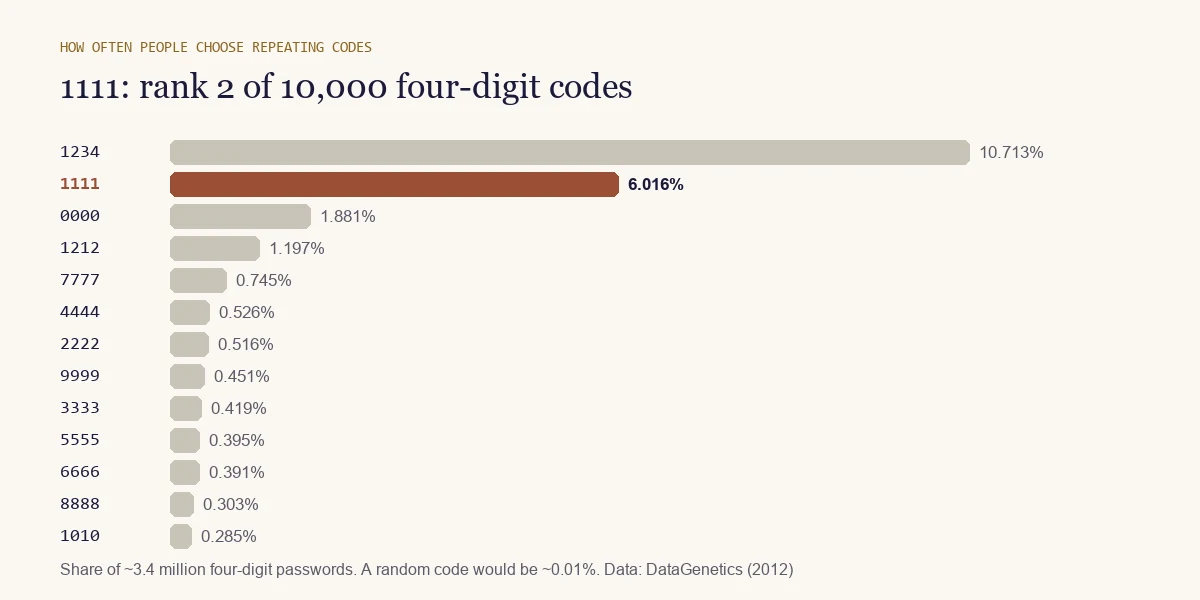
In New Zealand, 111 is the emergency telephone number, first used in Masterton and Carterton in 1958. Its four-digit form is one of the most common codes in the world: 1111 was the second most popular in a study of about 3.4 million four-digit passwords, chosen by 6.0% of people.
1111, the four-digit cousin, was picked by 6.016% of people in the password study: about 600 times the share a random pick would give. A number that people choose on purpose is a number they will keep meeting.
111 in numerology
Adding the digits of 111 gives 3 (1 + 1 + 1 = 3), so numerologists would set it beside 3 as a Life Path number. The angel reading comes from the digit 1 repeated, not from that sum.
111 by the numbers: the building block of the list
111 is the smallest three-digit repdigit, and the others (222 to 999) are just 111 multiplied by a single digit. It equals 3 × 37, so every one of them is divisible by 37, a fact that has nothing to do with angels but explains why the whole family of numbers shares the same factors.
| Property | Value |
|---|---|
| Prime factors | 3 × 37 |
| Roman numeral | CXI |
| Digits added | 1 + 1 + 1 = 3 |
| First place in the decimals of pi | decimal 153 |
| Times in the first 1,000,000 decimals of pi | 1,051 (chance alone predicts about 1,000) |
In pi, 111 first turns up at decimal 153 and then 1,051 times in the first million decimals, a little above the 1,000 that chance predicts. The point of the table is the last two rows: a three-digit pattern is not rare in a long stream of digits, which is the same reason it is not rare in a long life.
What the early number books say about 1
Neither Balliett nor Cheiro wrote about seeing 111; both were working from birth dates and names. What they did write about is the single digit, and on that point the old and new traditions agree. Cheiro opens his chapter on the number 1 like this:
It is the beginning — that by which all the rest of the nine numbers were created.
Cheiro, Cheiro’s Book of Numbers (London: Herbert Jenkins), Chapter III, “The Number 1”
Balliett pairs the 1 with unity rather than with novelty. In her chapter on opposites she describes a No. 1 or 10 as one that should:
express and maintain unity and assist in holding together that which seems to them good.
L. Dow Balliett, How to Attain Success Through the Strength of Vibration (1905), Chapter VIII
She also gives 1 two months: her chapter on the vibration of days says “Both of these months vibrate 1 and mean creation and unity of action”, naming January and October. Add the three ones of 111 and you reach 3, which Cheiro ties to Jupiter, “a Planet which plays a most important role both in Astrology and in all systems of Numerology”.
The most striking match with the angel-number idea is in the back of Balliett’s book, where she gives every number a guardian angel. For the 1 she names Malakh, glossed as a messenger:
| Balliett’s 1905 lists, No. 1 | Entry as printed |
|---|---|
| Guardian angel | Malakh — meaning a messenger of Jehovah |
| Birds | Dove, blue-bird, humming-bird, bird of Paradise |
The old books therefore agree on “beginning”, and Balliett adds both “unity” and a named messenger that the modern summary leaves out.
111 on the calendar and in the birth records
Written month then day with no zeros, two dates spell 111: January 11 (1/11) and November 1 (11/1). In the day-first order used in most of the world it is the same two dates the other way round. November also hosts the days 10 to 19, which write as 1110 to 1119 and so contain the digits 111 too.
| Cheiro’s “1” birthdays | Share of US births 1994 to 2014 | Share of calendar days |
|---|---|---|
| 1st, 10th, 19th, 28th | 13.16% | 13.14% |
Cheiro says number 1 people are those born on the 1st, 10th, 19th or 28th of a month. Across 85,386,227 US births those four days hold 13.16% of babies against a 13.14% share of calendar days, so being a “1” by Cheiro’s rule is as common as arithmetic predicts. The 1st is the one day of the four with fewer births than its calendar share (98.2% of it).
Frequently asked questions
Why do I keep seeing 111 specifically?
Angel-number folklore reads it as a "beginnings" cue. A separate, non-mystical explanation is the frequency illusion: once a number feels significant, you start noticing it far more than before. See our article on why people notice repeating numbers for that side of it.
Is 111 a Life Path number too?
Not directly: Life Path numbers reduce to 1–9 (or 11/22/33), so 111 itself isn't a Life Path result, though it reduces numerologically to 3 (1+1+1). Angel numbers and Life Path numbers are separate traditions read differently.
Is 111 a twin flame number?
Twin-flame readings are a separate New Age idea that later writers and online communities layered onto angel numbers. Numyra doesn't treat them as part of the traditional reading, and numerology itself has no twin-flame concept.
How many minutes a day show 111 on a clock?
Counting the digits in a row with the colon ignored, 22 minutes on a 12-hour clock (1:11 and 11:10 to 11:19, morning and evening) and 12 on a 24-hour clock. Only 1:11 AM and 1:11 PM show exactly 111.
How often should I expect to catch 111 by chance?
If you glance at a clock 20 times a day at random moments, about 111.5 times a year on a 12-hour display, or roughly once every 3.3 days. That figure is an illustration of opportunity, not a measurement of you.
Why is 111 connected with 37?
111 = 3 × 37, and every repeated-digit number from 222 to 999 is 111 times a digit, so each is divisible by 37. It is a property of the number system, unrelated to any angel-number meaning.
Which dates look like 111?
January 11 (1/11) and November 1 (11/1) in month-first order, and November 10 to 19 contain the digits 111 inside 1110 to 1119. In day-first notation the two main dates swap places.
Which planet and angel go with 1 in the old books?
Cheiro gives the number 1 to the Sun, and the digit sum of 111 is 3, which he gives to Jupiter. Balliett’s 1905 list names Malakh, “a messenger of Jehovah”, as the guardian angel of the 1.
Did the idea of watching for repeating numbers start with angel books?
Not entirely. Cheiro’s Chapter XVII collects readers’ letters about numbers that “recur in lives”, long before Virtue and Brown’s 2005 book. What the angel books added was the angel framing.
Sources
- L. Dow Balliett, How to Attain Success Through the Strength of Vibration (1905), Chapter VII (“How to find the vibration of any day”), Chapter VIII, and the guardian-angel, patron-saint, symbol and bird lists
- Cheiro, Cheiro’s Book of Numbers (London: Herbert Jenkins), Chapters III and V, and Chapter XVII, “Examples of how numbers recur in lives”
- US births 1994 to 2014: CDC/NCHS and SSA daily counts, FiveThirtyEight copy.
- Virtue, Doreen. Angel Numbers 101. Hay House, 2008. The book most responsible for popularizing the modern "angel numbers" practice.
- Numyra Editorial Desk. Why you keep seeing the same number.
- Numyra Methodology Desk. Sourcing standard.
- Virtue, Doreen, and Lynnette Brown. Angel Numbers: The Angels Explain the Meaning of 111, 444, and Other Numbers in Your Life. Hay House, 2005. Internet Archive. Source of the quotes above.
- DataGenetics. "PIN analysis." 2012. Frequencies of about 3.4 million four-digit passwords.
- "111 (New Zealand telephone number)." Wikipedia.
- Aldrich, Renu. "Doreen Virtue's conversion to Christianity sparks debate." The Wild Hunt, 5 September 2017. Virtue later renounced her New Age beliefs; neither this report nor her Wikipedia biography addresses angel numbers specifically.