Birth Chart Calculator
Enter your birth date, time and place for your full natal chart: the Sun, Moon, eight planets and the North Node by sign, degree and house, your rising sign and Midheaven, the house cusps, the major aspects and a chart wheel. The method and its measured accuracy are below.
Key takeaways
- Your Sun sign needs only your birth date. The Moon, the rising sign and the houses need your birth time and place too.
- Choose whole-sign or Placidus houses; the planets stay the same, only the house borders move.
- Checked against the Swiss Ephemeris on 50,000 random charts from 1900 to 2030: a typical position is within about a minute of arc, and fewer than 1 placement in 1,000 lands in a different sign.
- Nothing here is medical, financial, legal or psychological advice. Astrology is a cultural tradition, presented for reflection.
Your birth chart
For entertainment and self-reflection. Numerology is a cultural tradition, not a science, and nothing here is medical, financial, legal, or psychological advice.
How the chart is calculated
Your birth time is converted to Universal Time with the time-zone and daylight-saving rules your browser holds for that date and place. The Sun, Moon and planets come from Paul Schlyter's published orbital formulas, with the extra perturbation terms for the Moon, Jupiter, Saturn and Uranus, computed in Terrestrial Time (we add the difference between the two clocks, ΔT, from the Espenak and Meeus polynomials). The North Node is the mean node, and the obliquity of the ecliptic and the sidereal time follow Meeus's Astronomical Algorithms.
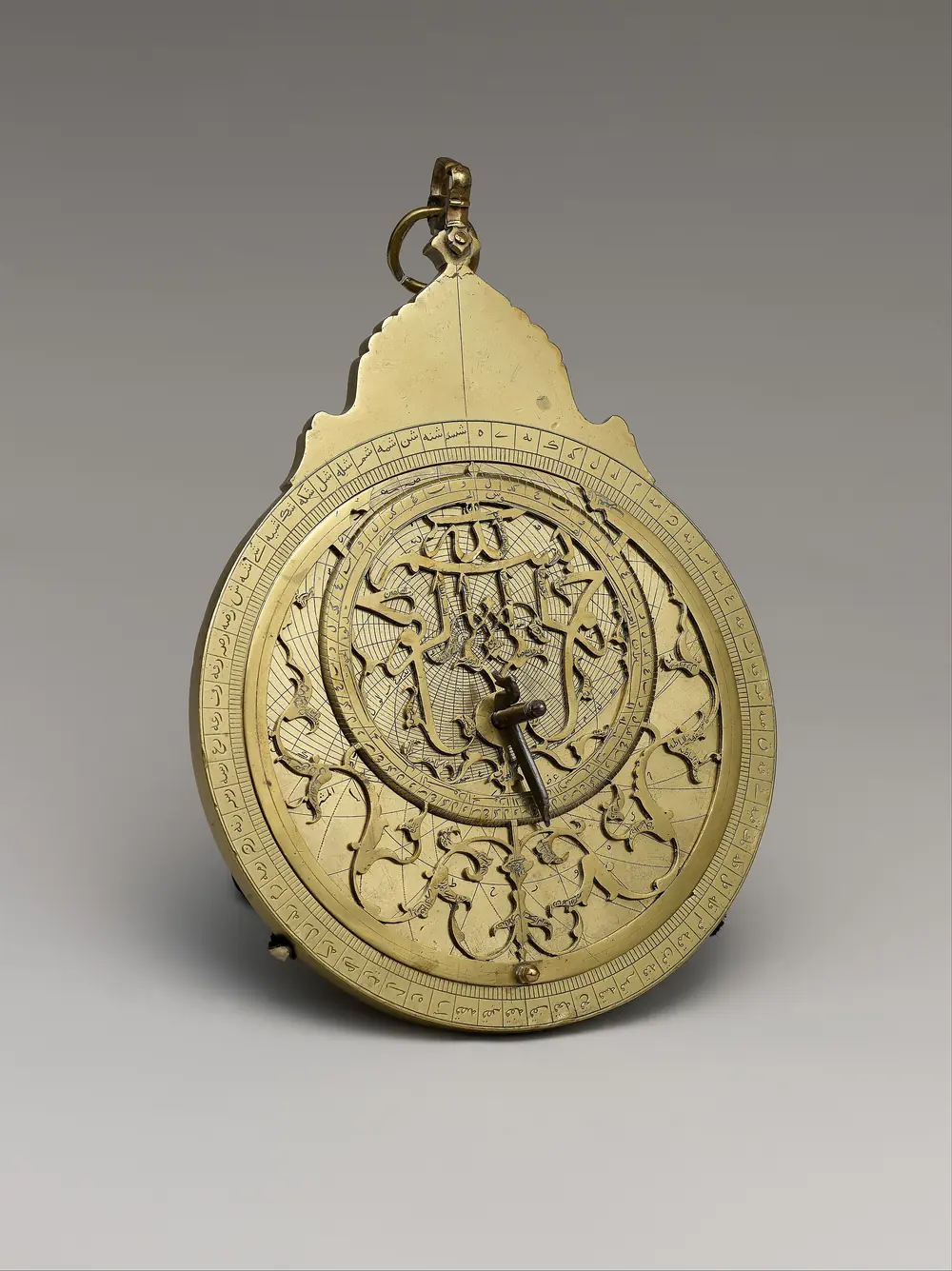
The Ascendant and Midheaven come from the local sidereal time at your birthplace and the tilt of Earth's axis. Placidus cusps divide the time each degree of the zodiac takes to travel from the horizon to the meridian into thirds, solved by iteration; whole-sign houses start the 1st house at 0° of the rising sign. Near and beyond the polar circles (about 66° north or south) Placidus cusps cannot be found for every moment, so there the calculator falls back to whole-sign houses and says so; coordinates up to 75° are accepted. A planet counts as retrograde if its longitude was falling across the 24 hours around your birth.
We measured the result against the Swiss Ephemeris, the reference most astrology software uses, on 50,000 random moments from 1900 to 2030 at latitudes from 60°S to 65°N:
| Point | Typical error | Largest error | Different sign |
|---|---|---|---|
| Sun | 0.4′ | 1.1′ | 1 in 4,500 |
| Moon | 1.1′ | 6.0′ | 1 in 1,500 |
| Mercury, Venus, Mars | 0.5 to 0.6′ | 3.5′ | 1 in 3,800 |
| Jupiter to Pluto | 0.4 to 0.6′ | 2.7′ | 1 in 3,500 |
| Mean North Node | 0.2′ | 0.3′ | 1 in 25,000 |
| Ascendant and Midheaven | 0.2′ | 3.6′ | rare |
| Placidus house of a planet | 1 in 2,700 placements |
One arcminute (′) is a sixtieth of a degree. A sign changes only when a body sits within a few arcminutes of a border, which is why mismatches are so rare; if a result sits within a degree of a border, an exact birth time matters more than the calculation. The two runs (20,000 and 30,000 charts, different random seeds) agreed to within a few hundredths of an arcminute.
To read what the pieces mean, start with the houses, the Sun, Moon and rising sign and your chart ruler; our astrology methodology sets out the standard every calculator here follows.
How common is each Sun sign?
Not every sign is equally common. We matched every US birth from 1994 to 2014, 85.4 million in all, to the sign the Sun was in on that date.
| Sun sign | Share of US births, 1994–2014 |
|---|---|
| Aries | 8.15% |
| Taurus | 8.33% |
| Gemini | 8.56% |
| Cancer | 8.87% |
| Leo | 8.96% |
| Virgo | 8.92% |
| Libra | 8.49% |
| Scorpio | 8.16% |
| Sagittarius | 7.95% |
| Capricorn | 7.60% |
| Aquarius | 7.94% |
| Pisces | 8.07% |
Leo (8.96%), Virgo (8.92%) and Cancer (8.87%) are the most common Sun signs, because US births peak in late summer. Capricorn is the least common at 7.60%: about 15% fewer people than Leo. The signs also differ slightly in length, which adds to the gap.
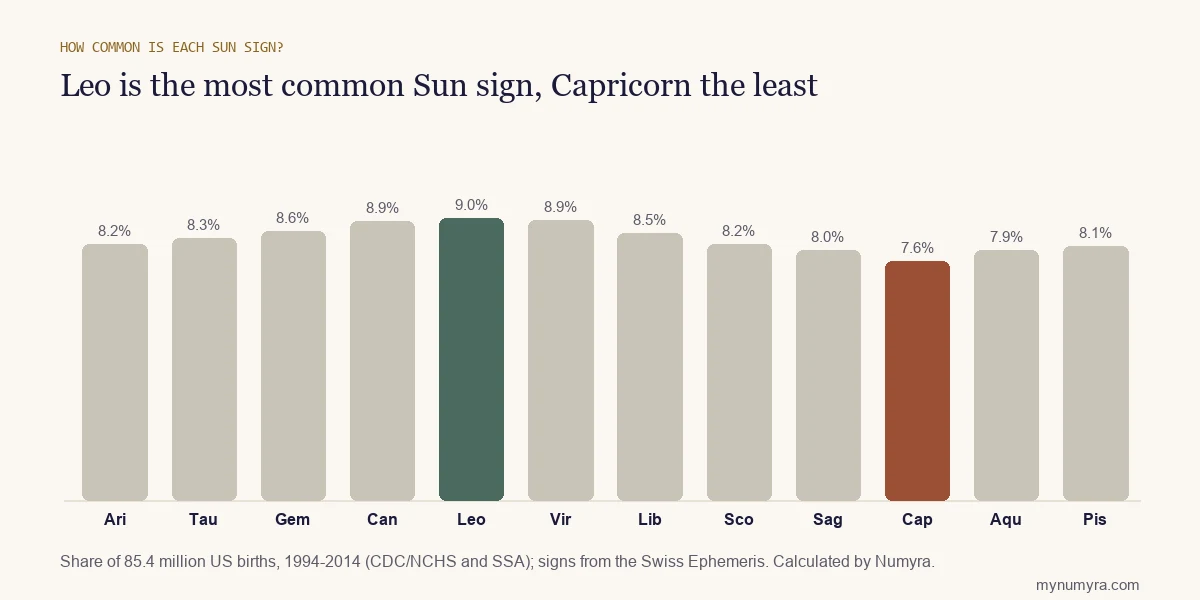
Data: US daily birth counts, 1994–2014: CDC/National Center for Health Statistics (1994–2003) and Social Security Administration (2004–2014), as compiled by FiveThirtyEight. 85.4 million births. Swiss Ephemeris (Astrodienst), used to find the Sun's sign for each birth date. Calculated by the Numyra Methodology Desk.
Frequently asked questions
Why do you need my birth time and place, not just my date?
The Sun moves about 1° a day, so the date is enough for your Sun sign. The Moon moves about 13° a day and changes sign every two to three days, and the rising sign and the houses depend on which degree of the zodiac was on your eastern horizon, which changes about every two hours. Those need the exact time, and the place sets both the time zone and the horizon.
Which house system should I choose?
Whole-sign houses make each sign one house, starting with the rising sign; they are the oldest system and the simplest to read. Placidus divides the time each degree takes to rise and culminate, and is the default in most modern Western software. The planets and signs stay the same; only the house borders move. Our whole sign vs Placidus guide shows how often the two disagree.
How accurate is this calculator?
We compared it with the Swiss Ephemeris on 50,000 random charts from 1900 to 2030. The median error was 0.4 to 1.1 arcminutes depending on the body, and the largest was 6 arcminutes (the Moon). A single placement came out in a different sign fewer than once in 1,000 (in about 1 chart in 300 one body is affected, always within minutes of a sign change), and the Placidus house of a planet differed in fewer than 4 cases in 10,000. The Ascendant and Midheaven were within 0.2 arcminutes in a typical chart.
What do "retrograde" and the orbs in the aspect table mean?
A planet is listed as retrograde when, seen from Earth, it was moving backward through the zodiac on your birth date. An aspect is a set angle between two planets: 0° conjunction, 60° sextile, 90° square, 120° trine and 180° opposition. The orb is how far from the exact angle the pair is; we count an aspect within 8° (6° for the sextile).
Why is the North Node in the table?
The North Node is the point where the Moon's orbit crosses the ecliptic going north, and most astrologers include it in a birth chart. We use the mean node, which moves smoothly backward; the "true" node swings up to about 2° either side of it (1.98° at most from 1900 to 2030 in the Swiss Ephemeris). See our North Node guide.
My birth city isn't listed. What should I do?
Tick "My birthplace isn't listed" and enter its latitude and longitude (from any map app) and its time zone. If you only know a nearby city in the same time zone, picking it moves the Midheaven by about one degree for every 50 to 60 miles east or west across the US, and the rising degree by a similar amount (sometimes more, sometimes less). That matters only when a point sits near a sign border.
Do you store my birth data?
No. Every calculation runs in your browser; nothing you enter is sent to or saved on our servers. See our privacy approach for detail.
What is the most common Sun sign?
In US births from 1994 to 2014, Leo was the most common Sun sign at 8.96%, just ahead of Virgo and Cancer. Capricorn was the least common at 7.60%. The pattern follows the late-summer peak in births.
Sources
- Schlyter, Paul. How to Compute Planetary Positions. Orbital elements and perturbation terms for the Sun, Moon and planets.
- Meeus, Jean. Astronomical Algorithms, 2nd ed. (Willmann-Bell, 1998), chapters 12, 22 and 47: sidereal time, obliquity and the mean lunar node.
- Espenak, Fred, and Jean Meeus. "Polynomial Expressions for Delta T". NASA Goddard Space Flight Center. The ΔT correction.
- Astrodienst. Swiss Ephemeris. The reference we measured against (pyswisseph, Moshier mode).
- "House (astrology)." Wikipedia. Definitions of the whole-sign and Placidus systems.
- Numyra Methodology Desk. Astrology calculation standard.