Personality Number Calculator
Enter your full birth name to find your Personality Number, calculated from the consonants in your name.
Key takeaways
- Every letter of the alphabet has a number value in the Pythagorean chart (and a different one in the Chaldean chart): nothing here is arbitrary.
- Your Personality Number comes from your full birth name, not a nickname, and it never changes.
- Accented letters are mapped to their base letter (é → E) before conversion.
- Choosing a name for a baby? Our baby name numerology guide shows how to compare a name's Destiny Number with the baby's Life Path.
- Nothing here is medical, financial, legal, or psychological advice. It is a cultural tradition, presented for reflection.
Your Personality Number
EXAMPLEOther method: each name reduced on its own
Numerologists don't agree on this step. We show both so you can see where your number comes from; our methodology page explains the difference.
For entertainment and self-reflection. Numerology is a cultural tradition, not a science, and nothing here is medical, financial, legal, or psychological advice.
What a Personality Number describes
The Personality Number uses only the consonants in your full name. It's traditionally read as how others tend to perceive you at first, the outward impression, as distinct from the Soul Urge Number's inner motivation, which uses the vowels instead.

How this is calculated
Each letter of your name is converted to a number using the Pythagorean chart by default (A, J, S = 1; B, K, T = 2; and so on through I, R = 9). Only the consonants count, Y counts as a consonant unless no other vowel appears in its syllable, in which case it's treated as a vowel instead. The values are added together, then reduced the same way as a Life Path Number, keeping 11, 22 and 33 intact at the final step.
"Sofia Grace Bennett," step by step
A real name with no Y in it, so there's no ambiguity about whether a letter counts as a vowel or consonant: that specific edge case gets its own explanation in the FAQ below rather than being folded silently into this example.
- 1 · Letters counted
S-F-G-R-C-B-N-N-T-TOnly the consonants, the vowels are skipped entirely. - 2 · Letter values
1+6+7+9+3+2+5+5+2+2 = 42Each letter's Pythagorean value, added together. - 3 · Reduce
42 → 4+2 = 6Single digit reached: no further reduction needed.
All Your Personality Numbers
How common is each Personality Number?
We ran 200,000 simulated American full names (first, middle and last) through this calculator's exact rules. First and middle names were drawn in proportion to Social Security baby-name data for 1950 to 2008, and surnames in proportion to the 2000 US Census.
| Personality | Whole name at once | Each name reduced first |
|---|---|---|
| 1 | 11.16% | 11.16% |
| 2 | 0.11% | 5.20% |
| 3 | 11.20% | 11.20% |
| 4 | 10.88% | 7.54% |
| 5 | 11.09% | 11.09% |
| 6 | 9.90% | 10.16% |
| 7 | 11.22% | 11.22% |
| 8 | 11.03% | 11.03% |
| 9 | 11.13% | 11.13% |
| 11 | 10.91% | 5.82% |
| 22 | 0.16% | 3.50% |
| 33 | 1.21% | 0.95% |
Personality 2 is the rarest result of all, at 0.11% of full names under the whole-name method: a full name's consonants usually add up to between about 30 and 75, and nearly every total in that range that would reduce to 2 (29, 38, 47, 56, 65) passes through 11 first. Reduce each name separately and 2 appears for about 5% of names.
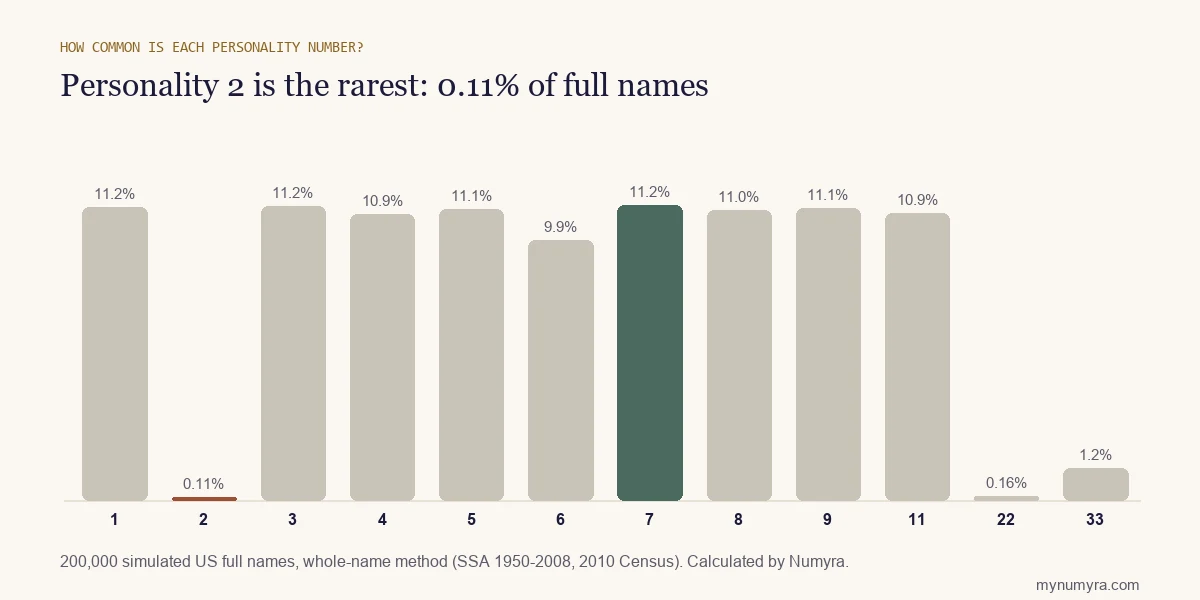
Data: US Social Security Administration baby-name data (1950–2008) and US Census Bureau 2000 surname data, used for the 200,000-name simulation. Calculated by the Numyra Methodology Desk.
Frequently asked questions
Should I use my current name or my birth name?
Traditional practice uses the full name given on your birth certificate, including middle names: not a nickname or a name you've since changed.
Why do Pythagorean and Chaldean give different numbers?
They assign different values to the same letters, and Chaldean leaves 9 unassigned. See our full comparison of the two systems.
Does a middle name or hyphenated last name change the result?
Yes: every letter in every part of your full birth name is included, so adding or removing a middle name will change the total.
When does Y count as a vowel instead of a consonant?
Only when no other vowel appears in the same syllable as the Y. In a name like "Lynn" or "Sky," the Y is the only vowel sound in its syllable, so it's traditionally counted as a vowel. In a name like "Yara" or "Yolanda," the Y starts the syllable right before a real vowel, so it's counted as a consonant instead. This calculator applies that rule automatically to whatever name you enter.
Which Personality Number is the rarest?
Personality 2, at just 0.11% of our 200,000 simulated US full names under the whole-name method. Nearly every consonant total that would reduce to 2 passes through 11 first and is kept as a master number.
Sources
- Balliett, L. Dow. The Philosophy of Numbers: Their Tone and Colors. 1908. Full text, Internet Archive.
- Cheiro (William John Warner). Cheiro's Book of Numbers. 1926. Internet Archive.
- Numyra Methodology Desk. Name-based calculation standard.