Personal Year Number Calculator
Enter your birth month and day to find your Personal Year Number for 2026 — the number that changes every year in a nine-year cycle. Looking ahead? See what 2027, an 11/2 Universal Year, means.
Key takeaways
- Unlike your Life Path Number, your Personal Year Number changes every year: it cycles through 1 to 9 and then starts again.
- It's calculated from your birth month, birth day, and the current calendar year: not your birth year.
- Personal Year numbers are always reduced fully to 1–9; master numbers (11, 22, 33) aren't kept here the way they are for a Life Path Number.
- Nothing here is medical, financial, legal, or psychological advice. It is a cultural tradition, presented for reflection.
Your Personal Year Number
For entertainment and self-reflection. Numerology is a cultural tradition, not a science, and nothing here is medical, financial, legal, or psychological advice.
How the nine-year cycle works
Personal Year Numbers are traditionally read as a repeating nine-year cycle: a Personal Year 1 marks a new beginning, and by the time you reach 9 the cycle is read as complete, with the following year starting back at 1. Two people with the same Life Path Number can be in completely different years of their own cycle, since it depends on your birth month and day, not just your birth year.
How this is calculated
Your birth month, birth day, and the current calendar year are each reduced to a single digit separately, then added together and reduced once more: always down to a single digit 1–9. This differs from the Life Path Number calculation, which keeps 11, 22 and 33 as master numbers at every stage; Personal Year is conventionally kept to the 1–9 cycle throughout.
Born June 22, Personal Year 2026
We're deliberately naming a specific year here rather than "this year," since that's the one thing about a Personal Year Number that keeps changing: the calculator above always uses whatever year it actually is when you use it.
- 1 · Month
June = 6 → already a single digitNo reduction needed. - 2 · Day
22 → 2 + 2 = 4Reduced the same way as a Life Path Number's day. - 3 · Year
2026 → 2+0+2+6 = 10 → 1+0 = 1The calendar year, not the birth year: reduced fully. - 4 · Add and reduce
6 + 4 + 1 = 11 → 1 + 1 = 2Unlike Life Path, 11 is not kept here: Personal Year always reduces fully to 1–9.
The full nine-year cycle
Is any Personal Year rarer than the others?
Because the Personal Year only uses your birth month and day, we can work out how many people are in each one. We weighted every birthday by the number of US births on that date from 1994 to 2014.
| Personal Year | Share of people in 2026 | Share of people in 2027 |
|---|---|---|
| 1 | 10.95% | 10.74% |
| 2 | 10.61% | 10.95% |
| 3 | 11.09% | 10.61% |
| 4 | 11.49% | 11.09% |
| 5 | 11.34% | 11.49% |
| 6 | 11.52% | 11.34% |
| 7 | 11.03% | 11.52% |
| 8 | 11.23% | 11.03% |
| 9 | 10.74% | 11.23% |
No Personal Year is rare: each one covers between 10.6% and 11.5% of people in both years. The small differences come from the uneven spread of birthdays through the calendar. Notice that every share moves up one place from 2026 to 2027, because everyone's Personal Year rises by one.
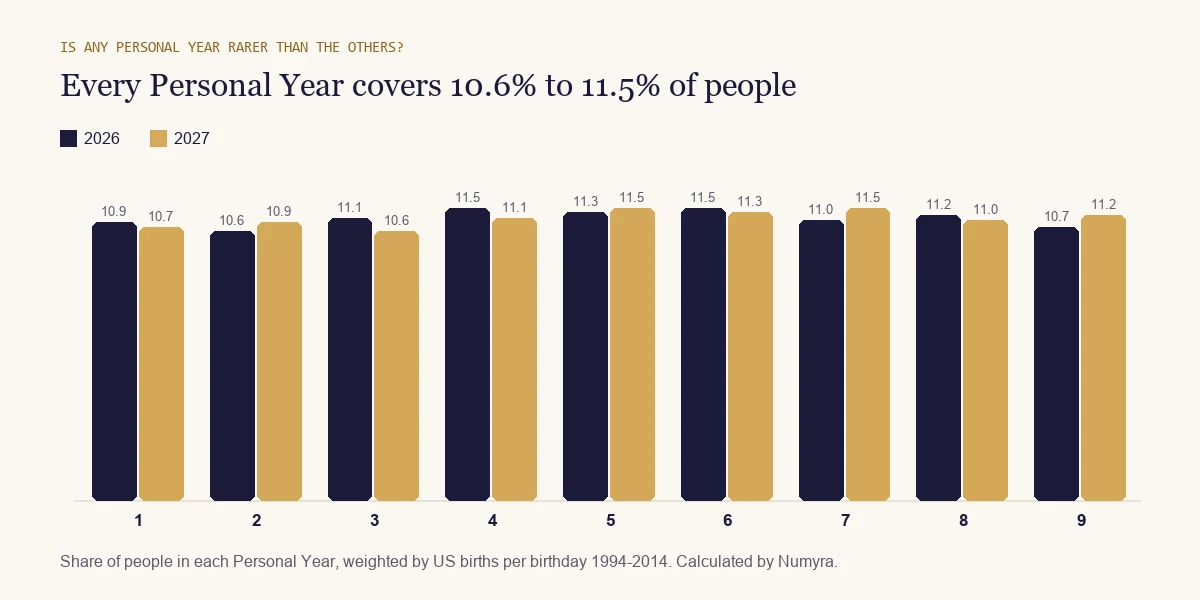
Data: US daily birth counts, 1994–2014: CDC/National Center for Health Statistics (1994–2003) and Social Security Administration (2004–2014), as compiled by FiveThirtyEight. 85.4 million births. Calculated by the Numyra Methodology Desk.
Frequently asked questions
Why doesn't my birth year matter here?
Personal Year is about where you are in the nine-year cycle right now, so it uses the current calendar year rather than your birth year. Your Life Path Number, by contrast, always uses your full birth date.
When does my Personal Year change?
Most numerologists count a Personal Year as changing on your birthday, not on January 1st, so for part of the calendar year, your Personal Year Number is one cycle-step behind or ahead of someone using a strict calendar-year convention.
Can two people share a Personal Year Number?
Yes: since only your birth month and day matter (not your birth year), it's common for two people of different ages to share the same Personal Year Number in a given year.
What Personal Year are most people in?
Personal Years are spread almost evenly: in both 2026 and 2027, each of the nine covers between 10.6% and 11.5% of people, based on US birthdays from 1994 to 2014.