Life Path Number Meanings
Every Life Path number, 1 through 9, plus the three master numbers 11, 22, and 33: how to work yours out, what each is traditionally read as, and how common each one really is among 85.4 million US births.
Key takeaways
- Your Life Path Number is calculated by reducing your full birth date to a single digit, except for the three master numbers.
- 11, 22, and 33 are traditionally kept unreduced: they're read as an intensified version of the number they'd otherwise reduce to (11→2, 22→4, 33→6), not a completely separate theme.
- Life Path is the broadest, most commonly cited number in a numerology reading: a starting point, not the whole picture.
- Life Path 33 is the rarest by far: 0.29% of US births from 1994 to 2014, about one baby in 345. Life Paths 1, 3, 7, 8 and 9 each cover about 11%.
- Nothing here is medical, financial, legal, or psychological advice. It is a cultural tradition, presented for reflection.
How to find your Life Path Number
- Write your birth date as three numbers: month, day and four-digit year.
- Reduce each one separately by adding its digits until one digit is left, but stop if you reach 11, 22 or 33.
- Add the three results together.
- Reduce that total the same way. The number you end with is your Life Path.
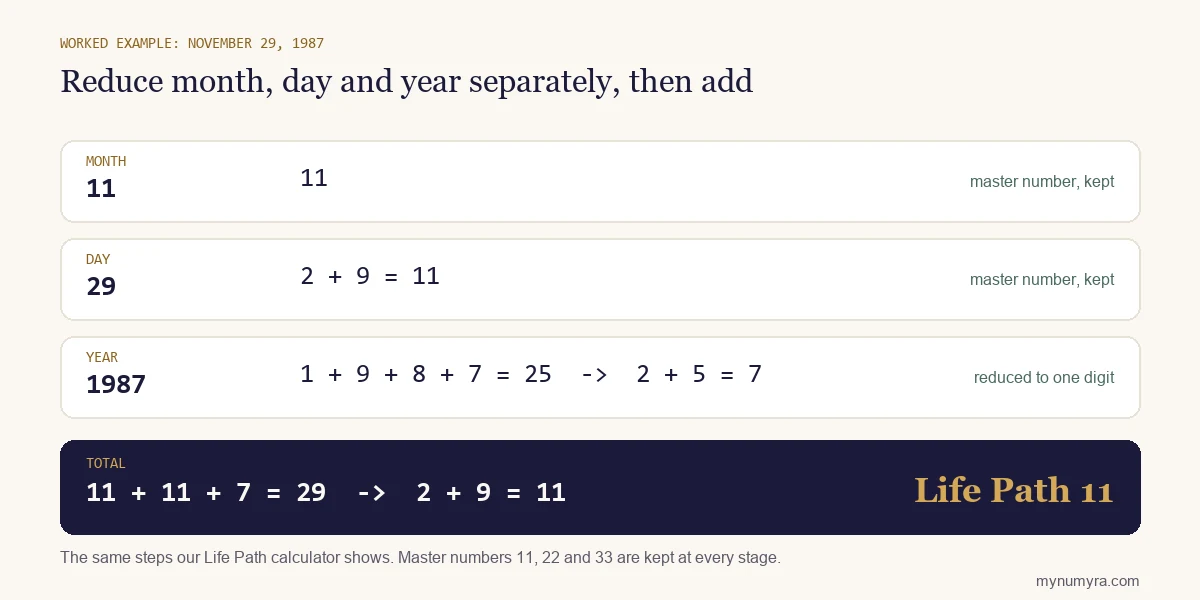
Take July 4, 1990. The month is 7 and the day is 4. The year adds up to 1 + 9 + 9 + 0 = 19, then 1 + 9 = 10, then 1 + 0 = 1. The three results add up to 7 + 4 + 1 = 12, and 1 + 2 = 3, so the Life Path is 3. The example below shows what happens when a master number turns up along the way: the month 11 and the day 29 (2 + 9 = 11) are both kept whole, and the final total of 29 reduces to 11 rather than to 2.
Reducing the parts first matters. Adding every digit of the date in one long string can give a different answer: September 9, 1991 comes to 9 + 9 + 2 = 20, so Life Path 2, by this method, but to 38 and then 11 as one string. That is a common reason two calculators disagree. Our guide to calculating a full numerology chart by hand covers the other core numbers the same way. Some numerologists also watch for 13, 14, 16 or 19 appearing along the way, which they call karmic debt numbers.
All 12 Life Path numbers, side by side
| Number | Archetype | Type | Share of US births |
|---|---|---|---|
| 1 | Initiator | Standard | 11.14% |
| 2 | Mediator | Standard | 5.23% |
| 3 | Communicator | Standard | 11.12% |
| 4 | Builder | Standard | 7.54% |
| 5 | Explorer | Standard | 11.08% |
| 6 | Nurturer | Standard | 10.79% |
| 7 | Seeker | Standard | 11.12% |
| 8 | Organizer | Standard | 11.10% |
| 9 | Humanitarian | Standard | 11.12% |
| 11 | Intuitive | Master number | 5.89% |
| 22 | Master Builder | Master number | 3.59% |
| 33 | Master Teacher | Master number | 0.29% |
Each Life Path number in one line
Each profile covers the number's strengths, its traditional challenge, love, work and the numbers it is usually paired with.
- Life Path 1: The Initiator
- Traditionally read as the number of independence and self-direction: the energy of starting something before anyone else is ready to.
- Life Path 2: The Mediator
- Traditionally read as the number of partnership and patience: the energy of building something together rather than alone.
- Life Path 3: The Communicator
- Traditionally read as the number of expression: the energy of putting an inner idea into a form other people can actually see or hear.
- Life Path 4: The Builder
- Traditionally read as the number of structure: the energy of doing the unglamorous, patient work that makes something last.
- Life Path 5: The Explorer
- Traditionally read as the number of change: the energy of needing variety and resisting anything that feels like a cage.
- Life Path 6: The Nurturer
- Traditionally read as the number of responsibility: the energy of caring for a home, a family, or a community.
- Life Path 7: The Seeker
- Traditionally read as the number of reflection: the energy of needing to understand something fully before acting on it.
- Life Path 8: The Organizer
- Traditionally read as the number of ambition: the energy of managing resources, people, or systems toward a tangible result.
- Life Path 9: The Humanitarian
- Traditionally read as the number of completion: the last single digit, often read as an outward, universal orientation.
- Life Path 11: The Intuitive
- A master number, traditionally read as an intensified version of 2: heightened sensitivity and insight, kept unreduced rather than simplified to a single digit.
- Life Path 22: The Master Builder
- A master number, traditionally read as an intensified version of 4: the same structural instinct, applied at a much larger scale.
- Life Path 33: The Master Teacher
- A master number, traditionally read as an intensified version of 6: care and responsibility extended outward to guiding or teaching many people.
How common is each Life Path number?
We worked out the Life Path for every one of the 85.4 million babies born in the United States from 1994 to 2014, using the same method as this calculator (month, day and year reduced separately, master numbers kept). Five Life Paths (1, 3, 7, 8 and 9) each cover about 11% of births. 2, 4 and 6 are rarer because some of their routes stop at the master numbers 11, 22 and 33 instead. Life Path 33 is the rarest by far, at 0.29% of births, or about one baby in 345.

Rarity is not a ranking. In this tradition a rare number is read as more intense, not as better, and the master numbers carry their own traditional difficulties. Our explainer on why 11, 22 and 33 are treated as master numbers traces where the idea came from.
Why 11, 22, and 33 aren't reduced
Standard numerology reduces any multi-digit total to a single digit by adding its digits together repeatedly. Master numbers are the one traditional exception: 11, 22, and 33 are kept as-is rather than reduced further to 2, 4, or 6. They're read as a more intense, higher-stakes version of that same underlying theme (11 as an amplified 2, 22 as an amplified 4, and 33 as an amplified 6) rather than a wholly separate meaning. Traditional readings also treat master numbers as carrying more real difficulty alongside that intensity, not just extra "specialness."
Frequently asked questions
How do I find my own Life Path Number?
Use our Life Path Number Calculator: enter your birth date and it shows every step of the reduction, calculated in your browser and never stored.
Is Life Path the same as Destiny Number?
No. Life Path is calculated from your birth date; Destiny (also called Expression) is calculated from every letter of your full birth name. They're read as different layers of the same reading: see our full numerology guide for how all five core numbers relate.
Can two people share the same Life Path Number?
Yes. It comes only from the birth date, and there are just twelve possible results, so millions of people share each one: Life Paths 1, 3, 7, 8 and 9 each cover about 11% of US births. Traditional readings treat it as a broad theme, not a unique identifier. Two random people have the same Life Path about 9.9% of the time.
How do you calculate a Life Path number?
Reduce the month, day and year of your birth date separately to a single digit, keeping 11, 22 and 33, then add the three results and reduce the total the same way. For November 29, 1987: the month is 11, the day 29 becomes 11, the year 1987 becomes 25 and then 7, and 11 + 11 + 7 = 29, which becomes 11. That is Life Path 11.
What is the rarest Life Path number?
Life Path 33. Of the 85.4 million babies born in the United States from 1994 to 2014, 0.29% had Life Path 33, about one in 345. Among the single digits, 2 was the rarest, at 5.23%, because many of its routes stop at 11 first.
Sources
- Dudley, Underwood. Numerology: Or What Pythagoras Wrought. Mathematical Association of America, 1997.
- Numyra Methodology Desk. Life Path calculation standard.
- FiveThirtyEight. US births data, 1994–2014, compiled from the CDC National Center for Health Statistics and the Social Security Administration. Used for the share of births with each Life Path.