Angel Number Lookup
Look up any repeating number sequence you keep noticing (on a clock, a receipt, a plate) and see how it's traditionally read.
Key takeaways
- "Angel numbers" is a recent, internet-era practice: the term itself was coined by author Doreen Virtue, who published two books on repeating number sequences in 2005 and 2008.
- It's not part of historical Pythagorean or Chaldean numerology: it's a separate, much newer tradition that happens to also use numbers.
- We cover the most-searched sequences in depth; anything else gets an honest numerological reduction instead of a made-up answer.
- Nothing here is medical, financial, legal, or psychological advice: presented for entertainment and reflection.
You looked up
This is a general reduction, not a specific angel-number tradition for this exact sequence.
Read the full page →For entertainment and self-reflection. Numerology and astrology are cultural traditions, not sciences, and nothing here is medical, financial, legal, or psychological advice.
Where "angel numbers" actually came from
Unlike Life Path or Destiny numbers, "angel numbers" isn't part of historical Pythagorean numerology. The term was coined and popularized by author Doreen Virtue, who published Angel Numbers in 2005 and Angel Numbers 101 in 2008: both collections of interpretations for sequences like 111, 222 and 444. The broader habit of noticing repeating numbers is older and less tidy than any one book: frequency illusion (the same effect behind noticing a word right after learning it) plays a real role in why people start seeing a specific sequence everywhere once they've decided it means something.
Every sequence we cover
Not seeing your sequence? Enter it in the lookup above: anything outside this list gets an honest numerological reduction instead of a made-up meaning.
Why some numbers really are everywhere
Some sequences turn up more often than chance because people choose them. In a study of about 3.4 million four-digit passwords, a random code would appear about 0.01% of the time. These did far better:
| Result | Share of 3.4 million codes |
|---|---|
| 1234 | 10.713% (rank 1) |
| 1111 | 6.016% (rank 2) |
| 0000 | 1.881% (rank 3) |
| 1212 | 1.197% (rank 4) |
| 7777 | 0.745% (rank 5) |
| 4444 | 0.526% (rank 8) |
Clocks add more. Sequences like 111 to 555 appear twice a day on a 12-hour clock (1:11, 2:22 and so on), and 1010, 1111, 1212 and 1234 as 10:10, 11:11, 12:12 and 12:34, while 666 to 999 can never appear, because no clock shows minute 66 or above.
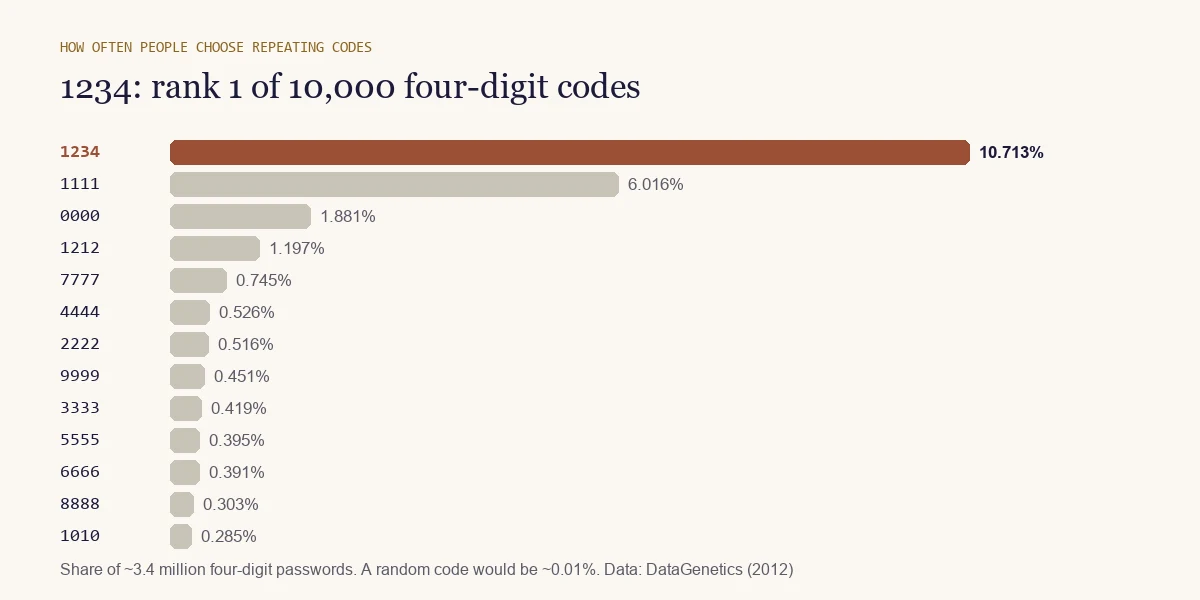
Data: DataGenetics. "PIN analysis." 2012. Frequencies of about 3.4 million four-digit passwords. Calculated by the Numyra Methodology Desk.
Frequently asked questions
Why do I keep seeing the same number?
Partly attention: once a sequence feels meaningful, you notice it far more often than sequences you've never assigned meaning to, a well-documented effect called the frequency illusion. Read the full explanation.
Is this the same as numerology?
Related, but not the same tradition. Historical Pythagorean numerology (Life Path, Destiny, etc.) is centuries older in its core ideas; "angel numbers" as a named practice dates to the mid-2000s. See our history of numerology.
What if my number isn't in your list?
We show you its numerological reduction instead of guessing at a meaning we can't source: see the note under your result above.
Which angel numbers can actually appear on a clock?
On a 12-hour clock, 111, 222, 333, 444 and 555 each appear twice a day, and 1010, 1111, 1212 and 1234 appear as 10:10, 11:11, 12:12 and 12:34. 666, 777, 888 and 999 can never appear, because there is no minute 66 or higher.