Most baby-name numerology pages tell you what a name’s number means in isolation. Almost none of them actually do the thing they all mention in passing: compare a candidate name against the one number your baby already has fixed before you’ve named them at all — their Life Path Number, set by birth date. Here’s how to actually do that comparison, with a real worked example.
Key takeaways
- A baby’s Life Path Number is fixed by birth date before any name is chosen. A candidate name’s Destiny (Expression) Number is calculated separately from the letters — comparing the two is the real, if informal, “does this name fit” framework numerology offers.
- We show this comparison actually worked out with a real example, rather than just mentioning that it exists the way most sources do.
- Some sources claim a matching name and Life Path Number leads to “better opportunities” in life — there’s no evidence for this, and we’re not going to imply otherwise just because it’s a common claim in this space.
- Nothing here is medical, developmental, or parenting advice — a cultural tradition, presented for entertainment and reflection while you’re already thinking hard about a name.
In this guide
- The two numbers involved
- A real worked example
- How to read the comparison
- What each Destiny Number is traditionally read as, for a name
- Naming more than one child
- Is this the same in every culture?
- Why we’re not selling you a “better” name
- Does the name you pick actually matter?
- Frequently asked questions
- Try it yourself
The two numbers involved
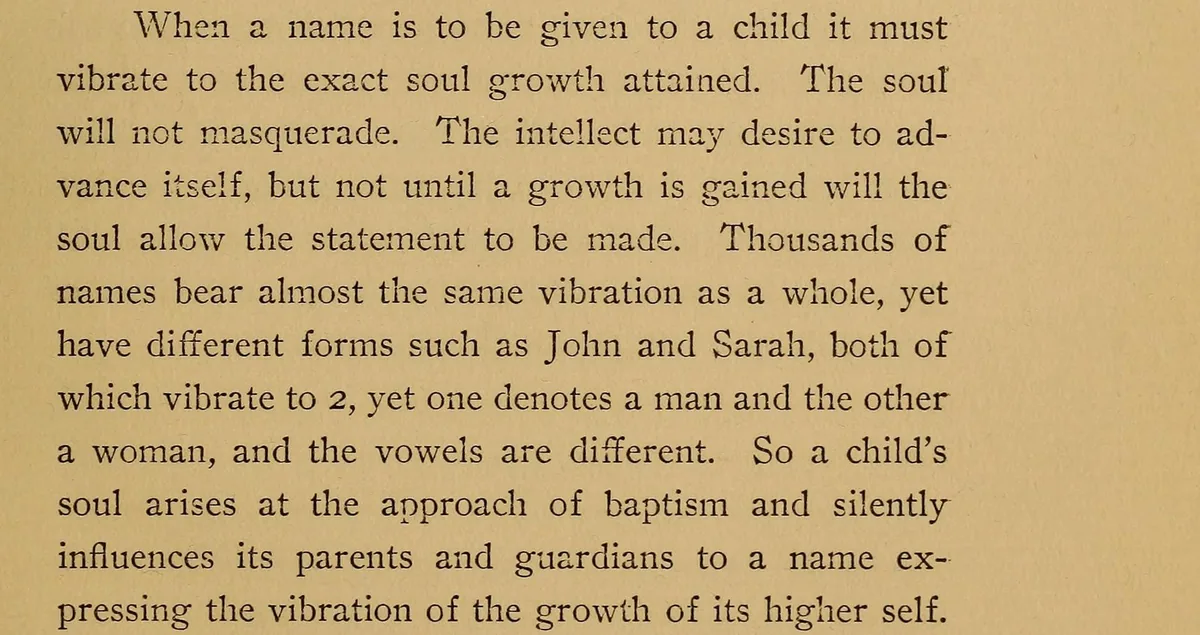
The idea that a chosen name carries its own real numerological weight isn’t a modern invention — it’s the central claim of the same 1908 text that popularized the letter-to-number chart this site’s own calculators use:
“When a name is to be given to a child it must vibrate to the exact soul growth attained.”
— L. Dow Balliett, The Philosophy of Numbers: Their Tone and Colors (1908)
Two separate numerology numbers are relevant to naming a baby, and it’s worth being clear about which is which before comparing them:
- Life Path Number — calculated from the birth date alone. This is fixed the moment your baby is born and can’t be changed by anything you name them. See our Life Path Number Calculator.
- Destiny Number (also called Expression Number) — calculated from every letter of the full name you’re considering. This is the number that actually changes depending on which name you pick. See our Destiny Number Calculator.
The informal practice some numerologists describe — and that we’re actually showing worked out here, rather than just mentioning — is calculating a candidate name’s Destiny Number and comparing it against the baby’s already-fixed Life Path Number, on the reasoning that a name whose number relates well to the birth-date number reads as a smoother fit than one that doesn’t.
A real worked example
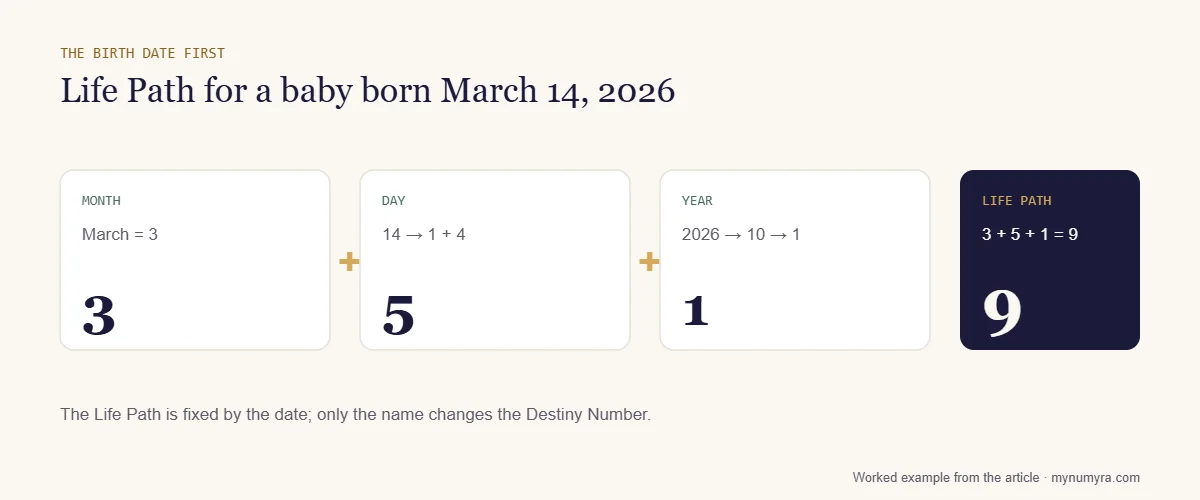
Say a baby is born on March 14, 2026. Their Life Path Number:
| Step | Math |
|---|---|
| Month | March = 3 |
| Day | 14 → 1+4 = 5 |
| Year | 2026 → 2+0+2+6 = 10 → 1+0 = 1 |
| Total | 3 + 5 + 1 = 9 — Life Path 9 |
Now, two candidate names, calculated using the Pythagorean chart (see our full Pythagorean vs. Chaldean guide if you want to try Chaldean values instead):
| Candidate name | Letter sum | Destiny Number |
|---|---|---|
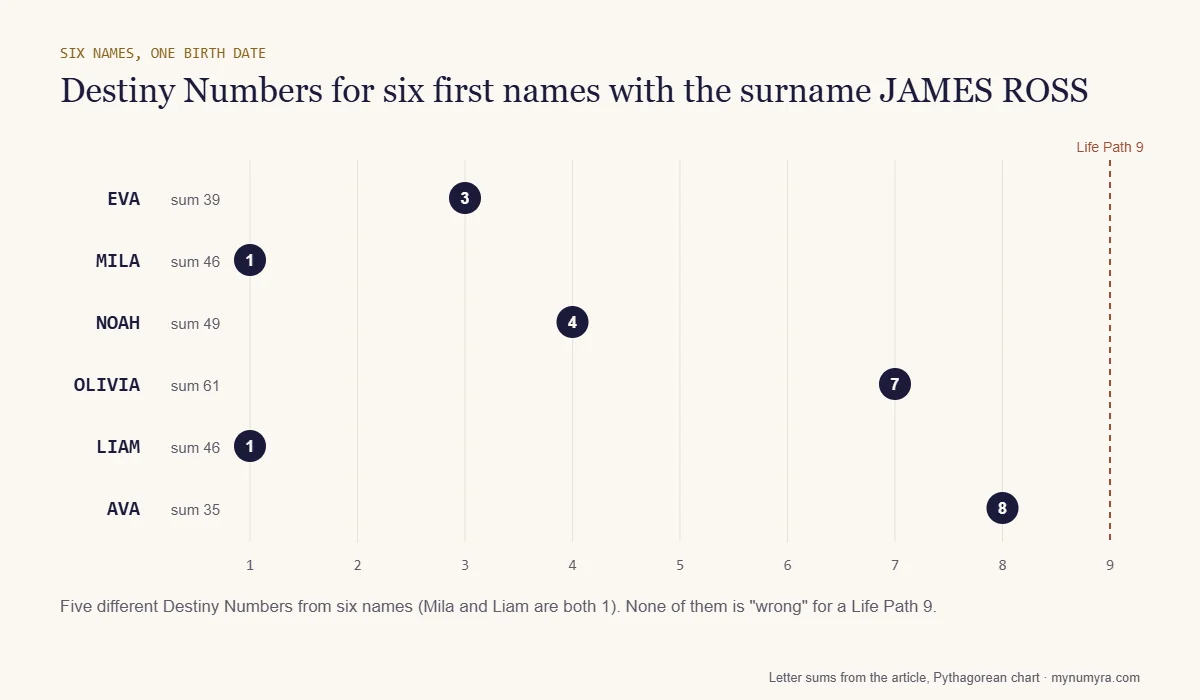
| EVA JAMES ROSS | 5+4+1 + 1+1+4+5+1 + 9+6+1+1 = 39 | 3+9 = 12 → 1+2 = 3 |
| MILA JAMES ROSS | 4+9+3+1 + 1+1+4+5+1 + 9+6+1+1 = 46 | 4+6 = 10 → 1 |
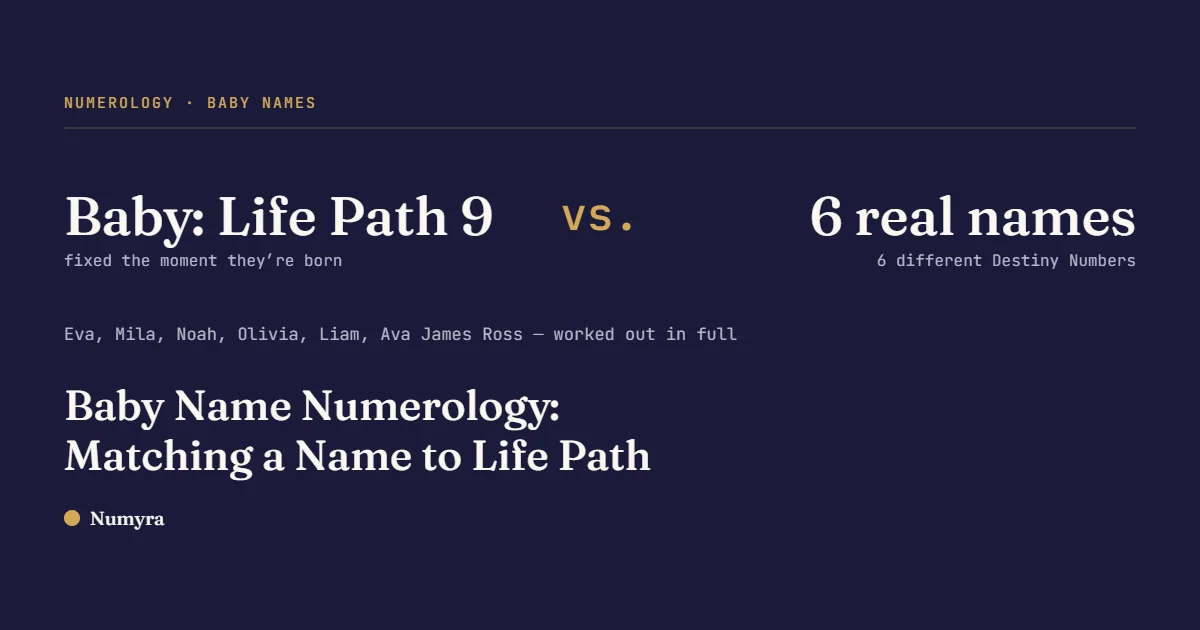
Two real names, two genuinely different Destiny Numbers (3 and 1) against the same fixed Life Path 9. This is the actual comparison the practice describes — most sources mention that you’re supposed to do this, but stop short of showing it done with real names and real math. For a wider reference point, here are a few more real, popular first names run through the same last name and the same calculation, so you can see the spread:
| Candidate name | Letter sum | Destiny Number |
|---|---|---|
| NOAH JAMES ROSS | 49 | 4+9 = 13 → 4 |
| OLIVIA JAMES ROSS | 61 | 6+1 = 7 |
| LIAM JAMES ROSS | 46 | 4+6 = 10 → 1 |
| AVA JAMES ROSS | 35 | 3+5 = 8 |
Every one of these is a genuinely different result, all against the identical last name and the identical Life Path 9 — which is exactly why we’re skeptical of any source that claims one specific number is simply “the best” fit. Six popular, well-liked names here span five different Destiny Numbers; treating any one of them as objectively wrong for this birth date would mean dismissing most of the names on this list before even considering how they sound or what they mean to you.
How to read the comparison
There’s no single agreed formula for “compatible” here the way there is for the reduction math itself — this is squarely in interpretation territory, and sources vary. The most common approach reads it the same way Numyra’s own Numerology Compatibility calculator reads two Life Path Numbers: same or closely related numbers are read as an easy, reinforcing fit; very different numbers are read as a more contrasting pairing — not worse, just different in theme, the same as a chart with any two contrasting numbers in it. A Destiny 3 next to a Life Path 9, from our example above, would be read as two different but not opposing themes (expression and completion); a Destiny 1 next to a Life Path 9 similarly reads as different-but-workable rather than a “bad” pairing. We’re not going to manufacture a false sense of precision here by asserting harder rules than the tradition itself actually offers.
What each Destiny Number is traditionally read as, for a name
These carry the same core meanings as an adult’s own Destiny Number — see our full Numerology guide for the complete profiles — read here specifically as a theme the name itself carries.
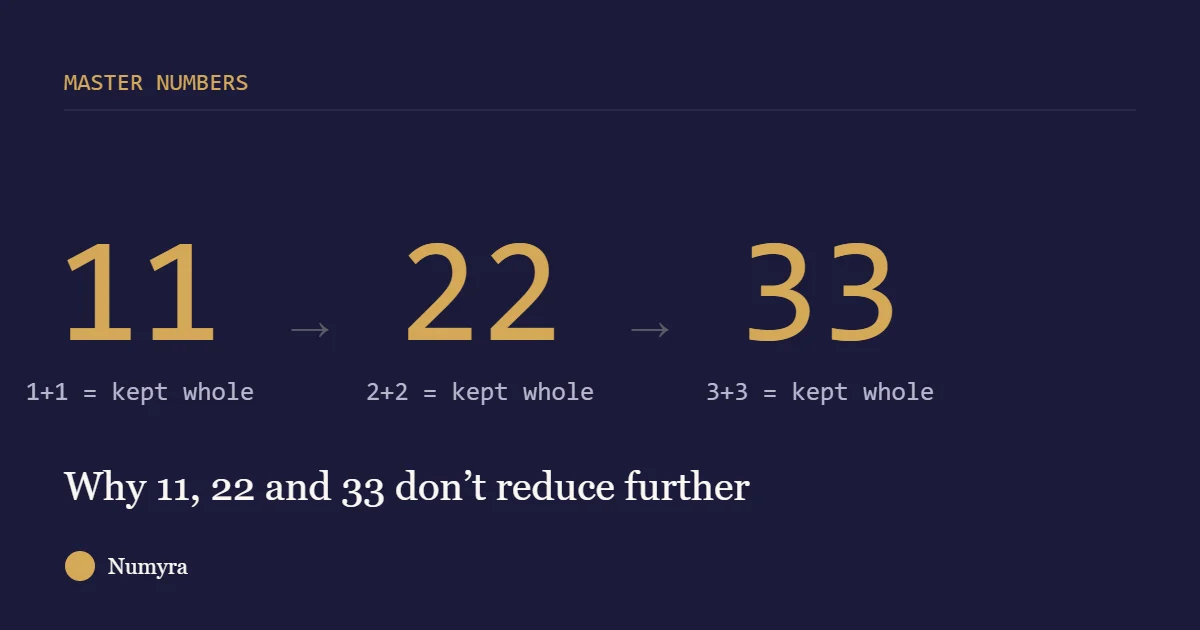
Master numbers 11, 22 and 33 can also appear in a name’s Destiny Number the same way they do for an adult’s, and are traditionally read as an intensified version of the number they’d otherwise reduce to — see our master numbers guide for the fuller explanation. In practice, a full name landing on a master number is uncommon enough that it’s worth double-checking your arithmetic before assuming it’s correct — see our Destiny Number Calculator to verify.
Naming more than one child
Parents naming siblings sometimes ask whether the children’s Destiny Numbers should relate to each other the same way the parent-and-child comparison above works. There’s no single traditional answer here — some numerologists apply the same same-or-contrasting reading between siblings’ names that we describe above between a name and a Life Path Number; others don’t extend the practice to sibling comparison at all, treating each child’s own name-and-birth-date pairing as the only comparison that matters. We haven’t found this specific question addressed consistently enough across sources to state a single traditional answer, so we’re saying that plainly rather than inventing a rule that doesn’t actually exist in the tradition.
Is this the same in every culture?
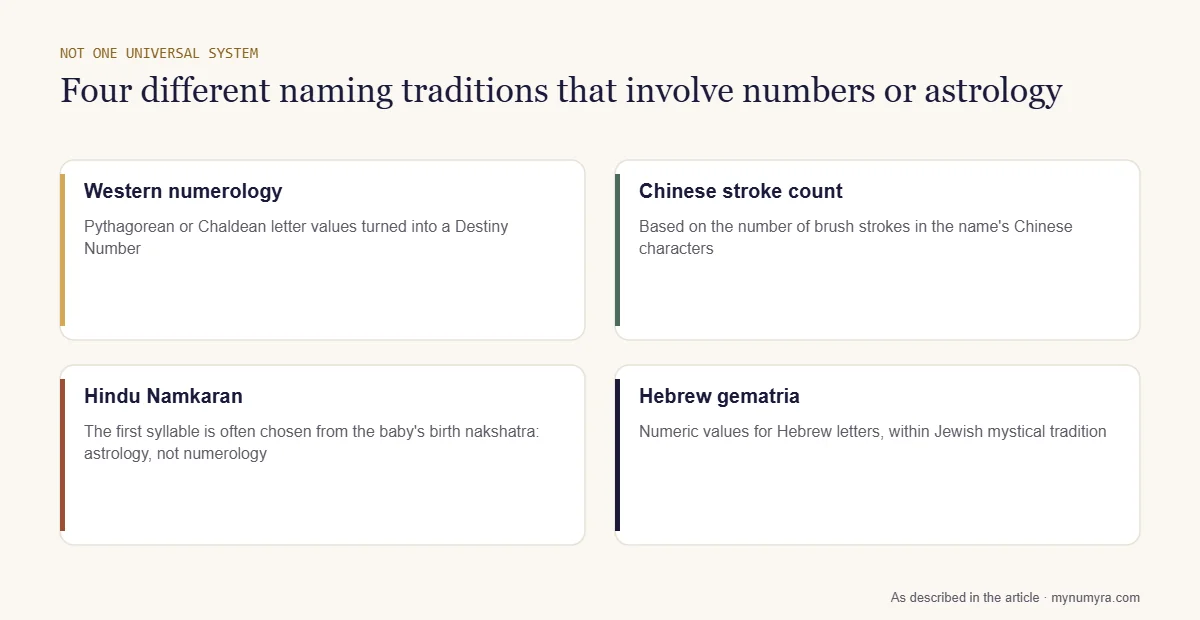
No — what’s described here is specifically Western numerology, built on the Pythagorean (or optionally Chaldean) letter-value system. Other cultures have entirely separate baby-naming traditions involving numbers or astrology, and they’re genuinely different practices, not the same system with different labels:
- Chinese stroke-count numerology — based on the number of brush strokes in the Chinese characters of a name, unrelated to Latin-alphabet letter values.
- Hindu Namkaran naming — a real, traditional Hindu naming ceremony where the first syllable of a name is often chosen based on the child’s birth nakshatra (lunar mansion) — an astrology-based practice tied to birth timing, not a numerology system at all.
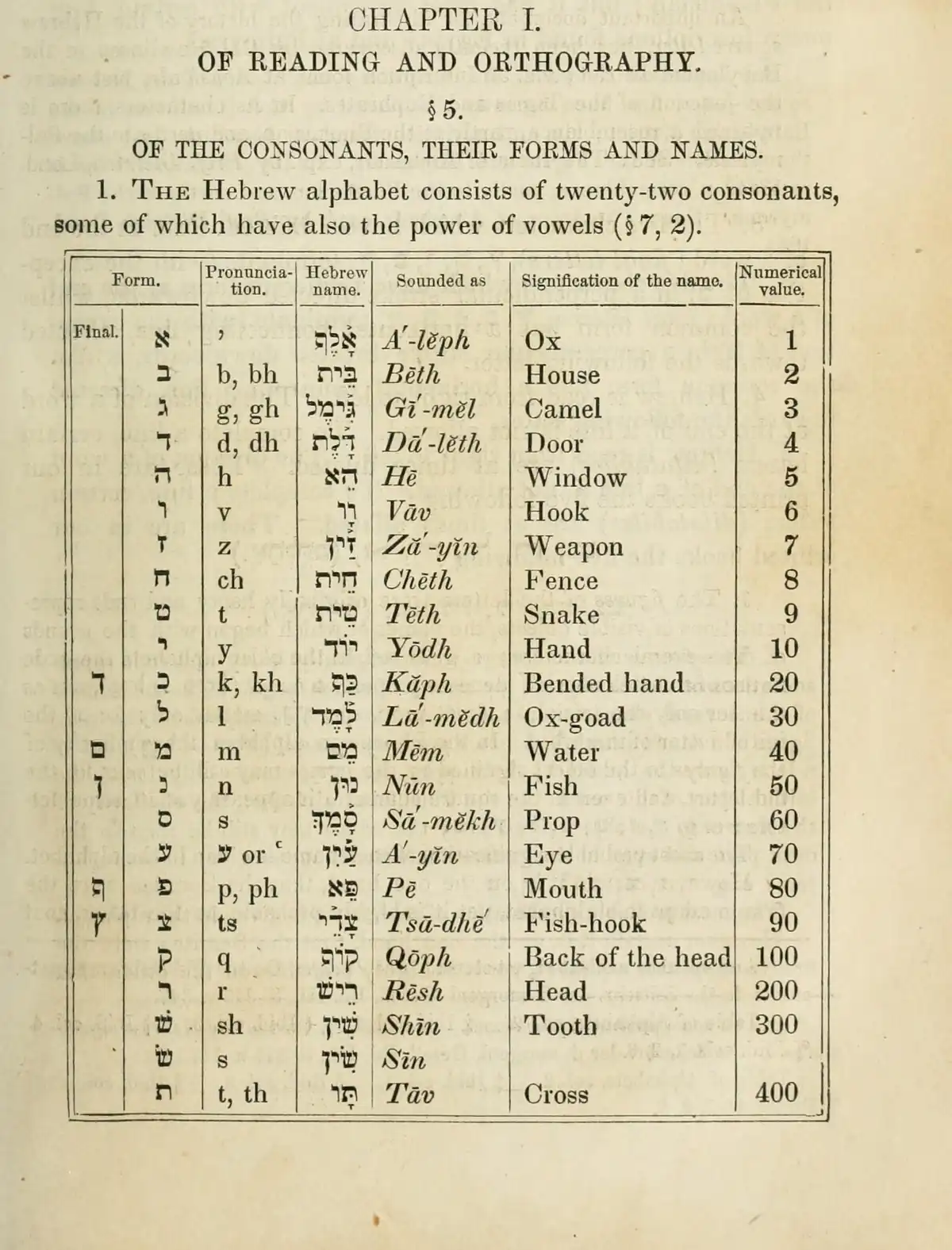
- Hebrew gematria — assigns numeric values to Hebrew letters within Jewish mystical tradition; see our Pythagorean, Chaldean and Kabbalah numerology comparison for how this relates to (and differs from) the Western systems described here.
If you’re drawing on one of these traditions specifically, the calculation method described on this page won’t transfer directly — it’s specific to the Western Pythagorean/Chaldean system.
Why we’re not selling you a “better” name
Several sites in this space pair baby-name numerology content with paid psychic-reading upsells — book a session, get a “personalized” name recommendation. We don’t do that: Numyra runs no affiliate psychic-reading links, and we’re not going to tell you a name you already love is wrong because its number doesn’t line up with a birth date. See our advertising disclosure for exactly how (and whether) this site makes money. The calculators above are free, run entirely in your browser, and the input never leaves your device — see our methodology page for the technical detail.
Does the name you pick actually matter?
Direct answer: there’s no real evidence that it does, and we want to say that plainly rather than bury it at the bottom. Several sources in this space claim outright that a name matching a baby’s Life Path Number leads to “better opportunities” through life — that’s a causal claim with no study behind it, and we’re not going to repeat it uncritically just because it’s common in this niche. What numerology genuinely offers here is a reflective framework, not a documented outcome: a structured way to think about a name you’re already drawn to, not a reason to rule one out that you love. If a name’s Destiny Number happens to contrast with the birth-date Life Path Number, plenty of numerologists would still read that as a workable, simply different pairing — not a reason to avoid the name.
Frequently asked questions
Should I use the baby’s full legal name or a nickname?
Traditional practice uses the full name as it will appear on the birth certificate, including middle names — not a nickname or a shortened version, since every letter of the full name is part of the calculation.
Does the last name count too?
Yes — the Destiny Number calculation described here uses every letter of the full name, first, middle, and last, the same way it does for an adult’s Destiny Number.
What if I want to use Chaldean instead of Pythagorean?
You can — the same comparison framework works with either system, as long as you calculate the Destiny Number and the Life Path Number using the same convention consistently. See our Pythagorean vs. Chaldean comparison for the full letter-value tables under both.
Is there a “best” number for a baby name?
No single number is traditionally read as universally best — each carries a different theme, not a better-or-worse ranking. See the traits listed above for what each one is traditionally read as.
Can I check a name before the baby is born, using a due date?
You can calculate it against an expected due date, but be aware the Life Path Number will change if the actual birth date ends up different — this is common enough with early or late arrivals that it’s worth double-checking after the birth rather than treating a due-date calculation as final.
Should sibling names have related Destiny Numbers?
There’s no consistent traditional answer here — some numerologists apply the same comparison logic between siblings, others don’t extend the practice that far. We haven’t found a settled convention across sources, so we’re not presenting one as though it exists.
Does a middle name change the result?
Yes — every letter in every part of the full name is included in the calculation, so adding, removing, or changing a middle name will change the final Destiny Number.
Try it yourself
Destiny Number CalculatorCalculate a candidate name’s number to compare against it.
Numerology Compatibility CalculatorSee how two numbers are traditionally read together.
Sources
- Dudley, Underwood. Numerology: Or What Pythagoras Wrought. Mathematical Association of America, 1997.
- Balliett, L. Dow. The Philosophy of Numbers: Their Tone and Colors. 1908. Internet Archive. Origin of the Pythagorean letter chart this article’s calculations use.
- Numyra Editorial Desk. Pythagorean vs. Chaldean Numerology: How the Two Systems Differ.
- Numyra Methodology Desk. Name-based calculation standard.