Pinnacle Numbers Calculator
Enter your birth date to get your four pinnacle numbers, your four challenge numbers and the age each pinnacle begins and ends. The first pinnacle ends at 36 minus your single-digit Life Path number, so between age 27 and 35; the second and third last nine years each, and the fourth lasts for the rest of your life. Master numbers 11, 22 and 33 are kept in every sum.
Key takeaways
- Pinnacles: first = month + day, second = day + year, third = first + second, fourth = month + year, each reduced with 11, 22 and 33 kept. Challenges use differences, with master numbers reduced to a single digit first.
- Timing: the first pinnacle ends at 36 minus the single-digit Life Path (11, 22 and 33 count as 2, 4 and 6); the next two last nine years each.
- Tested on every date from 1900 to 2025 (46,021 dates) against an independent Python version: 0 mismatches, and all 7 published worked examples reproduce.
- Your result also shows how common each number is among 85.4 million US births. Nothing here is medical, financial, legal, or psychological advice; it is a cultural tradition, presented for entertainment and reflection.
Your pinnacles and challenges
For entertainment and self-reflection. Numerology is a cultural tradition, not a science, and nothing here is medical, financial, legal, or psychological advice.
What your result shows
Your Life Path number is one figure for a whole life. Pinnacles divide that life into four stretches and give each its own number, so the tradition can say which themes are in the foreground at which age. Each pinnacle card shows the number, the ages and calendar years it covers, the working, a one-line traditional theme, and the share of US births that have the same number in the same position. The four challenges are the subtraction twin: the lessons traditionally paired with those phases.
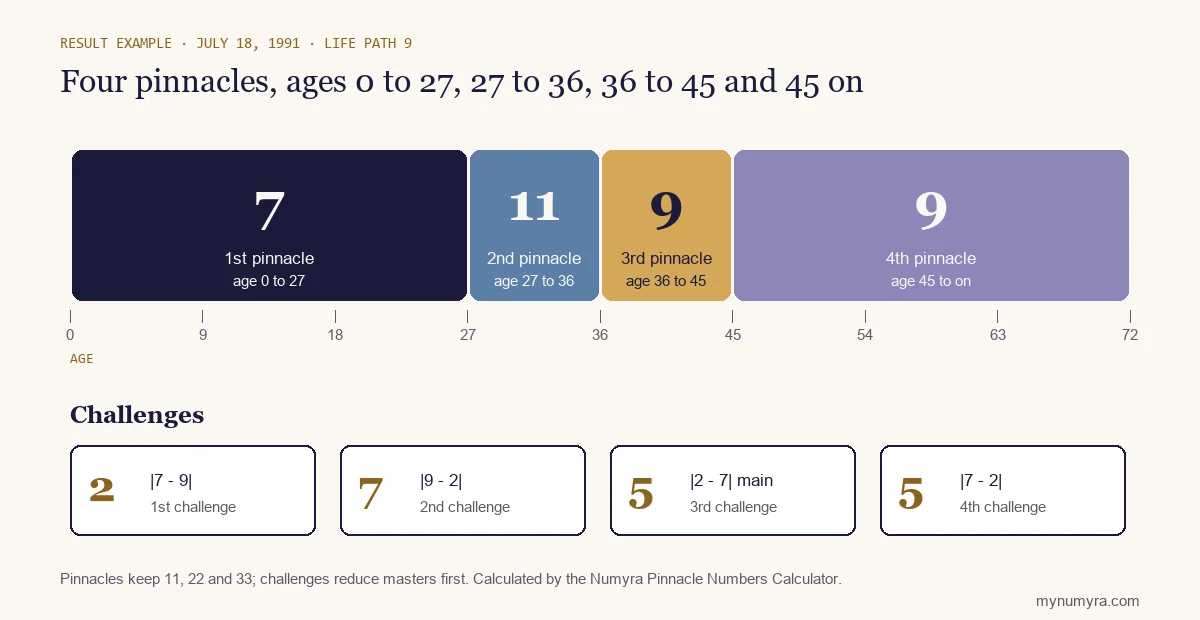
For the full story of what each number is said to mean, see our pinnacle numbers guide. The same birth date gives your Life Path number, which sets the timing, and your Personal Year number, the faster cycle that runs inside a pinnacle.
The rules this calculator follows
These are the rules on our methodology page for every date-based number, applied to the pinnacle method published by Hans Decoz on World Numerology.
| Step | Rule |
|---|---|
| Date parts | Reduce month, day and year separately; stop at 11, 22 or 33 (29 becomes 11, 1991 becomes 2). |
| Pinnacles | First = month + day; second = day + year; third = first + second; fourth = month + year. Each sum is reduced, keeping 11, 22 and 33. |
| Challenges | Reduce month, day and year to single digits first (11 becomes 2). First = |month − day|; second = |day − year|; third = |first − second|; fourth = |month − year|. Results run from 0 to 8. |
| Timing | First pinnacle ends at 36 minus the single-digit Life Path; the second and third last nine years; the fourth runs on. The pinnacle changes on the birthday at the stated age. |
| Dates | Real calendar dates from 1900 to the current year; February 29 only in leap years. |
Sources disagree on two points, and the guide explains both. Aryabhatt reduces master numbers in the date parts before adding, which changes the four pinnacles for about 4.8% of US births. Some sources count the boundary year one year differently, so a pinnacle can be said to end at 28 or 29. We state our rule on every result and do not mix them.
How common is each result?
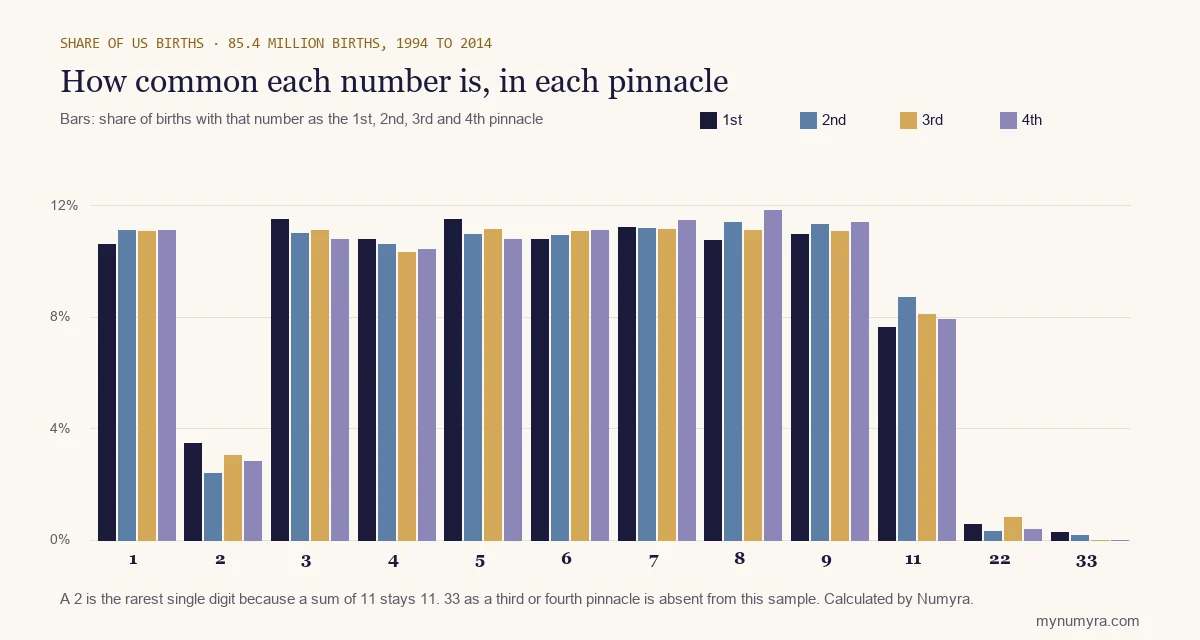
None of the sources we read says how often a result occurs, so we counted. For every day from January 1, 1994 to December 31, 2014 we worked out all four pinnacles and challenges and weighted them by the 85,386,227 US births on those days (CDC National Center for Health Statistics and Social Security Administration counts). A 2 is the rarest single digit in every position, because under the master-number rule a sum of 11 stays 11. Eleven is the most frequent master number, at 7.6% to 8.7% in each position; 22 and 33 are uncommon; and challenge 1 is the most common challenge in every position. This covers US births from 1994 to 2014 only.
How we tested it
This calculator is plain arithmetic that runs in your browser, so nothing you enter leaves your device. To check it, we wrote the same rules a second time in Python, with its own reduction code, and compared both for every calendar date from January 1, 1900 to December 31, 2025:
| Check | Result |
|---|---|
| Dates compared (every day, 1900 to 2025) | 46,021 |
| Differences in pinnacles, challenges, Life Path or ages | 0 |
| Published worked examples reproduced (Decoz, Aryabhatt and others) | 7 of 7 |
| Frequency-table cells re-derived and matching the guide | 84 of 84 |
The worked examples include Decoz's May 15, 1949 (pinnacles 11, 11, 22, 1), the challenges 4, 6, 2 and 2 for July 3, 1962, and December 14, 1968 (8, 11, 1, 9, with the first ending at age 31). Matching an independent copy of the rules shows the code does what the rules say; it does not prove the tradition, which is a matter of interpretation.
Frequently asked questions
How do you calculate your pinnacle numbers?
Reduce your birth month, day and year separately, keeping 11, 22 and 33. First pinnacle = month + day, second = day + year, third = first + second, fourth = month + year, each reduced again with master numbers kept. The calculator above shows every step.
At what age does each pinnacle start and end?
The first pinnacle runs from birth to 36 minus your single-digit Life Path, so to age 27 for a Life Path 9 and age 35 for a Life Path 1. The second and third last nine years each, and the fourth continues for the rest of your life. Life Paths 11, 22 and 33 count as 2, 4 and 6 for this.
Does this calculator keep master numbers?
Yes, following Hans Decoz and our methodology page: 11, 22 and 33 are kept in the month, day and year parts and in every pinnacle sum. Some sources, such as Aryabhatt, reduce master numbers in the date parts first, which gives a different set of four pinnacles for about 4.8% of US births.
What is the difference between pinnacle and challenge numbers?
Pinnacles come from adding parts of your birth date and describe the theme of each life phase. Challenges come from subtracting them and describe the lesson traditionally paired with the phase. Challenge timing is loose and overlapping, so the calculator gives no ages for challenges.
Can a challenge number be 9 or a master number?
No. Challenges are differences between single digits, with master numbers reduced to a single digit first, so they range from 0 to 8. A 0 is allowed and about 35% of people have at least one.
Is my pinnacle number rare?
Among US births from 1994 to 2014, a 2 is the rarest single-digit pinnacle, at 2.4% to 3.5% depending on the position, and a 22 or 33 is rarer still. The calculator shows the share for each of your results. Rarity only describes the calendar arithmetic; the tradition does not treat a rarer number as more significant.
How accurate is this calculator?
It is plain arithmetic, so we tested it exhaustively: the browser code and an independent Python implementation gave identical pinnacles, challenges and ages for all 46,021 dates from 1900 to 2025, with 0 mismatches, and it reproduces the published worked examples from Decoz and others.
Is there evidence that pinnacles predict anything?
No. Pinnacle numbers are an interpretive tradition, and the age ranges are conventions. Use them as prompts for reflection, not as a forecast.
Sources
- Decoz, Hans. Pinnacle Cycles and The Challenges. World Numerology. The formulas, the timing rule and the 7/3/1962 example.
- Aryabhatt. Pinnacle Phases. The variant that reduces master numbers in the date parts.
- The Free Numerology with Heart eCourse. Lesson 16: The Pinnacles. HeartCore Corporation. Age chart.
- FiveThirtyEight. US births data, 1994 to 2014, from the CDC National Center for Health Statistics and the Social Security Administration. Birth counts for the shares.
- Numyra Methodology Desk. Date-based number rules.