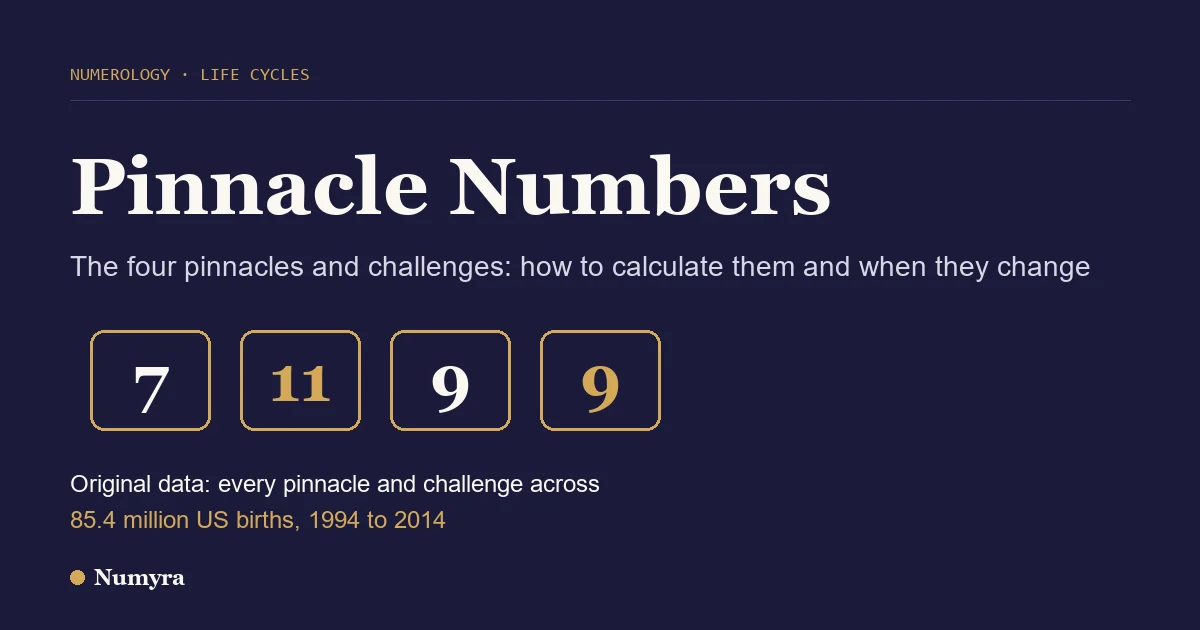
A pinnacle number in numerology is one of four numbers worked out from your birth date, each marking a long phase of life. The first pinnacle runs from birth until age 36 minus your Life Path number, the second and third last nine years each, and the fourth lasts for the rest of your life. Four matching challenge numbers, found by subtraction instead of addition, describe the lessons traditionally paired with those phases. Someone born July 18, 1991, for example, has pinnacles 7, 11, 9 and 9, and the first one ends at age 27. This is a traditional interpretive system, not a tested science, and nothing in it predicts events.
Key takeaways
- Pinnacles: first = month + day, second = day + year, third = first + second, fourth = month + year, each reduced. Challenges use differences instead: month and day, day and year, the first two challenges, and month and year.
- Timing: the first pinnacle ends at 36 minus the single-digit Life Path, so between age 27 (Life Path 9) and age 35 (Life Path 1). The next two last nine years each. Every source we read uses 36, though they count the boundary year slightly differently.
- Master numbers are the real point of disagreement. Hans Decoz keeps 11, 22 and 33 in pinnacles but reduces them in challenges; another site reduces them before adding. Numyra follows Decoz, as our methodology page does for every date-based number.
- Original data from 85.4 million US births (1994 to 2014): 30.6% of people have at least one master-number pinnacle, 48.5% have four different pinnacle numbers, and a 2 is the rarest single digit in all four positions.
- For challenges, 1 is the most common number in every position, a 0 appears somewhere for 35.1% of people, and a 9 cannot occur.
In this guide
- What pinnacle numbers are
- How to calculate your four pinnacles
- The age ranges: when each pinnacle starts and ends
- Master numbers and where the sources disagree
- What each pinnacle number means, by tradition
- Challenge numbers: how to calculate them
- How common each pinnacle and challenge number is (original data)
- Using pinnacles alongside your other numbers
- Frequently asked questions
What pinnacle numbers are
Your Life Path number is one figure for your whole life. Pinnacles divide that life into four stretches and give each its own number, so the tradition can say which themes are in the foreground at which age. Hans Decoz, whose World Numerology site is the most-cited reference for the method, describes them as “your most important long-term cycles” in his article on pinnacle cycles, and the labels many sites repeat for the four stages are attainment, obligation, foundation and retrospection. Several sites compare them to the four seasons.
The same birth date also produces the personal year cycle, which turns over every year (see our guide to personal year numbers and the nine-year cycle). Pinnacles are the slow layer: one number held for roughly a decade or more. Decoz adds that the change from one pinnacle to the next is “usually prepared for approximately 2 years in advance,” and that the move from the first to the second is the most strongly felt. That is a claim of the tradition, with no study behind it.
How to calculate your four pinnacles
You need only your birth month, day and year. The rules below are the ones used by Decoz and by the Numyra calculators; where other authors do something different, the section on master numbers says so.
- Reduce the three parts of the date separately (the day part alone is your birthday number). Add the digits of the month, day and year until one digit is left, but stop at 11, 22 or 33. March is 3, November is 11, the 18th is 1 + 8 = 9, the 29th is 2 + 9 = 11, and 1991 is 1 + 9 + 9 + 1 = 20, then 2.
- First pinnacle: reduced month + reduced day, reduced again.
- Second pinnacle: reduced day + reduced year, reduced again.
- Third pinnacle: first pinnacle + second pinnacle, reduced again.
- Fourth pinnacle: reduced month + reduced year, reduced again.
“Reduced again” means adding digits until one digit is left, unless the total is 11, 22 or 33. Because the year enters the second and fourth pinnacles, two people born on the same day of the year in different years share a first pinnacle but usually not the others. If you also want your Life Path, our Life Path calculator does the same reduction, and the guide to calculating a chart by hand walks through it.
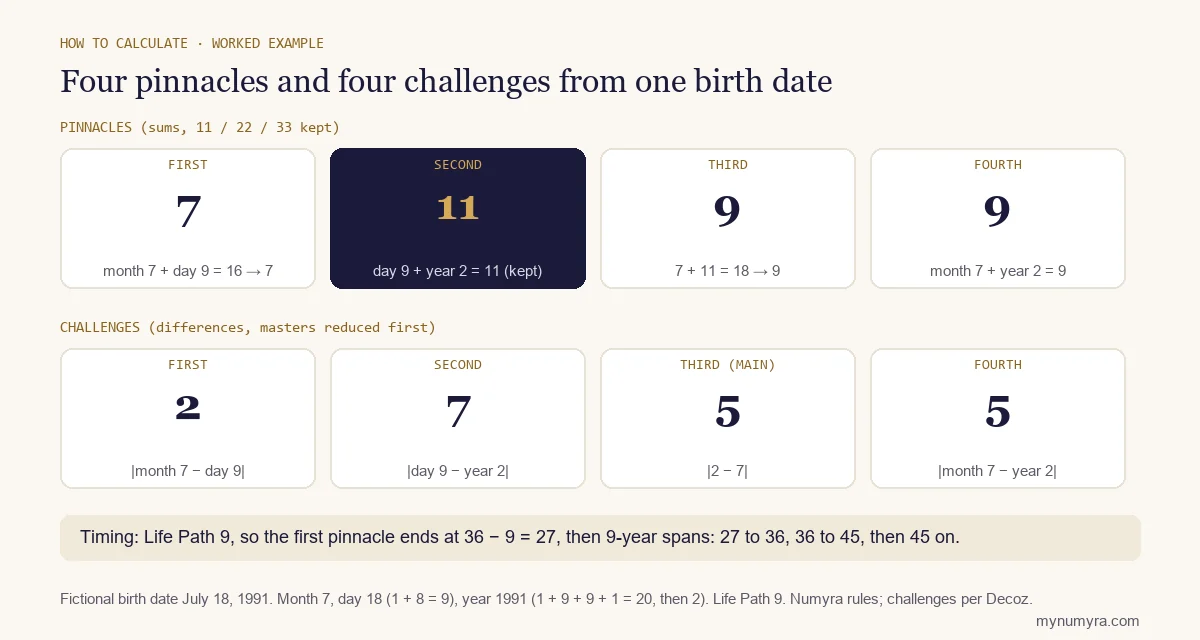
A worked example (fictional birth date)
Take July 18, 1991. The month is 7. The day is 18, and 1 + 8 = 9. The year is 1991, and 1 + 9 + 9 + 1 = 20, then 2. The Life Path is 7 + 9 + 2 = 18, then 9.
| Pinnacle | Sum | Result | Ages (Life Path 9) |
|---|---|---|---|
| First | 7 + 9 = 16 | 1 + 6 = 7 | birth to 27 |
| Second | 9 + 2 = 11 | 11 (kept) | 27 to 36 |
| Third | 7 + 11 = 18 | 1 + 8 = 9 | 36 to 45 |
| Fourth | 7 + 2 = 9 | 9 | 45 onward |
Since this person was born in July 1991, the second pinnacle runs from July 2018 to July 2027 and the third from July 2027 to July 2036, if the boundary falls on the birthday. A second pinnacle that happens to be a master number is the kind of detail the tradition flags as intense, and that is why the 11 matters in the next sections.
The age ranges: when each pinnacle starts and ends
Every source we read, from Decoz’s World Numerology to the free “Numerology with Heart” course, Aryabhatt, numerologist.com and several smaller sites, uses the same timing rule. Decoz states it this way:
“Your First Pinnacle cycle starts at birth and runs until your 36th birth day minus your Life Path number.”
Hans Decoz, Pinnacle Cycles, World Numerology
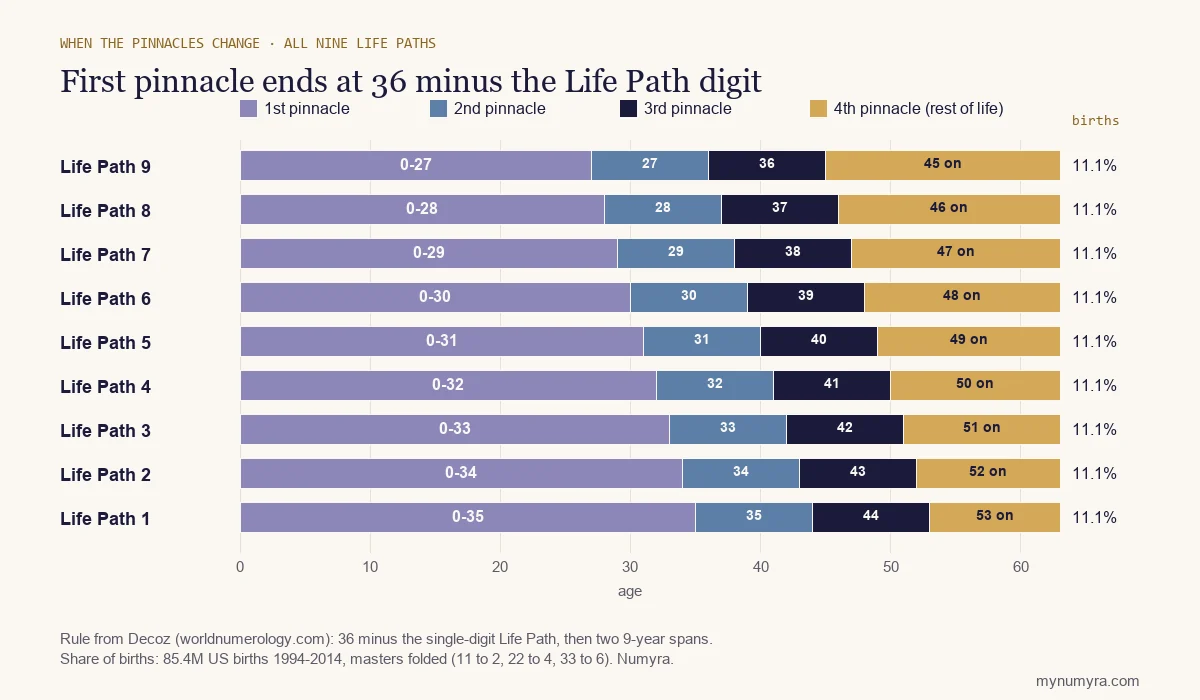
The Numerology with Heart lesson explains where the 36 comes from: you “begin with the number 36 (which is 4 times 9),” subtract the Life Path digit, then add nine years for each of the second and third pinnacles. The fourth begins after that and continues for life. The result is a table with nine rows, one for each Life Path from 1 to 9.
| Life Path | 1st pinnacle | 2nd pinnacle | 3rd pinnacle | 4th pinnacle | Share of US births |
|---|---|---|---|---|---|
| Life Path 1 | 0 to 35 | 35 to 44 | 44 to 53 | 53 on | 11.1% |
| Life Path 2 | 0 to 34 | 34 to 43 | 43 to 52 | 52 on | 11.1% |
| Life Path 3 | 0 to 33 | 33 to 42 | 42 to 51 | 51 on | 11.1% |
| Life Path 4 | 0 to 32 | 32 to 41 | 41 to 50 | 50 on | 11.1% |
| Life Path 5 | 0 to 31 | 31 to 40 | 40 to 49 | 49 on | 11.1% |
| Life Path 6 | 0 to 30 | 30 to 39 | 39 to 48 | 48 on | 11.1% |
| Life Path 7 | 0 to 29 | 29 to 38 | 38 to 47 | 47 on | 11.1% |
| Life Path 8 | 0 to 28 | 28 to 37 | 37 to 46 | 46 on | 11.1% |
| Life Path 9 | 0 to 27 | 27 to 36 | 36 to 45 | 45 on | 11.1% |
Life Path 11, 22 and 33 are 5.9%, 3.6% and 0.3% of US births and sit inside the 2, 4 and 6 rows. The table counts them with the single digit they reduce to (2, 4 and 6), which is the instruction in Decoz’s text: “If your Life Path is a Master number, reduce it to a single digit first.” Aryabhatt gives the same pairing, 11 as 2 and 22 as 4. The reason matters arithmetically: subtracting a raw 22 from 36 would put the end of the first pinnacle at age 14, and a raw 33 would put it at age 3, neither of which any source describes.
One year of fuzz at each boundary
The sources do not all count the boundary year the same way. Decoz writes that for a Life Path 8 the first pinnacle “ends at age 28,” and numerologist.com has a Life Path 7 second pinnacle running “from 29 to 38.” The Numerology with Heart chart instead lists ranges that do not touch: 0 to 28, then 29 to 37, then 38 to 46, then 47 on. Aryabhatt’s Life Path 5 example says the first pinnacle ends at 31, the second runs “until age 40” and the fourth begins at age 50. In practice this is a difference of one year, and the tradition itself treats the changeover as a period, not a date: Decoz says the shift is felt for about two years before it arrives and calls the first-to-second change “a gateway to maturity.” The table above uses the birthday version, in which the pinnacle changes on the birthday at the stated age.
Because each Life Path digit shows up in about one birth in nine, the first pinnacle’s end age is spread almost evenly across 27 to 35 in our data below. Decoz’s “late 20s or early 30s” fits about two thirds of people (those ending at 27 to 32) and is a fair summary of the tradition, not a rule. The average end age works out to 31.0.
Master numbers and where the sources disagree
The 36-minus-Life-Path rule is universal, but the way sources treat master numbers inside the calculation is not. This is the table to check if your result differs from another website’s.
| Source | Month, day and year parts | Pinnacle sums | Life Path for timing |
|---|---|---|---|
| Decoz (World Numerology), Numyra | 11, 22, 33 kept | 11, 22, 33 kept | master reduced to a single digit |
| Aryabhatt | all reduced to a single digit | 11 kept in its example | 11 counts as 2, 22 as 4 |
| Numerologist.com | 11, 22, 33 kept | 11, 22, 33 kept | single-digit Life Path |
| Numerology with Heart | 11 kept (month 11 shown as 11/2) | not shown in its example | single digit |
Decoz’s rule for the sums is “Master numbers encountered during the Pinnacle calculations are not reduced,” with an example that adds a birth month of 11 and a day of 5 to get 16, then 7. Aryabhatt takes the opposite approach for the building blocks:
“Even master numbers will be reduced in this exercise.”
Pinnacle Phases, Aryabhatt
Its December 14, 1968 example turns month 12 into 3, day 14 into 5 and year 1968 into 6, then still keeps the 11 that results from 5 + 6 as a second pinnacle. We ran both rules over every day from 1994 to 2014, weighted by births. They give a different set of four pinnacles for 4.8% of people, and the difference shows up in the first pinnacle for 2.2%, the second for 1.6%, the third for 0.4% and the fourth for 1.6%. A rule that never keeps master numbers would change the result for the 30.6% of people who have a master-number pinnacle under the Decoz rule, because a pinnacle only differs when it lands on 11, 22 or 33.
Challenges go the other way. Decoz’s page carries the note that when calculating Challenge Numbers, “Master Numbers are reduced to single digits,” which is why 11 and 22 never appear as challenges. Why the master numbers get special treatment at all is covered in our explainer on 11, 22 and 33. Numerologist.com adds a practical reason to reduce the parts separately: adding every digit of the date at once can hide the intermediate sums behind the karmic debt numbers 13, 14, 16 and 19.
We could only read online sources. The classic print books on the subject (for example Faith Javane and Dusty Bunker’s Numerology and the Divine Triangle, 1979) are access-restricted on the Internet Archive, so we cannot say whether older authors used a different timing rule, and we have not claimed that they did.
What each pinnacle number means, by tradition
Practitioners read the number as the theme of the phase, and the same number reads differently as a first pinnacle (a young person still discovering the quality) and as a fourth (a mature person applying it). The wording below summarizes the Decoz-lineage sources and the Chaldean Numbers guide we read; it is interpretation, not fact.
| Pinnacle | Traditional theme |
|---|---|
| 1 | Independence, initiative and standing on your own; courage and willpower are the lesson. |
| 2 | Cooperation, patience and sensitivity; working through partnership and diplomacy. |
| 3 | Creative expression and social life; the caution is scattered effort. |
| 4 | Hard work, order and building a lasting foundation; the caution is rigidity. |
| 5 | Change, travel, freedom and learning from experience; the caution is restlessness. |
| 6 | Family, community and responsibility; the caution is over-giving. |
| 7 | Inner development, study and spiritual questions; time alone is part of the theme. |
| 8 | Ambition, money, authority and organization; keeping material goals in proportion is the lesson. |
| 9 | Compassion, completion and service to a wider group; letting go of the old. |
| 11 | Heightened intuition and sensitivity, with nervous intensity; grounding the vision is the task. |
| 22 | Large-scale building: big plans and big demands, a “pinnacle of extremes” in the Chaldean Numbers wording. |
You can compare these with the single-number profiles on this site, such as Life Path 1, Life Path 4 and Life Path 11, but note that a pinnacle describes a period and a Life Path describes a whole life. Treat any of it as a prompt for reflection. If a reading says a decade will be difficult, that is not a forecast.
Challenge numbers: how to calculate them
Challenges are the subtraction twin of pinnacles. Decoz’s page says plainly that this is “one of the few areas where subtraction is used.” First reduce the month, day and year to single digits, turning any master number into its single digit (11 becomes 2, 22 becomes 4). Then subtract, always taking the smaller number from the larger so the result is not negative.
- First challenge: month and day.
- Second challenge: day and year.
- Third (main) challenge: the difference between the first and second challenges.
- Fourth challenge: month and year.
For July 18, 1991 (month 7, day 9, year 2) the challenges are |7 − 9| = 2, |9 − 2| = 7, |2 − 7| = 5 and |7 − 2| = 5. Decoz’s own example, Tom Cruise’s 7/3/1962, gives 4, 6, 2 and 2, and our code reproduces it. A result of 0 is allowed. Differences of single digits can only be 0 to 8, so a 9 never occurs and master numbers never occur either.
The timing is much looser than for pinnacles, which is the main thing other pages leave out:
“Challenges do NOT have closely defined durations, they are more fluid than cycles and overlap for several years.”
Hans Decoz, The Challenges, World Numerology
Decoz gives approximate ranges: the first challenge from birth to about age 30 to 35, the second until about 35 to 55 or 60, the fourth from about 55 or 60, and the third, which he calls the main challenge, throughout life. Other sites, such as NumerologyCalc, say the four challenge periods line up with the four pinnacles, so check which convention a given calculator uses. The Chaldean Numbers guide also says to subtract “or reverse,” which gives the same absolute difference.
| Challenge | Traditional theme |
|---|---|
| 0 | No single dominant obstacle; Decoz links it to a 9 and a wider, humanitarian view, and says it is “very common.” |
| 1 | Standing up for yourself, trusting your own judgment instead of following the crowd. |
| 2 | Oversensitivity, self-consciousness and a wish to blend in. |
| 3 | Self-criticism, doubt about creative expression, unfinished projects. |
| 4 | Disorder, procrastination and the pull toward the path of least resistance. |
| 5 | Restlessness, impulsiveness and overindulgence. |
| 6 | Perfectionism and rigid ideals, with a harsh view of self and others. |
| 7 | Skepticism, suppressed feeling and over-reliance on analysis. |
| 8 | Letting money and status become the main priority. |
How common each pinnacle and challenge number is (original data)
None of the pages we read says how often any pinnacle or challenge number occurs, so we calculated it. The method: for every calendar day from January 1, 1994 to December 31, 2014 (7,670 days), we worked out all four pinnacles and all four challenges with the rules above, and counted each result weighted by the number of babies born that day, 85,386,227 births in all. The birth counts are from the CDC National Center for Health Statistics for 1994 to 2003 and the Social Security Administration for 2004 to 2014, as compiled by FiveThirtyEight. As a check, the code reproduces the published pinnacle examples from Decoz, Numerology with Heart and Aryabhatt, and the challenge example from Decoz.
What this is not: it covers US births only, and only the years 1994 to 2014. Because the second and fourth pinnacles use the birth year, the results depend on which years are included. For example, no year from 1994 to 2014 reduces to 22, so a fourth pinnacle of 33 (month 11 plus year 22) never occurs in this sample, whereas across every calendar date from 1900 to 2025 it occurs on 0.46% of dates. The first pinnacle uses no year, so its shares match the long-run values closely.
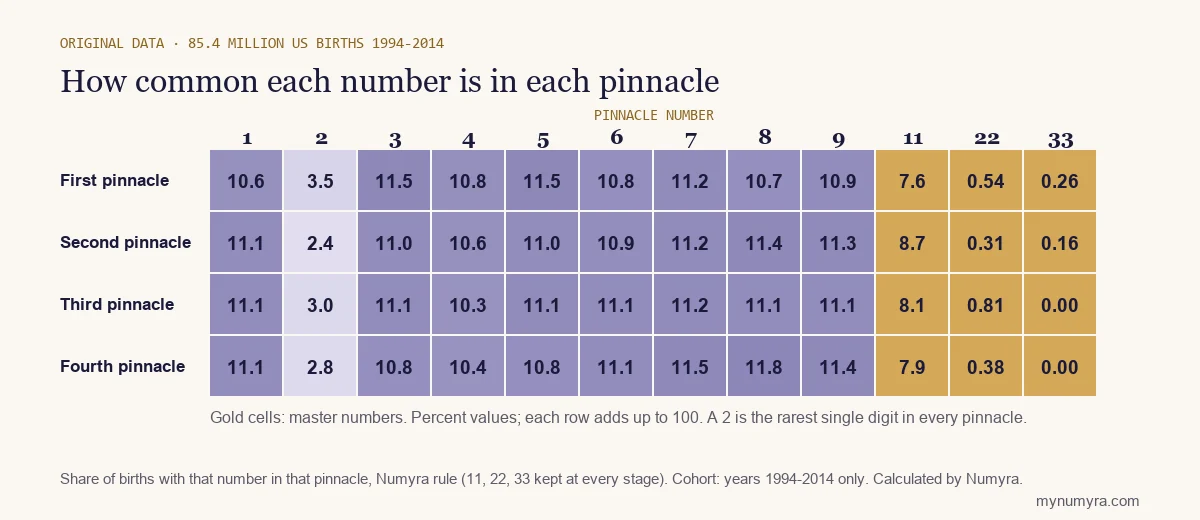
| Pinnacle | 1 | 2 | 3 | 4 | 5 | 6 | 7 | 8 | 9 | 11 | 22 | 33 |
|---|---|---|---|---|---|---|---|---|---|---|---|---|
| First | 10.6% | 3.5% | 11.5% | 10.8% | 11.5% | 10.8% | 11.2% | 10.7% | 10.9% | 7.6% | 0.54% | 0.26% |
| Second | 11.1% | 2.4% | 11.0% | 10.6% | 11.0% | 10.9% | 11.2% | 11.4% | 11.3% | 8.7% | 0.31% | 0.16% |
| Third | 11.1% | 3.0% | 11.1% | 10.3% | 11.1% | 11.1% | 11.2% | 11.1% | 11.1% | 8.1% | 0.81% | 0.00% |
| Fourth | 11.1% | 2.8% | 10.8% | 10.4% | 10.8% | 11.1% | 11.5% | 11.8% | 11.4% | 7.9% | 0.38% | 0.00% |
Four findings stand out. First, a 2 is the rarest single digit in every position (3.5%, 2.4%, 3.0% and 2.8% against about 11% for most others), because under the master-number rule a sum of 11 stays 11. Among single-digit parts, 1 + 1 is the only sum that gives 2, while 2 + 9, 3 + 8, 4 + 7 and 5 + 6 all become 11. Second, 11 is the most frequent master number, at 7.6% to 8.7% in each position, and 29.2% of people have an 11 somewhere among their four. Third, 22 and 33 are uncommon: only 2.0% of people have a 22 and 0.4% a 33 anywhere. Fourth, no one in the sample, and no date in the 1900 to 2025 sweep, has a 33 as a third pinnacle.
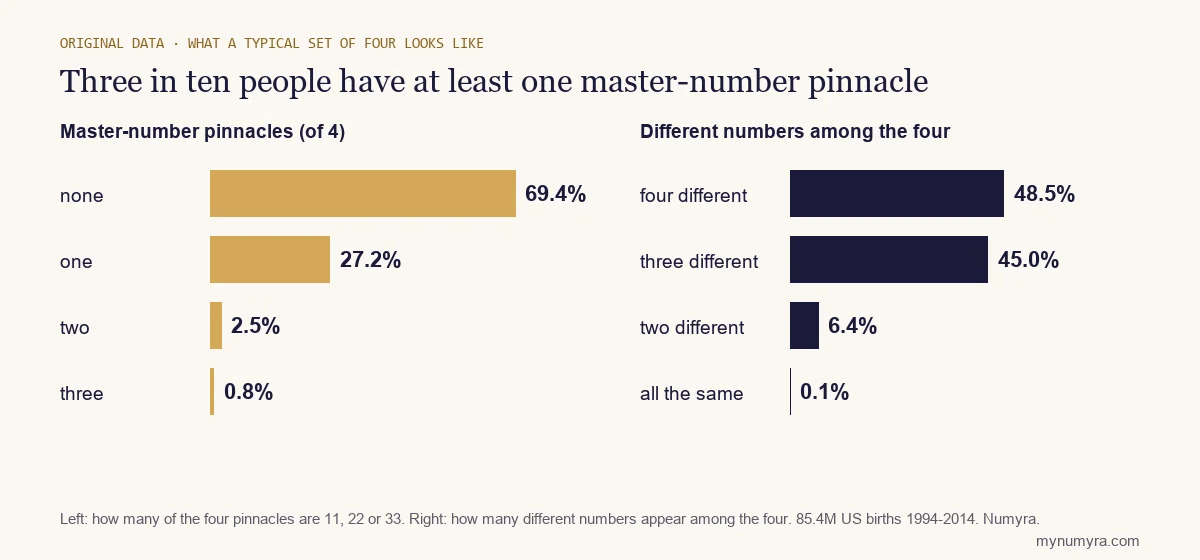
Taken together, 69.4% of people have no master-number pinnacle, 27.2% have exactly one, 2.5% have two and 0.8% have three; nobody has four. Pinnacles also rarely repeat: 48.5% of people have four different numbers, 45.0% have three different, 6.4% have two, and only 0.09% have the same number in all four slots. There are 827 distinct four-number sequences in the data, and the most common, 6-8-5-8, covers just 0.32% of births, so two strangers rarely share a full set.
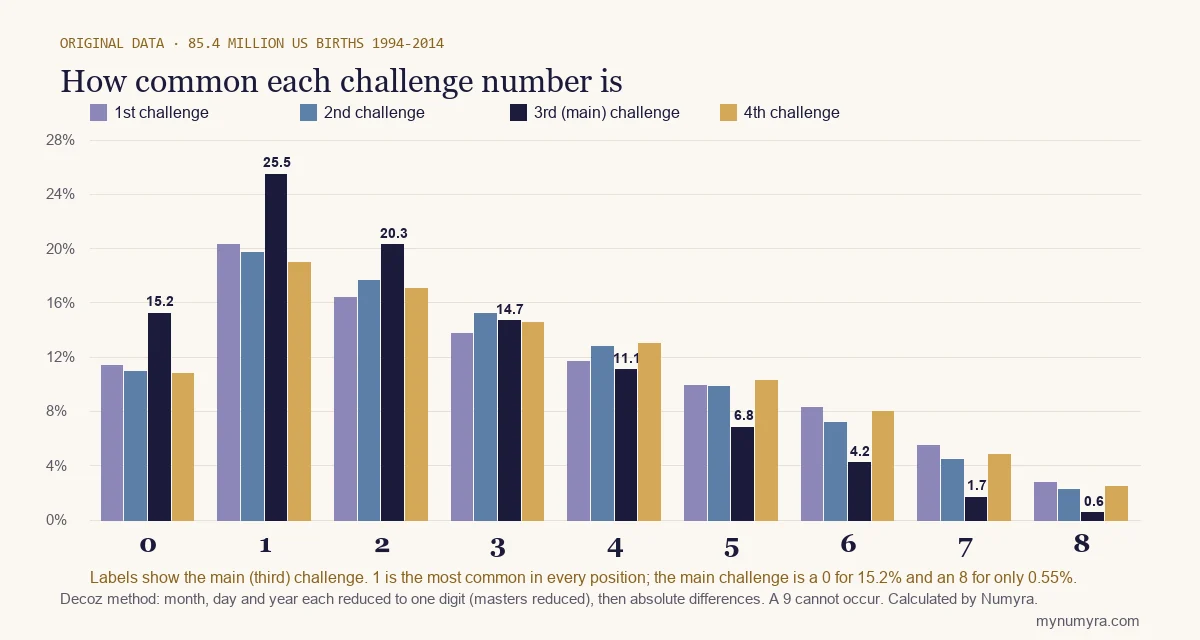
| Challenge | 0 | 1 | 2 | 3 | 4 | 5 | 6 | 7 | 8 |
|---|---|---|---|---|---|---|---|---|---|
| First | 11.4% | 20.3% | 16.4% | 13.8% | 11.7% | 9.9% | 8.3% | 5.5% | 2.8% |
| Second | 11.0% | 19.7% | 17.6% | 15.2% | 12.8% | 9.8% | 7.2% | 4.5% | 2.2% |
| Third (main) | 15.2% | 25.5% | 20.3% | 14.7% | 11.1% | 6.8% | 4.2% | 1.7% | 0.6% |
| Fourth | 10.8% | 19.0% | 17.1% | 14.6% | 13.0% | 10.3% | 8.0% | 4.8% | 2.5% |
Challenges follow the shape of subtraction. The difference between two random digits from 1 to 9 is 1 about 20% of the time and 8 only about 2.5% of the time, and that pattern shows in all four positions. The main challenge, which is a difference of differences, leans even more toward low numbers: 25.5% are 1, 20.3% are 2, 15.2% are 0 and just 0.55% are 8. Decoz notes that a 0 challenge is “very common,” and the data agree: each position is a 0 for 10.8% to 15.2% of people, 35.1% have at least one 0 among the four, 9.6% have two and 1.2% have all four (month, day and year all reduce to the same digit). Exactly three zeros is impossible.
A fair question is whether a rarer number carries more weight. Numerology offers no evidence that it does, and these shares only describe the arithmetic of the calendar. A 2 pinnacle is not more special for being rare; the rarity comes from the 11 rule.
Using pinnacles alongside your other numbers
Most practitioners read pinnacles as the long background and the personal year as the weather within it. One lesson on the Numerology with Heart site, for instance, reads a person in a 2 personal year inside a 9 third pinnacle. The Maturity Number is sometimes tied to the same stretch: that lesson says it “often begins to make sense” in the third pinnacle, and our guide to the maturity number lists the ages different sources give for it. The three name numbers, covered in Expression, Soul Urge and Personality, come from the letters of a name and are separate from the birth-date cycles on this page, while karmic lessons look at numbers missing from a name.
The simplest use is reflective. Work out your four numbers, find the one that covers your current age, read the traditional theme and decide whether it describes anything you recognize. If it does not, that tells you about the tradition, not about you. Numerology and astrology are cultural traditions, not sciences, and our disclaimer applies; the way we calculate each number is on the methodology page.
Frequently asked questions
How do you calculate pinnacle numbers?
Reduce your birth month, day and year separately, keeping 11, 22 and 33. First pinnacle = month + day, second = day + year, third = first + second, fourth = month + year, each reduced again.
At what age does the first pinnacle end?
At 36 minus your single-digit Life Path number, so at 27 for a Life Path 9 and at 35 for a Life Path 1. Life Paths 11, 22 and 33 count as 2, 4 and 6 for this, giving 34, 32 and 30.
How long does each pinnacle last?
The first lasts until 36 minus your Life Path digit. The second and third last nine years each, and the fourth continues for the rest of your life.
Do you keep master numbers in a pinnacle?
Numyra does, following Hans Decoz, so a pinnacle can be 11, 22 or 33. Some sources, such as Aryabhatt, reduce master numbers in the month, day and year first, which changes the result for 4.8% of people in our sample.
What is the difference between pinnacle and challenge numbers?
Pinnacles are found by adding parts of the birth date and describe the theme of each life phase. Challenges are found by subtracting them and describe the lesson traditionally paired with that phase. Challenges are also timed much more loosely.
Can a challenge number be 9 or a master number?
No. Challenges are differences between single digits, so they range from 0 to 8, and master numbers are reduced to single digits before subtracting.
Which pinnacle number is rarest?
Among single digits, 2, at 2.4% to 3.5% depending on the position. Among masters, 33 and 22 are rarer than 11. In US births from 1994 to 2014, 29.2% of people have an 11 in some pinnacle but only 2.0% have a 22.
Do pinnacle numbers change over time?
No. All four are fixed by your birth date. What changes is which one is active at your current age.
Is there scientific evidence for pinnacle numbers?
No. They are an interpretive tradition and the age ranges are conventions. Use them for reflection, not as a forecast.
Sources
- Decoz, Hans. Pinnacle Cycles. World Numerology. Source of the pinnacle formulas, the timing rule and the master-number instruction quoted above.
- Decoz, Hans. The Challenges. World Numerology. Source of the challenge formulas, the 7/3/1962 example, the approximate durations and the quote on fluid timing.
- Aryabhatt. Pinnacle Phases. The variant that reduces master numbers in the date parts.
- The Free Numerology with Heart eCourse. Lesson 16: The Pinnacles. HeartCore Corporation. Source of the 4 times 9 explanation and the age chart.
- Numerologist.com. Pinnacle Numbers. Source of the attainment, obligation, foundation and retrospection labels and a Life Path 7 timing example.
- Bender, Felicia. Age and Timing for Pinnacles. Cross-check of the 36-minus-Life-Path rule and of Decoz’s four labels.
- NumerologyCalc. Challenge Numbers. Cited for the statement that the four challenge periods line up with the four pinnacles.
- Chaldean Numbers. Pinnacles and Challenges: Basics. Cited for pinnacle themes and the “or reverse” challenge wording.
- FiveThirtyEight. US births data, 1994 to 2014, from the CDC National Center for Health Statistics and the Social Security Administration. Birth counts for the original data.