Angel Number 1234: Sequence
Read less symbolically than most entries here, often noticed simply because ascending sequences catch the eye.
Key takeaways
- 1234 is traditionally read as sequence. 1 + 2 + 3 + 4 = 10, the count of dots in the Pythagorean tetractys, and 1234 was the single most common code in a study of about 3.4 million four-digit passwords: more than 1,000 times what chance predicts.
- Ascending sequences like 1234 are a natural pattern for the eye to catch on a clock or receipt independent of any numerology tradition, which is part of why this entry's folk reading tends to be the mildest of the fourteen covered here.
- Nothing here is medical, financial, legal, or psychological advice. It is a cultural tradition, presented for reflection.
What 1234 is traditionally read as
Traditionally read as a light nudge to keep moving forward in order, rather than carrying the layered symbolic weight of repeating-digit sequences like 111 or 888. Because 1234 is simply consecutive rather than repeated, several angel-number writers treat it as a lower-key, more everyday sighting than the others on this list.
1234 is read as steady progress: things moving forward step by step, in the right order. Because it is a simple count, writers describe it as a sign to simplify, take one step at a time and trust that progress does not have to be dramatic to be real.
1234 in love, career, and spirituality
One theme, read three ways, not three predictions.
1234 and money, and whether it is a warning
What 1234 means for money
For money, 1234 is read as encouragement to handle finances step by step: one debt, one goal, one plan at a time.
Can 1234 be a warning?
No. If anything it is a reminder to keep things simple.
What to do when you keep seeing 1234
Sequence is the theme, so the suggestions are about taking things in order. The three common steps:
- Break a big goal into four small steps.
- Do the first one today.
- Remove one complication from your plans.
Why you might be seeing it
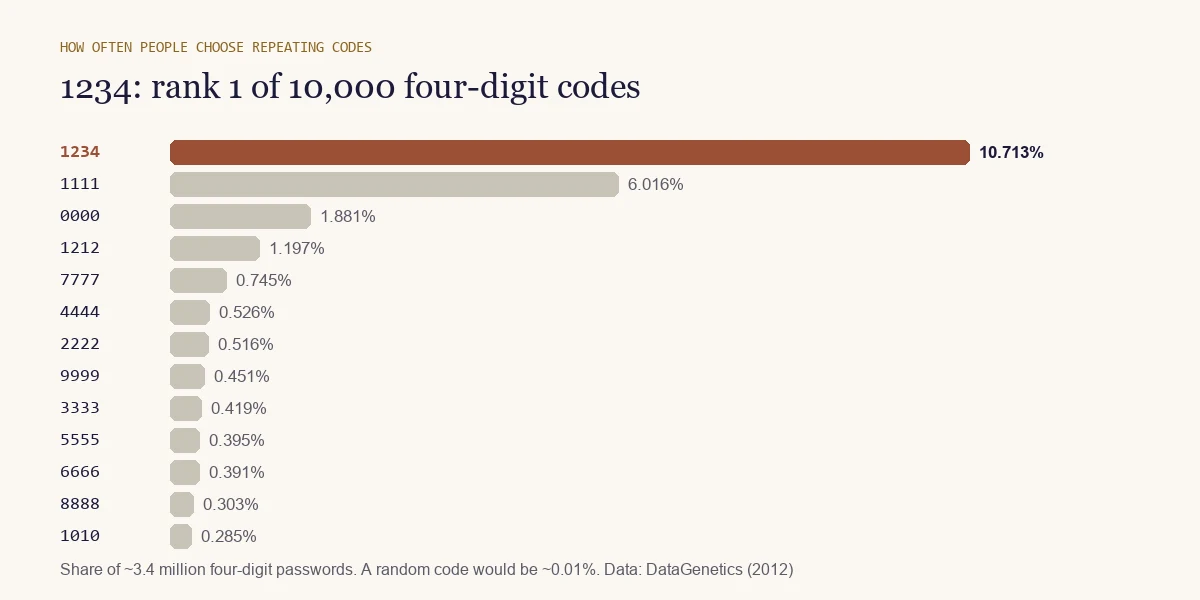
The explanation for seeing 1234 is mostly human behaviour. In the DataGenetics study, 10.713% of about 3.4 million four-digit passwords were 1234; the top three codes (1234, 1111, 0000) together took 18.61%, nearly one in five. A number that this many people choose on purpose is written in a great many places.
12:34 is also a real clock time, twice a day on a 12-hour dial and once on a 24-hour one, so it has its place among the four-digit times alongside 10:10, 11:11 and 12:12.
The modern angel-number reading was popularized by Doreen Virtue’s books of the 2000s; her own words are quoted on the 111 page.
How often 1234 really shows up
1234 fits a real clock reading in both formats, like 1010, 1111 and 1212.
| How the clock is read | Minutes per day | Which minutes |
|---|---|---|
| 12-hour clock, exactly 1234 | 2 | 12:34 AM and 12:34 PM |
| 24-hour clock, exactly 1234 | 1 | 12:34 |
12:34 AM is 00:34 on a 24-hour dial, which is why that clock gives it once, not twice. On a 24-hour dial there are two more such times, 01:23 and 23:45.
1234 beyond angel numbers
1234 is by far the most common four-digit code people choose. In a study of about 3.4 million four-digit passwords, 10.7% were 1234, more than a thousand times what chance would predict. If you see it often, part of the reason is that the world is full of it.
1234 was by far the most common code in the study, chosen by 10.713% of people, about 1,071 times what a random pick would give.
1234 in numerology
Adding the digits of 1234 gives 10, and 1 + 0 gives 1 (1 + 2 + 3 + 4 = 10), so numerologists reach 1 as a Life Path number by way of the compound number 10. The sum 10 is also the tetractys, described below.
1234 by the numbers: 2 × 617
1234 = 2 × 617, and 617 is prime, so its only prime factors are 2 and 617. It is also the smallest four-digit number made of consecutive ascending digits, since 0123 would start with a zero.
| Property | Value |
|---|---|
| Prime factors | 2 × 617 |
| Roman numeral | MCCXXXIV |
| Digits added | 1 + 2 + 3 + 4 = 10 → 1 + 0 = 1 |
| First place in the decimals of pi | decimal 13,807 |
| Times in the first 1,000,000 decimals of pi | 78 (chance alone predicts about 100) |
In pi, 1234 first appears at decimal 13,807, a long way in, and 78 times in the first million decimals, 22 below the 100 that chance predicts.
The tetractys and the old books on 1, 2, 3 and 4
1234 has a pedigree in old number-lore, because 1 + 2 + 3 + 4 = 10 is the Pythagorean tetractys: Wikipedia describes it as a triangular figure of ten points in four rows of one, two, three and four points, which was “very important to the secret worship of Pythagoreanism”. The four rows added up to ten, which the Pythagoreans took as a unity of a higher order.
Cheiro’s compound-number table gives the 10 its own picture:
Symbolised as the “Wheel of Fortune.”
Cheiro, Cheiro’s Book of Numbers (London: Herbert Jenkins), Chapter XIII, “The compound or spiritual numbers”: 10
It also reads the two halves of 1234. He calls 12 “the Sacrifice” or “the Victim”, and says of 34 only that it has “the same meaning as the number 25”, which is a number denoting:
strength gained through experience
Cheiro, Cheiro’s Book of Numbers (London: Herbert Jenkins), Chapter XIII: 25, and 34 “has the same meaning”
The old books therefore give 1234 a mixed set of readings, from a sacred triangle to a sacrifice to strength through experience, whereas the angel books reduce it to steady progress. None of these old readings was written about seeing 1234. Neither Balliett’s nor Cheiro’s text mentions the tetractys (we searched both); that detail comes from Wikipedia’s account of Pythagoreanism.
Why 1234 is the world’s favourite code
| Code | Share of about 3.4 million four-digit passwords | Times more than a random pick (0.01%) |
|---|---|---|
| 1234 | 10.713% | about 1,071 |
| 1111 | 6.016% | about 602 |
| 0000 | 1.881% | about 188 |
The study is DataGenetics’ 2012 analysis; the three codes above took 18.61% between them.
Frequently asked questions
Is 1234 considered a "real" angel number?
It appears across most popular angel-number references, though with a lighter, more generic reading than repeated-digit sequences: some stricter definitions of the practice focus only on repeating digits and would exclude it.
Why don't you read 1234 as strongly as 1111?
We're matching the general pattern across sources: repeated-digit sequences carry a stronger, more specific traditional reading than a simple ascending run, so we present 1234's meaning more lightly rather than overstating it.
Is 1234 a twin flame number?
Twin-flame readings are a separate New Age idea that later writers and online communities layered onto angel numbers. Numyra doesn't treat them as part of the traditional reading, and numerology itself has no twin-flame concept.
Why is 1234 so common as a PIN?
In the 2012 DataGenetics study of about 3.4 million four-digit passwords, 10.713% were 1234, roughly 1,071 times what a random pick would give.
What is the tetractys and how does it relate to 1234?
A triangle of ten points in rows of one, two, three and four, important to Pythagoreanism per Wikipedia. Its ten points are 1 + 2 + 3 + 4, the digit sum of 1234.
Which clock times contain 1234?
Only 12:34, at 12:34 AM and 12:34 PM on a 12-hour clock and at 12:34 on a 24-hour clock. On a 24-hour dial 01:23 and 23:45 are also built from four ascending digits, but those are different numbers.
What is the Wheel of Fortune in Cheiro’s table?
His compound table pictures it as “the Wheel of Fortune”. 1234 adds to 10, so the sum falls on that entry.
Is 1234 prime?
No. 1234 = 2 × 617, and 617 is prime, so its only prime factors are 2 and 617.
Does pi favour or avoid 1234?
It first appears at decimal 13,807 and occurs 78 times in the first 1,000,000 decimals, below the 100 that chance predicts for a four-digit pattern.
Sources
- Cheiro, Cheiro’s Book of Numbers (London: Herbert Jenkins), Chapter XIII, “The compound or spiritual numbers”
- “Tetractys.” Wikipedia (revision 1366298924, retrieved 23 October 2026).
- Virtue, Doreen. Angel Numbers 101. Hay House, 2008. The book most responsible for popularizing the modern "angel numbers" practice.
- Numyra Editorial Desk. Why you keep seeing the same number.
- Numyra Methodology Desk. Sourcing standard.
- DataGenetics. "PIN analysis." 2012. Frequencies of about 3.4 million four-digit passwords.