Unlike your Life Path Number, your Personal Year Number changes every year — and most sites that explain it quietly pick one of two genuinely different ways to calculate it without telling you there’s a second one.
Key takeaways
- Your Personal Year Number comes from your birth month, birth day, and the current year — reduced fully to 1 through 9, with no master-number exception (unlike Life Path, Destiny, Soul Urge or Personality).
- There are two genuinely different conventions for which “year” to use — calendar year or birthday-to-birthday year — and most numerology sites pick one silently. We tell you which one our own calculator uses, and why.
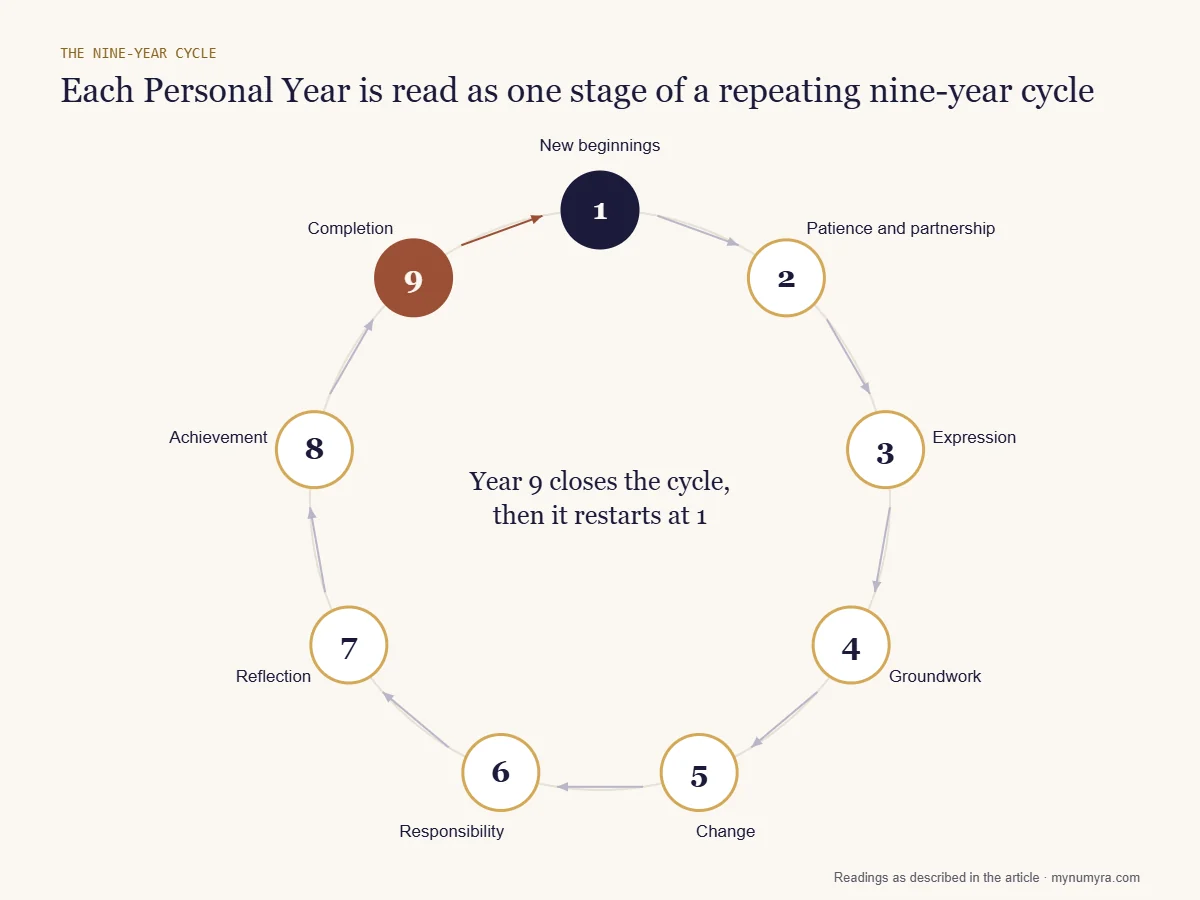
- The nine years form a repeating cycle: Year 1 starts something new, Year 9 closes it out, then the cycle restarts at 1 the following year.
- Nothing here is medical, financial, legal, or psychological advice — a cultural tradition, presented for reflection.
A note on sources: the Personal Year cycle is a modern numerology convention without one clean primary-source origin the way master numbers or the letter chart have — we’re citing the real, current explainers we checked our own method against (below) rather than manufacturing a historical quote that doesn’t exist for this specific technique.
How to calculate it
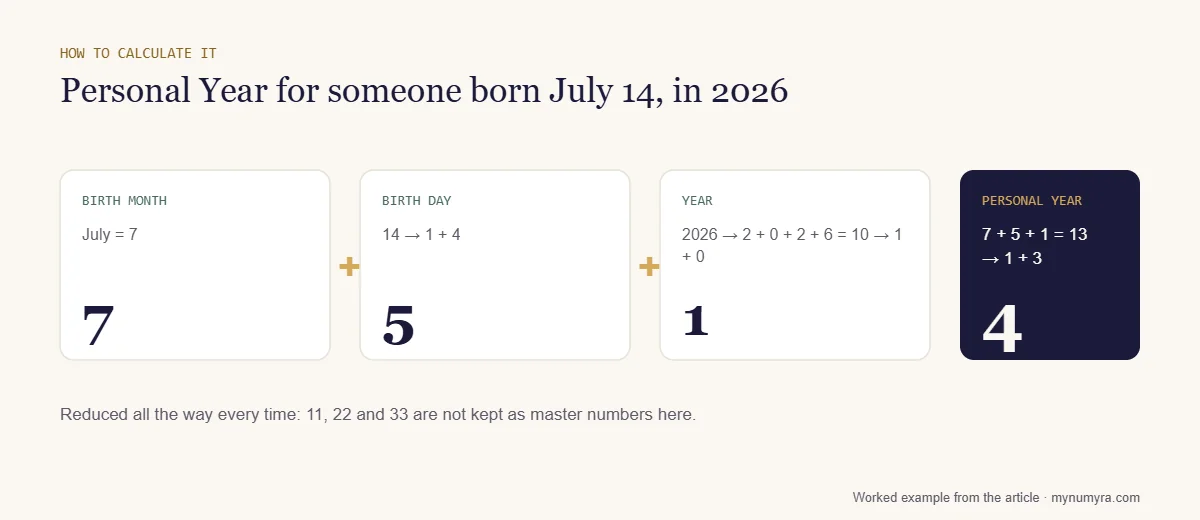
Reduce your birth month, birth day, and the year in question separately down to a single digit, then add the three results together and reduce that total the same way:
| Birth month | July = 7 |
| Birth day | 14 → 1 + 4 = 5 |
| Year | 2026 → 2 + 0 + 2 + 6 = 10 → 1 + 0 = 1 |
| Total | 7 + 5 + 1 = 13 → 1 + 3 = 4 |
Personal Year = 4 for someone born July 14, in 2026. Unlike the Life Path, Destiny, Soul Urge and Personality numbers, Personal Year is traditionally reduced all the way down every time — 11, 22 and 33 are treated as ordinary numbers here, not kept as master numbers. Check any date on our Personal Year Number calculator.
The dispute most sites don’t tell you about
Here’s the honest complication: numerologists genuinely disagree on which “year” belongs in that calculation, and most sites that explain Personal Year never mention there’s a choice at all. There are two real conventions:
- Calendar year — use the actual current year (2026, 2027, and so on) for everyone, regardless of whether their birthday has happened yet this year.
- Birthday-to-birthday year — your Personal Year changes on your birthday, not on January 1st. Under this convention, someone whose birthday hasn’t happened yet this calendar year is technically still in last year’s Personal Year number until it does.
Numyra’s own calculator uses the calendar-year convention — the actual current year, for everyone, all year. We’re naming that choice explicitly rather than leaving it implicit, because most sources don’t.
The Old Farmer’s Almanac guide acknowledges both conventions but stops short of picking one:
“Some numerologists believe your year runs from birthday to birthday. In contrast, others consider the beginning of a year to be more accurate. Test both theories to see which feels right for you.”
— Theresa Reed, “What’s Your Personal Year Number? Numerology Guide 2026”, The Old Farmer’s Almanac
That’s an honest way to handle real disagreement, but it leaves the reader to do the work of actually running both calculations themselves — we’d rather tell you plainly which one you’re getting from our own tool.
Where the two conventions actually give different answers
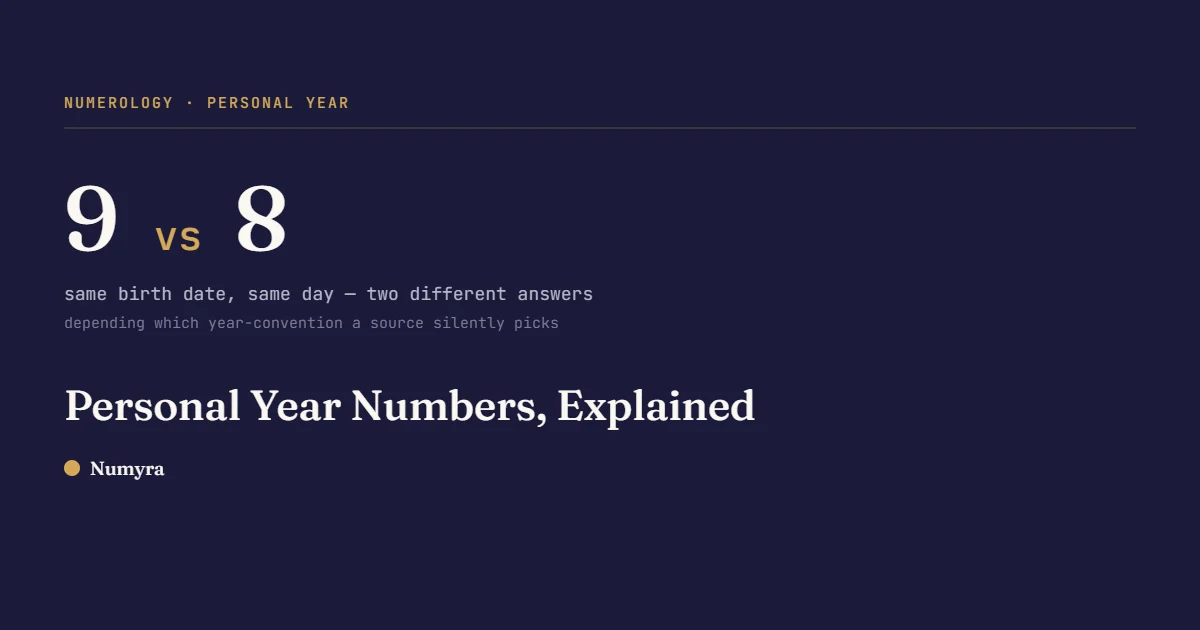
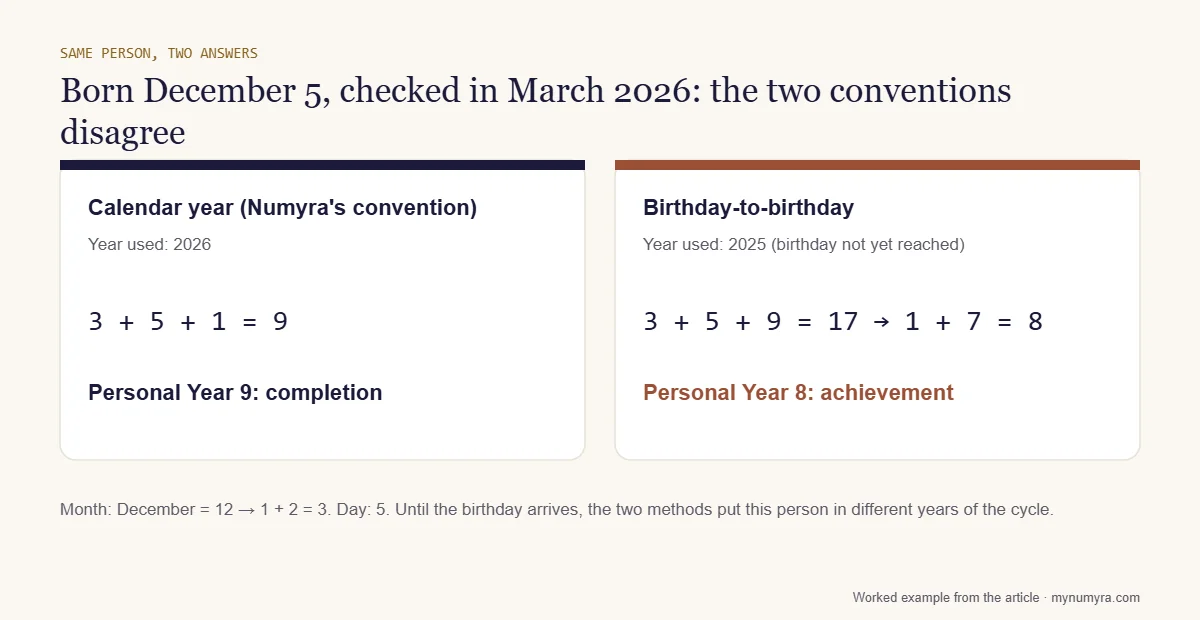
This isn’t just a theoretical disagreement — the two conventions can produce genuinely different numbers for the same person. Take someone born December 5, calculating their Personal Year in March 2026, before their birthday that year:
| Convention | Year used | Result |
|---|---|---|
| Calendar year (Numyra’s convention) | 2026, for everyone, all year | 3 + 5 + 1 = 9 → Personal Year 9 |
| Birthday-to-birthday | 2025 (birthday hasn’t happened yet) | 3 + 5 + 9 = 17 → 1 + 7 = Personal Year 8 |
Same person, same date of calculation, two different Personal Year numbers — 9 (completion) under one convention, 8 (achievement) under the other. This is exactly why naming which convention a source uses isn’t a minor technicality: for roughly the first several months of any given year, before your birthday arrives, the two methods can disagree on what year of your cycle you’re actually in.
The nine-year cycle
| Year | Traditionally read as |
|---|---|
| 1 | New beginnings — the start of the cycle |
| 2 | Patience and partnership — developing what Year 1 started |
| 3 | Expression — sharing what’s been developing |
| 4 | Groundwork — building the structure underneath it |
| 5 | Change — unexpected shifts and new freedom |
| 6 | Responsibility — home, family, and care for others |
| 7 | Reflection — an inward year, thinking rather than launching |
| 8 | Achievement — material and practical progress |
| 9 | Completion — closing the cycle before it restarts at 1 |
The framework traces to the same early-20th-century wave of popular numerology writing behind the site’s other core numbers — Hans Decoz and Matthew Goodwin’s Numerology and the Divine Triangle is one of the more widely cited modern references for the nine-year-cycle framing specifically. See our real history of numerology for how that whole tradition got started.
Frequently asked questions
Does my Personal Year Number ever come out as a master number like 11 or 22?
No — by design, our Personal Year calculator (and most sources) reduce fully to 1 through 9 every time, unlike Life Path, Destiny, Soul Urge and Personality, which keep master numbers unreduced. Conventions genuinely vary by number, and we state ours explicitly on every calculator page.
Which is “correct” — calendar year or birthday-to-birthday?
Neither is more authoritative than the other; both are real, actively-used conventions within numerology. We use calendar year on this site and say so plainly, rather than leaving readers to guess which one a given source is using.
Does my Personal Year change on January 1st or on my birthday?
That depends entirely on which convention a source uses — under the calendar-year convention (what Numyra uses), it changes January 1st for everyone. Under the birthday-to-birthday convention some other sources use, it changes on your personal birthday instead.
How is Personal Year different from my Life Path Number?
Life Path is calculated once from your full birth date and never changes. Personal Year recalculates every year from just your birth month and day plus the current year, moving through the nine-year cycle described above.
What Personal Year am I in for 2026?
Reduce your birth month and birth day to one digit each, add 1 (because 2026 gives 2 + 0 + 2 + 6 = 10 → 1), then reduce the total. Someone born July 14, for example, gets 7 + 5 + 1 = 13 → 4. Our Personal Year calculator does this for any date.
What comes after a Personal Year 9?
The cycle starts again at 1, read as a new beginning. Under the calendar-year convention your number simply goes up by one every January 1, from 1 through 9 and back to 1.