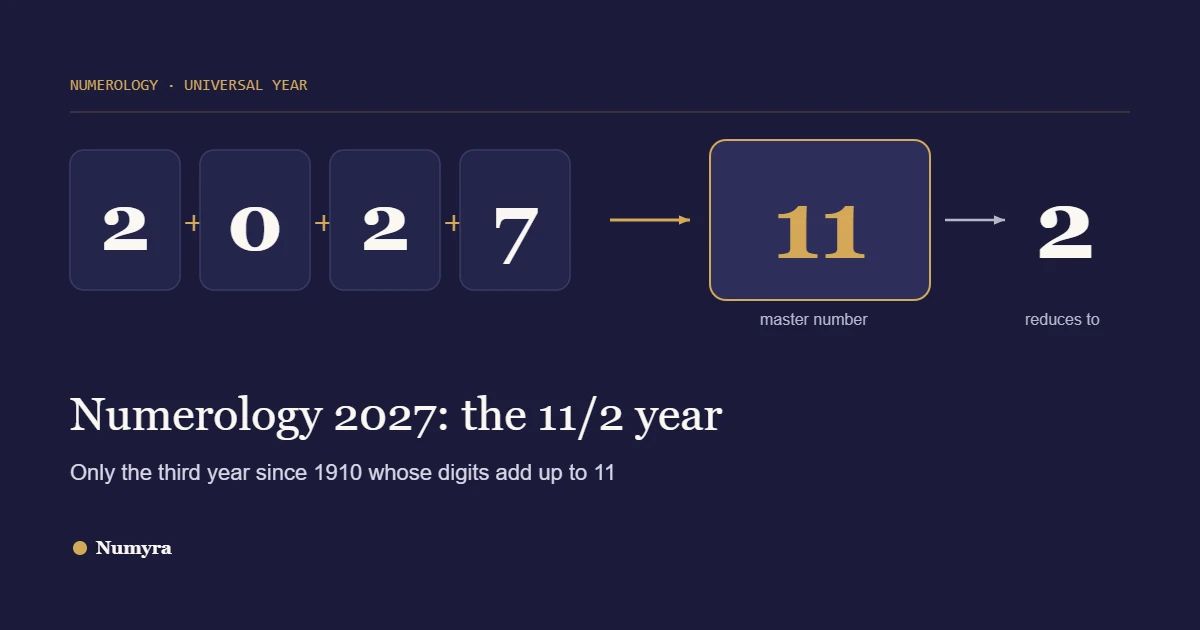
In numerology, 2027 is an 11/2 universal year: its digits add up to the master number 11, which reduces to 2. That much every source agrees on. What most 2027 forecasts skip is how rare an 11 year is, where the idea of a “universal year” comes from, and why two common methods give different numbers for some months of 2027.
Key takeaways
- 2 + 0 + 2 + 7 = 11, and 1 + 1 = 2, so 2027 is written as an 11/2 universal year. Splitting the year as 20 + 27 = 47 → 4 + 7 also reaches 11 before 2.
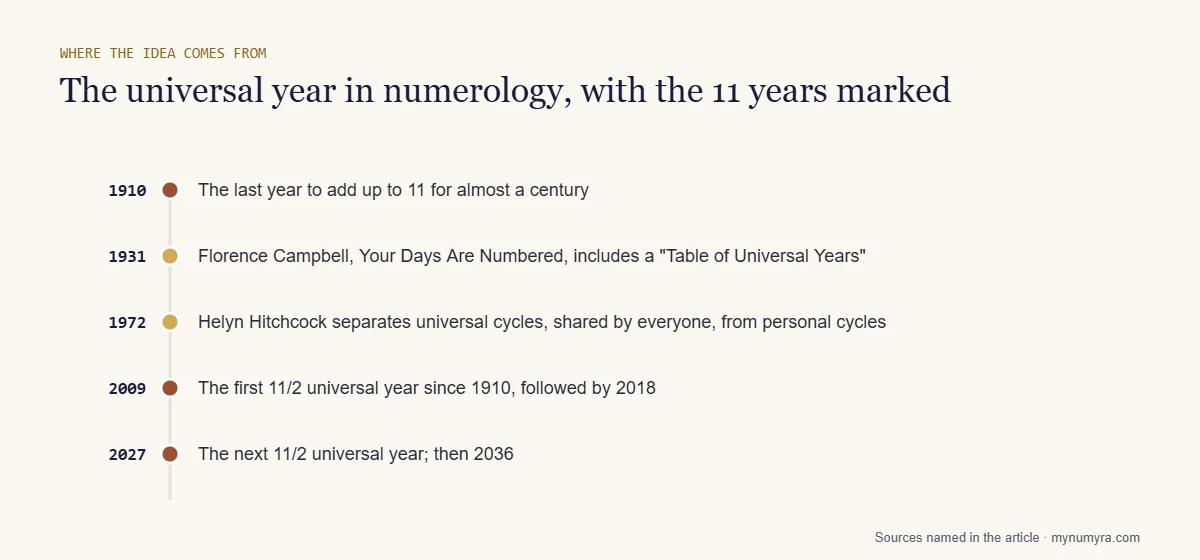
- 11 years are not common. Before 2009, the last year whose digits added up to 11 was 1910. Since then they come every nine years: 2009, 2018, 2027, 2036.
- The universal year goes back at least to Florence Campbell’s 1931 Your Days Are Numbered, which included a table of universal years.
- Everyone’s Personal Year number goes up by one in 2027, because the universal year moves from 1 (2026) to 2.
- Two methods for universal months disagree on September and November 2027: one gives a master 11 in September, the other a master 22 in November.
- This is a cultural tradition presented for reflection, not a prediction or advice of any kind.
In this guide
- What 2027 adds up to
- Is 2027 an 11 year or a 2 year?
- How rare an 11 year is
- Where the “universal year” comes from
- What an 11/2 year is traditionally read as
- From 2026 to 2027: where we are in the cycle
- The 2027 universal months
- Your Personal Year in 2027
- What each Personal Year traditionally means in 2027
- 2027 in the sky
- Is 2027 a good year in numerology?
- Frequently asked questions
What 2027 adds up to
A universal year number is the calendar year reduced the same way numerology reduces any number: add the digits, and keep adding until one digit is left. The same digit-sum method is behind every core number in a chart.
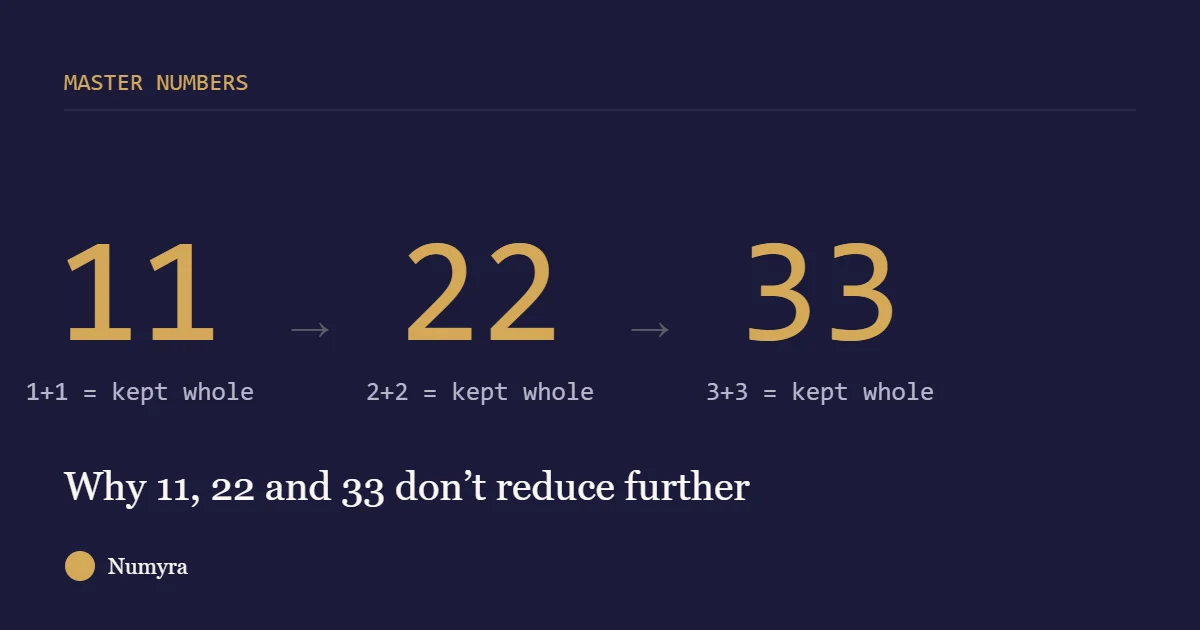
For 2027, the first total is 11. Most modern numerologists stop there and note it, because 11 is one of the three master numbers (11, 22 and 33) that are traditionally not reduced in a person’s core numbers. Reduce it anyway and you get 2. Hence the label 11/2: the master number first, the single digit after the slash.
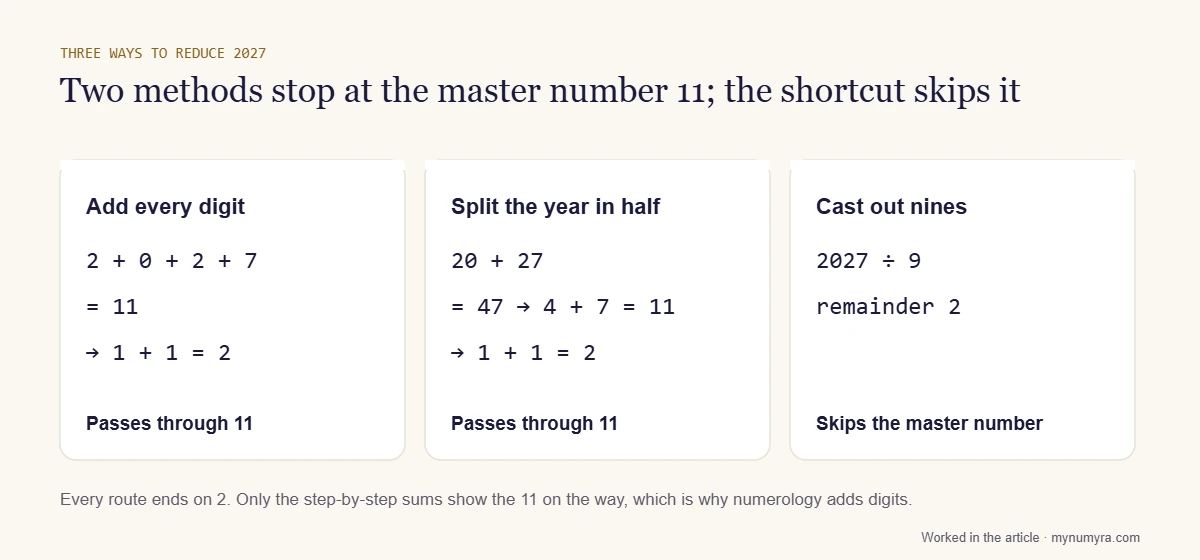
The route does not change the answer this year, which is not true of every year. We checked three common ways of doing the sum:
| Method | Working | Passes through | Final digit |
|---|---|---|---|
| Add every digit | 2 + 0 + 2 + 7 = 11 → 1 + 1 | 11 | 2 |
| Split into two halves | 20 + 27 = 47 → 4 + 7 = 11 → 1 + 1 | 11 | 2 |
| Cast out nines | 2027 ÷ 9 leaves a remainder of 2 | (skips the master number) | 2 |
Casting out nines is a shortcut that always gives the right final digit, but because it jumps straight to the end it can never show a master number. That is why numerology guides add the digits instead: the step on the way is part of the reading.
Is 2027 an 11 year or a 2 year?
Both, depending on who is writing. We read the 2027 pages that rank on Google, and the arithmetic never differs; only the label does. Some call 2027 a “Universal Year 2” and mention the 11 in passing. Others lead with “Master Number 11” and say some numerologists reduce it further. Many now write “11/2”, which is the clearest option because it records both numbers.
The choice matters for how the year is read. A plain 2 is about cooperation and patience. An 11 adds the master number’s associations with intuition, inspiration and nervous tension. An 11/2 reading keeps both and treats the 11 as a heightened version of the 2. This site uses the 11/2 label for universal years, the same way our Life Path calculator keeps master numbers in core numbers. For Personal Years, covered below, we reduce all the way to a single digit, and we say so.
How rare an 11 year is
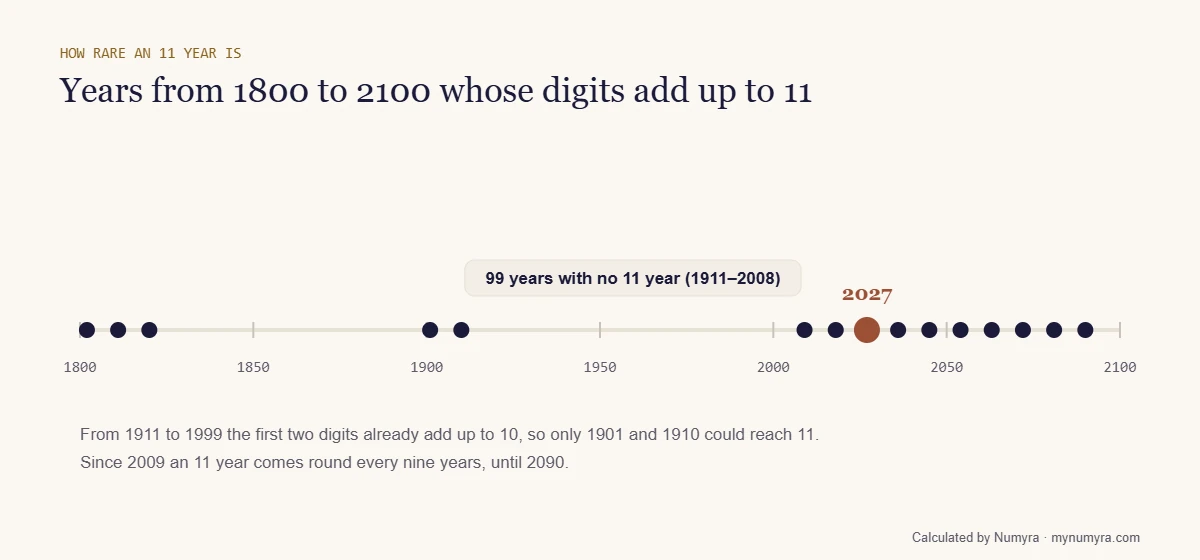
Pages about 2027 tend to present an 11 year as routine. It isn’t, and it is easy to check. We listed every year from 1800 to 2100 whose digits add up to exactly 11:
| Century | Years whose digits add up to 11 |
|---|---|
| 1800s | 1802, 1811, 1820 |
| 1900s | 1901, 1910 (then none for 99 years) |
| 2000s | 2009, 2018, 2027, 2036, 2045, 2054, 2063, 2072, 2081, 2090 |
The reason is simple arithmetic. Any year from 1911 to 1999 starts with 1 + 9 = 10, so its other two digits would have to add up to 1. Only 1901 and 1910 manage that. Every “2 year” between 1919 and 1991 got to 2 by way of 20 instead: 1919, 1928, 1937 and so on, down to 1991. The year 2000 was a plain 2. So the 11/2 year is, in practice, a 21st-century pattern: 2027 is only the third since 1910. The early books on universal years, from 1931 and 1972, were both written decades after the last 11 year, 1910.
Where the “universal year” comes from
None of the 2027 forecasts we checked names a source for the idea that a calendar year has its own number. The earliest one we could verify is Florence Campbell’s Your Days Are Numbered: A Manual of Numerology for Everybody, first published in 1931. It already included a “Table of Universal Years” and used the same method numerologists use today:
“To find the vibration for any year, we use the same process as we did for 1931, adding the single numbers together and reducing to a final digit.”
— Florence Campbell, Your Days Are Numbered, p. 80 (1931; quoted from the 1974 printing)
The sentence continues with an exception that the available preview cuts off, so we do not quote it or guess what it says. Forty years later, Helyn Hitchcock’s Helping Yourself with Numerology (1972), the same book that gave us the earliest verified list of karmic debt numbers, drew the distinction that still shapes every yearly forecast:
“Universal year cycles belong to everyone alike, while personal cycles apply to you as an individual.”
— Helyn Hitchcock, Helping Yourself with Numerology (Parker Publishing, 1972)
Hitchcock also set out the method for universal months, adding the number of the calendar month to the number of the universal year, which we use for the 2027 table below. The idea did not come from ancient tradition; like most of modern numerology, it grew out of early 20th-century American writing. For the longer story, see what numerology is and where it came from.
What an 11/2 year is traditionally read as
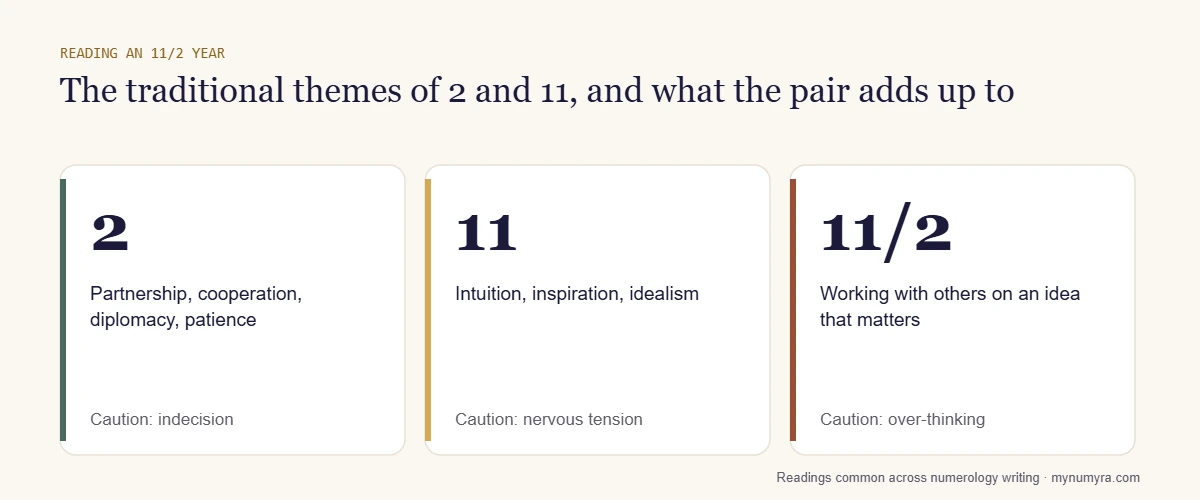
A universal year is meant to describe the general “climate” everyone shares, not events. The readings below are the ones that recur across numerology writing, including the 2027 pages we reviewed. They describe themes, not predictions.
| Number | Traditional themes | The usual caution |
|---|---|---|
| 2 | Partnership, cooperation, diplomacy, patience, listening | Indecision; waiting too long for others |
| 11 | Intuition, inspiration, idealism, a spiritual or creative charge | Nervous tension; ideals running ahead of practice |
| 11/2 together | Working with others on an idea that matters; slower, relationship-led progress | Sensitivity and over-thinking |
In practice, writers describe an 11/2 year as one for building on what was started the year before, with other people rather than alone. That is also why relationships and commitments come up so often in 2027 forecasts: the 2 is the number of the pair. People who see repeating 11s or 2s, such as 1111 or 222, often connect them to a year like this, but the tradition treats those as separate readings.
From 2026 to 2027: where we are in the cycle
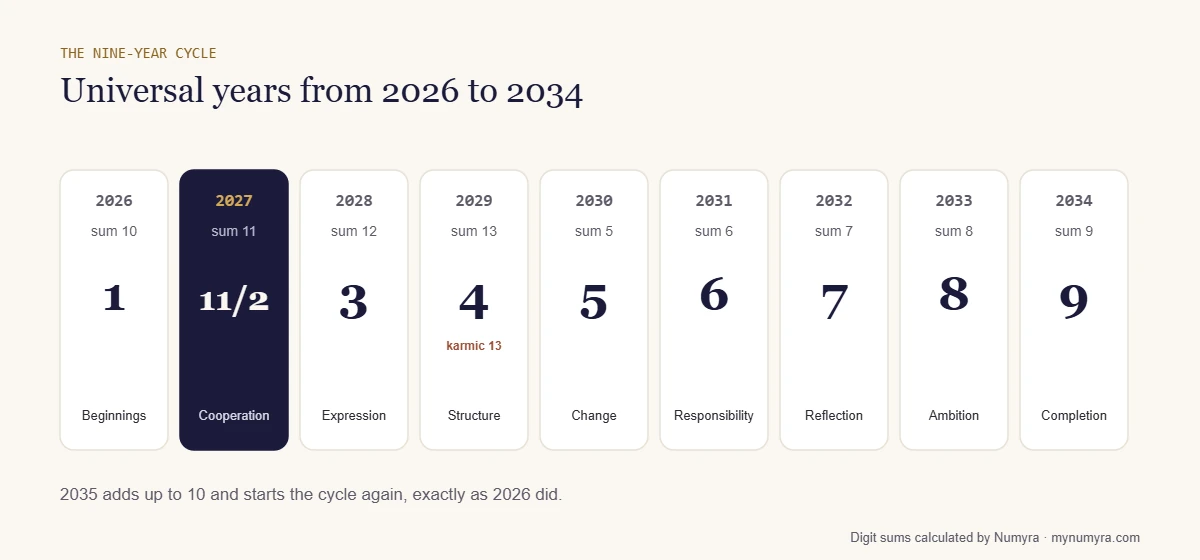
Universal years run in a nine-year cycle, the same structure as Personal Year numbers. 2026 added up to 10 and reduced to 1, the traditional year of beginnings. 2027 is the second step:
| Year | Digit sum | Universal year | Traditional theme |
|---|---|---|---|
| 2026 | 10 | 1 | Beginnings, initiative |
| 2027 | 11 | 11/2 | Cooperation, intuition, patience |
| 2028 | 12 | 3 | Expression, creativity |
| 2029 | 13 | 4 | Structure, hard work |
| 2030 | 5 | 5 | Change, freedom |
| 2031 | 6 | 6 | Home, responsibility |
| 2032 | 7 | 7 | Reflection, study |
| 2033 | 8 | 8 | Ambition, material results |
| 2034 | 9 | 9 | Completion, letting go |
Notice 2029: its digits add up to 13, one of the four karmic debt numbers, so some writers will call it a 13/4 year. The cycle then restarts in 2035, which adds up to 10, exactly as 2026 did.
The 2027 universal months
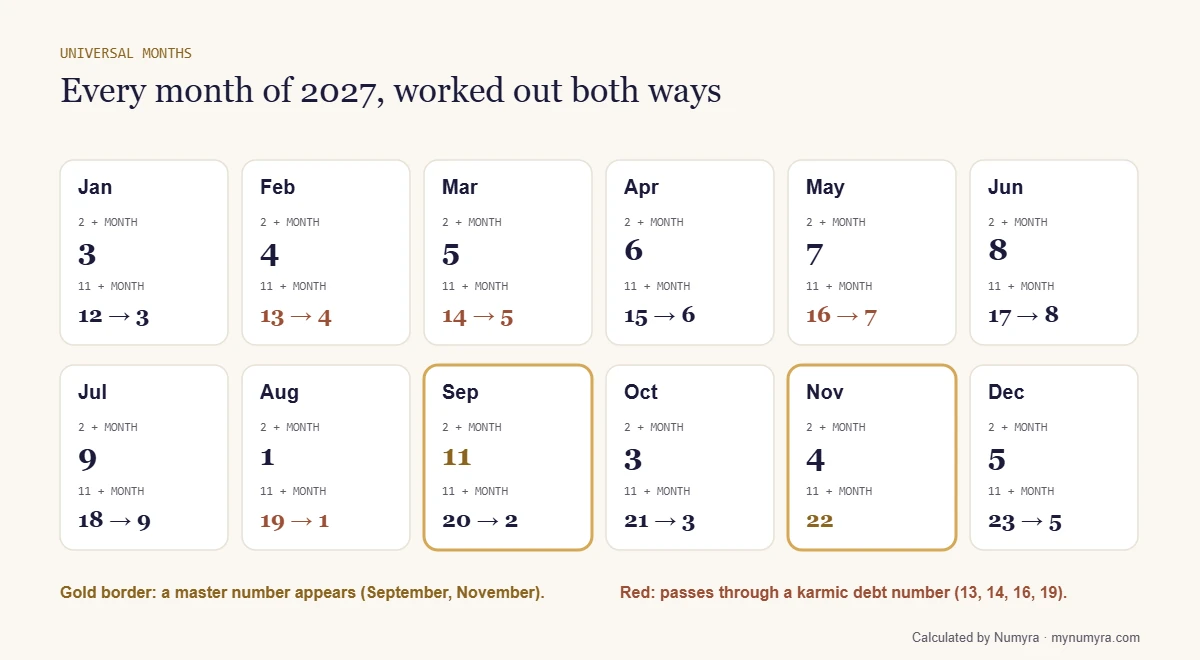
A universal month is the universal year plus the calendar month. The catch is which version of the year you add. Add the reduced year, 2, and only September produces a master number (2 + 9 = 11). Add the unreduced 11 and September becomes an ordinary 2, while November becomes 11 + 11 = 22, a master number of its own. Both methods are in use, so here is the whole year both ways:
| Month | Year 2 + month | Year 11 + month | Note |
|---|---|---|---|
| January | 3 | 12 → 3 | |
| February | 4 | 13 → 4 | 13 is a karmic debt number |
| March | 5 | 14 → 5 | 14 is a karmic debt number |
| April | 6 | 15 → 6 | |
| May | 7 | 16 → 7 | 16 is a karmic debt number |
| June | 8 | 17 → 8 | |
| July | 9 | 18 → 9 | |
| August | 10 → 1 | 19 → 1 | 19 is a karmic debt number |
| September | 11 | 20 → 2 | Master 11 in the first method only |
| October | 3 | 21 → 3 | |
| November | 4 | 22 | Master 22 in the second method only |
| December | 5 | 23 → 5 |
Apart from those two months, the single digits agree. The second method also passes through all four karmic debt numbers (13, 14, 16 and 19) in February, March, May and August, which is why some forecasts flag those months and others do not. One date stands out under the “keep every master number” approach: November 11, 2027, where month, day and year are all 11 and add up to 33, the third master number. Add every digit at once and the same date gives 1 + 1 + 1 + 1 + 2 + 0 + 2 + 7 = 15 → 6, which is also where 33 reduces.
Your Personal Year in 2027
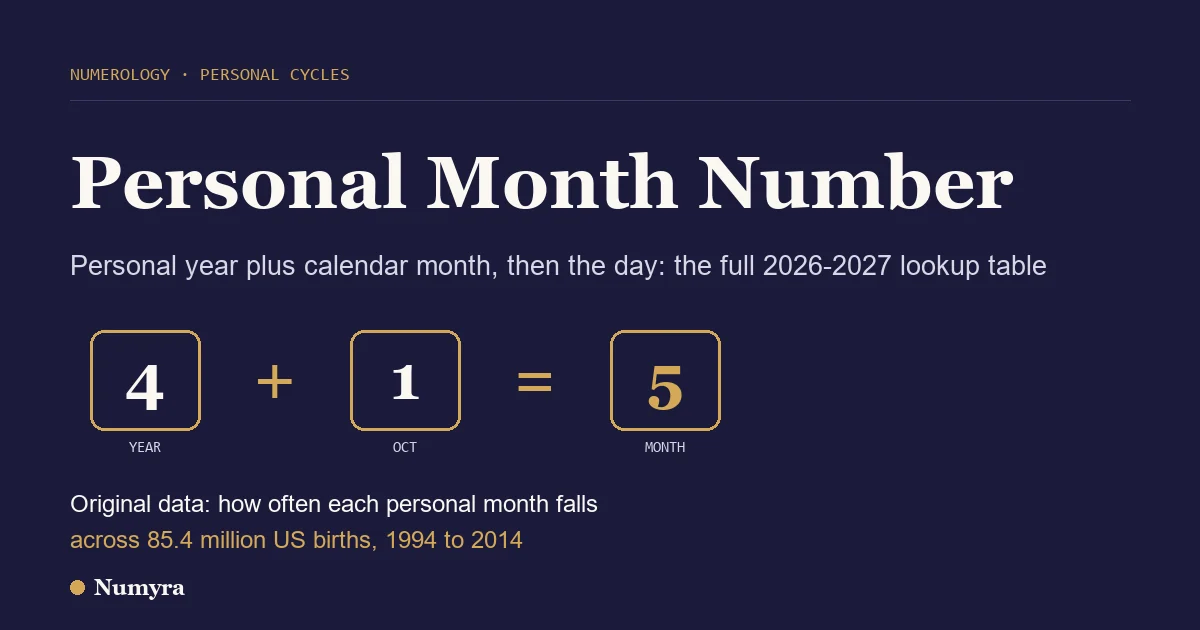
The universal year is shared. Your Personal Year is the individual version (and each personal year has a monthly cycle of its own: see personal month numbers): your birth month, plus your birth day, plus the year in question, each reduced and then added together. Our Personal Year calculator does it for you and shows every step.
For 2027 there is a shortcut. Reduce your birth month and day as usual, add them, and reduce again; then add 2 for the year:
| Birth month + birth day reduces to | 1 | 2 | 3 | 4 | 5 | 6 | 7 | 8 | 9 |
|---|---|---|---|---|---|---|---|---|---|
| Personal Year in 2027 | 3 | 4 | 5 | 6 | 7 | 8 | 9 | 1 | 2 |
Worked example: born June 22. June is 6, and 22 reduces to 2 + 2 = 4, so 6 + 4 = 10 → 1. Add 2 for 2027 and the Personal Year is 3. In 2026, the same person was in a Personal Year 2: every Personal Year goes up by exactly one from 2026 to 2027, and a 9 goes back to 1.
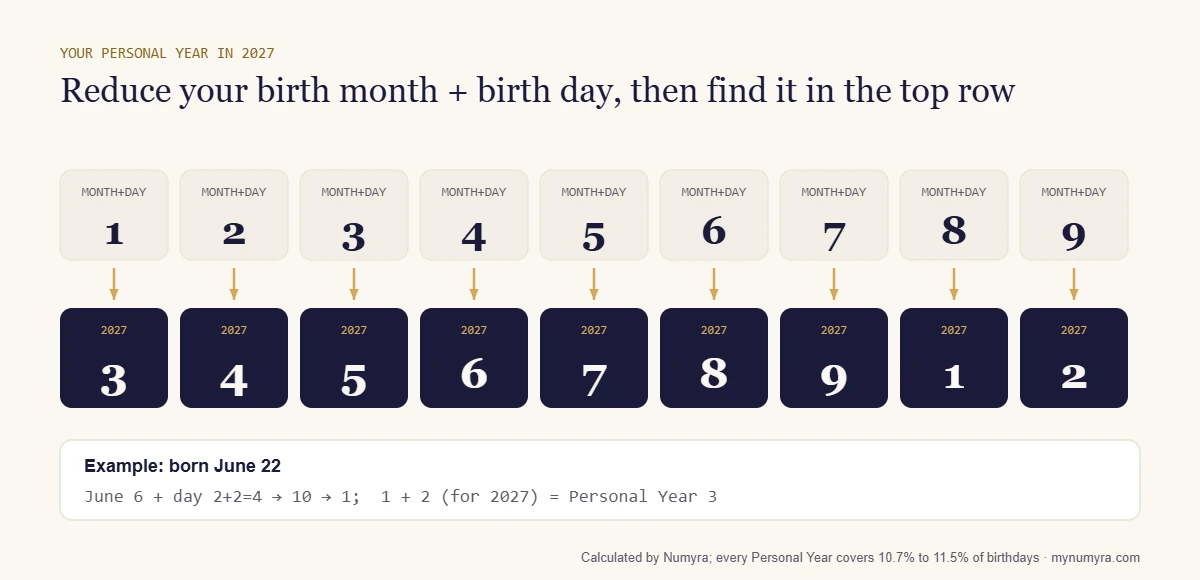
The nine possible Personal Years are spread almost evenly across birthdays. Counting all 366 possible birthdays, each one covers between 10.7% and 11.5% of them, so no Personal Year is “rare” in 2027. Like most sources, this site reduces Personal Years fully to 1 through 9, without keeping master numbers. Our Personal Year guide explains that convention and also the dispute over whether the year starts on January 1 or on your birthday, which decides when your 2027 number begins.
What each Personal Year traditionally means in 2027
Numerologists read a Personal Year against the universal year around it: your own theme is the foreground, the shared 11/2 tone of cooperation, patience and intuition is the background. The table pairs the two, using the traditional meanings from our guide to the nine-year cycle. The last column is real data: the share of people born in the United States from 1994 to 2014 who are in each Personal Year in 2027, counting every birthday by its number of births.
| Your 2027 Personal Year | Traditionally read as | In an 11/2 universal year | Share of people |
|---|---|---|---|
| Personal Year 1 | New beginnings, the start of a new nine-year cycle | Start something new, but with a partner or a team rather than alone: the shared year favors cooperation over solo launches. | 10.7% |
| Personal Year 2 | Patience and partnership | Your personal year matches the universal one, so the 2 themes of patience, diplomacy and close relationships are read as doubled. | 10.9% |
| Personal Year 3 | Expression: sharing what has been developing | Self-expression in a year that rewards tact: collaborations, joint creative projects and communication that brings people together. | 10.6% |
| Personal Year 4 | Groundwork: building the structure underneath | Steady building alongside others: shared plans, contracts and long-term arrangements rather than going it alone. | 11.1% |
| Personal Year 5 | Change, unexpected shifts and new freedom | Change in a year whose shared tone is gentle: traditionally, change that is negotiated rather than forced. | 11.5% |
| Personal Year 6 | Responsibility: home, family and care for others | Home and family in a relationship year: read as one of the most harmonious combinations in 2027. | 11.3% |
| Personal Year 7 | Reflection: an inward year | The inward 7 meets the intuitive master number 11: traditionally a year for study, insight and quiet decisions. | 11.5% |
| Personal Year 8 | Achievement: material and practical progress | Progress that comes through alliances and diplomacy rather than force, in the tradition’s reading of 8 inside a 2 year. | 11.0% |
| Personal Year 9 | Completion, closing the cycle before it restarts | Finishing and letting go, ideally on good terms: closing chapters with people rather than walking away from them. | 11.2% |
Two things stand out. Personal Year 2 is the only one that matches the universal year exactly, so by the tradition’s own logic its themes of partnership and patience are doubled in 2027. And no Personal Year is rare: the most common, 7, covers 11.5% of people and the least common, 3, covers 10.6%, a gap that comes only from the uneven spread of birthdays through the calendar. These are traditional readings for reflection, not forecasts.
2027 in the sky
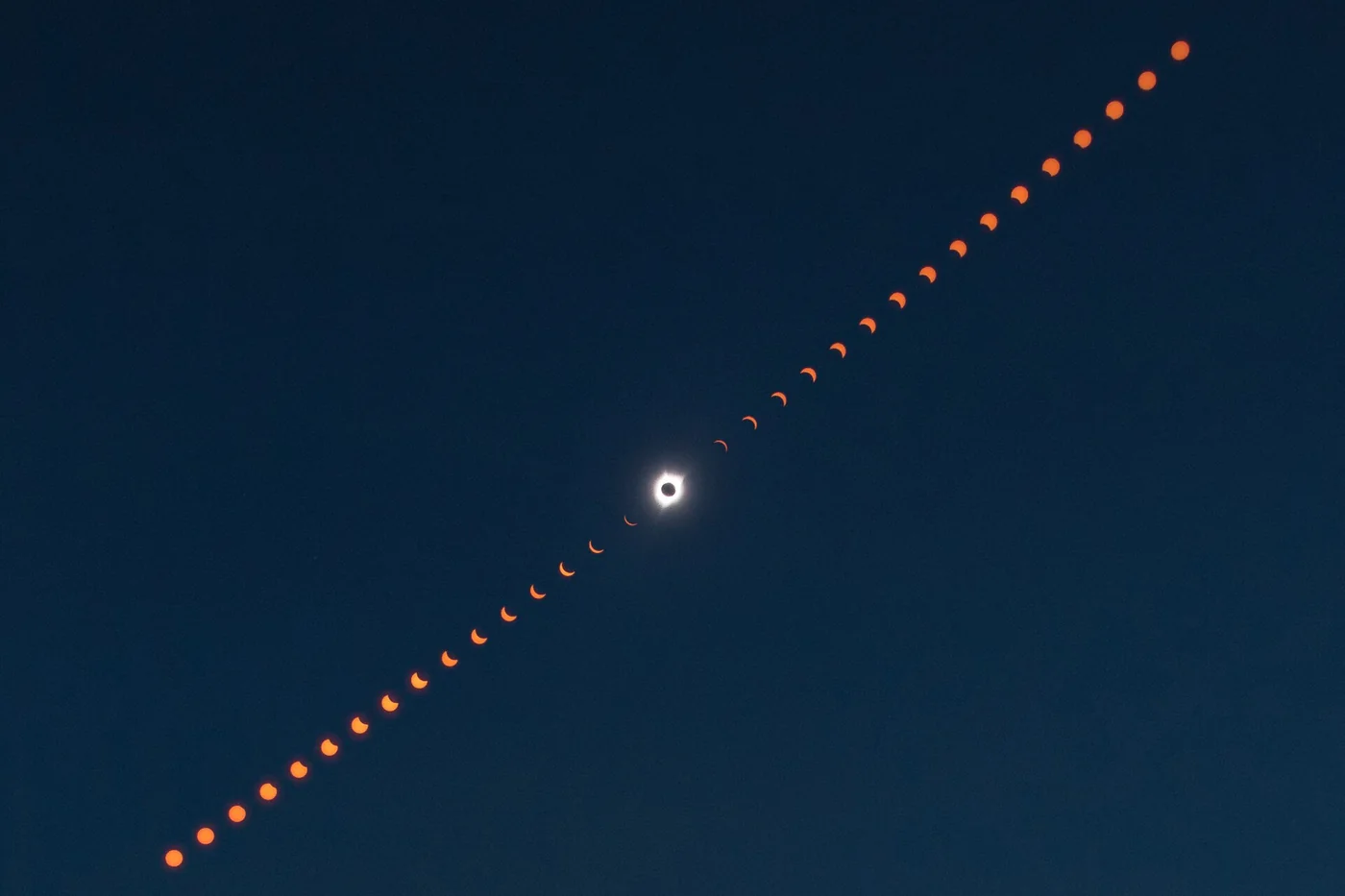
Readers searching for 2027 often want to know what is actually scheduled to happen. Numerology does not predict events, but the sky does have a fixed calendar, and 2027 includes one of the longest total solar eclipses of the century. According to NASA’s eclipse tables:
| Date (UT) | Eclipse | Where it can be seen |
|---|---|---|
| February 6, 2027 | Annular solar eclipse | Annular path across Chile, Argentina and the Atlantic; partial in South America, Antarctica and parts of Africa |
| February 20, 2027 | Penumbral lunar eclipse | Americas, Europe, Africa, Asia |
| July 18, 2027 | Penumbral lunar eclipse | East Africa, Asia, Australia, Pacific |
| August 2, 2027 | Total solar eclipse, up to 6 min 23 s of totality | Total in Morocco, Spain, Algeria, Libya, Egypt, Saudi Arabia, Yemen and Somalia |
| August 17, 2027 | Penumbral lunar eclipse | Pacific, Americas |
Astrologers read eclipses through the signs and houses they fall in, which you can find for your own chart with our Birth Chart calculator. Our guide to the 2027 eclipses gives every degree, the totality length in eight cities and the house for each rising sign. As a plain number, 2027 also has one mathematical oddity: it is a prime number, and so is 2029, which makes them a pair of twin primes.
Is 2027 a good year in numerology?
Numerology has no “good” or “bad” years. Each number in the cycle is read as suited to some things and not others. By that reading, an 11/2 year favors cooperation, patience and following through on what began in 2026, and it is a poor fit for going it alone or forcing quick results. Whether it is a good year for you is better answered by your own Personal Year than by the universal one, since the tradition ties the personal number to you as an individual and the universal one to everyone at once.
It is also worth keeping the scale in mind. A universal year number is the same for all eight billion people on Earth. If a reading of it makes you anxious rather than reflective, that is a good reason to hold it lightly. Nothing here is financial, medical, legal or psychological advice.
Frequently asked questions
Is 2027 a lucky year in numerology?
Numerology doesn’t rank years as lucky or unlucky. 2027 is an 11/2 universal year, traditionally read as favoring cooperation, patience and intuition over bold solo moves, so the tradition calls it a good year for partnerships and a slower one for going it alone. Your own Personal Year matters more than the shared number.
Which Personal Year is best in 2027?
None is officially “best.” By the tradition’s own logic, Personal Year 2 is the most in tune with 2027, because it matches the 2 universal year and doubles its themes of partnership and patience. About 11% of people are in each Personal Year, so whichever one you are in, roughly one person in nine shares it.
What is the numerology number for 2027?
2027 is an 11/2 universal year. Its digits add up to 2 + 0 + 2 + 7 = 11, a master number, which reduces to 1 + 1 = 2. Splitting the year as 20 + 27 = 47 → 11 gives the same result.
Is 2027 a master number year?
Yes, if you keep master numbers, which most modern numerologists do for universal years. Years that add up to 11 are uncommon: before 2009 the last one was 1910. After 2027 the next is 2036.
What were the last 11/2 universal years?
2018 and 2009. Before that, 1910 and 1901. The “2 years” in between, such as 1955 or 1991, reached 2 by way of 20, not 11, and 2000 was a plain 2.
What is my Personal Year in 2027?
Reduce your birth month and day to one digit, then add 2 and reduce again. For example, born June 22: 6 + 4 = 10 → 1, then 1 + 2 = 3, a Personal Year 3. Our Personal Year calculator shows every step.
How is 2027 different from 2026 in numerology?
2026 was a universal 1 year (2 + 0 + 2 + 6 = 10 → 1), traditionally read as a year of beginnings. 2027 is the 11/2 that follows, read as a year for cooperation and patience. Everyone’s Personal Year also goes up by one.
Which months of 2027 are master number months?
It depends on the method. Adding the reduced year (2) to the month gives a master 11 in September. Adding the unreduced 11 gives a master 22 in November instead. Every other month comes out the same both ways.
What’s special about the number 2027?
Numerologically, it adds up to the master number 11. Mathematically, it is a prime number, and with 2029 it forms a pair of twin primes. In the sky, it has a total solar eclipse on August 2 with up to 6 minutes 23 seconds of totality, according to NASA.
Who invented universal years in numerology?
No single inventor is documented. The earliest source we could verify is Florence Campbell’s 1931 book Your Days Are Numbered, which included a table of universal years. Helyn Hitchcock’s 1972 book set out the difference between universal and personal cycles.
Sources
- Campbell, Florence. Your Days Are Numbered: A Manual of Numerology for Everybody. Ferndale, PA: Gateway, 1931. Quoted from the 1974 printing, p. 80, via Google Books snippet view.
- Hitchcock, Helyn. Helping Yourself with Numerology. West Nyack, NY: Parker Publishing, 1972. Internet Archive. Source of the quote above and the universal-month method.
- Espenak, Fred. “Solar Eclipses: 2021 to 2030.” NASA Eclipse Web Site. Dates, types, durations and paths of the 2027 solar eclipses.
- Espenak, Fred. “Lunar Eclipses: 2021 to 2030.” NASA Eclipse Web Site. Dates and visibility of the 2027 lunar eclipses.
- Numyra Methodology Desk. Year digit sums for 1800 to 2100, the universal-month table, the Personal Year spread across all 366 birthdays and the prime check were calculated by us.