Venus Sign Calculator
Your Venus sign is the sign Venus was in on your birth date. Enter the date to get it, with the degree, whether Venus was retrograde and, on the few days a year Venus changes sign, both possible signs and the exact time of the change in US Eastern and Pacific time.
Your Venus sign
Key takeaways
- A birth date alone gives one Venus sign on all but about 4% of dates: 3.9% of the 85.4 million US births from 1994 to 2014 fell on a day Venus changed sign. On those days the calculator shows both signs and the exact time of the change, and asks for your birth time.
- Venus is never more than about 47° from the Sun (the widest gap we measured from 1900 to 2100 was 47.26°), so your Venus sign is your Sun sign or up to two signs either side. 7.1% of US births had Venus retrograde, and Gemini was the most common Venus sign at 10.8%.
- Checked against the Swiss Ephemeris on 20,000 random moments from 1900 to 2100: the sign matched 99.98% of the time, the median error was 0.52 arcminute and the largest 1.82. All 5 disagreements were flagged as close calls.
- Nothing here is medical, financial, legal, relationship, or psychological advice. This is a cultural tradition, presented for entertainment and reflection.
For entertainment and self-reflection. Numerology is a cultural tradition, not a science, and nothing here is medical, financial, legal, or psychological advice.
What your Venus result shows
Enter a birth date and the calculator returns the sign and degree of Venus, whether Venus was retrograde, the sign it was in a week before and a week after your birth date, the dates it entered and will leave your sign, and how far it was from the Sun along with the Sun’s sign. It also shows how common your Venus sign is among US births, and links to what the placement is traditionally said to mean, in our Venus sign guide. This page is the tool; the guide holds the interpretation.
Venus never strays far from the Sun. Across every day from 1900 to 2100 the widest gap was 47.26°, a little more than one and a half signs, so only the Sun’s sign and the two signs either side are possible. The result tells you which side of the Sun Venus was on (east, the evening sky, or west, the morning sky). For the odds of each of the five signs for your Sun sign, see the guide’s table.
Venus also turns retrograde, appearing to move backward against the stars, about every 19 months according to NASA’s synodic period of 583.92 days. The calculator labels your birth moment retrograde or direct. Our Venus retrograde guide covers the dates and what astrologers read into them.
When you need a birth time, and when you do not
Venus changes sign about 12 or 13 times a year, so on almost every date it sits in one sign from midnight to midnight and your birth time does not matter. Of the 85.4 million US births from 1994 to 2014, 3.9% (about 1 in 26) fell on a date when Venus changed sign somewhere between midnight Eastern and midnight Pacific. Those are the only people for whom the birth time decides the answer.
If your date is one of them and you leave the time empty, the calculator shows both signs, the moment of the change, and who gets which: born before the change, the earlier sign; after it, the later one. Times are shown in US Eastern and Pacific time with daylight saving applied for that date, and in Universal Time. Choose a birth city and it uses that city’s own calendar day instead of the US-wide one, which matters for births outside North America.
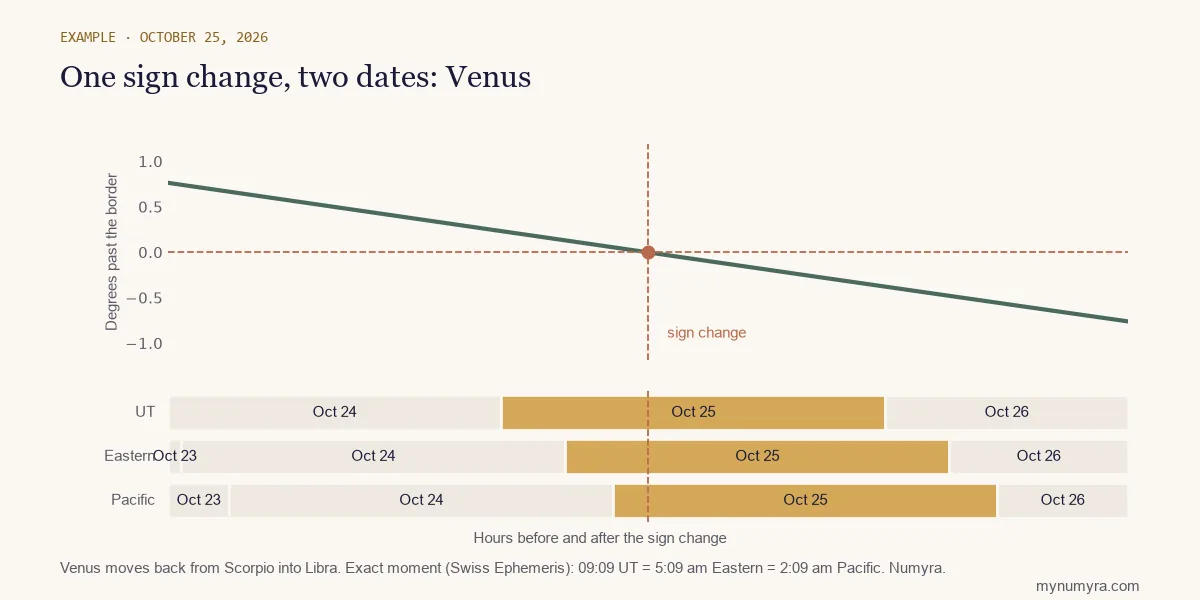
For that same date the calculator shows 4:50 a.m. Eastern, 19 minutes earlier than the Swiss Ephemeris. A retrograde crossing is the hard case: Venus moves more slowly near a turn, so a small position error becomes a larger time error. The accuracy section gives the full distribution, and the calculator marks any birth moment close enough to a sign border that this could matter.
Which Venus sign is most common among US births?
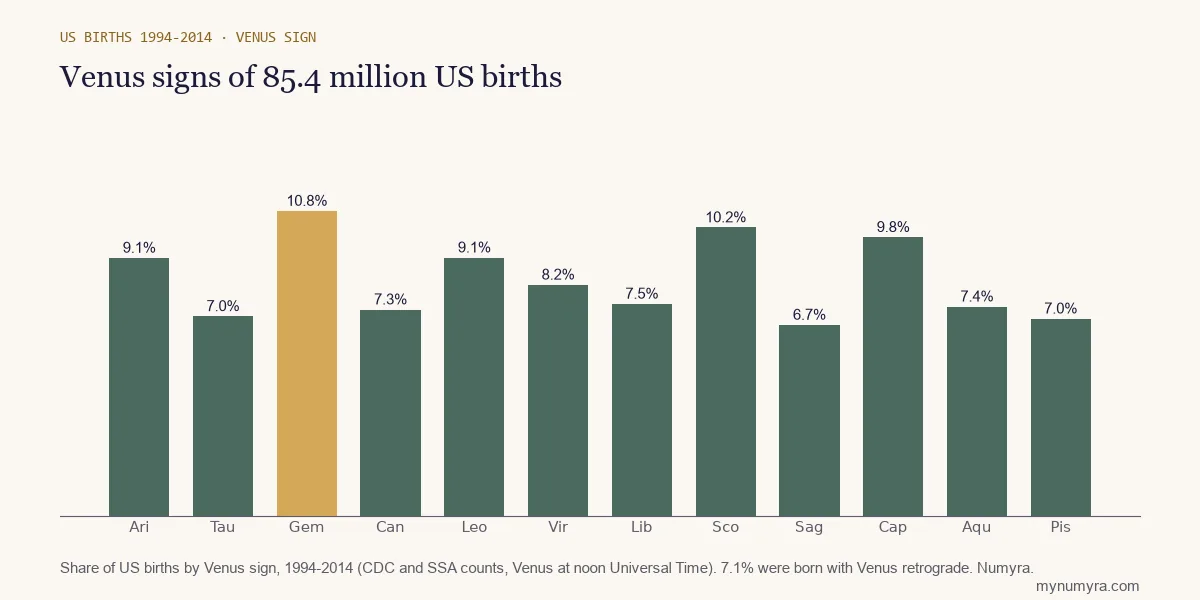
We placed Venus for every birth date of the 85.4 million babies born in the United States from 1994 to 2014, using CDC and Social Security birth counts. Gemini (10.8%) and Scorpio (10.2%) were the most common Venus signs and Sagittarius (6.7%) the least. 7.1% of those births, about 1 in 14, had Venus retrograde.
| Venus sign | Share of US births | Births (millions) |
|---|---|---|
| Aries | 9.1% | 7.77 |
| Taurus | 7.0% | 6.01 |
| Gemini | 10.8% | 9.18 |
| Cancer | 7.3% | 6.21 |
| Leo | 9.1% | 7.78 |
| Virgo | 8.2% | 6.96 |
| Libra | 7.5% | 6.39 |
| Scorpio | 10.2% | 8.69 |
| Sagittarius | 6.7% | 5.75 |
| Capricorn | 9.8% | 8.39 |
| Aquarius | 7.4% | 6.30 |
| Pisces | 7.0% | 5.94 |
| Venus retrograde at birth | 7.1% |
Treat the ranking as a description of those 21 birth years, not a rule. Venus repeats its pattern every eight years, so a stretch of twenty-one years only roughly samples it and a different generation would rank the signs differently. The guide’s odds by Sun sign count days over 100 years instead of births.
How this calculator works, and how accurate it is
Position comes from Paul Schlyter’s published method, the same engine as our stellium calculator and the other astrology calculators on this site. It needs no ephemeris files, so it runs in your browser in milliseconds and nothing you type leaves your device. The price is precision: the method is good to a few arcminutes, not arcseconds, which is why this page publishes its measured error instead of claiming exactness. All three calculators use the tropical zodiac, the Western standard; Vedic (sidereal) astrology uses a zodiac shifted by roughly 24 degrees, so a Vedic sign differs from the one here for most birth dates.
To test it, we ran the shipped code against the Swiss Ephemeris (Moshier mode) three ways: on 20,000 random moments between 1900 and 2100, on every one of the 2,548 times Venus changed sign in those 201 years, and on 4,000 random birth dates with and without a city.
| Check | Result |
|---|---|
| Random birth moments tested | 20,000, 1900 to 2100 |
| Sign matched the Swiss Ephemeris | 99.98% (5 differed, all flagged as close calls) |
| Position error: median, 95th, 99th percentile | 0.52′, 1.04′, 1.20′ (arcminutes) |
| Largest position error | 1.82′ |
| Retrograde or direct label matched | 100.00% (0 differed) |
| Sign changes compared, 1900 to 2100 | 2,548 |
| Time of a sign change: median, 95th percentile | 12 minutes, 22 minutes |
| Largest time difference | 86 minutes |
| Birth date only: change day found correctly | 99.95% of 4,000 random dates and cities (2 differed, all flagged as close calls) |
| Birth moments flagged as close calls | 0.73% of random moments |
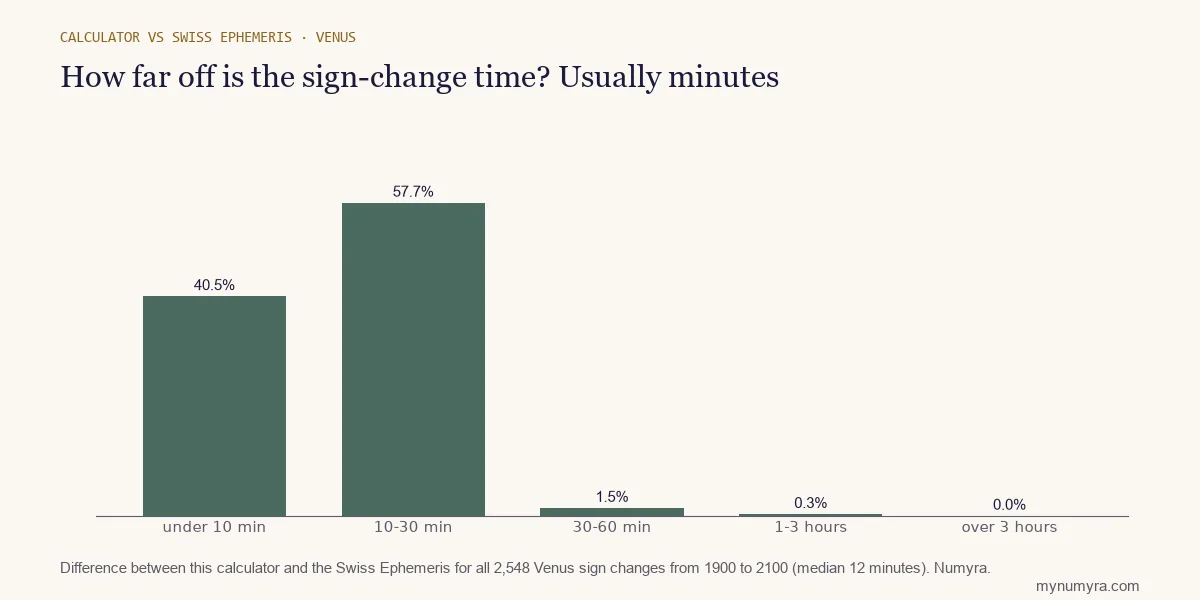
Near a sign border a few arcminutes of error can change the answer, so the calculator flags any birth moment within 0.1° (6 arcminutes) of a border, and any date on which Venus came that close at the start or end of the day, as a close call, and shows the neighboring sign. In the test 0.73% of random moments were flagged, and all 5 signs that disagreed with the Swiss Ephemeris were among them. It does the same when Venus is almost stationary and the retrograde label could differ between programs. Nothing is calculated before 1900 or after 2100.
Frequently asked questions
What is my Venus sign?
It is the sign Venus was in on your birth date. Enter the date above and the calculator shows the sign and degree, whether Venus was retrograde, and, if Venus changed sign that day, both signs with the exact time of the change. What each sign means is covered in our Venus sign guide.
Do I need my birth time to find my Venus sign?
Usually not. Venus changes sign about 12 or 13 times a year, and only 3.9% of US births from 1994 to 2014 fell on such a day. If yours did, the calculator shows both signs and the exact time of the change in Eastern and Pacific time, and you add your birth time and city to settle it.
Can my Venus sign be different from my Sun sign?
Yes, and it usually is. Venus is never more than about 47 degrees from the Sun, so your Venus sign is your Sun sign or up to two signs either side of it. It can never be the opposite sign.
How do I know if Venus was retrograde when I was born?
The calculator reports it for your birth moment. Venus turns retrograde about every 19 months, and 7.1% of US births from 1994 to 2014 had it retrograde. On the rare day Venus changes direction the label depends on your birth time.
Which Venus sign is the most common?
Among US births from 1994 to 2014 it was Gemini at 10.8%, then Scorpio at 10.2%, while Sagittarius was the least common at 6.7%. Because Venus repeats its pattern every eight years, other generations can rank differently.
Why does another website show a different Venus sign for my birthday?
The usual causes are a birth date on a change day where one site assumes Universal Time and the other your local time, a wrong birth time or time zone, or a sidereal (Vedic) zodiac, which shifts every sign by roughly 24 degrees. This calculator uses the tropical zodiac and your own city’s calendar day.
How accurate is this Venus sign calculator?
Against the Swiss Ephemeris on 20,000 random moments from 1900 to 2100 the sign matched 99.98% of the time. The median position error was 0.52 arcminute and the largest 1.82. Sign-change times have a median difference of 12 minutes, and the calculator flags birth moments close enough to a border for that to matter.
Is my birth information stored or sent anywhere?
No. The calculation runs in your browser, and your birth details are not sent to our servers, stored, or placed in cookies. The text you can copy contains only your sign and this page’s address, never your birth date.
Sources
- Schlyter, Paul. How to Compute Planetary Positions. The position method used by this calculator.
- Astrodienst. Swiss Ephemeris. Reference used to test the calculator and to place Venus for every US birth date from 1994 to 2014.
- FiveThirtyEight. US births data, 1994–2014, compiled from the CDC National Center for Health Statistics and the Social Security Administration.
- NASA Space Science Data Coordinated Archive. Venus Fact Sheet. Synodic period 583.92 days.
- Numyra. Venus sign guide. The meaning of each Venus sign and the odds of each sign for every Sun sign.
- Numyra Methodology Desk. Astrology calculation standard.