Stellium Calculator
Enter your birth date, time and place to see where all ten planets were and whether three or more of them share a sign. A stellium is more common than most guides suggest: about six people in ten have one.
Key takeaways
- A stellium is three or more of the ten traditional bodies (the Sun, Moon and Mercury to Pluto) in one zodiac sign; some astrologers ask for four.
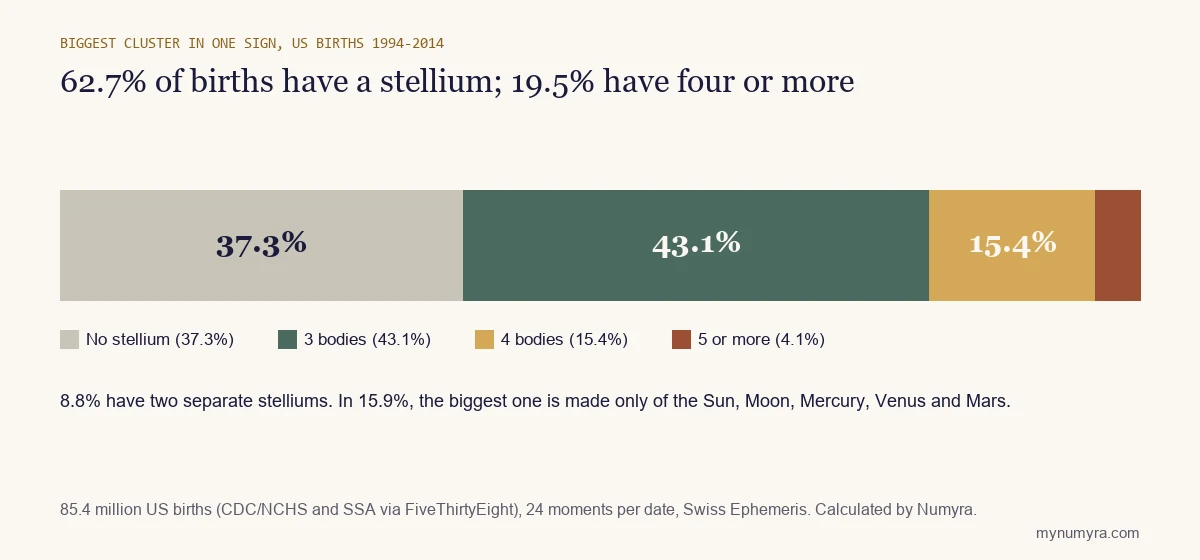
- Using the Swiss Ephemeris for 85.4 million US births from 1994 to 2014, 62.7% had a stellium and 19.5% had four or more bodies in one sign.
- Your birth date is enough for most stelliums; the Moon and the house need a birth time, and the calculator tells you when the result depends on it.
- Nothing here is medical, financial, legal, or psychological advice — this is a cultural tradition, presented for entertainment and reflection.
Your stellium check
For entertainment and self-reflection. Numerology is a cultural tradition, not a science, and nothing here is medical, financial, legal, or psychological advice.
How common is a stellium?
Many guides present a stellium as a rare, special placement. We checked. Using the Swiss Ephemeris, the reference behind professional astrology software, we found the sign of all ten bodies for every date of the 85.4 million babies born in the United States from 1994 to 2014, at 24 moments across each day, and weighted each date by its births.
| Result | Share of US births, 1994–2014 |
|---|---|
| At least 3 bodies in one sign (a stellium) | 62.7% |
| At least 4 bodies in one sign (the strict rule) | 19.5% |
| At least 5 bodies in one sign | 4.1% |
| Two separate stelliums | 8.8% |
| No stellium at all | 37.3% |
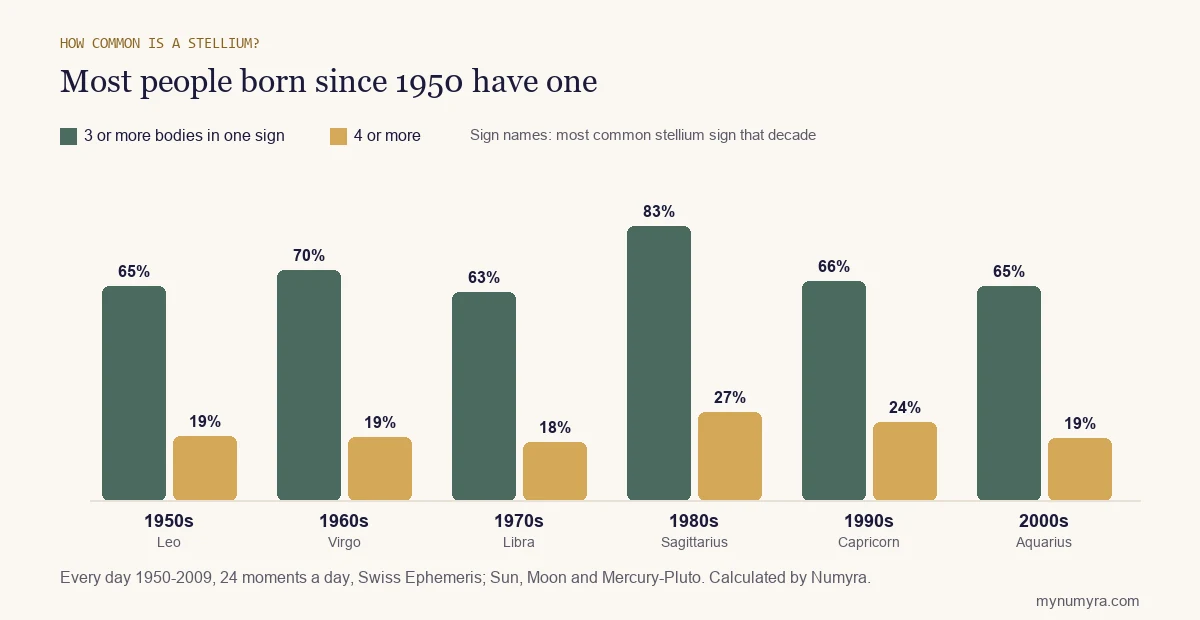
The reason is simple arithmetic plus slow planets. Ten bodies share only twelve signs, and Mercury and Venus always stay near the Sun, so the three of them often land together. On top of that, Jupiter, Saturn, Uranus, Neptune and Pluto move so slowly that for years at a time two or three of them sit in the same sign. Through most of the 1980s two of them shared a sign: Uranus was in Sagittarius with Neptune until 1984 and with Saturn from late 1985, and from the end of 1988 Saturn, Uranus and Neptune were all in Capricorn. That is why the share peaked for people born in that decade:
So a stellium on its own says less than it seems. Astrologers usually give more weight to one that includes the Sun, the Moon or the planets up to Mars, or to a tight one with the bodies within a few degrees of each other. In 15.9% of births, the biggest stellium was made only of the Sun, Moon, Mercury, Venus and Mars.
How to read your result
A stellium is traditionally read as a concentration of energy in the themes of its sign: a Virgo stellium in work, detail and usefulness, a Leo stellium in self-expression, and so on. Start with the sign's own profile, linked in your result, then look at which bodies are involved, since the Sun, Moon and personal planets describe the most personal themes. Our guide to what a stellium means covers the traditional readings in full.
If you entered a birth time, the result also gives the house, using whole-sign houses: your rising sign is the 1st house and each sign after it the next. The house adds the area of life where the stellium is said to play out; our guide to the twelve houses explains each one. Quadrant systems such as Placidus can split the same planets across two houses, so a full professional chart may show the house differently even when the sign is the same.
How this calculator works, and how accurate it is
Positions come from Paul Schlyter's published method for computing planetary positions, which starts from each planet's orbit, adds the main corrections for Jupiter, Saturn and Uranus, and converts the result to the view from Earth. It runs in your browser, so nothing you enter leaves your device. To check it, we compared every body with the Swiss Ephemeris at 20,000 random moments from 1900 to 2030:
| Body | Largest difference | 95% of moments within | Different sign |
|---|---|---|---|
| Sun | 1.1′ | 0.8′ | 0.035% |
| Moon | 6.3′ | 3.3′ | 0.06% |
| Mercury | 1.5′ | 1.1′ | 0.025% |
| Venus | 1.8′ | 1.0′ | 0.025% |
| Mars | 3.4′ | 1.4′ | 0.055% |
| Jupiter | 2.1′ | 1.2′ | 0.025% |
| Saturn | 2.7′ | 1.8′ | 0.065% |
| Uranus | 2.4′ | 1.7′ | 0.02% |
| Neptune | 1.8′ | 1.2′ | 0.03% |
| Pluto | 1.5′ | 1.1′ | 0.05% |
One arcminute (′) is a sixtieth of a degree, and a sign is 30 degrees wide. The sign only came out differently for moments within a few minutes of a body changing sign. The check also caught a real error before launch: Schlyter's formula for Pluto is already referred to the date, and an extra correction we had added was doubling the precession of the equinoxes, putting Pluto up to 1.4° out. With it removed, Pluto agrees to within 1.5′. Our Birth Chart calculator uses the same method for your Sun, Moon and rising sign.
Frequently asked questions
What counts as a stellium?
Three or more of the ten traditional bodies (the Sun, the Moon and the planets from Mercury to Pluto) in the same zodiac sign. Some astrologers insist on four or more, or on the planets being within a few degrees of each other; this calculator shows both the three-body and the stricter four-body result. The lunar nodes, Chiron and the angles are not counted.
How common is a stellium?
Far more common than most guides suggest. Using the Swiss Ephemeris for every date of the 85.4 million US births from 1994 to 2014, 62.7% had at least three bodies in one sign, 19.5% had four or more and 4.1% had five or more. For people born in the 1980s, when Saturn, Uranus, Neptune and Pluto were close together, it was 83%.
Do I need my birth time?
Not for most stelliums. Every body except the Moon moves slowly enough that your birth date fixes its sign, apart from rare days when a planet changes sign. The Moon changes sign every two to three days, so without a birth time the calculator estimates it at noon and tells you if your result depends on it. A birth time is also needed to say which house a stellium falls in.
Which house is my stellium in?
If you enter a birth time, the calculator works out your rising sign and places the stellium using whole-sign houses, in which your rising sign is the 1st house, the next sign the 2nd, and so on. Other house systems, such as Placidus, can put a stellium across two houses, so a professional chart may differ.
Is a stellium in the outer planets meaningful?
Traditionally it is read as generational rather than personal. Uranus, Neptune and Pluto move so slowly that everyone born within a few years shares their signs; a stellium made only of outer planets is shared with millions of people. Stelliums that include the Sun, Moon or the planets up to Mars are read as more personal.
How accurate is this calculator?
We compared it with the Swiss Ephemeris, the reference used by professional astrology software, at 20,000 random moments from 1900 to 2030. Every body was within about 6 arcminutes (a tenth of a degree), and the sign only differed for births within minutes of a sign change, at most 0.065% of the time for any body.
Sources
- Schlyter, Paul. How to Compute Planetary Positions. The position method used by this calculator.
- Astrodienst. Swiss Ephemeris. Reference used to test the calculator and to compute how common stelliums are.
- FiveThirtyEight. US births data, 1994–2014, compiled from the CDC National Center for Health Statistics and the Social Security Administration.
- Numyra Methodology Desk. Astrology calculation standard.