The most-cited histories of the newspaper horoscope column — Columbia Journalism Review’s and Smithsonian’s, both still the top search results for this topic — were both written in early 2016. Neither mentions Co-Star, the app that put a horoscope in tens of millions of pockets the following year, or the TikTok astrology boom that followed it. The story didn’t stop in 2016. Here’s the rest of it, told with the same real sources the existing histories already use.
Key takeaways
- The modern newspaper horoscope column traces to a single, real, dated article: R.H. Naylor’s horoscope for the newborn Princess Margaret, published in London’s Sunday Express on August 24, 1930 — written only because Cheiro, the astrologer originally asked, wasn’t available.
- Naylor’s column took off after a real, specific forecast (danger to “a British aircraft”) appeared to come true when the R101 airship crashed 11 days later — but his own 1939 forecast on the eve of World War II was published, dated, and wrong, a real counterweight most retellings leave out.
- The format crossed the Atlantic through two real, named figures: Sydney Omarr’s 200-newspaper US syndication and Linda Goodman’s 1968 book Sun Signs — the first astrology title ever to make the New York Times Best Seller list.
- In 1948, psychologist Bertram Forer ran a classroom experiment using a real newspaper astrology column, and found it independently: people rate vague, one-size-fits-all personality text as personally accurate, a documented effect that still replicates today.
- The story most existing histories tell stops around 2016. What actually happened next — Co-Star’s 2017 launch, real survey data on Gen Z belief, and astrology’s move onto dating apps — is a whole additional chapter with its own real sources.
In this guide
- Before Naylor: horoscopes were already in American papers
- The horoscope that started the modern format
- The prediction that made his career
- The prediction that didn’t work
- How the format crossed the Atlantic and became a fixture
- Why it worked even when it was wrong
- The chapter most existing histories miss
- Frequently asked questions
Before Naylor: horoscopes were already in American papers
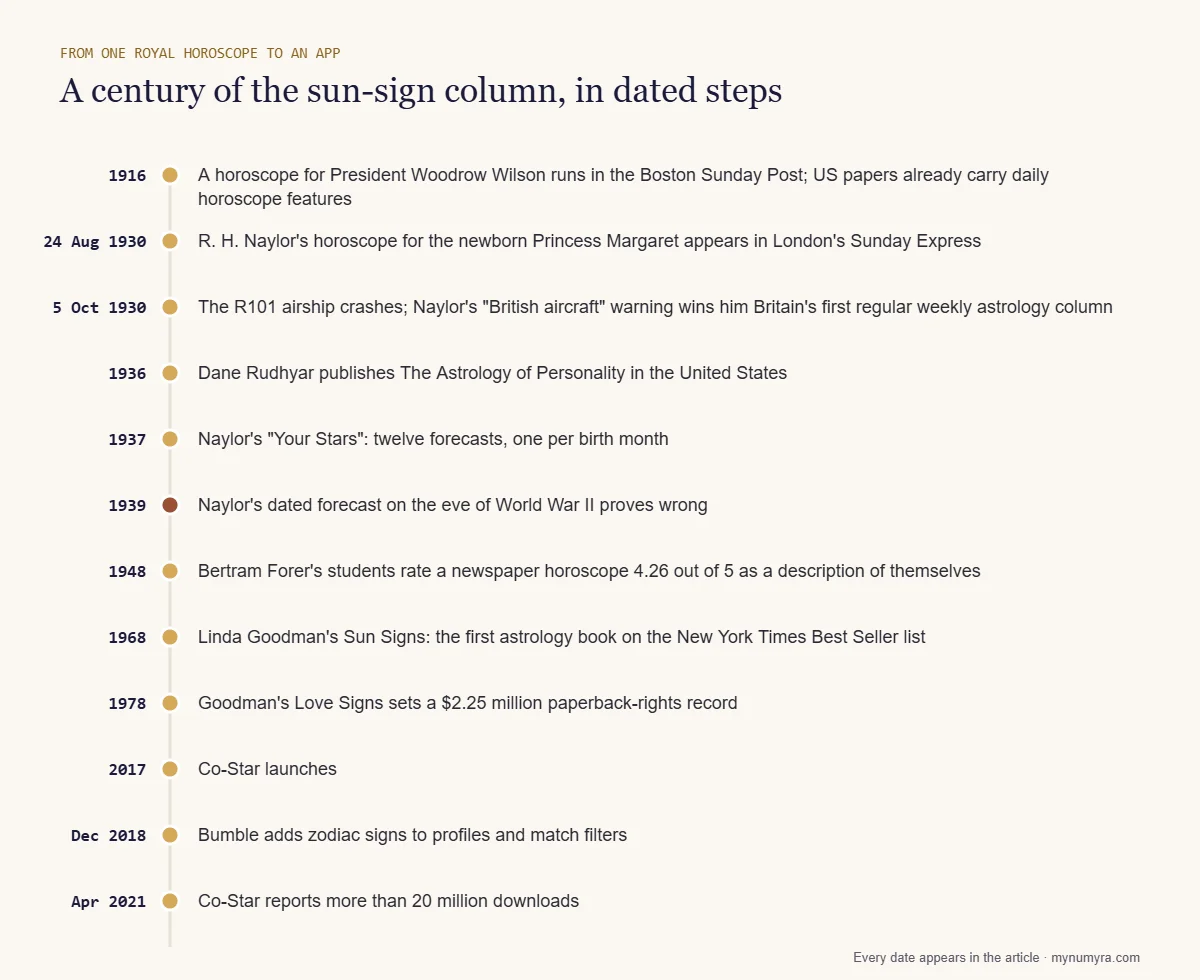
It’s worth being precise about what actually started in 1930, because it wasn’t horoscopes in newspapers generally — that predates Naylor. As early as 1916, a horoscope for President Woodrow Wilson ran in the Boston Sunday Post, and by that same year several US papers were already running a daily horoscope feature distributed by the McClure Newspaper Syndicate, the same company that pioneered syndicating comics and fiction nationally. What didn’t exist yet was the format that would come to define the genre: a short, mass-produced, personal-sounding forecast tied to an individual reader rather than a public figure’s birth chart. Astrology historian Nicholas Campion is the source most existing histories credit for pinpointing where that specific format actually began.
The horoscope that started the modern format
In August 1930, the Sunday Express’s editor, John Gordon, wanted a horoscope for the newborn Princess Margaret and asked Cheiro — the era’s leading British celebrity astrologer, whose own self-mythologized career is its own story — to write it. Cheiro wasn’t available. The assignment went instead to his assistant, a young astrologer named Richard Harold Naylor. The resulting piece, “What The Stars Foretell For The New Princess,” ran on August 24, 1930, three days after the princess’s birth, opening with a line that had to explain the entire concept to readers:
“Everybody is interested in the future. Can it be told by the stars?”
— R.H. Naylor, “What The Stars Foretell For The New Princess,” Sunday Express, August 24, 1930
The article was popular enough that Gordon asked Naylor for more. What happened next is the real reason it became a regular feature rather than a one-off novelty.
The prediction that made his career
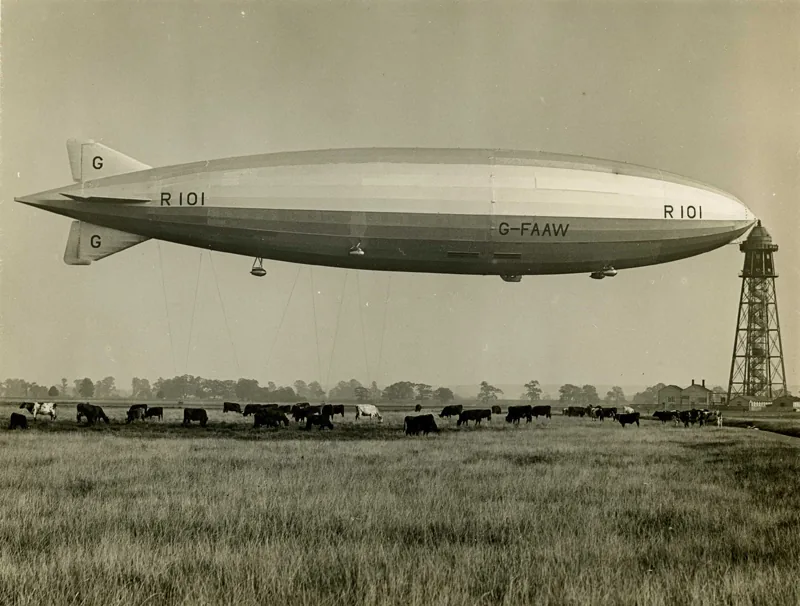
In September 1930, Naylor’s column forecast that “a British aircraft will be in danger.” On October 5, 1930, the airship R101 crashed and burned at Beauvais, France. The timing was close enough that Naylor was publicly credited with a direct hit, and Gordon offered him what became Britain’s first regular weekly astrology column — a format other British papers began copying within the same decade.
By 1937, Naylor had simplified his method into something that could scale indefinitely: twelve forecasts, one per birth month, based on what he called “Your Stars” — the sun-sign format still used by essentially every horoscope column today. The appeal was structural as much as mystical: twelve pre-written forecasts could be recombined and republished forever, which is exactly what made it viable as a permanent newspaper feature rather than a one-time stunt. Separately, in the United States, astrologer Dane Rudhyar was developing a similar twelve-part structure around the same period, publishing The Astrology of Personality in 1936 — the sun-sign format wasn’t a single invention so much as a format two continents converged on at once, for the same practical reason.
The prediction that didn’t work
Most retellings stop at the R101 hit. A complete account has to include what came next, because Naylor’s own column is also on the record being confidently, specifically wrong. On May 28, 1939 — three months before Britain declared war on Germany — Naylor’s column advised readers not to “look to Europe as the seat of conflagration,” predicting instead that “the danger lies in the Mediterranean, the Near East and Ireland.” World War II began that September, centered on exactly the Europe-wide conflict he’d told readers to discount. It’s a real, dated, published forecast, sitting in the same archive as the R101 hit — the same track record contains both, and an honest history has to hold both facts rather than only the one that makes the format look prescient.
How the format crossed the Atlantic and became a fixture
Naylor’s sun-sign format didn’t stay a British phenomenon. Sydney Omarr — born Sidney Kimmelman in Philadelphia, and, in a detail this site’s own numerology readers might appreciate, someone whose first serious interest was actually numerology, not astrology, before he switched fields — built the American equivalent into arguably the most widely-read version the format ever had. His daily Sun Sign Horoscope column ran in more than 200 newspapers via the Los Angeles Times syndicate, and his annual forecast books, one per zodiac sign, sold a reported 50 million copies over his career. Omarr’s own origin story has the same kind of honest asterisk Naylor’s does: a 1945 Air Force profile of him, written partly as satire, quoted him predicting Japan’s defeat in “mid-August, 1945” — a prediction the article’s own author later said was never seriously made and was part of the piece’s satire. Omarr used the quote to promote his astrology career anyway, and it followed him into an influential column at the Los Angeles Times.
The format’s biggest single leap in reach, though, came from a book, not a column. In 1968, Linda Goodman — born Mary Alice Kemery in West Virginia — published Sun Signs, structured around the same twelve-part format Naylor and Omarr had already made standard. It became the first astrology book ever to make the New York Times Best Seller list, at a moment when astrology was already crossing over into the mainstream counterculture. Her 1978 follow-up, Love Signs, also hit the list and set a non-fiction paperback-rights record at the time: $2.25 million. Between Naylor’s original column, Omarr’s 200-paper syndication, and Goodman’s bestseller status, the sun-sign format had, by the late 1970s, saturated print media on both sides of the Atlantic — decades before it had any reason to need an app.
Why it worked even when it was wrong
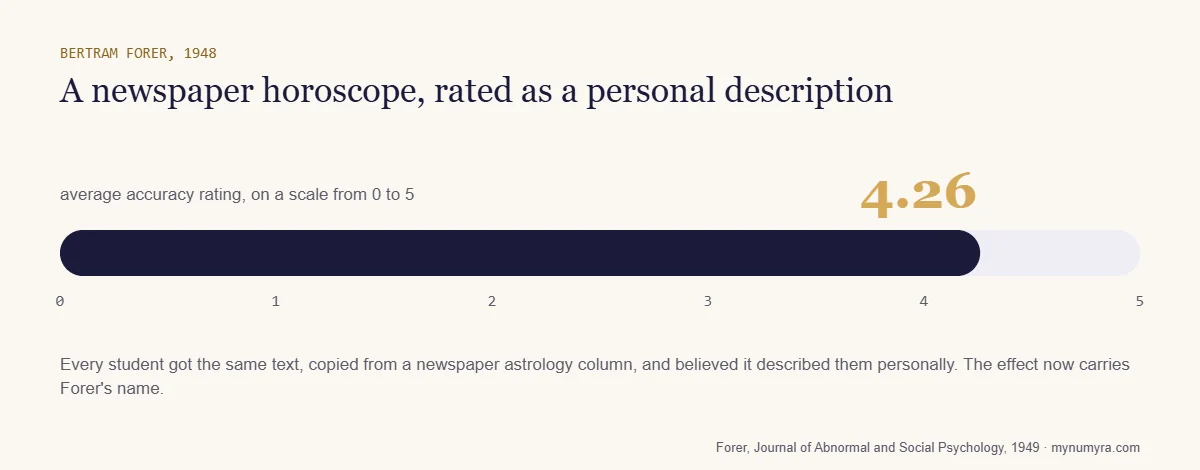
The mechanism behind that appeal was itself documented, independently, less than two decades later — and by a real, dated, citable psychology experiment that used an actual newspaper astrology column as its material. In 1948, psychologist Bertram Forer gave his students a personality test, then handed every single student the identical write-up — not individually scored, but copied verbatim from a newspaper astrology column. Asked to rate its accuracy from 0 to 5, the class average came out to 4.26. Forer published the result the following year as “The Fallacy of Personal Validation: A Classroom Demonstration of Gullibility.” The effect now carries his name, and it has been re-run many times since 1948; the average score has stayed close to that original 4.2. It’s a genuine explanation, backed by a real replicated study, for why a mass-produced, one-size-fits-all sun-sign forecast can still feel personally written for the reader receiving it — the same structural feature that made Naylor’s format scalable in the first place.
The chapter most existing histories miss
Both of the most-cited histories of this topic — Columbia Journalism Review’s (published March 2016) and Smithsonian’s (published January 2016) — end their narratives around 2014 and 2015. Neither mentions what happened in the decade after: astrology didn’t fade from newspaper “furniture” into irrelevance, it moved onto phones.
Co-Star, the astrology app now most associated with that shift, launched on October 17, 2017, built by Banu Guler with Anna Kopp and Ben Weitzman, using public NASA data and an unusually blunt, algorithmically generated tone for its daily push notifications. By April 2021, alongside a $15 million funding round, the company reported more than 20 million downloads. Real survey data backs up the scale of the shift: an August 2019 MTV Insights survey of 1,000 people aged 14 to 29 found 75% believed in astrology and 66% believed it affects romantic compatibility — numbers large enough that dating apps built features around them. Bumble added zodiac sign profile fields and match filtering in December 2018, explicitly in response to user demand; OkCupid recorded a 34% rise in astrology-related profile mentions between January 2017 and January 2019 alone.
None of this replaced Naylor’s format — it’s the same twelve-part sun-sign structure he settled on in 1937, still recombined and republished, just through a notification instead of newsprint. The chapter existing histories are missing isn’t a break from the newspaper horoscope column’s story; it’s the same story continuing on a different device.
Frequently asked questions
Was R.H. Naylor the first person to publish a horoscope in a newspaper?
No — individual celebrity horoscopes appeared in US papers as early as 1916. What Naylor’s 1930 column actually started was the specific format still used today: a short, mass-producible, personal-sounding forecast for ordinary readers, not public figures.
Did R.H. Naylor really predict the R101 airship crash?
He forecast general danger to “a British aircraft” in a specific window, and the R101 crashed within that window — a real, documented coincidence he was publicly credited for at the time. His own column was also confidently wrong about the outbreak of World War II nine years later, a fact usually left out of the retelling.
What is the Forer effect?
A documented psychological finding, from a real 1948 classroom experiment, that people rate vague, generic personality descriptions as personally accurate — even when everyone in the room received the exact same text, copied from a newspaper astrology column.
Why did astrology apps like Co-Star become so popular?
Real survey data from 2019 found strong belief and engagement with astrology among people aged 14-29 already in place before Co-Star’s growth accelerated — the app met existing demand rather than creating it from nothing, using push notifications to deliver the same sun-sign format newspapers had run for 80 years.
Is the sun-sign format the same as real astrological calculation?
No — sun-sign columns simplify astrology down to a single input (birth month), which is what made them scalable as a daily newspaper feature in the first place. Full natal astrology considers many more chart factors than sun sign alone.
Sources
- “R. H. Naylor.” Wikipedia. Biographical detail and the original Sunday Express citations for the Princess Margaret and 1939 columns.
- Gourarie, Chava. “How Horoscopes Conquered the Media.” Columbia Journalism Review, March 3, 2016.
- Rodriguez McRobbie, Linda. “How Are Horoscopes Still a Thing?” Smithsonian Magazine, January 5, 2016.
- “Bertram Forer.” Wikipedia, citing Forer, B.R. (1949), “The Fallacy of Personal Validation: A Classroom Demonstration of Gullibility,” Journal of Abnormal and Social Psychology, 44, 118–123.
- “Sydney Omarr.” Wikipedia.
- “Linda Goodman.” Wikipedia.
- “Co–Star.” Wikipedia. Founding, launch date, and funding/download figures.
- Colvin, Caroline. “Astrology Impacts Dating More Than You’d Expect — Even For Non-Believers.” Elite Daily, February 20, 2020. Source for the MTV Insights survey and Bumble/OkCupid figures.