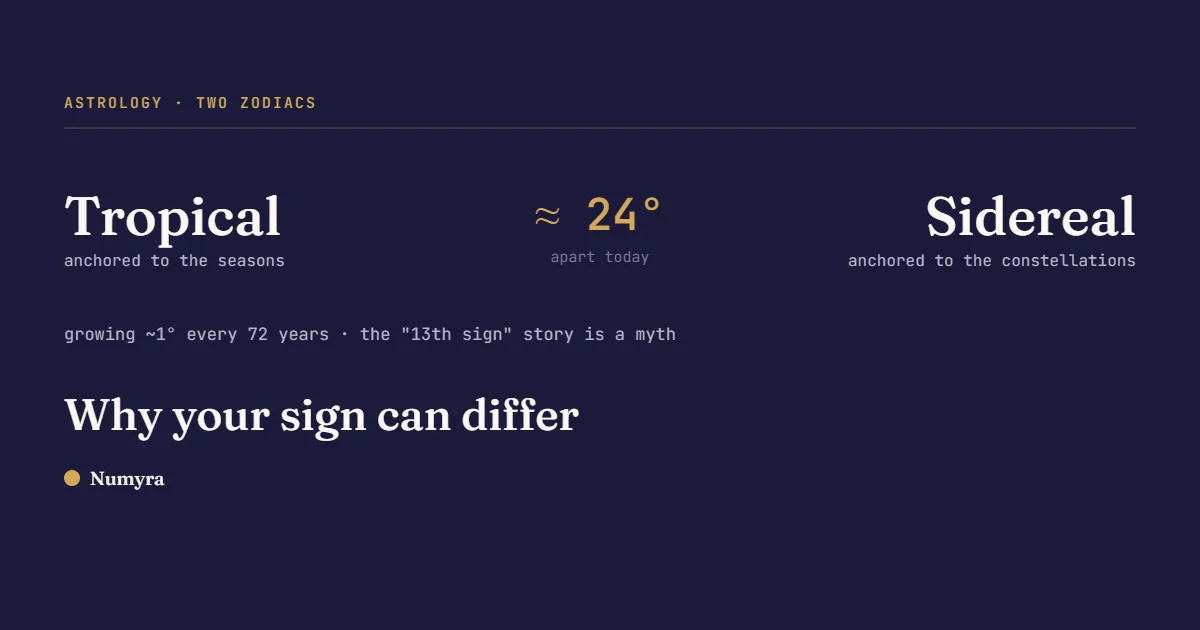
If you’ve ever seen a claim that your “real” zodiac sign is different from the one you grew up with, this is why: there are two entirely different zodiacs in use today, and they currently disagree by about 24 degrees — nearly a full sign’s width.
Key takeaways
- Western horoscopes use the tropical zodiac (anchored to the seasons); Vedic astrology uses the sidereal zodiac (anchored to the actual constellations). They’re currently offset by roughly 24°, a gap that grows about 1° every 72 years.
- Sidereal astrologers don’t agree on one exact offset either — different ayanamsa (correction) systems, like Lahiri or Fagan-Bradley, put the gap at slightly different values.
- The “NASA added a 13th zodiac sign” story is a recurring myth. Ophiuchus, the constellation involved, isn’t part of either mainstream system’s 12 signs.
- Neither system is more “correct” in an absolute sense — they’re built on different reference points for different purposes. This is a case of two internally consistent systems, not one right answer and one wrong one.
- Nothing here is a claim that either system predicts real-world outcomes — this is a technical and historical explainer on a cultural tradition, for reflection and entertainment.
The short version: two different reference points
Every zodiac sign is really a 30° slice of the sky along the Sun’s apparent yearly path (the ecliptic). The disagreement between tropical and sidereal astrology comes down to one question: a slice measured from what?
- Tropical zodiac measures from the seasons. 0° Aries is defined as the exact moment of the spring equinox, every year, regardless of where the constellations happen to be. This is what Western horoscope columns, and Numyra’s own sign profiles, use.
- Sidereal zodiac measures from the constellations themselves — where Aries the constellation actually sits in the sky right now. This is what Vedic (Jyotish) astrology uses.
Two thousand years ago, these lined up closely enough that the difference didn’t matter much in practice. They don’t anymore, for a real, well-documented astronomical reason: Earth’s axis slowly wobbles, a 25,800-year cycle called the precession of the equinoxes. The tropical zodiac ignores that wobble by design, staying locked to the seasons. The sidereal zodiac tracks it. For the full story of how the Greek astronomer Hipparchus discovered precession and what it meant for the ancient zodiac, see our history of the zodiac signs — this article picks up where that one leaves off, on what the split actually means for your own chart today.
How big is the gap, exactly?
As of the mid-2020s, the tropical and sidereal zodiacs are offset by roughly 24°, and the gap widens by about 1° every 72 years. In practice, that means a large share of people have a different Sun sign in Vedic astrology than in Western astrology — someone born in early April, a tropical Aries, is commonly a sidereal Pisces instead.
The exact number isn’t perfectly agreed on even within sidereal astrology, because sidereal systems need a correction factor — called an ayanamsa — to convert a tropical position into a sidereal one, and different traditions calculate that correction slightly differently:
| Ayanamsa | Used by | Approx. offset today |
|---|---|---|
| Lahiri | India’s official civil and religious calendar; most Vedic astrologers | ~24° |
| Fagan-Bradley | Western sidereal astrology | ~25° |
| Raman | A minority of Vedic astrologers, following B. V. Raman | ~22° |
| Sri Yukteswar | A smaller yoga/spiritual-lineage tradition | ~23° |
The Fagan-Bradley system traces back to Cyril Fagan, a Dublin-born astrologer who, after studying ancient Babylonian astronomical records in the 1940s, concluded that the Babylonians themselves had originally used a star-anchored zodiac — and built a modern Western sidereal system to match. It’s a useful reminder that “sidereal” isn’t only a Vedic import; it has its own separate Western lineage.
The Ophiuchus “13th sign” myth
Every few years, a headline resurfaces claiming NASA “added a new zodiac sign” — Ophiuchus, the serpent-bearer — and that everyone’s sign has secretly shifted. It’s a genuinely common point of confusion, and it’s rooted in a real fact wrapped around a wrong conclusion.
The real fact: the Sun’s actual path does pass through 13 constellations, not 12 — Ophiuchus included, for about 18 days in late November/early December. The Babylonians knew this over two thousand years ago and dropped Ophiuchus anyway, dividing the ecliptic into 12 equal 30° segments to match their 12-month calendar, rather than 13 unequal ones matched to the constellations’ actual, very uneven sizes.
“We see your comments about a zodiac story that re-emerges every few years. No, we did not change the zodiac.”
— NASA, responding on social media to a recurring “13th sign” story, first explained in a 2016 NASA Space Place post
NASA’s own point wasn’t that the constellations don’t matter — it’s that neither tropical nor mainstream sidereal astrology was ever built around the constellations’ literal, unequal boundaries in the first place. Tropical astrology is anchored to the seasons; mainstream sidereal astrology still uses 12 equal 30° segments too, just measured from a different zero point. A separate, genuinely minority approach — 13-sign sidereal astrology — does use the constellations’ real, unequal sizes and does include Ophiuchus, but it’s a small niche within sidereal practice, not what either “sidereal astrology” or “your sign” usually means.
So which one should you use?
Neither system is wrong on its own terms — they’re answering different questions. Tropical astrology asks “where is the Sun relative to the seasons,” which is why it’s stayed so tightly linked to the seasonal, cyclical themes (spring/Aries as beginnings, winter/Capricorn as culmination) that show up throughout Western sign interpretation. Sidereal astrology asks “where is the Sun relative to the actual sky,” which is the framework Vedic astrology’s own predictive techniques were built around from the start.
Numyra’s own zodiac compatibility calculator and sign profiles use the tropical system, consistent with mainstream Western astrology — see our astrology methodology for the full reasoning. If you’ve had a Vedic reading and gotten a different sign, that’s not an error in either calculation. It’s two internally consistent systems measuring from two different starting points, same as two clocks correctly showing two different time zones.
Frequently asked questions
Is sidereal astrology more scientifically accurate than tropical?
Sidereal astrology’s positions correspond more closely to the constellations’ actual current locations, which is sometimes called more astronomically accurate. But that doesn’t make it more predictively accurate — no controlled study has found either system reliably predicts personality or life events. “Accounts for precession” and “accurately predicts outcomes” are two separate claims.
Why do different sidereal astrologers give me slightly different signs?
Because sidereal astrology needs an ayanamsa (correction value) to convert from tropical positions, and several real, differently-calculated ayanamsas are in use — Lahiri, Fagan-Bradley, Raman and others each land 1-3° apart, which occasionally shifts a borderline chart position into a different sign depending which one is used.
Did NASA actually study astrology to make this claim?
No — NASA’s point was specifically about the astronomy (how many constellations the ecliptic actually passes through), not an astrological judgment. NASA has been explicit that it doesn’t study or endorse astrology; the clarification was about a factual mix-up in the viral story, not a verdict on either zodiac system.
Does Numyra plan to offer a sidereal option?
Not currently. Our calculators and sign profiles are built on the tropical system used by mainstream Western astrology, documented in our methodology. If that changes, this page and our methodology will be updated to reflect it.
Sources
- “Sidereal and tropical astrology.” Wikipedia. Ayanamsa figures and the Fagan-Bradley/Lahiri/Raman/Sri Yukteswar comparison.
- “Cyril Fagan.” Wikipedia. Biographical background on the founder of modern Western sidereal astrology.
- Locker, Melissa. “NASA Elegantly Shuts Down Those New Zodiac Star Theories.” TIME, July 17, 2020 — reporting NASA’s statement and its original 2016 explanation of the 13-constellation/12-sign discrepancy.
- “Ophiuchus (astrology).” Wikipedia. Background on 13-sign sidereal astrology as a minority practice.
- Numyra Methodology Desk. Astrology framework and sourcing standard.