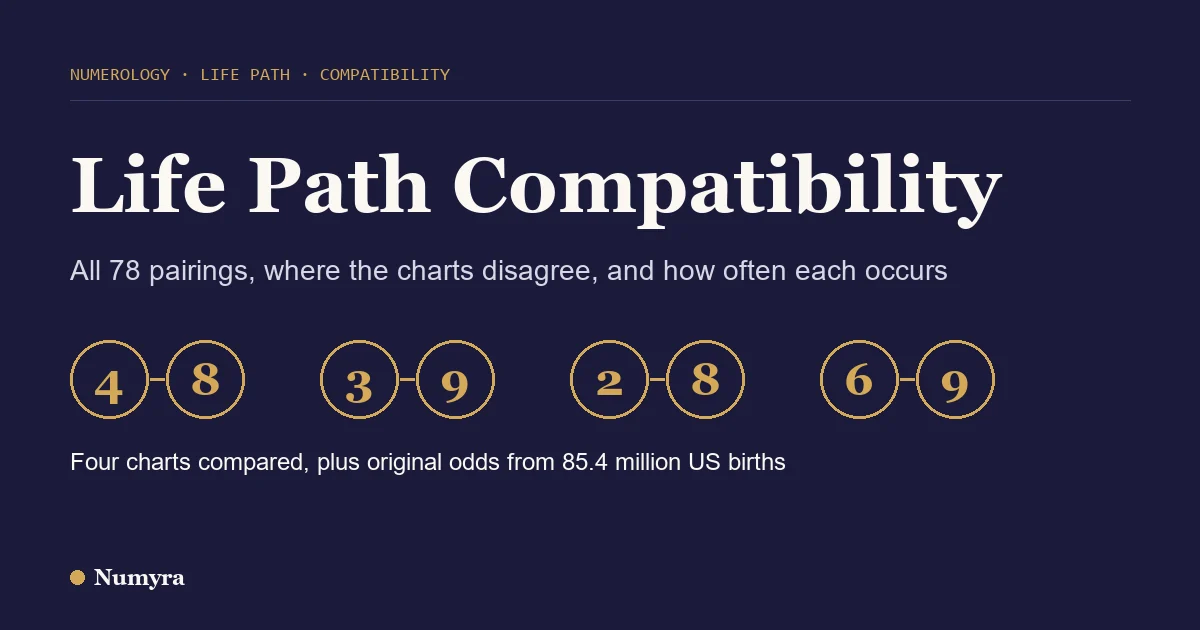
Life Path number compatibility compares the Life Path numbers of two people and reads how the two numbers combine. There are 12 possible Life Path numbers (1 to 9, plus the master numbers 11, 22 and 33), which gives 78 distinct pairings, and published charts do not agree on which ones are good. We compared four of them across the 45 single-digit pairings and found only four that every chart rates positively: 2 & 8, 3 & 9, 4 & 8 and 6 & 9. This guide explains how the charts work, lists all 78 pairings with how often each one occurs among random US birth dates, shows exactly where the charts contradict each other, and says how much weight a chart can bear.
Key takeaways
- Twelve Life Path numbers make 78 pairings: 66 mixed pairs and 12 same-number pairs. Most charts read 11, 22 and 33 as 2, 4 and 6, which leaves 45 distinct readings.
- Of those 45 pairings, only 2 & 8, 3 & 9, 4 & 8 and 6 & 9 are rated positively by all four charts we compared. Another six are positive in three.
- Sixteen pairings are rated positive by at least one chart and negative by another, among them 1 & 1, 1 & 8, 3 & 6 and 5 & 9. Numerology.com and the Numerologist.com cheat sheet give opposite verdicts on seven of the 45.
- Original data from 85.4 million US births: two random people share a Life Path number 9.89% of the time, 18.6% of random pairs include at least one master number, and a 33 and 33 pairing occurs in about 1 in 120,000.
- Depending on the chart, a randomly chosen US couple is rated compatible between 35% and 49% of the time. None of the charts has been tested against real relationships, and one of them says so itself.
In this guide
- How Life Path compatibility is read
- All 78 pairings and how often each occurs
- The four charts we compared
- The 45 single-digit pairings, chart by chart
- Where the charts agree and where they clash
- Same-number pairs
- Master numbers in compatibility
- How much weight a chart can bear
- Frequently asked questions
- Sources
How Life Path compatibility is read
The method has three steps. Work out each person’s Life Path from the full birth date: reduce the month, the day and the year separately, add the three results and reduce again, stopping at 11, 22 or 33 when one appears. Our Life Path calculator does this, and our hand-calculation guide shows each step. Then put the two numbers together as a pairing, in either order. Finally, look the pairing up in a chart or a set of descriptions, which is where the sources part ways.
Two ideas recur in the charts. The first is odd against even: Numerologist.com describes odd numbers as outward-directed and even numbers as receptive, treats matching directions as easier, and says the framework goes back at least to Cheiro’s work in the 1890s. We could not trace that claim to a primary text, so treat the history as the site’s own account. The second is a warning about sameness, which we return to below. Neither idea comes with a test, so a chart is best read as one tradition’s opinion.
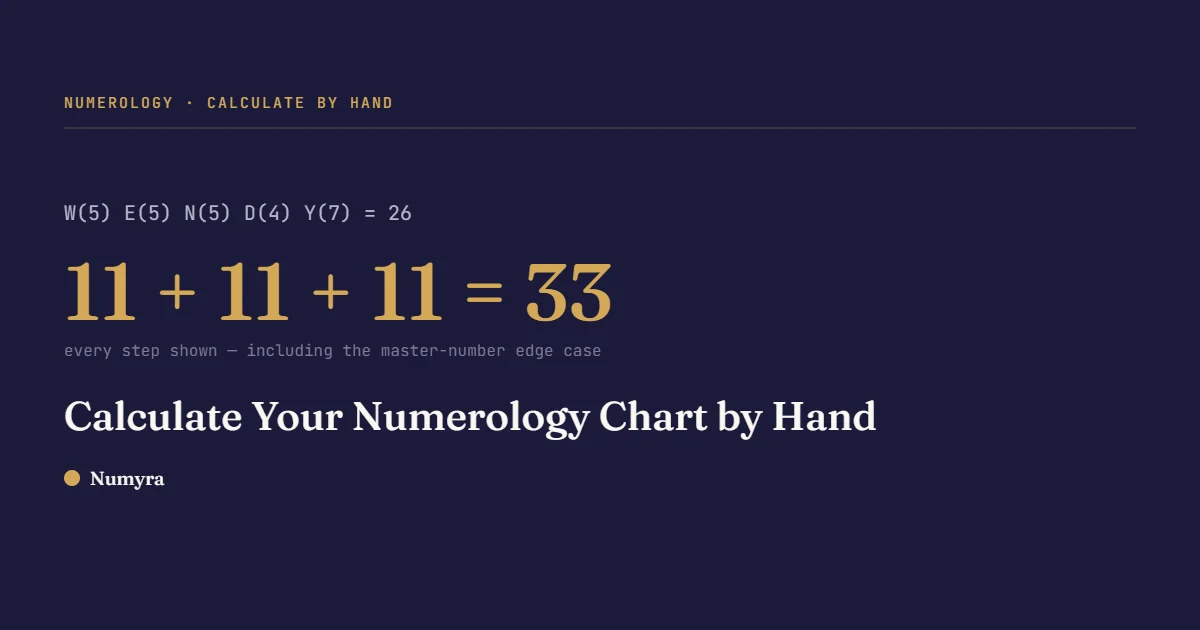
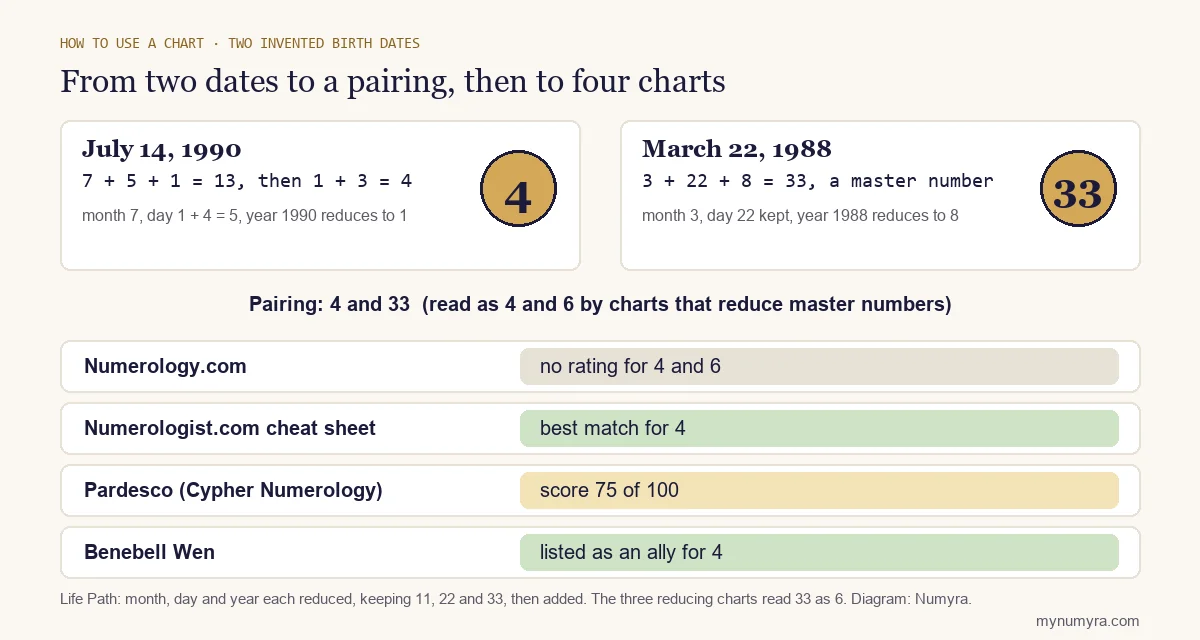
The figure below walks two invented birthdays through the steps and shows how four charts would read the result. The pairing of 4 and 33 is read by three of the charts as 4 and 6, which they treat as a single-digit pairing.
All 78 pairings and how often each occurs
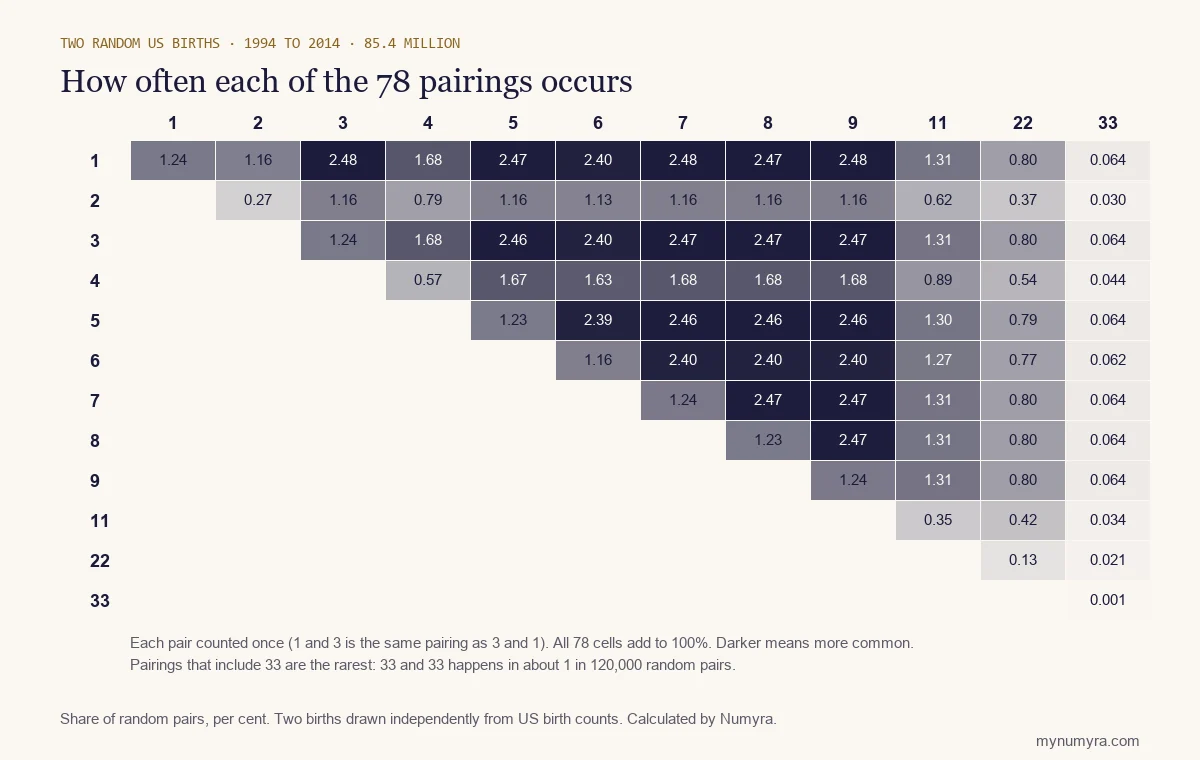
To put numbers on the pairings, we assigned a Life Path to every date in the US birth data, weighted by the number of babies born on each date, and then asked how often two people picked at random would form each pairing. The data are the CDC National Center for Health Statistics counts for 1994 to 2003 and the Social Security Administration counts for 2004 to 2014, 85,386,227 births in total. We treated the two people as independent draws, so the figures describe a pair of strangers born in this window and not any particular couple. They match the same-number and master-number odds on our compatibility calculator and extend them to every pairing.
Single digits other than 2, 4 and 6 each cover about 11% of births, because dates that reduce to 2, 4 or 6 are split between that digit and the master number 11, 22 or 33. Life Path 2 covers 5.23% of births, 4 covers 7.54% and 6 covers 10.79%, while the master numbers cover 5.89% (11), 3.59% (22) and 0.29% (33). The pairings follow from those shares:
- The commonest pairings, such as 1 and 3, occur in about 2.48% of random pairs, and a same-number pair of a common digit, such as 1 and 1, in about 1.24%.
- Two people share a Life Path number in 9.89% of random pairs. If both were born in the same year, which is closer to a couple of similar age, the figure is 10.07%.
- At least one master number appears in 18.57% of random pairs, and both partners have a master number in 0.95%.
- The rarest pairing is 33 and 33, at 0.0008%, or about 1 in 120,000 random pairs.
| Life Path | 1 | 2 | 3 | 4 | 5 | 6 | 7 | 8 | 9 | 11 | 22 | 33 |
|---|---|---|---|---|---|---|---|---|---|---|---|---|
| 1 | 1.24 | 1.16 | 2.48 | 1.68 | 2.47 | 2.40 | 2.48 | 2.47 | 2.48 | 1.31 | 0.80 | 0.064 |
| 2 | 0.27 | 1.16 | 0.79 | 1.16 | 1.13 | 1.16 | 1.16 | 1.16 | 0.62 | 0.37 | 0.030 | |
| 3 | 1.24 | 1.68 | 2.46 | 2.40 | 2.47 | 2.47 | 2.47 | 1.31 | 0.80 | 0.064 | ||
| 4 | 0.57 | 1.67 | 1.63 | 1.68 | 1.68 | 1.68 | 0.89 | 0.54 | 0.044 | |||
| 5 | 1.23 | 2.39 | 2.46 | 2.46 | 2.46 | 1.30 | 0.79 | 0.064 | ||||
| 6 | 1.16 | 2.40 | 2.40 | 2.40 | 1.27 | 0.77 | 0.062 | |||||
| 7 | 1.24 | 2.47 | 2.47 | 1.31 | 0.80 | 0.064 | ||||||
| 8 | 1.23 | 2.47 | 1.31 | 0.80 | 0.064 | |||||||
| 9 | 1.24 | 1.31 | 0.80 | 0.064 | ||||||||
| 11 | 0.35 | 0.42 | 0.034 | |||||||||
| 22 | 0.13 | 0.021 | ||||||||||
| 33 | 0.001 |
Each pairing is counted once, so the table is a triangle and its 78 cells add up to 100%. Our guide to why 11, 22 and 33 are master numbers explains why they sit outside the usual reduction.
The four charts we compared
We looked for charts that state a verdict for every pairing of the single digits and could be read from the page. Four qualified, and they are not variations of one source. Numerology.com publishes lists of compatible and least compatible numbers for each Life Path. The Numerologist.com cheat sheet sorts every number into best, possible and challenging matches. Cypher Numerology, whose chart sits on the numerology.pardesco.com site (Pardesco in the tables below), gives a score out of 100 for each of the 45 pairings. Benebell Wen lists, for each number, two allies and two like-minded numbers and no negatives.
A fifth site, Anytime Astro, publishes a chart identical to Numerology.com’s for the numbers 1 to 9 and adds separate lists for 11 and 22, so we count the two as one chart. A sixth source, Numerologist.com’s separate Life Path compatibility guide, covers 66 pairings of the numbers 1 to 9, 11 and 22 on individual pages that we could not read in full, so we used its cheat sheet. That guide gives its own caution in plain terms:
No combination is a death sentence, and no combination is a guarantee.
Blair Andrews, Life Path Compatibility, Numerologist.com, published May 4, 2026
To compare the charts we reduced each one to a verdict per pairing: positive, negative or unrated. For Numerology.com and the cheat sheet that is the list the source itself uses. Where a source lists a pairing from one number’s side only, we used that verdict. For Pardesco we call a score of 80 or more positive and 60 or below negative, which is our own cut-off and puts 21 pairings in the first group and 9 in the second. Benebell Wen’s allies and like-minded numbers count as positive and everything else as unrated.
The 45 single-digit pairings, chart by chart
Read each row as one pairing. Numerology.com and the cheat sheet give a verdict, Pardesco gives a score, and Benebell Wen marks allies. The last column counts positive and negative verdicts. A dagger marks a pairing that Numerology.com lists from one number’s side only, for example 2 and 8, which the page lists as compatible for 2 but not for 8.
| Pairing | Numerology.com | Numerologist.com cheat sheet | Pardesco score | Benebell Wen | Positive / negative |
|---|---|---|---|---|---|
| 1 & 1 | Least compatible | Best match | 65 | 1 positive, 1 negative | |
| 1 & 2 | No rating | Possible | 70 | Ally | 1 positive |
| 1 & 3 | Compatible | Possible | 90 | Ally | 3 positive |
| 1 & 4 | No rating | Best match | 75 | 1 positive | |
| 1 & 5 | Compatible | Possible | 85 | Ally | 3 positive |
| 1 & 6 | Compatible | Challenging | 60 | 1 positive, 2 negative | |
| 1 & 7 | No rating | Challenging | 65 | Ally | 1 positive, 1 negative |
| 1 & 8 | Least compatible | Best match | 70 | 1 positive, 1 negative | |
| 1 & 9 | Least compatible | Best match | 75 | 1 positive, 1 negative | |
| 2 & 2 | No rating | Best match | 80 | 2 positive | |
| 2 & 3 | Least compatible | Possible | 85 | Ally | 2 positive, 1 negative |
| 2 & 4 | Compatible | Possible | 70 | Ally | 2 positive |
| 2 & 5 | Least compatible | Challenging | 55 | Ally | 1 positive, 3 negative |
| 2 & 6 | Compatible | Possible | 90 | 2 positive | |
| 2 & 7 | No rating | Best match | 75 | Ally | 2 positive |
| 2 & 8 | Compatible† | Best match | 80 | Ally | 4 positive |
| 2 & 9 | No rating | Best match | 85 | 2 positive | |
| 3 & 3 | Least compatible | Best match | 75 | 1 positive, 1 negative | |
| 3 & 4 | Least compatible† | Challenging | 50 | 0 positive, 3 negative | |
| 3 & 5 | Compatible | Best match | 95 | 3 positive | |
| 3 & 6 | Least compatible | Best match | 85 | Ally | 3 positive, 1 negative |
| 3 & 7 | No rating | Best match | 80 | 2 positive | |
| 3 & 8 | Least compatible | Challenging | 60 | 0 positive, 3 negative | |
| 3 & 9 | Compatible | Best match | 90 | Ally | 4 positive |
| 4 & 4 | No rating | Best match | 70 | 1 positive | |
| 4 & 5 | Least compatible | Challenging | 45 | Ally | 1 positive, 3 negative |
| 4 & 6 | No rating | Best match | 75 | Ally | 2 positive |
| 4 & 7 | Compatible | Possible | 85 | 2 positive | |
| 4 & 8 | Compatible | Best match | 90 | Ally | 4 positive |
| 4 & 9 | Least compatible | Possible | 55 | 0 positive, 2 negative | |
| 5 & 5 | No rating | Possible | 80 | 1 positive | |
| 5 & 6 | No rating | Possible | 50 | Ally | 1 positive, 1 negative |
| 5 & 7 | Compatible | Possible | 85 | Ally | 3 positive |
| 5 & 8 | Least compatible† | Possible | 70 | 0 positive, 1 negative | |
| 5 & 9 | Least compatible | Possible | 90 | 1 positive, 1 negative | |
| 6 & 6 | No rating | Best match | 85 | 2 positive | |
| 6 & 7 | Least compatible | Possible | 55 | 0 positive, 2 negative | |
| 6 & 8 | Compatible | Challenging | 75 | 1 positive, 1 negative | |
| 6 & 9 | Compatible | Best match | 95 | Ally | 4 positive |
| 7 & 7 | Compatible | Best match | 90 | 3 positive | |
| 7 & 8 | Least compatible | Possible | 60 | Ally | 1 positive, 2 negative |
| 7 & 9 | Least compatible | Challenging | 70 | Ally | 1 positive, 2 negative |
| 8 & 8 | No rating | Best match | 80 | 2 positive | |
| 8 & 9 | Least compatible | Possible | 65 | Ally | 1 positive, 1 negative |
| 9 & 9 | Compatible | Possible | 85 | 2 positive |
Where the charts agree and where they clash
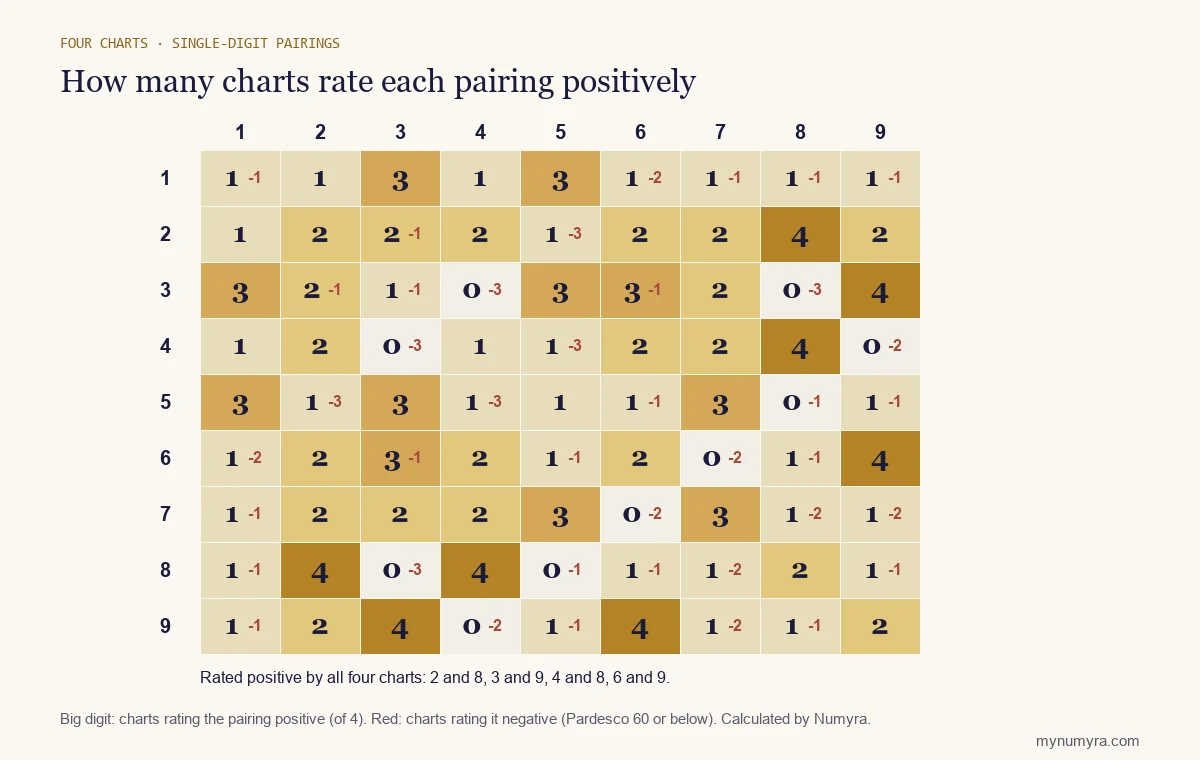
Four pairings are positive in all four charts: 2 & 8, 3 & 9, 4 & 8 and 6 & 9. Six more are positive in three: 1 & 3, 1 & 5, 3 & 5, 3 & 6, 5 & 7 and 7 & 7. At the other end, 2 & 5, 3 & 4, 3 & 8 and 4 & 5 are negative in all three charts that carry negatives, and Benebell Wen is the only source to list any of them (2 & 5 and 4 & 5) as positive. Those fourteen pairings are the closest thing to common ground, and even they rest on a handful of sites.
The clashes are larger. Sixteen pairings are positive in at least one chart and negative in another: 1 & 1, 1 & 6, 1 & 7, 1 & 8, 1 & 9, 2 & 3, 2 & 5, 3 & 3, 3 & 6, 4 & 5, 5 & 6, 5 & 9, 6 & 8, 7 & 8, 7 & 9 and 8 & 9. Take 1 & 8. Numerology.com lists 8 among the least compatible numbers for 1, the cheat sheet lists it as a best match, and Pardesco scores it 70, in the middle. Numerology.com and the cheat sheet give the same verdict on only 14 of the 45 pairings and opposite verdicts on seven. Numerology.com rates 1 & 1, 1 & 8, 1 & 9, 3 & 3 and 3 & 6 as least compatible, where the cheat sheet calls them best matches, and it rates 1 & 6 and 6 & 8 as compatible, where the cheat sheet calls them challenging. With our cut-offs, Pardesco sits closer to both: it agrees with the cheat sheet on 21 pairings and contradicts it on none, and it contradicts Numerology.com on four.
The disagreement is not an accident of one site’s taste. Pardesco’s chart states what its scores are:
The scores are assigned numerology ratings, not measured probabilities of relationship success.
Cypher Numerology, Life Path Compatibility Chart, Pardesco
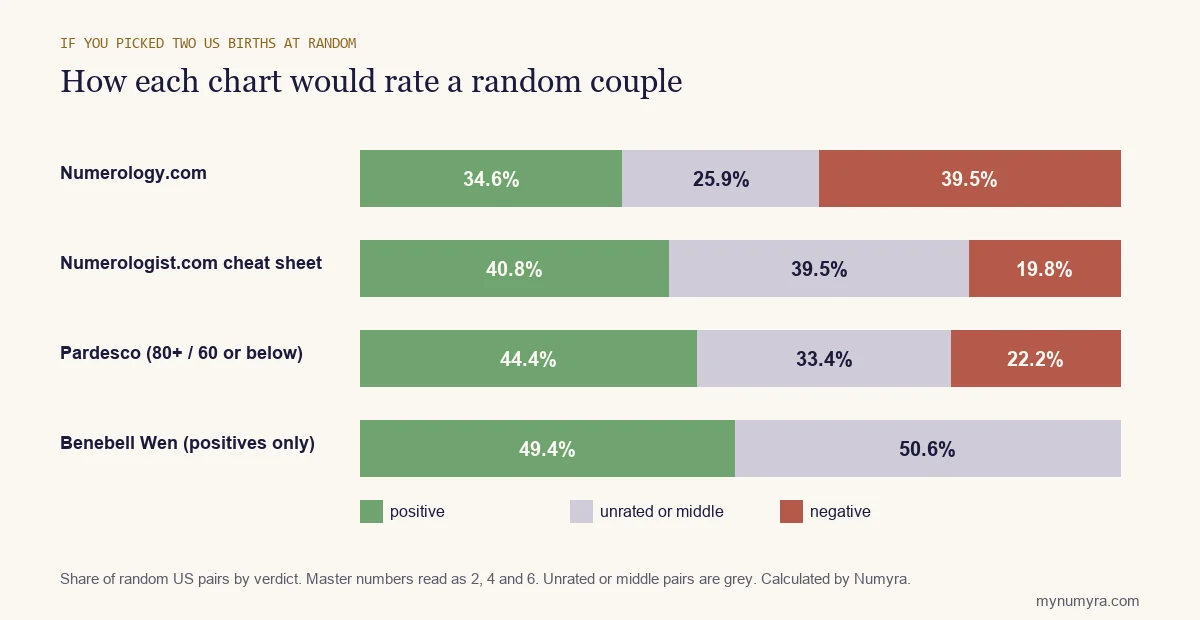
That is the honest framing, and it explains why charts can differ without any of them being checked against data: each is one author’s assignment of ratings. The result for ordinary people is that the verdict depends heavily on the chart opened. Weighting every pairing by how often it occurs, Numerology.com would rate 34.6% of random US pairs compatible and 39.5% least compatible. The cheat sheet would call 40.8% best matches and 19.8% challenging, and Pardesco 44.4% high and 22.2% low. Benebell Wen’s allies cover 49.4% of random pairs.
Same-number pairs
Sources also split on two people with the same Life Path. Numerologist.com’s guide warns that same-number pairs carry a particular risk, because both people express the same shadow and neither supplies friction. The charts do not follow that warning consistently. Numerology.com rates 1 and 1 and 3 and 3 as least compatible and 7 and 7 and 9 and 9 as compatible, with the other five unrated. The cheat sheet lists a same-number pairing as a best match for seven numbers (1, 2, 3, 4, 6, 7 and 8) and as possible for 5 and 9. Pardesco scores same-number pairings from 65 (1 and 1) to 90 (7 and 7).
Whatever one thinks of the tradition, these pairings are common: about one random pair in ten shares a Life Path number, and the same-year figure is slightly higher at 10.07%. A chart that marks them as a problem is describing a tenth of all couples.
Master numbers in compatibility
Treatment of 11, 22 and 33 is a second fault line. Numerology.com says that for compatibility only single digits are used, so a Life Path of 11, 22 or 33 is read as 2, 4 or 6. Pardesco does the same for its scores only and keeps the master label elsewhere. Numerologist.com goes further and gives 11 and 22 their own pages, covering 21 pairings, on the idea that a master number moves between its high-voltage expression and its root number. That separate set leaves out 33.
Anytime Astro treats 11 and 22 as separate numbers in a chart, and the results differ from the root numbers. Its Life Path 2 list names 4, 6 and 8 as most compatible, but its Life Path 11 list names 2, 6 and 8. Its Life Path 4 list names 2, 7 and 8, while its Life Path 22 list names 4, 6, 7, 8 and 9. So even a chart that agrees master numbers matter does not give a 22 the same partners as a 4.
The choice affects many people. In our data 18.57% of random pairs include at least one master number, which means that for roughly one pairing in five a source that reduces masters and one that does not can give different answers. Our own profiles for Life Path 11, Life Path 22 and Life Path 33 keep them separate, and the compatibility calculator reads the pairing as two numbers without inventing a score.
How much weight a chart can bear
None of the four charts cites a study, a survey or a dataset of relationships, and we found none in our search for this guide. What each offers is an interpretation. Benebell Wen, who publishes one of them, puts the limit better than most:
No matter what the charts say, you still have to work at any relationship for it to achieve harmony.
Benebell Wen, Life Path Compatibility
A sensible use of the material is as a list of questions rather than a ranking. If a chart calls your pairing challenging, the descriptions behind it usually point to a specific contrast, such as stability against variety or the need for solitude against the need for company, and that contrast is worth discussing whatever the numbers say. If it calls the pairing easy, the same descriptions suggest what might be taken for granted.
Life Path is also only one number. Numerologist.com suggests adding the Soul Urge and Expression numbers, which come from the name, and our guide to the three name numbers explains how they differ. Our Life Path profiles describe each number on its own. For the astrology equivalent, see our guides to zodiac sign compatibility and the synastry chart. This page is a cultural tradition presented for reflection and is not relationship advice.
Frequently asked questions
What Life Path numbers are most compatible?
There is no single answer, because the charts disagree. Among the 45 single-digit pairings, only 2 and 8, 3 and 9, 4 and 8, and 6 and 9 are rated positively by all four charts we compared.
How many Life Path pairings are there?
There are 78 if you count the master numbers 11, 22 and 33 separately: 66 pairings of two different numbers and 12 same-number pairings. Charts that read the master numbers as 2, 4 and 6 have 45.
Are Life Path 1 and 5 compatible?
Three of the four charts rate 1 and 5 positively. Numerology.com lists them as compatible, Pardesco scores them 85 and Benebell Wen lists them as like-minded, while the Numerologist.com cheat sheet ranks 5 as a possible match for 1.
Can two people with the same Life Path number work as a couple?
The charts split. Numerology.com rates 1 and 1 and 3 and 3 as least compatible but 7 and 7 and 9 and 9 as compatible, while the cheat sheet calls most same-number pairings best matches. About 9.9% of random US pairs share a Life Path number.
How do master numbers 11, 22 and 33 affect compatibility?
Numerology.com reads them as 2, 4 and 6 for compatibility. Numerologist.com gives 11 and 22 their own pairing pages, and Anytime Astro lists different partners for 11 and 22 than for 2 and 4. About 18.6% of random US pairs include at least one master number.
How often do two random people have a compatible Life Path?
It depends on the chart. Weighted by how common each pairing is in US births, Numerology.com rates 34.6% of random pairs compatible, the Numerologist.com cheat sheet 40.8% as best matches and Pardesco 44.4% as high-scoring.
Is Life Path compatibility accurate?
None of the charts we compared cites a test against real relationships, and they contradict each other on many pairings. Treat the results as a tradition for reflection, not a prediction.
Do I need my partner’s exact birth date?
Yes, the full date including the year, because the year feeds into the Life Path. The same date produces the same Life Path wherever the person was born.
Sources
- Numerology.com Staff. Your Numerology Compatibility Guide. Source of the compatible and least compatible lists for numbers 1 to 9 and of the rule that master numbers are read as 2, 4 and 6.
- Andrews, Blair. Your Numerology Chart: Relationship Compatibility Cheat Sheet. Numerologist.com, published May 5, 2010, updated May 10, 2026. Source of the best, possible and challenging lists.
- Andrews, Blair. Life Path Compatibility. Numerologist.com, published May 4, 2026, updated July 20, 2026. Source of the quotation, the odd-even framework, the master number pages and the same-number warning.
- Cypher Numerology. Life Path Compatibility Chart, Pardesco. Source of the 45 scores and the quotation.
- Wen, Benebell. Life Path Compatibility. Source of the allies and like-minded numbers and the quotation.
- Anytime Astro. Life Path Number Compatibility Chart. Source of the separate lists for 11 and 22.
- FiveThirtyEight. US births data, 1994 to 2014, from the CDC National Center for Health Statistics and the Social Security Administration. Dates only. All pairing frequencies are calculated by the Numyra Methodology Desk.