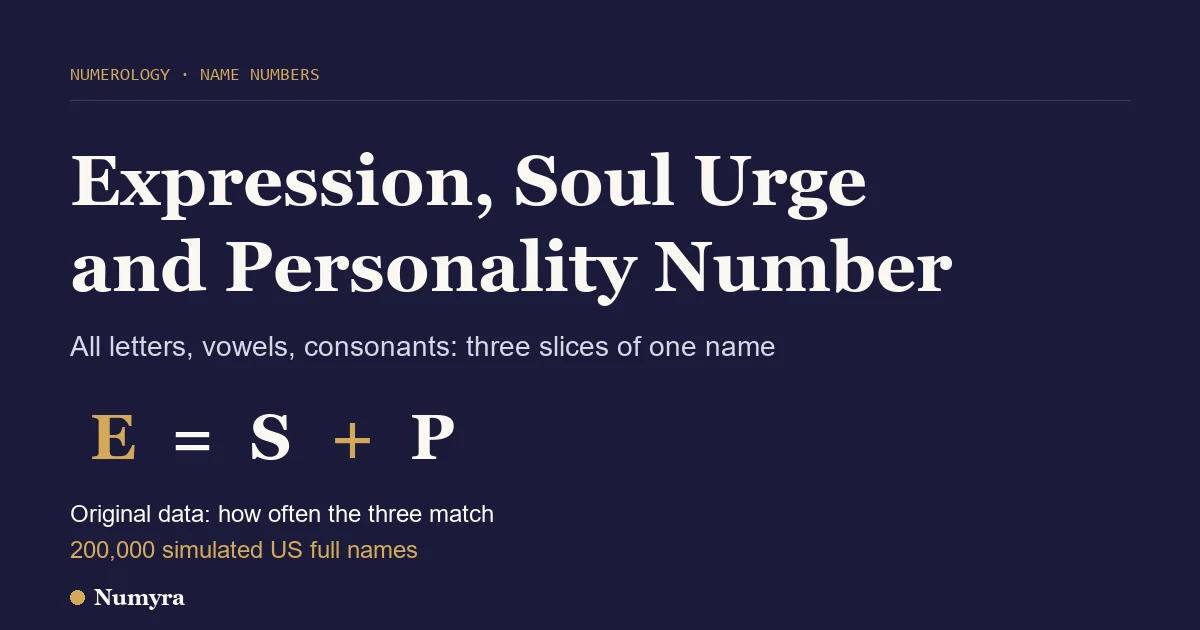
The Expression, Soul Urge and Personality numbers are three readings of the same birth name: Expression adds every letter, Soul Urge adds only the vowels, and Personality adds only the consonants. Because the vowels and consonants together make up the whole name, Expression is always tied to the other two by simple addition, so only two of the three carry independent information. In 200,000 simulated US full names, all three came out equal for just 1.3% of people, and in every one of those cases the number was 9. Numerology is a traditional interpretive system, not a tested science, so treat the readings as prompts for reflection.
Key takeaways
- Letters used: Expression (also called Destiny) uses all letters, Soul Urge (Heart’s Desire) uses vowels, Personality uses consonants. Tradition reads them as abilities, inner motivation and outward impression.
- They are linked by arithmetic: the vowel total plus the consonant total equals the whole-name total, so the digit of your Expression always equals the digit of your Soul Urge plus your Personality.
- Original data: in 200,000 simulated US full names, Expression equals Soul Urge for 10.0%, Expression equals Personality for 11.4% and Soul Urge equals Personality for 10.2%, all close to what chance predicts.
- Matches trace back to 9s: if Expression equals Soul Urge, Personality is a 9; if Expression equals Personality, Soul Urge is a 9; if all three agree, all are 9. Seven in ten names (71.0%) give three different numbers.
- Master numbers move the answer: 32.3% of names carry an 11, 22 or 33 in at least one slot, and reducing each name separately instead of the whole name changes at least one number for 30.2% of people.
In this guide
- The short answer: three slices of one name
- How each number is calculated
- How the three are linked: two numbers fix the third
- How often the three match (original data)
- Master numbers and the two reduction methods
- What a match or a gap is said to mean
- Which number to use for which question
- Frequently asked questions
The short answer: three slices of one name
All three numbers start from your full birth name, including middle names, converted with the Pythagorean letter chart (A, J and S are 1; B, K and T are 2; and so on up to I and R as 9). They differ only in which letters are added. Practitioners then read each slice as answering a different question about you.
| Number | Letters added | Other names | Traditionally read as | Calculator |
|---|---|---|---|---|
| Expression | All letters | Destiny Number | Abilities and potential: what you are equipped to do | Destiny Number calculator |
| Soul Urge | Vowels (A, E, I, O, U, and sometimes Y) | Heart’s Desire | Inner motivation: what you want beneath the surface | Soul Urge Number calculator |
| Personality | Consonants (and Y when it is not a vowel) | None in common use | Outward impression: how others tend to see you first | Personality Number calculator |
On this site the Expression number is called the Destiny Number; the two names refer to the same figure. Published sources use the same three-way split. Numerology.com, for example, lists all three as the core numbers based on your birth name, and the Professional Numerology Association’s short guide sums them up as how you operate, why you do it and how you appear while doing it. Those one-line summaries are the common ground. The rest of this guide covers what most comparison pages leave out: how the three are connected, and how often they actually agree.
How each number is calculated
The method is the same three times over with one change, which letters you include. The steps below follow Numyra’s rules, which are the rules in our methodology and in all three calculators: Pythagorean values, with 11, 22 and 33 kept as master numbers instead of being reduced further.
- Write out the full birth name and give every letter its Pythagorean value.
- Sort the letters into vowels (A, E, I, O, U) and consonants. The letter Y is a vowel only when no other vowel sits next to it in the same word; next to a vowel, it is a consonant.
- Add three totals: every letter (Expression), vowels only (Soul Urge), consonants only (Personality).
- Reduce each total by adding its digits until one digit is left, unless it lands on 11, 22 or 33.
Here is one fictional name, Kayla Tyler Brooks. The Y in Kayla sits next to an A, so it is a consonant. The Y in Tyler sits between T and L, so it is a vowel. The vowels add to 26 (1 + 1 + 7 + 5 + 6 + 6) and reduce to 8, the Soul Urge. The consonants add to 40 and reduce to 4, the Personality. All letters add to 66, which is 26 + 40, and reduce to 12 and then 3, the Expression. You can look up the readings for this name’s three numbers in the profiles for Destiny Number 3, Soul Urge Number 8 and Personality Number 4.
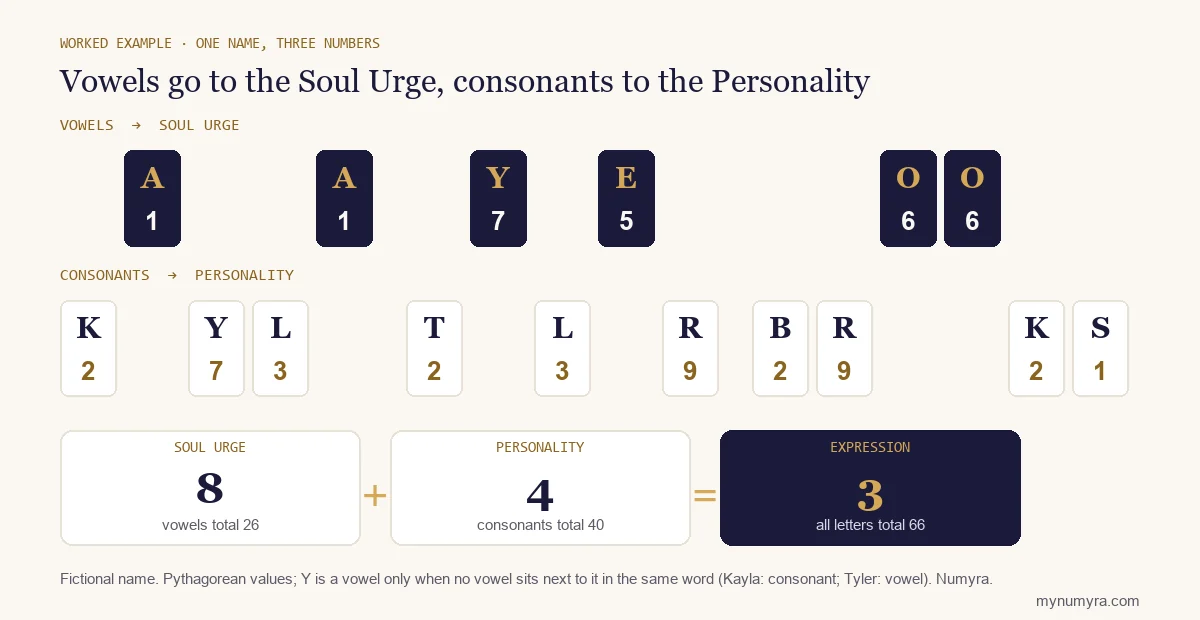
For the full hand-calculation routine, including the Life Path number that comes from your birth date, see our guide to calculating a full numerology chart by hand. Systems with different letter values give different results; the Pythagorean versus Chaldean comparison explains why.
How the three are linked: two numbers fix the third
Every letter in a name is either a vowel or a consonant, so the whole-name total is always the vowel total plus the consonant total. In the Kayla Tyler Brooks example, 26 + 40 = 66. A page from Numato makes the same point and uses it as an arithmetic check on a worked example. Reduced numbers follow the same rule, with one adjustment: the digit of the Expression always equals the digit of the Soul Urge plus the Personality. It holds in every one of the 200,000 names we tested, under both reduction methods described below.
Three practical consequences follow, and we confirmed each in the simulated names.
- Expression equals Soul Urge only when Personality is 9. Adding 9 to a number never changes its digit, so Expression and Soul Urge can only share a digit if the consonants contribute a 9. Every match in our sample had a Personality of 9.
- Expression equals Personality only when Soul Urge is 9, for the same reason. Again, every match had a Soul Urge of 9.
- Soul Urge equals Personality does not force a 9, but it does force the Expression: it is double the shared number, reduced. Two 4s give an Expression of 8; two 7s give 14, which reduces to 5.
The table below turns the rule into a lookup. Find your Soul Urge down the side and your Personality across the top. The large digit is the Expression number those two imply, and the small figure is the share of the simulated names that fall in that pair. To keep the grid readable, 11 is shown as 2, 22 as 4 and 33 as 6; the next sections explain how master numbers change the final answer.
| Soul Urge \ Personality | 1 | 2 | 3 | 4 | 5 | 6 | 7 | 8 | 9 |
|---|---|---|---|---|---|---|---|---|---|
| 1 | 2 1.32% |
3 1.32% |
4 1.31% |
5 1.33% |
6 1.30% |
7 1.30% |
8 1.35% |
9 1.29% |
1 1.28% |
| 2 | 3 1.18% |
4 1.18% |
5 1.16% |
6 1.20% |
7 1.13% |
8 1.17% |
9 1.20% |
1 1.19% |
2 1.20% |
| 3 | 4 1.15% |
5 1.12% |
6 1.21% |
7 1.07% |
8 1.17% |
9 1.16% |
1 1.14% |
2 1.14% |
3 1.17% |
| 4 | 5 1.27% |
6 1.24% |
7 1.31% |
8 1.23% |
9 1.27% |
1 1.26% |
2 1.26% |
3 1.23% |
4 1.28% |
| 5 | 6 1.36% |
7 1.28% |
8 1.31% |
9 1.32% |
1 1.31% |
2 1.32% |
3 1.33% |
4 1.28% |
5 1.33% |
| 6 | 7 1.28% |
8 1.21% |
9 1.24% |
1 1.26% |
2 1.27% |
3 1.24% |
4 1.22% |
5 1.26% |
6 1.25% |
| 7 | 8 1.13% |
9 1.08% |
1 1.17% |
2 1.13% |
3 1.13% |
4 1.13% |
5 1.17% |
6 1.14% |
7 1.12% |
| 8 | 9 1.21% |
1 1.24% |
2 1.17% |
3 1.22% |
4 1.19% |
5 1.22% |
6 1.21% |
7 1.19% |
8 1.21% |
| 9 | 1 1.26% |
2 1.36% |
3 1.33% |
4 1.28% |
5 1.32% |
6 1.32% |
7 1.34% |
8 1.31% |
9 1.29% |
You can use the table, or the plain arithmetic, as a self-check. Calculate your three numbers, add your Soul Urge digit to your Personality digit, reduce, and compare with your Expression digit. If they disagree, a letter was filed under the wrong list, and as the Numato page notes, it is usually a Y. This check works on digits, so a master number such as 11 should be treated as 2 when you run it. Run on the final numbers instead, the shortcut still reproduces the Expression for 94.5% of names, and it fails only when a master number sits in one of the three slots.
How often the three match (original data)
None of the comparison pages we read says how often the three numbers agree. Several describe a match as unusual or meaningful without counting, so we counted. Our calculator pages already show how common each single number is; the comparison below is about how the three behave together, and it does not repeat those tables. See the distribution for each number on the Destiny, Soul Urge and Personality calculator pages.
Sample and method. We simulated 200,000 American full names with a first, middle and last name. First and middle names were drawn in proportion to Social Security Administration baby-name frequencies for 1950 to 2008, and surnames in proportion to the Census Bureau’s surname list. Every name was run through the same rules the calculators use. This is a simulation, not a count of real people: the three parts of each name were drawn independently, so real-world correlations between first names and surnames are not captured, and the results describe typical US names rather than any individual.
| Comparison | Observed | Expected by chance | What drives it |
|---|---|---|---|
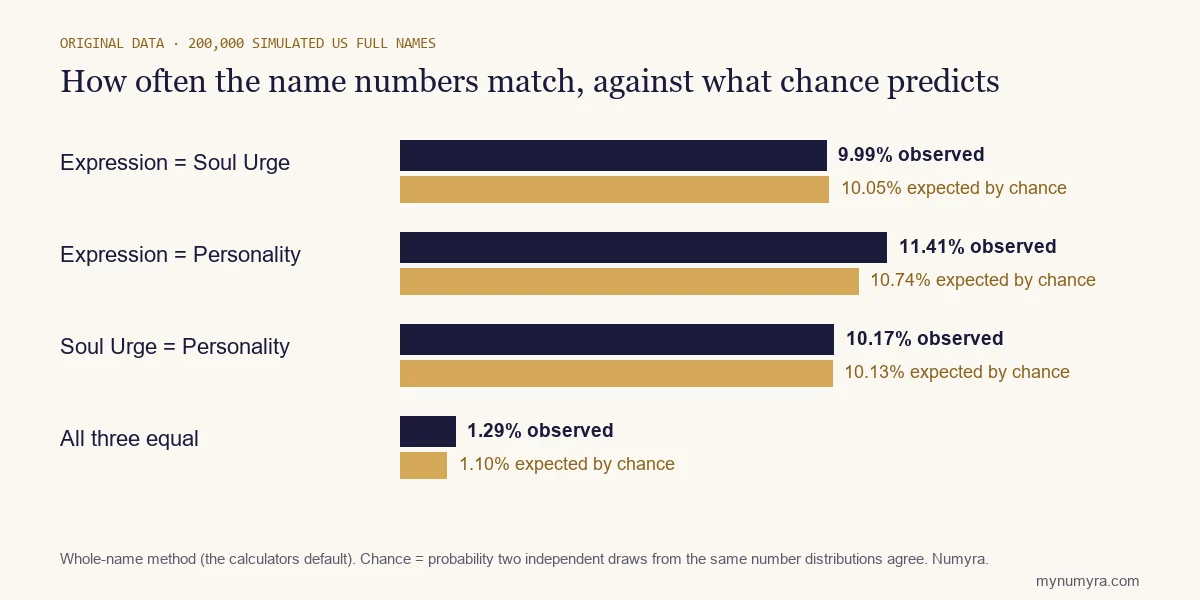
| Expression = Soul Urge | 9.99% | 10.05% | Personality must be 9 |
| Expression = Personality | 11.41% | 10.74% | Soul Urge must be 9 |
| Soul Urge = Personality | 10.17% | 10.13% | Expression is their double |
| All three equal | 1.29% | 1.10% | All three must be 9 |
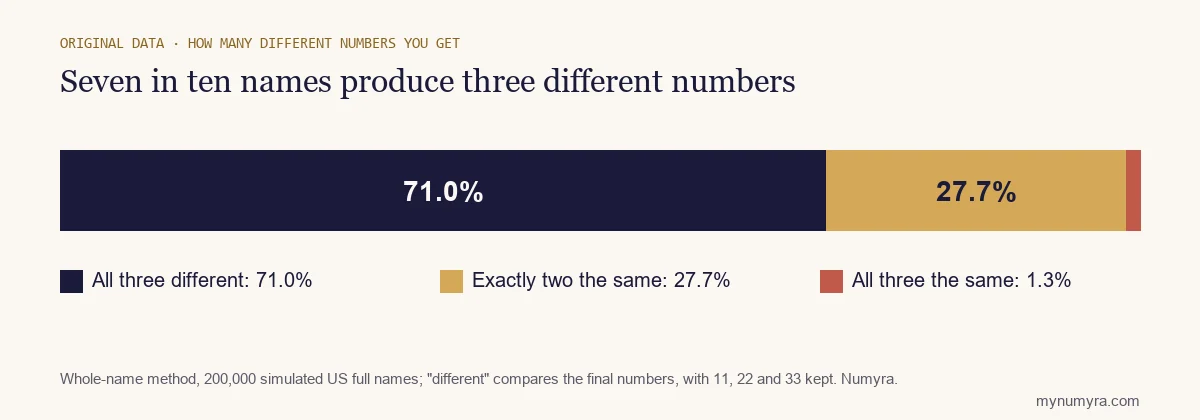
| At least two equal | 29.00% | 1 in 3.4 names | |
| All three different | 71.00% | The usual case |
“Expected by chance” is the chance that two independent numbers with the same distributions would agree. The observed rates sit close to it, which means that the numbers do not attract each other: a high Soul Urge does not make a matching Personality more likely. Matches happen at about the rate that random draws would give, and they cluster on the 9s because arithmetic leaves them no other option.
The split between three different numbers, one pair and a full match looks like this.
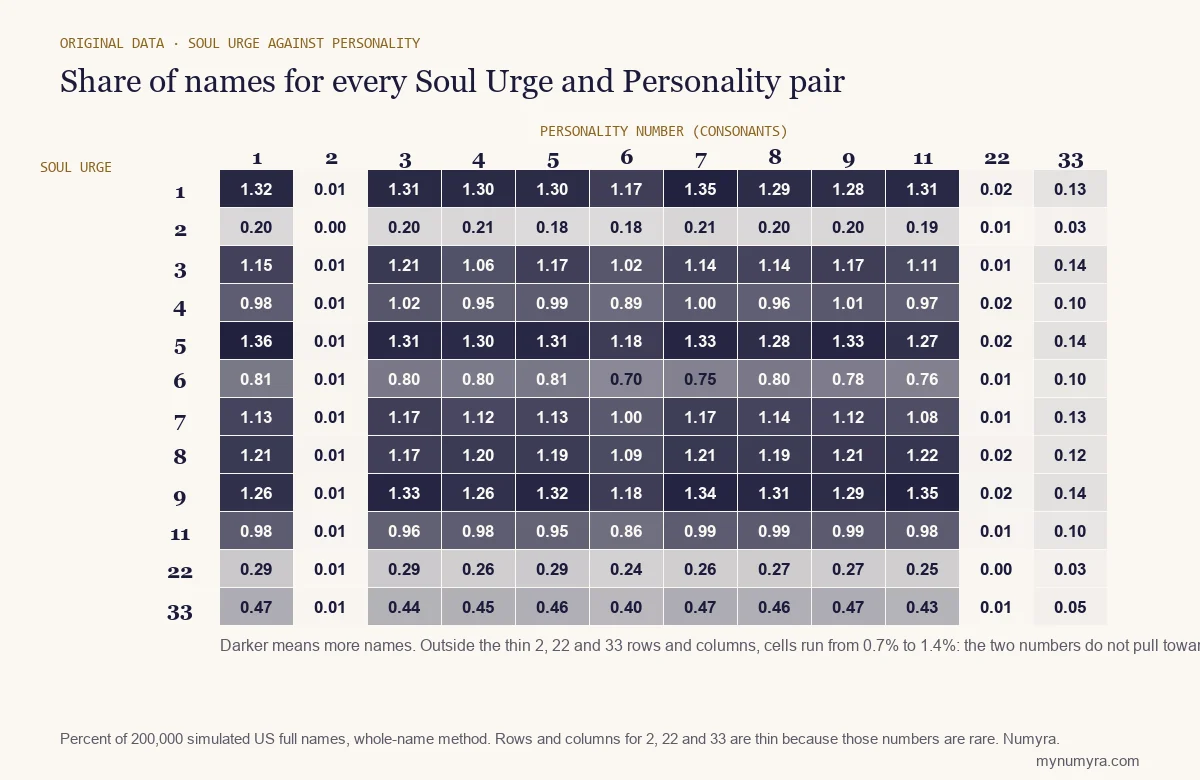
The same picture appears when we plot the pair that is most often compared, Soul Urge against Personality. Each cell below is the share of names with that combination. Cells for the common numbers 1, 3, 4, 5, 6, 7, 8, 9 and 11 all fall between 0.7% and 1.4%, with no diagonal band of extra matches. The thin rows and columns belong to the numbers that are rare in that slot (Personality 2, 22 and 33; Soul Urge 2 and 22), a pattern explained on the calculator pages.
When the names are reduced one part at a time instead (the second method described below), the matches stay close to chance: 9.8% for Expression and Soul Urge, 10.4% for Expression and Personality, 9.9% for Soul Urge and Personality, and 1.3% for all three. At least two numbers agree for 27.5% of names. A full match is one name in 77 under either method, and it is always the number 9.
What this means for a reader: if two of your numbers match, that is not evidence of a strongly unified name, because it mostly reflects a 9 in the third number. If they do not match, you are in the large majority.
Master numbers and the two reduction methods
Master numbers are where the neat arithmetic above gets untidy. Numyra keeps 11, 22 and 33 whenever a total lands on one, but a total can pass through a master number in some orders of addition and miss it in others. Our explainer on master numbers covers why traditions keep them. Three results from the simulation matter here.
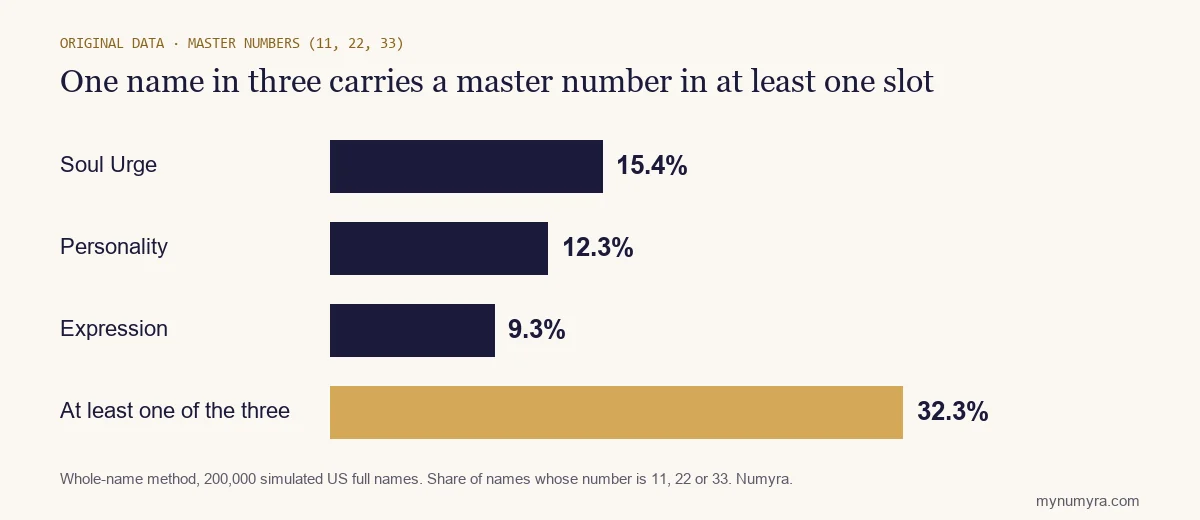
- Master numbers are common in the name numbers. 15.4% of names have a Soul Urge of 11, 22 or 33, 12.3% a Personality, and 9.3% an Expression (almost all of those 11). Altogether 32.3% of names carry at least one master number, and 4.6% carry two.
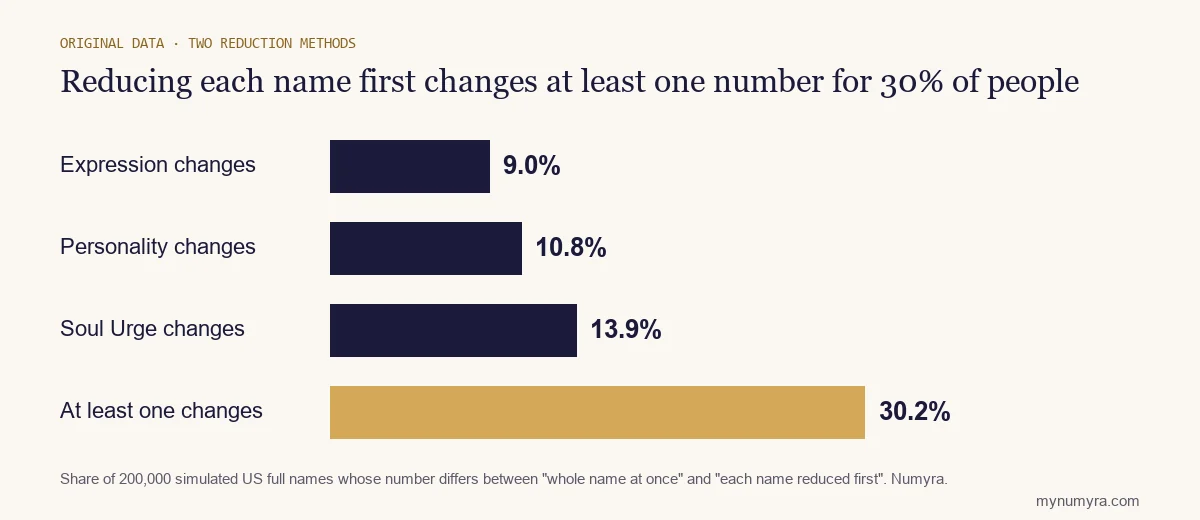
- The two methods disagree about masters, not digits. One method adds every letter of the full name at once. The other reduces the first, middle and last name each on their own, then adds those and reduces again. Our calculators show both. The digit never differs between the two methods, in any of the 200,000 names. What differs is whether a master number appears: the Expression changes for 9.0% of names, the Personality for 10.8% and the Soul Urge for 13.9%, and at least one of the three changes for 30.2%.
- The simple addition check can fail on final numbers. With master numbers in play, Soul Urge plus Personality reduced gives the Expression for 94.5% of names. When none of the three is a master number, that rises to 98.3%; the remaining cases are all one pattern, Soul Urge and Personality adding to exactly 11 while the Expression is the plain digit 2.
Hans Decoz’s World Numerology page takes a firm position on the method for the Soul Urge:
“This is incorrect and will give you the wrong double-digit results”
Hans Decoz, Soul Urge Number/Heart’s Desire, World Numerology, on adding all the vowels of a name at once instead of reducing each name separately
The same page notes that the single-digit result does not change, which matches what we found. Numyra’s calculators show both results side by side so you can see where a master number comes from, and the methodology page explains the difference. If your number looks different on another site, the reduction method is the first thing to check.
A second fictional name shows how this plays out. Kayla Mary Kelly has vowels adding to 22 and consonants to 33, so the whole-name method gives a Soul Urge of 22 and a Personality of 33, with an Expression of 1 (55, then 10, then 1). Reduce each name separately and the vowels give 2, 8 and 3, adding to 13 and then 4, while the consonants give 3, 4 and 8, adding to 15 and then 6. The Expression is 1 either way (5 + 3 + 2 = 10, then 1). The digits agree across methods, since 22 reduces to 4 and 33 to 6, and 4 + 6 = 10 reduces to 1, which is the Expression. Only the master-number labels differ. A name like this is unusual: it falls in the 4.6% with two masters. If it were yours, the Soul Urge 22 and Personality 33 profiles would be the ones to read, with the other method’s profiles for 4 and 6 as the second reading.
What a match or a gap is said to mean
Everything in this section is tradition and interpretation, not something the data above can confirm or refute. Sources read the numbers as layers. One common framing is that Expression is the toolkit, Soul Urge is the private motive and Personality is the public face. When two layers agree, writers tend to say that inner wants and outer presentation point the same way. When they differ, many say the result is a tension worth noticing. One example is the Starnum site’s discussion of a large gap between Personality and Soul Urge, which it says may lead others to misjudge you; the same page frames tension between numbers as useful information rather than a flaw.
The Numato page makes a claim that we can test against the data:
“A tidy match across all three is uncommon”
Numato, Name Numerology: Expression, Soul Urge and Personality Numbers
On the counting, it is: 1.3% of names. It is also a narrow result, because a full match is only possible as three 9s. The same page goes on to say that a full match is not the good result people assume, and that is a reading, not a count. Exactly two numbers matching, which happens for 27.7% of names, is a weak signal, since our sample shows it follows from a 9 in the third number and not from the name being unusually coherent.
Two cautions apply to any reading built on these comparisons. First, with two numbers fixing the third, the three do not give three independent pieces of information, however the sources describe them. Second, a gap between Soul Urge and Personality is the normal case for seven in ten names, so a mismatch by itself says little about a person. Numerology has not been validated as a measure of character or ability, so use the comparison as a prompt for reflection, not a verdict.
Which number to use for which question
If you are deciding what to look at first, match the question to the slice of the name. The mapping below is the traditional one.
| If you are asking | Start with | Why |
|---|---|---|
| What am I good at, and what is my potential? | Expression | Every letter counts, so it is read as the broadest picture of capacity. |
| What do I really want, and why do certain choices feel empty? | Soul Urge | Vowels are read as the private, inner layer. |
| How do people tend to see me when we first meet? | Personality | Consonants are read as the outward layer. |
| Do my inner wants and outer image line up? | Soul Urge against Personality | These are the two halves of the name; the Expression is their sum. |
| Which name should I use? | The birth name | Traditional practice uses the full name given at birth, middle names included. |
| What is the name’s number for a baby I am naming? | Expression | It is the figure compared with a Life Path in our baby name numerology guide. |
None of the three describes the path set by your birth date. That is the Life Path number, which you can find with the Life Path calculator. Adding the Life Path to the Expression gives the Maturity Number, covered in our maturity number guide. To see all your name numbers at once, use the name numerology calculator.
Frequently asked questions
What is the difference between the Expression, Soul Urge and Personality numbers?
They use different letters of your full birth name. Expression adds all the letters, Soul Urge adds only the vowels, and Personality adds only the consonants. Tradition reads them as abilities, inner motivation and outward impression.
Is the Expression number the same as the Destiny number?
Yes. Destiny and Expression are two names for the number built from every letter of your full name. This site calls it the Destiny Number.
Is the Soul Urge number the same as the Heart’s Desire number?
Yes. Both names describe the number made from the vowels in your full birth name.
How often do the Expression, Soul Urge and Personality numbers match?
In 200,000 simulated US full names, Expression matched Soul Urge for 10.0% of names, Expression matched Personality for 11.4% and Soul Urge matched Personality for 10.2%. All three matched for 1.3%, and then all three were 9.
Why is my Expression number not the sum of my Soul Urge and Personality?
The digits should agree: the digit of your Soul Urge plus your Personality equals the digit of your Expression. Master numbers can hide this, because 11 behaves like 2, 22 like 4 and 33 like 6 in the check. If the digits still disagree, check where a Y was placed.
Do I use my birth name or my current name?
Traditional practice uses the full name on your birth certificate, middle names included. Some practitioners read a married or chosen name as a second layer on top of the original.
Can the same number appear in all three slots?
Yes, but only as 9. If all three share a digit, that digit has to be 9. Across 200,000 simulated names, every full match was a 9, and it happened for about 1 name in 77.
Is any of this scientifically proven?
No. Numerology is an interpretive tradition, and nothing here is a prediction or professional advice. The counts on this page are arithmetic facts about names, not evidence that the readings describe people.
Sources
- Decoz, Hans. Soul Urge Number/Heart’s Desire. World Numerology. Source of the quoted statement on calculation by vowels, and of the note that the single-digit result does not change.
- Numato. Name Numerology: Expression, Soul Urge and Personality Numbers. Source of the quoted statement on matches, and of the vowel-plus-consonant check.
- Numerology.com. Your Core Numbers in Numerology. Lists Expression, Soul Urge and Personality as the three core numbers based on your birth name.
- Professional Numerology Association. Life Path vs Expression vs Soul Urge vs Personality. Source of the one-line summaries of what each number describes.
- Starnum. Five Core Numerology Numbers in Action. Source of the Personality and Soul Urge gap interpretation described above.
- Hadley Wickham. data-baby-names, a copy of the Social Security Administration baby-name data. First and middle name frequencies, 1950 to 2008, for the simulated names.
- US Census Bureau. Frequently Occurring Surnames from the 2000 Census. Surname frequencies for the simulated names.
- Numyra Methodology Desk. Name-based calculation standard, and the simulation described above: 200,000 names with a fixed random seed, run through the calculators’ exact rules.