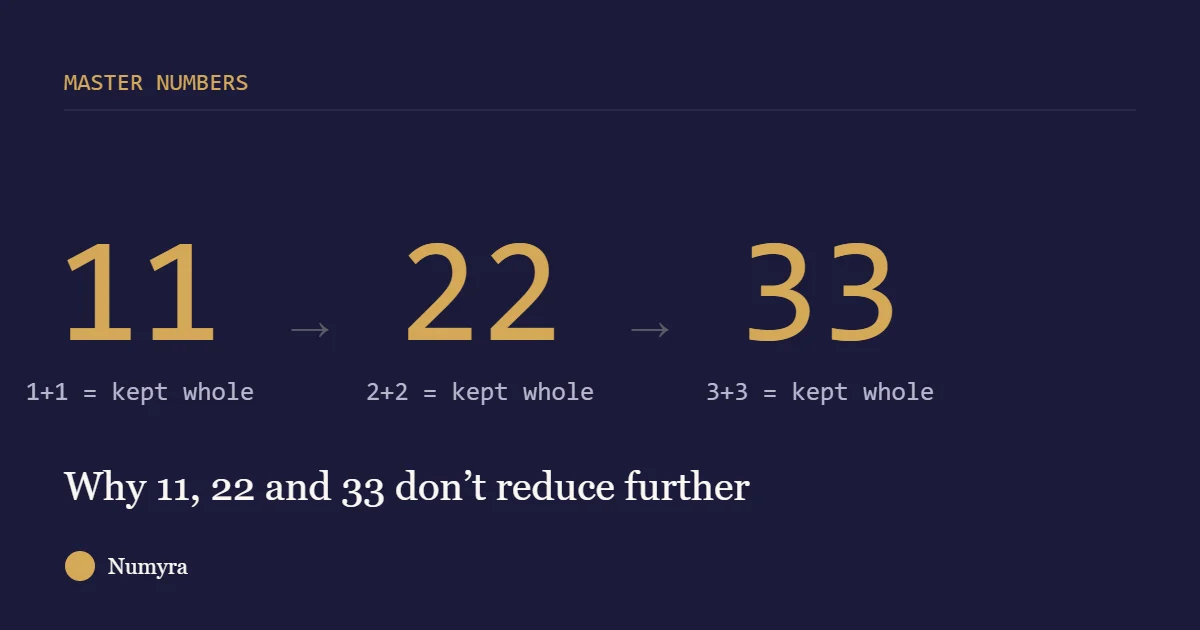
Most numbers in numerology get reduced down to a single digit. Three don’t. Here’s why 11, 22 and 33 are treated differently, and where that convention actually comes from.
Key takeaways
- 11, 22 and 33 are kept whole instead of being reduced further, because each is read as an intensified version of its single-digit root (11→2, 22→4, 33→6) rather than an ordinary instance of that root.
- This is a convention, not a mathematical necessity — some numerologists apply it more strictly than others, especially for 33, the rarest and most debated of the three.
- You’ll sometimes see master numbers described through a “karmic” or “Triangle of Enlightenment” framing. That’s one popular interpretive lens, not a universal rule every numerologist follows — we explain the more basic mechanism first and flag where that framing diverges.
- Nothing here is medical, financial, legal, or psychological advice — a cultural tradition, presented for reflection.
The basic mechanism: doubling, not just repeating
In Pythagorean numerology, almost every number gets reduced by adding its digits together until one digit remains: 47 becomes 4+7=11, which would normally reduce again to 1+1=2. Master numbers are the exception to that second step. When a calculation lands on 11, 22, or 33, the reduction traditionally stops there instead of continuing on to 2, 4, or 6.
The reasoning given for this exception is consistent across most sources: 11, 22 and 33 aren’t read as coincidentally repeated digits, but as their root number’s traits doubled — 11 as an intensified 2, 22 as an intensified 4, 33 as an intensified 6. See our Life Path 11, 22, and 33 profiles for what each of those three individually traditionally describes.
The three master numbers, side by side
| Master number | Root number | Read as | How often discussed |
|---|---|---|---|
| 11 | 2 (The Mediator) | An intensified 2 — heightened intuition and insight | Most common of the three |
| 22 | 4 (The Builder) | An intensified 4 — large-scale, practical ambition | Less common than 11 |
| 33 | 6 (The Nurturer) | An intensified 6 — guidance and service extended outward | Rarest and most debated — see below |
Where this convention actually comes from
Master numbers aren’t part of the classical Pythagorean number philosophy Aristotle describes in the 4th century BCE — that tradition concerned itself with number as the structure of reality generally, not with a specific “don’t reduce these three” rule for name and birth-date calculations. The master-number convention belongs to the much more recent, early-20th-century wave of popular numerology books (the same era that produced the modern Pythagorean letter chart itself — see our Pythagorean vs. Chaldean comparison for that history). Academic treatments of numerology, like mathematician Underwood Dudley’s, describe the practice’s core reduction method as a 20th-century popularization rather than an ancient one — which is worth knowing before assuming “master numbers” are as old as Pythagoras himself.
Why 33 is different from 11 and 22
Of the three, 33 is genuinely the most debated. It requires a specific combination of digits to appear at all, which is part of why it’s discussed far less often than 11 or 22 — and some numerologists apply extra conditions before treating a reduction to 33 as the master number rather than an ordinary 6, while others (including this site’s default convention) keep it whenever it appears, exactly like 11 and 22. We say this plainly on our Life Path 33 profile rather than presenting one convention as the only correct one — it’s a real, unresolved point of disagreement in the tradition, not a settled fact.
The “karmic” and “Triangle of Enlightenment” framing
If you search for master numbers, you’ll quickly run into language about karmic lessons, past lives, and a “Triangle of Enlightenment” linking 11, 22 and 33 as three phases of a creative process. That’s a real, popular interpretive layer — but it’s an addition on top of the basic doubling mechanism, not a substitute for it, and not every numerology source uses it. We’ve deliberately kept our own explanation to the more basic, widely-shared mechanism (doubling of the root number) rather than adopting one specific spiritual framework as though it were the single correct interpretation.
Frequently asked questions
Are there master numbers beyond 33?
Some writers extend the idea to 44 and beyond. Most traditional sources stop at 33, on the reasoning that 1, 2 and 3 (doubled into 11, 22, 33) are the only single digits whose “doubled” form is itself still a two-digit repdigit under 40 — once you reach 44, the underlying logic gets far less consistent across sources.
Does having a master number mean I’m more spiritually advanced?
Most numerology sources, including this one, explicitly reject that framing — a master number is traditionally read as a more intense or higher-pressure version of its root number’s traits, not a ranking of significance.
Can a Personal Year Number be a master number?
On this site, no — our Personal Year Number calculator reduces fully to 1-9, since the nine-year-cycle framing that number is traditionally read through doesn’t accommodate master numbers the way Life Path does. Conventions do vary by calculator and by source.
Sources
- Aristotle. Metaphysics, Book I (A), 985b–986a. Perseus Digital Library. The classical Pythagorean view of number, predating the modern master-number convention.
- Dudley, Underwood. Numerology: Or What Pythagoras Wrought. Mathematical Association of America, 1997. An academic, skeptical treatment of numerology’s actual (20th-century) history.
- Balliett, L. Dow. The Philosophy of Numbers: Their Tone and Colors. 1908. Internet Archive.
- Numyra Methodology Desk. Life Path calculation standard.