Every calculator on this site shows its work. This article shows you how to do that work yourself, by hand, for all four core name-and-birth-date numbers — with two genuinely tricky edge cases worked in full, and each result checkable against our own calculators.
Key takeaways
- A full Pythagorean numerology chart by hand needs just two inputs: your full birth name and your birth date — from those, you can calculate Life Path, Destiny, Soul Urge and Personality numbers.
- Two rules trip up most hand calculations: keeping master numbers (11, 22, 33) unreduced at every stage, and deciding when Y counts as a vowel. Both are worked through in full below.
- Every worked example here uses a real name and real date, computed two ways (by hand, and cross-checked against Numyra’s own calculators) so you can verify each step.
- Nothing here is medical, financial, legal, or psychological advice — a cultural tradition, presented for reflection.
A note on sources: this is a step-by-step calculation walkthrough rather than a historical piece. The letter chart itself comes from L. Dow Balliett’s 1908 The Philosophy of Numbers, quoted below and linked in Sources.
What you need before you start
Two pieces of information, nothing else: your full name exactly as it appears on your birth certificate (not a nickname or married name — see our name-based calculation standard for why), and your birth date. Everything below uses the Pythagorean letter chart, the system this site defaults to — see our Pythagorean vs. Chaldean comparison if you want to run the same name through the older Chaldean system instead.
The letter chart
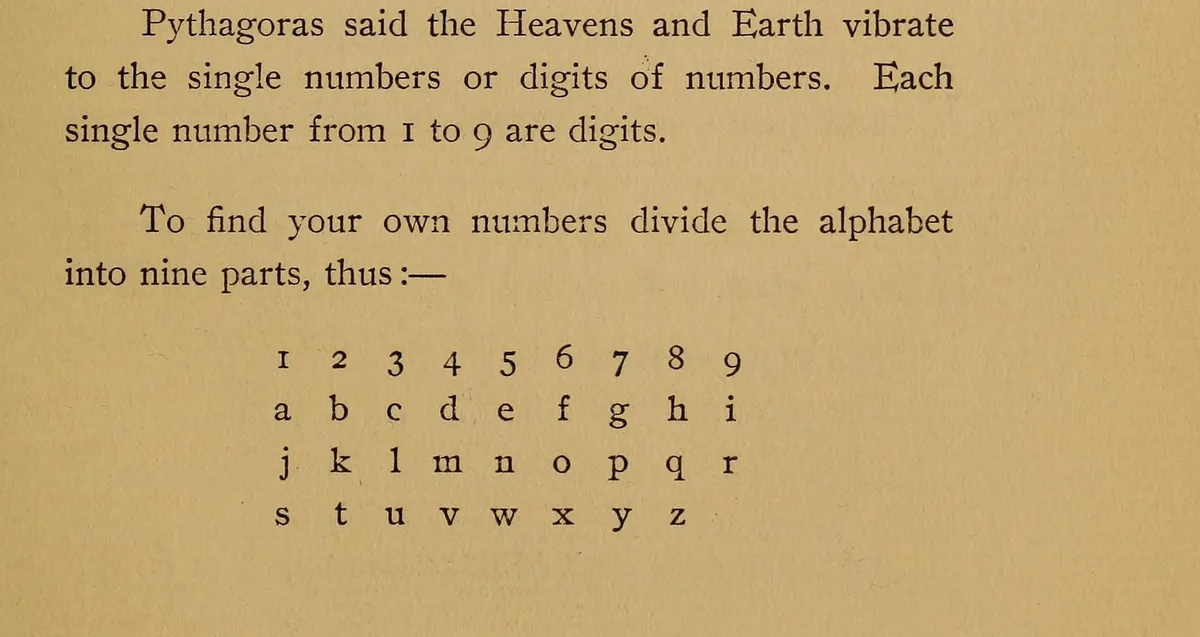
“Pythagoras said the Heavens and Earth vibrate to the single numbers or digits of numbers.”
— L. Dow Balliett, The Philosophy of Numbers (1908), p. 17, introducing the letter chart reproduced below
| Value | Letters |
|---|---|
| 1 | A J S |
| 2 | B K T |
| 3 | C L U |
| 4 | D M V |
| 5 | E N W |
| 6 | F O X |
| 7 | G P Y |
| 8 | H Q Z |
| 9 | I R |
The rule most hand calculations get wrong: master numbers
At every stage of every calculation below, if a sum lands on 11, 22, or 33, stop reducing — keep it as-is rather than continuing on to 2, 4, or 6. See our master numbers article for why. This single rule is where most hand calculations quietly go wrong, because it’s easy to reduce on autopilot.
The other rule: when Y counts as a vowel
Y is a vowel only when no other vowel sits next to it in the same word — otherwise it counts as a consonant. “Sky” has no other vowel next to the Y, so Y is a vowel there. “Bryan” has the Y next to A, a real vowel, so Y counts as a consonant instead. This single rule is the other place hand calculations most often go wrong.
Worked example: Wendy Marie Sky, born November 29, 1901
One name, run through every calculation, with the master-number and Y-as-vowel rules both genuinely in play.
Life Path Number
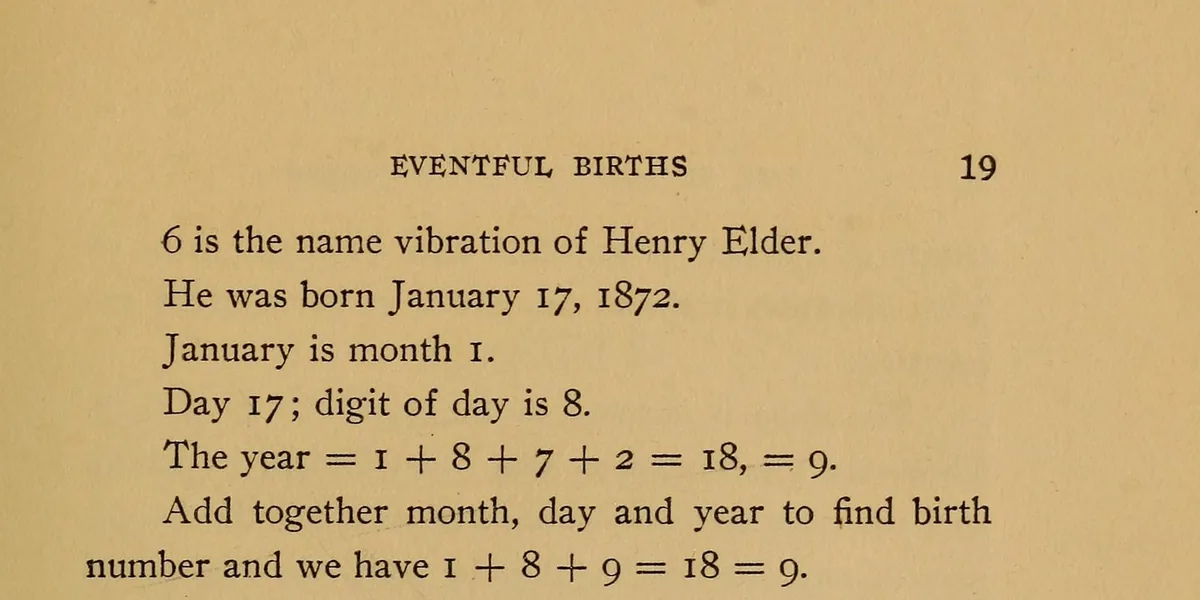
From the birth date alone. Reduce month, day and year separately, keeping any master number that appears at any stage:
| Month | November = 11 → master number, keep as 11 |
| Day | 29 → 2 + 9 = 11 → master number, keep as 11 |
| Year | 1901 → 1 + 9 + 0 + 1 = 11 → master number, keep as 11 |
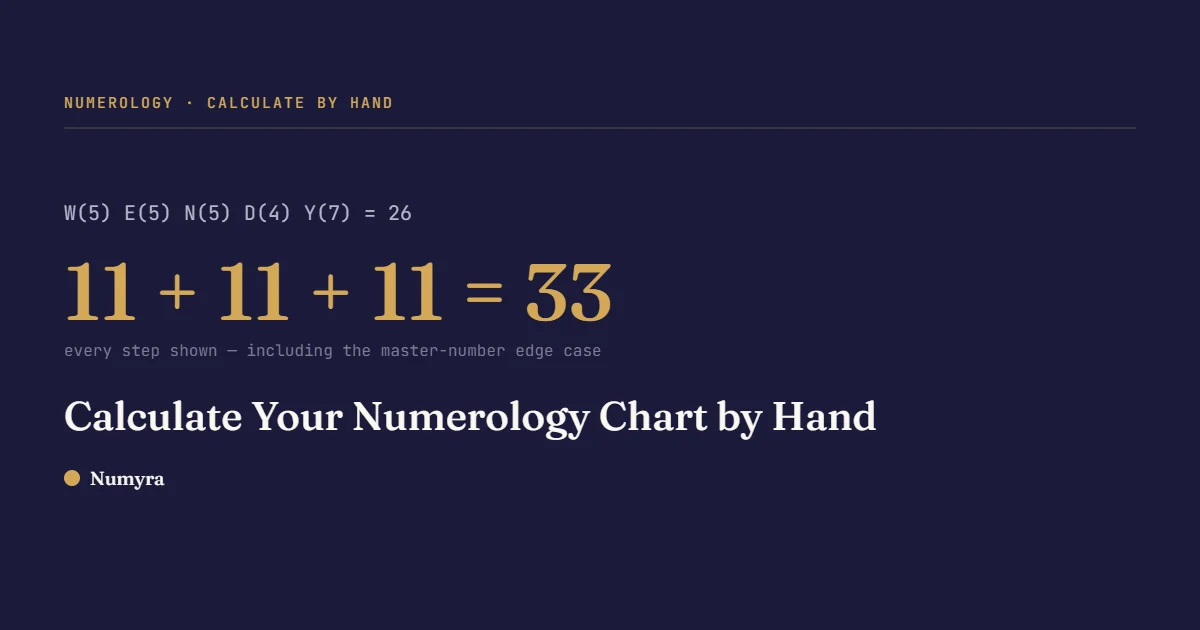
| Total | 11 + 11 + 11 = 33 → already a master number, done |
Life Path = 33, The Master Teacher — a genuine edge case, since all three inputs happened to be master numbers themselves. Check this exact date on our Life Path Number calculator.
Destiny (Expression) Number
From every letter of the full name. Convert each letter using the chart above and add them all:
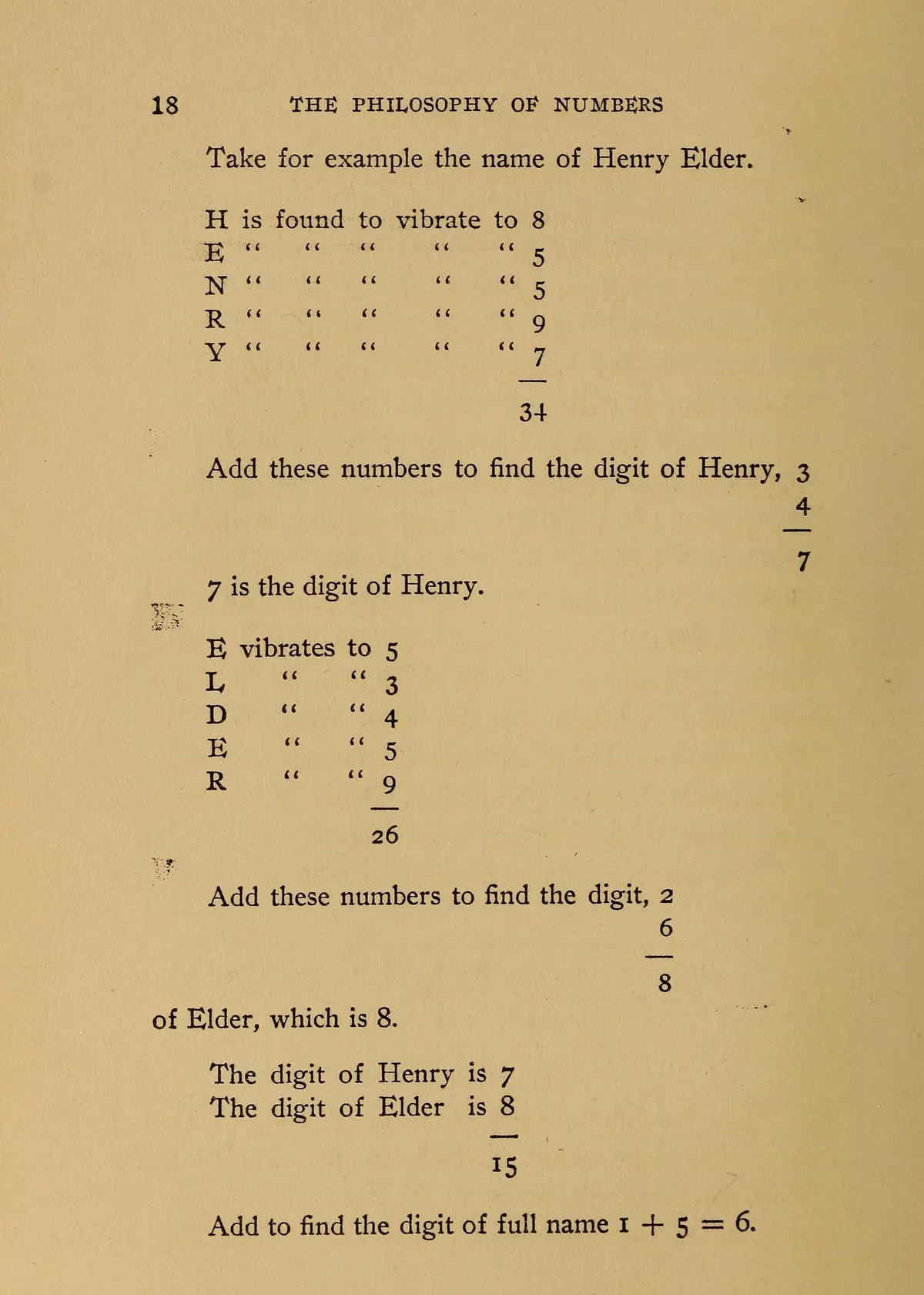
W(5) E(5) N(5) D(4) Y(7) M(4) A(1) R(9) I(9) E(5) S(1) K(2) Y(7) = 64 → 6 + 4 = 10 → 1 + 0 = 1
Destiny = 1. Check any name on our Destiny Number calculator.
Soul Urge (Heart’s Desire) Number — the Y-as-vowel edge case
From only the vowels. This is where the Y rule matters: both Y’s in “Wendy” and “Sky” sit at the end of their word with no adjacent vowel, so both count as vowels here.
E(5) Y(7) A(1) I(9) E(5) Y(7) = 34 → 3 + 4 = 7
Soul Urge = 7. Check any name on our Soul Urge Number calculator.
Personality Number
From only the consonants — everything that wasn’t counted as a vowel above, including both Y’s this time since they were already claimed by the vowel total:
W(5) N(5) D(4) M(4) R(9) S(1) K(2) = 30 → 3 + 0 = 3
Personality = 3. Check any name on our Personality Number calculator, or run all three name-based numbers at once on Name Numerology.
A second worked example: the Y-as-consonant case
To see the opposite Y ruling, take the name “Bryan”: the Y sits between R and A, and A is a real vowel right next to it — so here Y counts as a consonant, not a vowel. Vowels: just A (1). Consonants: B, R, Y, N (2+9+7+5=23→5). This is exactly why the rule is “no adjacent vowel,” not “Y is always a vowel at the end of a word” — the letters immediately next to the Y are what decide it, every time.
Frequently asked questions
Do I use my current name or my birth name?
Your full birth name, exactly as recorded at birth — not a nickname, married name, or shortened version. See our name-based calculation standard for the full rule, including how a legal name change is traditionally handled.
What if my total is already a single digit — do I still “reduce” it?
No further step is needed — reduction only continues while the number is above 9 (or is a master number). A single-digit total is already the final result.
Can a Personal Year Number have a master number too?
No — unlike the four numbers worked through here, our Personal Year Number calculator reduces fully to 1–9 by design. Conventions genuinely vary by number and by source; we state ours explicitly on every calculator page.
Is there a faster way to double-check this by hand?
Enter the same name and date into the matching Numyra calculator (linked after each worked example above) — it runs entirely in your browser and shows the identical step-by-step breakdown, so you can compare your hand calculation line by line.
Do I reduce the month, day and year separately, or add every digit at once?
Separately, then add the three results. That is the method this site uses, and it is the one that keeps a master number appearing in any part. The two methods can disagree: for November 29, 1901, adding every digit at once gives 1+1+2+9+1+9+0+1 = 24 → 6, while reducing each part first gives 11 + 11 + 11 = 33.
Are the Destiny Number and the Expression Number the same thing?
Yes. They are two names for the same number, calculated from every letter of your full birth name, as in the worked example above.
Sources
- Balliett, L. Dow. The Philosophy of Numbers: Their Tone and Colors. 1908. Internet Archive. Origin of the Pythagorean letter chart used throughout this article.
- Numyra Methodology Desk. Name-based calculation standard.
- Numyra Editorial Desk. Why 11, 22 and 33 are treated as master numbers.