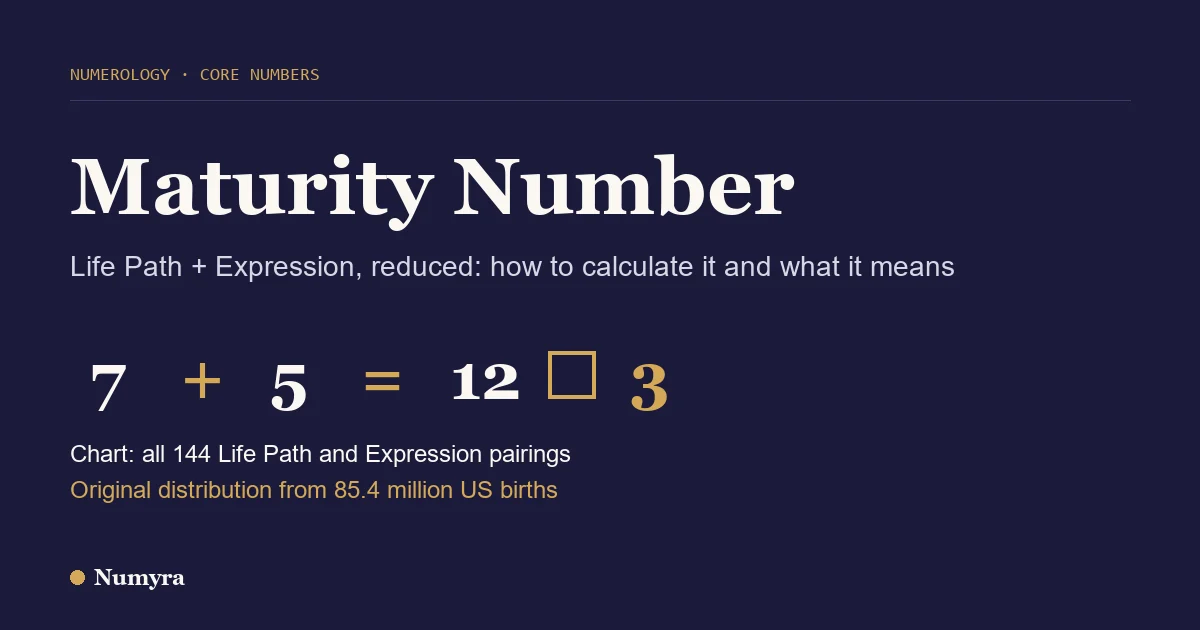
The maturity number in numerology is your Life Path number plus your Expression (Destiny) number, reduced to a single digit or to a master number (11, 22 or 33). Practitioners read it as the energy you grow into in the second half of life, usually said to become noticeable somewhere between the early thirties and around age 40. A Life Path 7 with an Expression 5 gives 7 + 5 = 12, and 1 + 2 = 3, so the maturity number is 3. This is a traditional interpretive system, not a tested science, and the reading is best used as a prompt for reflection.
Key takeaways
- The standard formula is Life Path + Expression, reduced. Numyra keeps 11, 22 and 33 at every stage, as our Life Path and Destiny Number calculators do. The lookup table below gives the answer for all 144 pairings.
- Sources disagree on the age. Hans Decoz writes that the number “doesn’t have much influence until you reach approximately age 35”; another site gives 30 to 40, and a third 30 to 35 as the first signs.
- Original data: across 85.4 million US births from 1994 to 2014 and 300,000 simulated US full names, maturity numbers 1, 3, 5, 7, 8 and 9 each come up 11.1% of the time, but a 2 only 2.9% and a 33 only 0.33%.
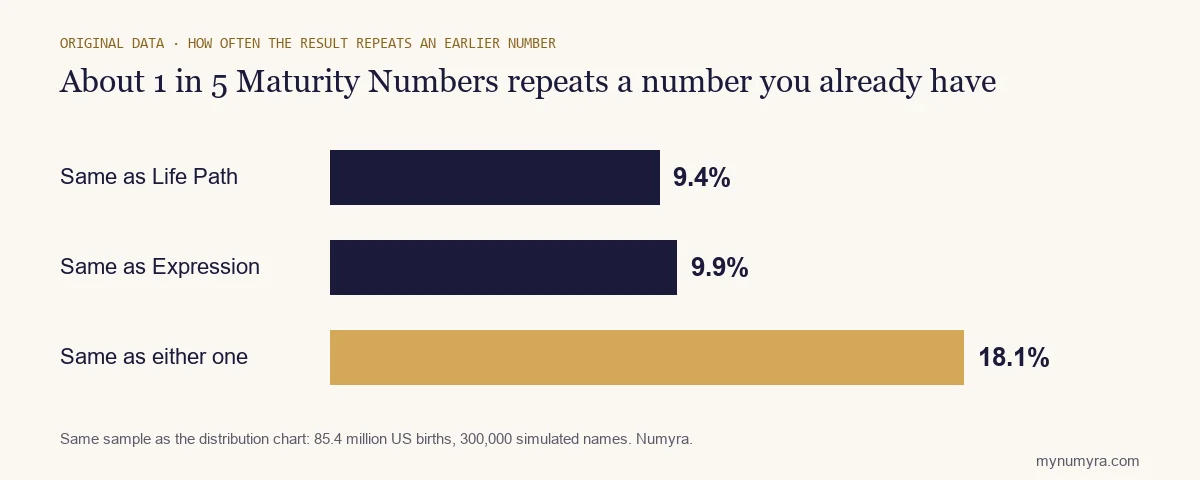
- About 9.05% of maturity numbers are master numbers, and 9.1% of people would get a different answer if masters were not kept. About 1 in 5 (18.1%) repeat their Life Path or Expression number.
- If your Expression is 9, your maturity number matches your single-digit Life Path, because adding 9 never changes the digit sum.
In this guide
- What the maturity number is
- How to calculate your maturity number
- Maturity number lookup table (all 144 pairings)
- When the maturity number is said to activate
- What each maturity number means
- How common each maturity number is (original data)
- Maturity number compared with your other core numbers
- Frequently asked questions
What the maturity number is
The maturity number is a derived number. It does not come from a date or a name on its own: it combines the two figures most numerologists treat as the core of a chart, the Life Path (from your birth date) and the Expression number (from the letters of your full birth name). The tradition behind it is simple. The Life Path is read as the road you are on, the Expression as the abilities you bring to it, and the maturity number as what the two produce once you have had time to use them together.
Hans Decoz, a numerologist whose site publishes reference articles on each core number, describes it as an underlying wish or goal that “gradually surfaces” with age. Other sites describe it as a second Life Path number or a truer self. Those are interpretations, and none has been tested in a study. What can be checked is the arithmetic, and that is where this guide spends most of its time.
How to calculate your maturity number
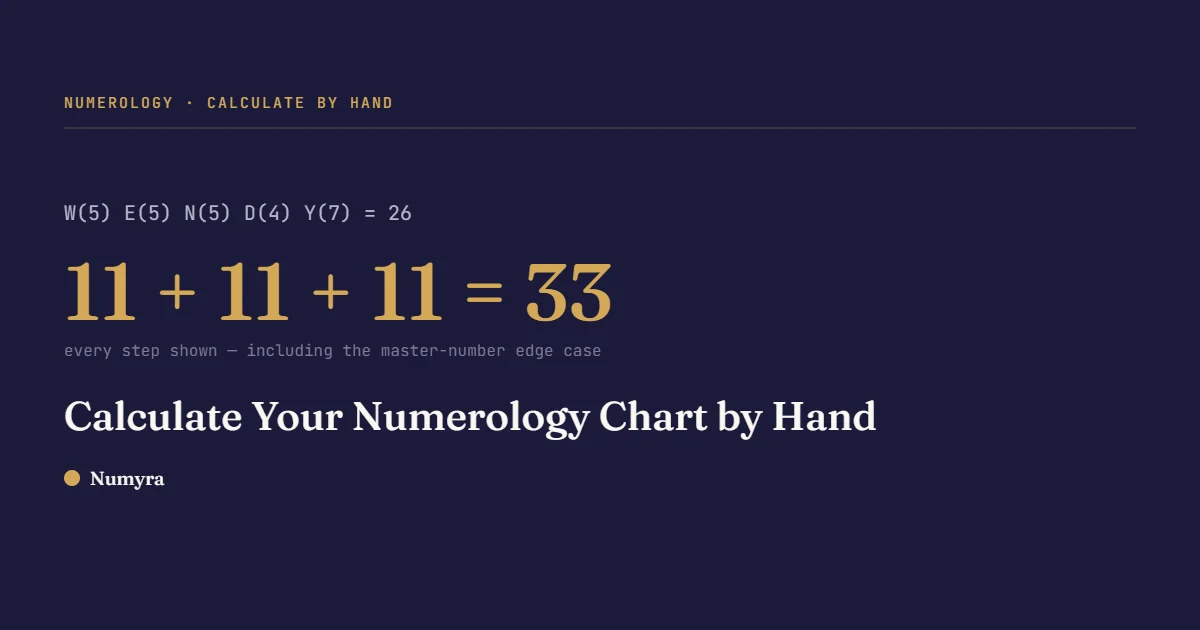
You need three things: your full date of birth, your full name as given at birth, and a Pythagorean letter chart (A, J and S are 1; B, K and T are 2; and so on up to I and R as 9). If you do not have your Life Path and Expression yet, use our Life Path calculator and Destiny Number calculator, or follow the steps in our guide to calculating a full chart by hand. The Destiny Number on this site and the Expression number are the same figure.
- Find your Life Path. Reduce the month, day and year separately, add the three results and reduce again. Master numbers 11, 22 and 33 stop the reduction.
- Find your Expression. Convert every letter of your full birth name to its value, add them all and reduce, again keeping 11, 22 and 33.
- Add the two numbers. Life Path plus Expression gives a raw total.
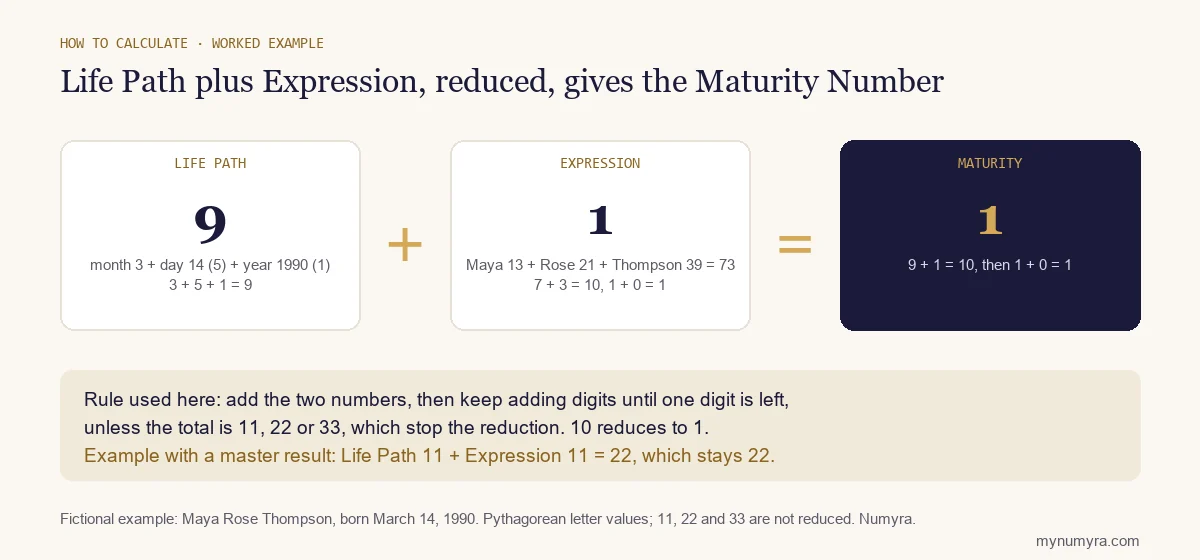
- Reduce the raw total. Add its digits until one digit is left, unless the total is 11, 22 or 33.
Three worked examples (fictional people)
- Maya Rose Thompson, born March 14, 1990. Life Path: 3 + 14 (1 + 4 = 5) + 1990 (1 + 9 + 9 + 0 = 19, then 1 + 9 = 10, then 1) gives 3 + 5 + 1 = 9. Expression: Maya 13 + Rose 21 + Thompson 39 = 73, then 7 + 3 = 10, then 1. Maturity: 9 + 1 = 10, which reduces to 1.
- Noah James Carter, born July 27, 1994. Life Path 3 (7 + 9 + 5 = 21, then 3). Expression: 20 + 12 + 29 = 61, then 7. Maturity: 3 + 7 = 10, then 1.
- Priya Anne Walker, born February 6, 2001. Life Path: 2 + 6 + 3 = 11, kept as the master number 11. Expression: 33 + 16 + 25 = 74, then 7 + 4 = 11, kept. Maturity: 11 + 11 = 22, which is a master number and stays 22.
Why sources disagree on master numbers
Two published rules are in use. Decoz’s page instructs: “To find your Maturity number, add your Life Path number and your Expression number and reduce the total to a single digit.” That wording has no master-number exception. Another widely read page, numerologist.com, reduces to a single digit “unless you hit 11, 22, or 33.” Numyra follows the second rule because it is the rule used everywhere else on the site; the methodology page says master numbers are kept at every stage, and our explainer on master numbers gives the reasoning.
The choice matters more than it looks. Running both rules over the sample described below, 9.1% of people would receive a different maturity number depending on which one is used. If you get an answer that does not match another site, check the master-number rule and whether the name used was the birth name before assuming an error. Systems also differ on letter values; see Pythagorean vs. Chaldean numerology for how much that changes a name number.
One shortcut helps when you check your work. Adding a 9 never changes a digit sum, so if either number is a plain 9, the maturity number equals the other one. A Life Path 6 with an Expression 9 gives 15, then 6.
Maturity number lookup table (all 144 pairings)
Find your Life Path in the left column and your Expression across the top. The cell is your maturity number under the rule above. The table was generated by script, and the worked examples above match it.
| Life Path \ Expression | 1 | 2 | 3 | 4 | 5 | 6 | 7 | 8 | 9 | 11 | 22 | 33 |
|---|---|---|---|---|---|---|---|---|---|---|---|---|
| 1 | 2 | 3 | 4 | 5 | 6 | 7 | 8 | 9 | 1 | 3 | 5 | 7 |
| 2 | 3 | 4 | 5 | 6 | 7 | 8 | 9 | 1 | 11 | 4 | 6 | 8 |
| 3 | 4 | 5 | 6 | 7 | 8 | 9 | 1 | 11 | 3 | 5 | 7 | 9 |
| 4 | 5 | 6 | 7 | 8 | 9 | 1 | 11 | 3 | 4 | 6 | 8 | 1 |
| 5 | 6 | 7 | 8 | 9 | 1 | 11 | 3 | 4 | 5 | 7 | 9 | 11 |
| 6 | 7 | 8 | 9 | 1 | 11 | 3 | 4 | 5 | 6 | 8 | 1 | 3 |
| 7 | 8 | 9 | 1 | 11 | 3 | 4 | 5 | 6 | 7 | 9 | 11 | 4 |
| 8 | 9 | 1 | 11 | 3 | 4 | 5 | 6 | 7 | 8 | 1 | 3 | 5 |
| 9 | 1 | 11 | 3 | 4 | 5 | 6 | 7 | 8 | 9 | 2 | 4 | 6 |
| 11 | 3 | 4 | 5 | 6 | 7 | 8 | 9 | 1 | 2 | 22 | 33 | 8 |
| 22 | 5 | 6 | 7 | 8 | 9 | 1 | 11 | 3 | 4 | 33 | 8 | 1 |
| 33 | 7 | 8 | 9 | 1 | 11 | 3 | 4 | 5 | 6 | 8 | 1 | 3 |
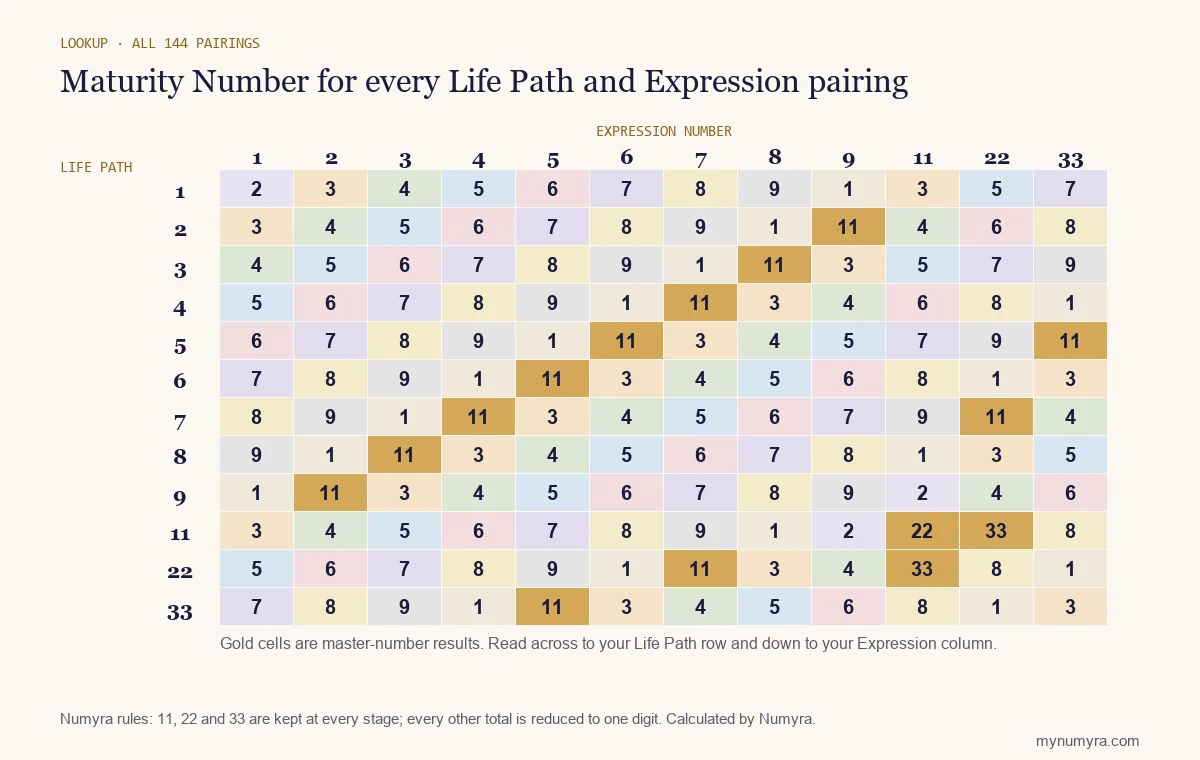
Reading the table shows a pattern the competing pages do not mention: the number 11 appears only when the raw total is 11, 29 or 38 , 22 appears only for Life Path 11 plus Expression 11, and 33 only for Life Path 22 plus Expression 11 (or the reverse). In the sample below, 22 shows up as a maturity number for 0.55% of people and 33 for 0.33%.
When the maturity number is said to activate
No page we read agrees on an exact age, and none offers evidence for one. The most-cited statement comes from Decoz’s article on the number:
“The Maturity Number doesn’t have much influence until you reach approximately age 35.”
Hans Decoz, The Maturity Number, World Numerology
The same page says the underlying wish “gradually surfaces around age thirty to thirty-five” and that the influence deepens after 35, around the time of the Second Pinnacle cycle. A different site puts the stretch later:
“Your Maturity Number shows the possibilities, wants, desires and chances that you’ll have in a period from 30 to 40 years of your life, after 40 years the influence of this number will grow stronger gradually.”
Maturity number, Numerology Center
Numerologist.com says it begins to register “somewhere between ages 30 and 35,” then strengthens through the forties and fifties. That page names Kevin Quinn Avery’s The Numbers of Life in the same section but gives no quotation or page number for an age, and we could not check the book. We also could not trace who first attached an age to the maturity number, so this guide attributes none.
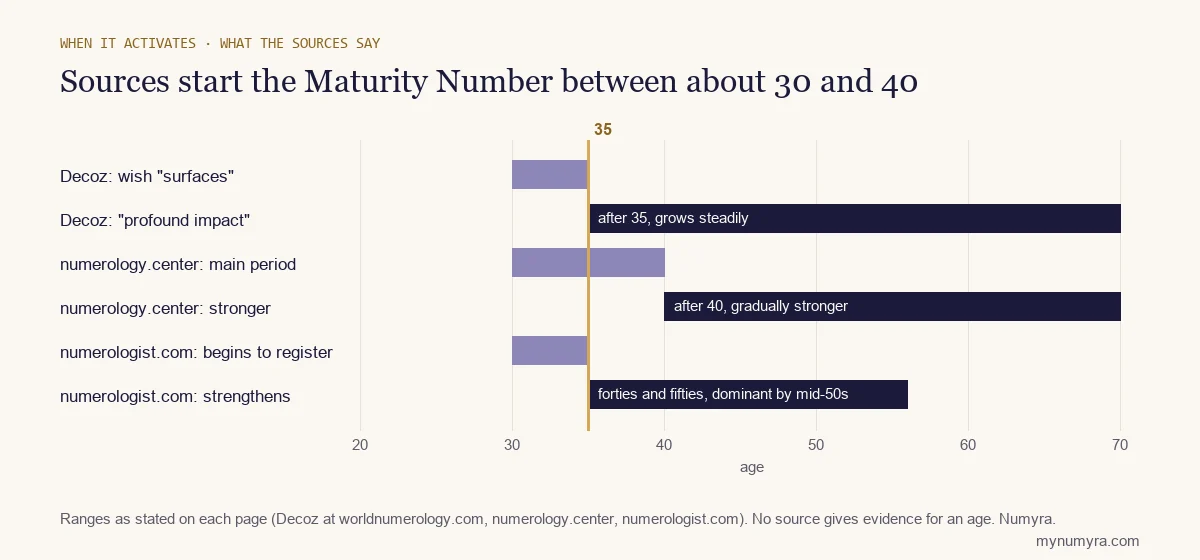
The practical reading is a range, not a switch: roughly 30 to 40 for the first signs, with the number described as stronger after 40. People tend to link it to changes of direction around midlife (compare the Uranus opposition, the astrological midlife transit), and that link is a matter of interpretation. If you are younger, the number is still the one your chart will produce; the tradition only says it will matter more later.
What each maturity number means
These are the traditional readings in our own words, drawn from the common themes across numerology sources. Read each as a tendency to reflect on, not a forecast.
Maturity number 1
Read as a pull toward independence and self-direction later in life: starting something of your own, taking responsibility for a vision. The caution is isolation presented as self-reliance.
Maturity number 2
Associated with partnership, patience and listening. The tradition says the second half of life favors cooperation over going it alone. The caution is deferring so much that your own view disappears.
Maturity number 3
Linked to expression: writing, speaking, art, humor and social life. Late creative energy is the usual image. The caution is scattering that energy across too many projects.
Maturity number 4
Read as a turn toward structure, routine, financial order and long projects that need daily effort. The caution is rigidity.
Maturity number 5
Linked to change, travel and the wish to loosen older routines. The tradition describes freedom as the theme. The caution is restlessness that drops commitments too easily.
Maturity number 6
Associated with care for family and community, and with making a home or a group work. The caution is giving until nothing is left for yourself.
Maturity number 7
Read as a turn inward: study, solitude, reflection, spiritual or intellectual practice. The caution is withdrawing so far that other people lose access to you.
Maturity number 8
Linked to ambition, management and money, and to the question of how to use power well. The caution is chasing results at the expense of relationships.
Maturity number 9
Associated with generosity and a wider circle of concern: teaching, service, giving back. The tradition also says it involves letting go of goals that once mattered. The caution is caring for everyone in general and no one in particular.
Maturity number 11 (master number)
Read as a stronger, more intuitive version of the 2: sensitivity, inspiration, counseling or teaching roles. The caution is nervous tension from taking on other people’s moods. It is common in our sample (8.2%), because many raw totals land on 11.
Maturity number 22 (master number)
Read as a stronger version of the 4: a practical builder with large aims. It requires a Life Path 11 and an Expression 11, so only 0.55% of people in the sample have it. The caution is a vision larger than the resources to build it.
Maturity number 33 (master number)
Read as a stronger version of the 6: devoted service, teaching and care at scale. It is the rarest result in the sample (0.33%). The caution is self-sacrifice.
How common each maturity number is (original data)
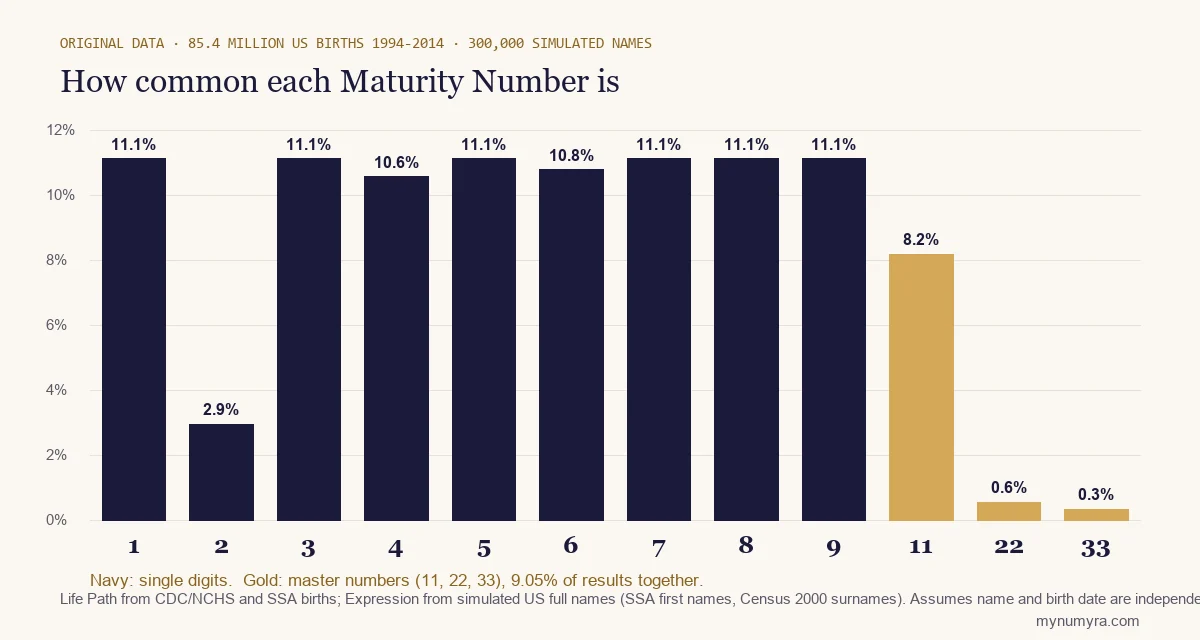
None of the pages we read says how often each maturity number occurs, so we calculated it. The method: Life Path numbers were counted from 85.4 million actual US births from 1994 to 2014 (CDC National Center for Health Statistics for 1994 to 2003, Social Security Administration for 2004 to 2014, as compiled by FiveThirtyEight), each date weighted by the number of babies born that day. Expression numbers came from 300,000 simulated full names, with first and middle names drawn at random by their real popularity in Social Security baby-name lists for babies born 1994 to 2008 and surnames drawn by their real frequency in the 2000 Census. We then combined the two distributions under the rule above.
What this is not: it is not a survey of anyone’s actual name and birth date. The names are simulated, and the calculation assumes a person’s name and birth date are independent, which is reasonable but unproven. It covers the United States only, and it applies Pythagorean letter values. It also uses only first, middle and last names, with no suffixes or later name changes.
| Number | Life Path | Expression | Maturity |
|---|---|---|---|
| 1 | 11.14% | 11.22% | 11.11% |
| 2 | 5.23% | 1.70% | 2.94% |
| 3 | 11.12% | 11.12% | 11.11% |
| 4 | 7.54% | 11.15% | 10.56% |
| 5 | 11.08% | 11.14% | 11.11% |
| 6 | 10.79% | 11.13% | 10.78% |
| 7 | 11.12% | 11.09% | 11.11% |
| 8 | 11.10% | 11.05% | 11.11% |
| 9 | 11.12% | 11.12% | 11.11% |
| 11 | 5.89% | 9.29% | 8.17% |
| 22 | 3.59% | 0.00% | 0.55% |
| 33 | 0.29% | 0.01% | 0.33% |
Three results stand out. First, a maturity 2 is rare (2.9%), because under the master-number rule only two raw totals reduce to 2 (2 and 20); a total of 11 or 29 is kept as 11 instead. As a result, a maturity number of 11 is nearly three times as likely as a 2. Second, Expression 22 never occurred in the 300,000 names and Expression 33 occurred 16 times, because a full name usually adds up to a large raw total that must hit 22 or 33 exactly. Third, 9.05% of maturity numbers are master numbers: 8.17% for 11, 0.55% for 22 and 0.33% for 33.
Maturity number compared with your other core numbers
The maturity number is the only core number built out of two others, so it is the most likely to repeat one of them. Under the rule here, 9.4% of people get a maturity number equal to their Life Path, 9.9% equal to their Expression, and 18.1% equal to at least one. Numerologist.com makes the same point qualitatively, saying the number can repeat a core number and “intensifies that energy.”
The comparison with other numbers is simple. For how the three name numbers relate to each other, see Expression vs Soul Urge vs Personality. The Life Path (birth date) is the route; the Expression or Destiny number (full name) is the toolkit; the Soul Urge number (vowels only) describes inner motivation. The maturity number is the sum of the first two, so it carries no new input: change your name and your maturity number changes with it. If you are choosing a name for a child, our guide to baby name numerology shows how a name number relates to a Life Path. For a cycle you can track year by year, use the Personal Year number.
Numerology is a symbolic tradition. Nothing in this guide, including the age ranges and meanings, is scientifically validated or a prediction, and our disclaimer applies. How we calculate is set out on the methodology page.
Frequently asked questions
How do you calculate the maturity number in numerology?
Add your Life Path number and your Expression (Destiny) number, then reduce the total to a single digit, keeping 11, 22 and 33. For example, 7 + 5 = 12, and 1 + 2 = 3.
At what age does the maturity number activate?
Sources differ. Hans Decoz says it has little influence until about 35 and surfaces around 30 to 35; Numerology Center gives 30 to 40 with stronger influence after 40. No source offers evidence for an age.
Is the maturity number the same as the destiny number?
No. The destiny (Expression) number comes only from your name. The maturity number is the sum of your Life Path and Expression numbers, reduced.
Should I keep master numbers 11, 22 and 33 when I calculate it?
Numyra does, at every stage, in line with the rest of the site. Decoz’s published instruction reduces to a single digit, and about 9.1% of people get a different result under that rule, so check which rule a source uses.
Can my maturity number be the same as my Life Path number?
Yes. In our sample it matches the Life Path 9.4% of the time and the Expression number 9.9% of the time. It always matches a single-digit Life Path when the Expression is 9.
Which maturity number is the rarest?
33, at 0.33% in our sample, then 22 (0.55%) and 2 (2.9%). The single digits 1, 3, 5, 7, 8 and 9 each appear about 11.1% of the time.
Does the maturity number change if I change my name?
Traditionally the Expression uses the full name given at birth, so a later name change is read separately. If you calculate with a changed name, the Expression and therefore the maturity number will differ.
Is the maturity number scientifically proven?
No. It is an interpretive tradition with no tested evidence behind its meanings or its age ranges. Treat it as a prompt for reflection, not as a prediction.
Sources
- Decoz, Hans. The Maturity Number. World Numerology. Source of the calculation wording and the age-35 statement quoted above.
- Numerology Center. Maturity number. Source of the 30-to-40 age statement.
- Andrews, Blair. The Maturity Number in Numerology. Numerologist.com. Cited for the master-number rule and the 30-to-35 range.
- FiveThirtyEight. US births data, 1994 to 2014, from the CDC National Center for Health Statistics and the Social Security Administration. Life Path counts.
- Hadley Wickham. data-baby-names, a copy of the Social Security Administration top-1000 baby name lists. First and middle name frequencies for the simulated names.
- US Census Bureau. Frequently Occurring Surnames from the 2000 Census. Surname frequencies for the simulated names.