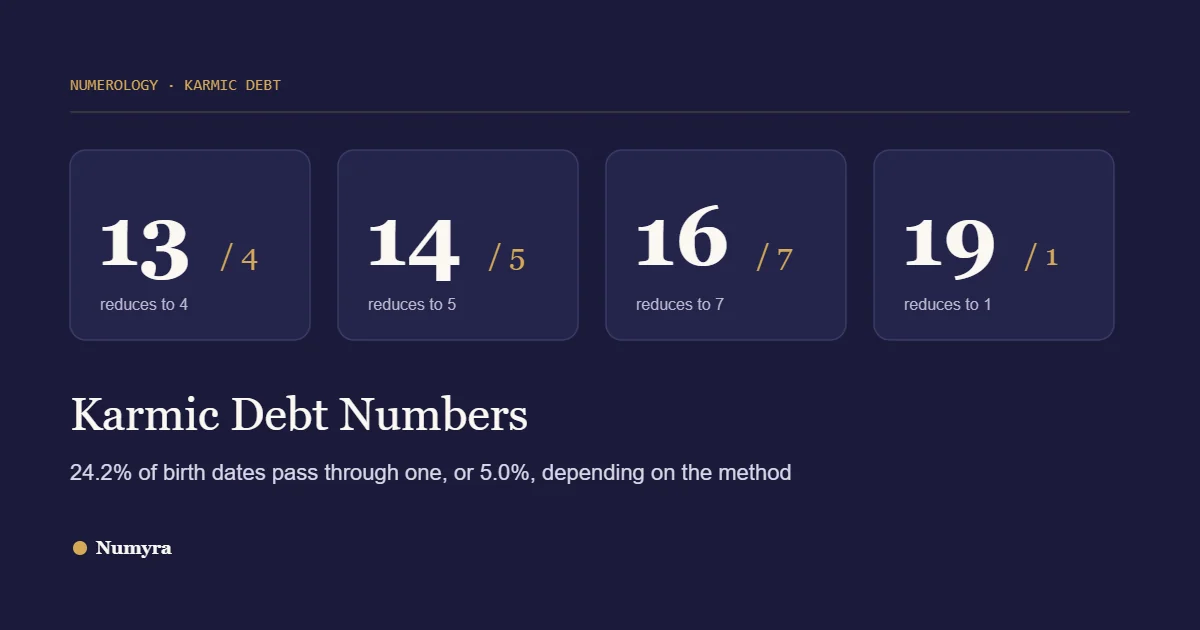
Karmic debt numbers are 13, 14, 16 and 19. In modern numerology, if one of them appears as a step on the way to one of your core numbers (including your maturity number), it is read as a lesson carried over from a past life. Whether you “have” one depends heavily on how the sum is done, and the sources disagree more than most pages admit.
Key takeaways
- The four karmic debt numbers are 13, 14, 16 and 19, usually written 13/4, 14/5, 16/7 and 19/1 to show the single digit each one reduces to.
- The method decides the answer. We ran every date from 1950 to 2009: 24.2% pass through a karmic debt number when month, day and year are reduced separately, but only 5.0% when all the digits are added at once.
- Sources disagree on where to look: the birthday only, the Life Path only, five core numbers, or every position including yearly cycles.
- The idea is modern. It does not appear in L. Dow Balliett’s 1908 book that founded modern numerology; the earliest use we could verify is Helyn Hitchcock’s 1972 Helping Yourself with Numerology.
- Nothing here is medical, financial, legal, or psychological advice. It is a cultural tradition, presented for reflection.
In this guide
- What karmic debt numbers are
- How to find a karmic debt number
- Where to look: the sources disagree
- How often karmic debt actually shows up
- What 13, 14, 16 and 19 are traditionally read as
- Where the idea comes from
- Karmic debt vs. karmic lessons
- Can a karmic debt be “cleared”?
- Frequently asked questions
What karmic debt numbers are
Numerology reduces a birth date or a name to a single digit by adding digits until one is left. Most two-digit totals on the way are treated as neutral steps. Four of them are not. When a calculation passes through 13, 14, 16 or 19, modern numerology reads the final digit as carrying a “debt”: a pattern from a past life that has to be worked through in this one.
That is why they are written as pairs. A 13 that reduces to 4 is a “13/4”: a 4, but a 4 with the 13’s lesson attached. The same goes for 14/5, 16/7 and 19/1. A 4 reached any other way, from 22 or 31 for example, carries no karmic debt at all. The single digit is the same; the route to it is what counts.
How to find a karmic debt number
Work out the number the usual way, then look at every step, not just the last one. If 13, 14, 16 or 19 appears anywhere in the chain, that position carries a karmic debt.
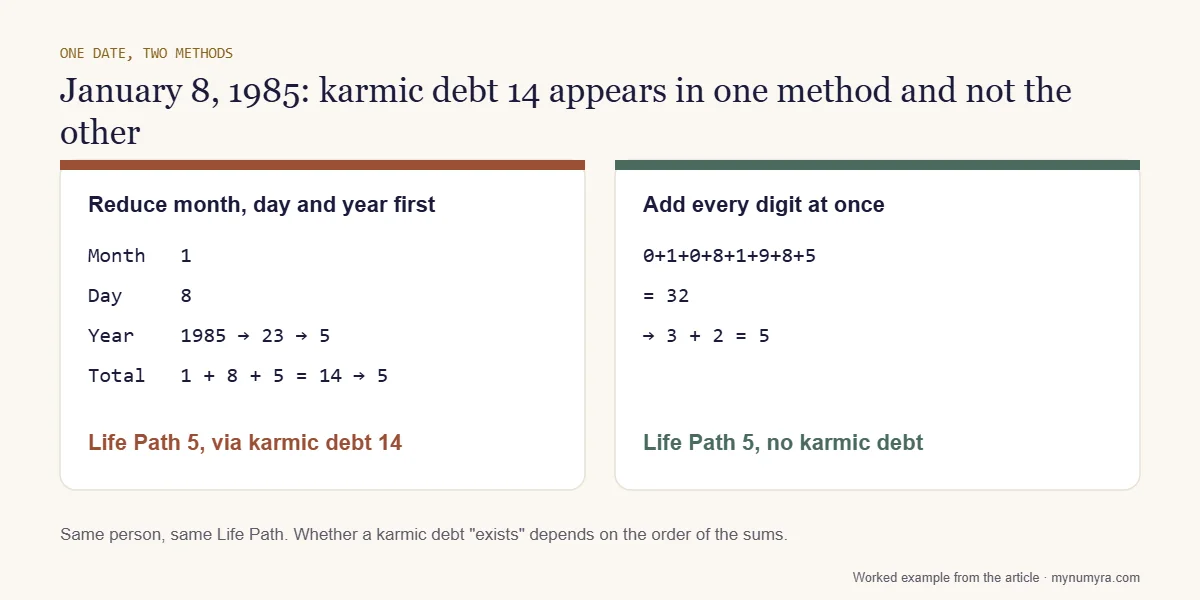
From a birth date: January 8, 1985
Reducing the month, day and year separately, the method our Life Path calculator uses:
| Step | Working | Result |
|---|---|---|
| Month | January = 1 | 1 |
| Day | 8 | 8 |
| Year | 1985 → 1 + 9 + 8 + 5 = 23 → 2 + 3 | 5 |
| Total | 1 + 8 + 5 = 14 → 1 + 4 | Life Path 5, via karmic debt 14 |
Now add every digit of the same date at once: 0 + 1 + 0 + 8 + 1 + 9 + 8 + 5 = 32 → 3 + 2 = 5. The Life Path is still 5, but the sum never touches 14, so under this method there is no karmic debt. Same person, same number, opposite verdict. Our guide to calculating a chart by hand explains why this site reduces each part first.
From a name: Emma Brown
Names work the same way with the Pythagorean letter chart. EMMA is 5 + 4 + 4 + 1 = 14, and BROWN is 2 + 9 + 6 + 5 + 5 = 27 → 9. Add the two raw totals and you get 41 → 5, with no karmic number. Reduce each name first, as our Name Numerology calculator also shows, and you get 14 → 5 for Emma and 5 + 9 = 14 → 5 for the full name: a Destiny 5 that passes through karmic debt 14 twice.
Where to look: the sources disagree
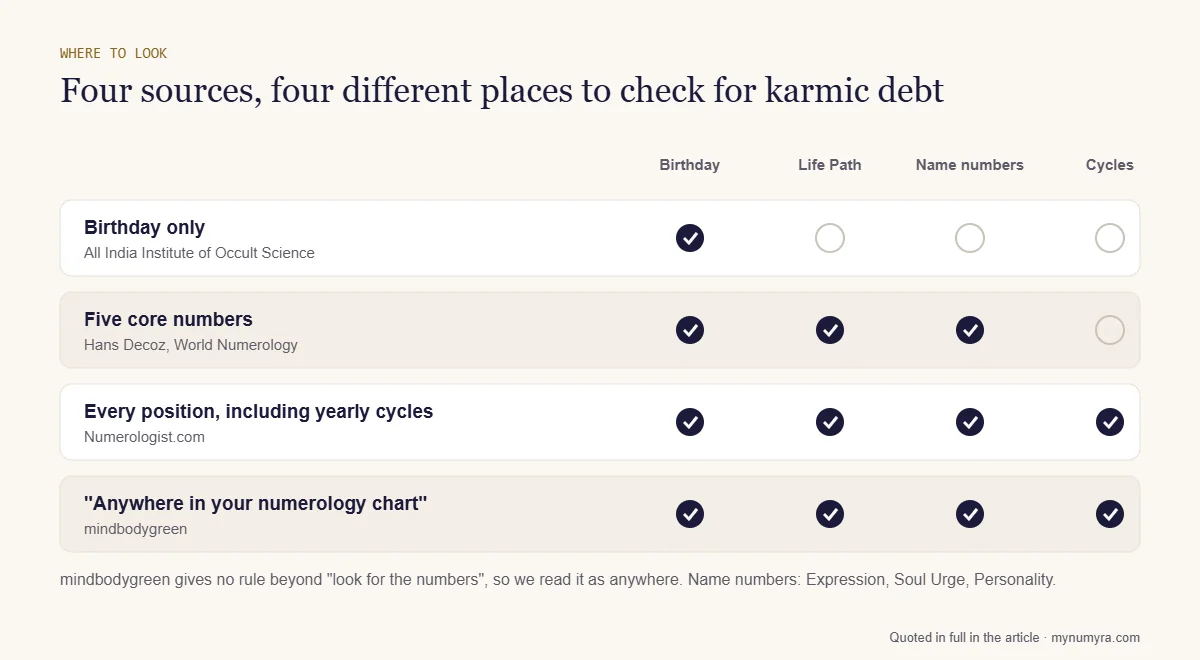
The four numbers are agreed. Almost nothing else is. Here is what four widely read sources actually say about where karmic debt counts, word for word:
| Source | Where it says to look |
|---|---|
| All India Institute of Occult Science | “If you were born on 13, 14, 16, and 19 of any month, you have to pay the karmic debts from past lives.” (birthday only) |
| Hans Decoz, World Numerology | “…found among your core numbers: the most important numbers, the Life Path, Expression, Heart’s Desire (or Soul Urge), Personality, and Birth Day.” (five core numbers) |
| Numerologist.com (Blair Andrews) | “A Karmic Debt can show up in any core number position – Life Path, Expression, Soul Urge, Personality, Birthday – and also in cycle positions like Pinnacles, Essences, and Personal Years.” (every position) |
| mindbodygreen (Sarah Regan) | “There is no equation for calculating karmic debt, simply look for the numbers 13, 14, 16, and 19 in your numerology chart.” (anywhere in the chart) |
None of them says whether the month, day and year should be reduced before adding, and as the example above shows, that single choice can create or erase a karmic debt. The honest answer to “do I have one?” is therefore “under which rule?” This site reduces each part first and checks every step of each core number, and we say so rather than presenting one rule as the only one.
How often karmic debt actually shows up
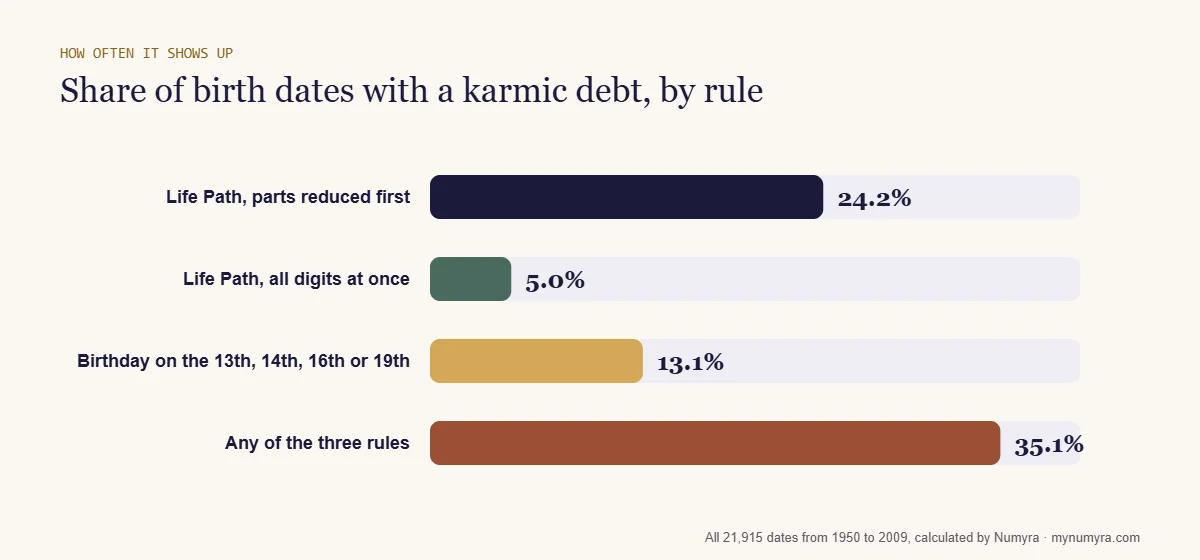
Pages on karmic debt tend to treat it as a rare, heavy marker. It is neither rare nor fixed, so we counted. We ran every calendar date from January 1, 1950 to December 31, 2009 (21,915 dates) through the Life Path calculation both ways, and checked the birthday rule too:
| Rule | Share of dates with a karmic debt |
|---|---|
| Life Path, month, day and year reduced separately (this site) | 24.2% (13: 6.3%, 14: 6.2%, 16: 6.4%, 19: 5.4%) |
| Life Path, all digits added at once | 5.0% |
| Birthday on the 13th, 14th, 16th or 19th | 13.1% |
| Any of the three rules | 35.1% |
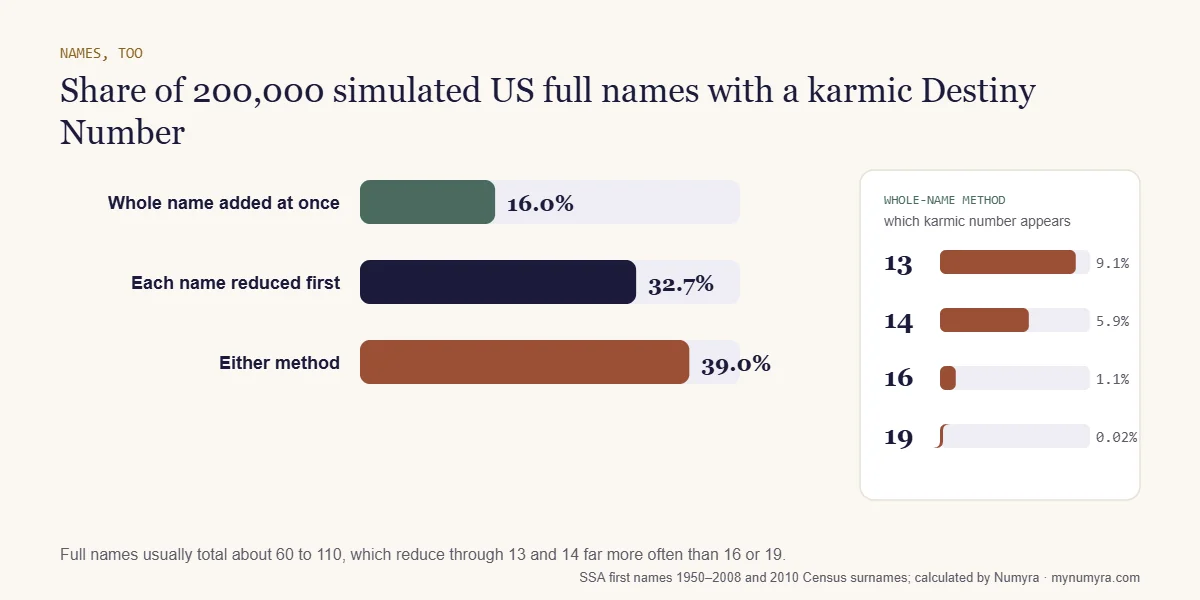
Names show the same split. We simulated 200,000 American full names, drawing first names in proportion to US birth records from 1950 to 2008 (Social Security Administration data) and surnames in proportion to the 2000 Census, and ran each through the Destiny calculation:
| Destiny method | Share of names with a karmic debt |
|---|---|
| Whole name added at once | 16.0% (13: 9.1%, 14: 5.9%, 16: 1.1%, 19: 0.02%) |
| Each name reduced first | 32.7% |
| Either method | 39.0% |
Two things stand out. First, depending on the rule, somewhere between one in twenty and more than one in three people “have” a karmic debt in their Life Path, which is a long way from rare. Second, the four numbers are not equally likely. A full name usually adds up to somewhere between about 60 and 110, and those totals reduce through 13 or 14 far more often than through 16 or 19. Under the whole-name method, a 19/1 Destiny Number is almost impossible: about two names in ten thousand.
What 13, 14, 16 and 19 are traditionally read as
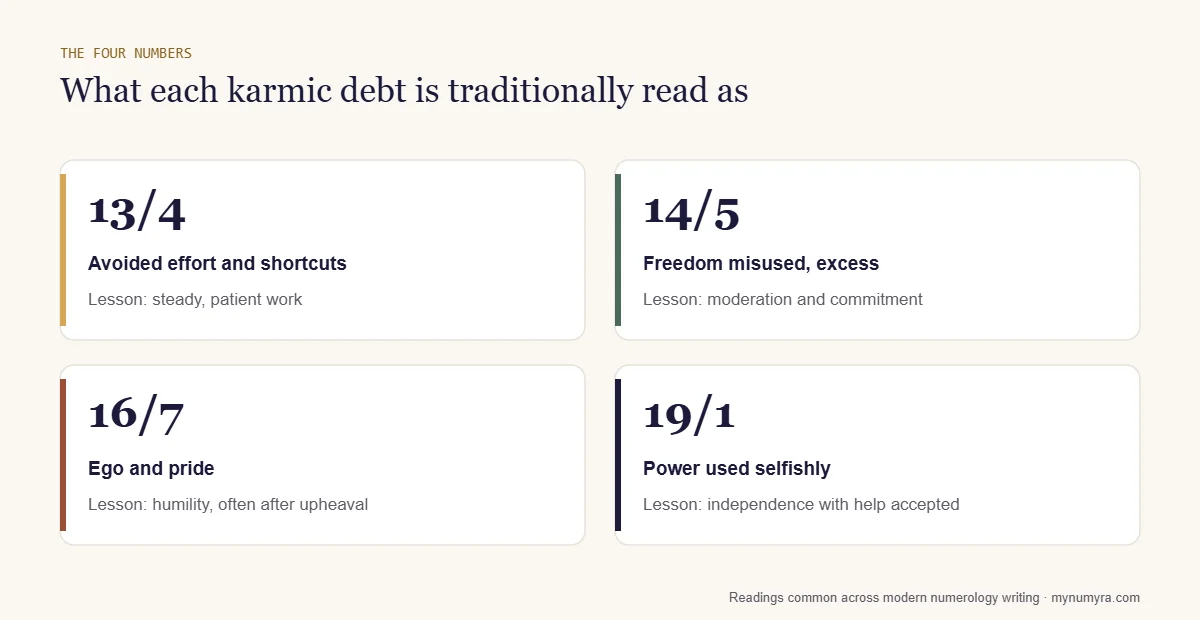
The readings below are the ones that recur across modern numerology writing, from Hans Decoz’s books to most of the pages above. They describe themes, not predictions.
| Number | Reduces to | The “debt” | The lesson usually attached |
|---|---|---|---|
| 13/4 | 4 | Avoided effort; shortcuts | Steady, patient work, and finishing what you start |
| 14/5 | 5 | Freedom misused; excess | Moderation and commitment, using change well |
| 16/7 | 7 | Ego and pride | Humility, often after a sudden upheaval |
| 19/1 | 1 | Power used selfishly | Independence balanced with accepting help |
Matthew Oliver Goodwin’s 1981 two-volume Numerology: The Complete Guide, one of the books that fixed the 13/4-style notation, sums up two of them in a single line each:
“19/1 Karmic Debt: Problems with self-centeredness and dependence. 16/7 Karmic Debt: Problems with being ‘different’ and self-centered.”
— Matthew Oliver Goodwin, Numerology: The Complete Guide, vol. 2 (Newcastle Publishing, 1981)
Where the idea comes from
Most karmic-debt pages call it ancient, or attribute it to “classical numerology sources” without naming one. We looked. L. Dow Balliett’s The Philosophy of Numbers (1908), the book that set out the letter chart modern numerology still uses, does not contain the word “karmic” anywhere in its text. The concept arrives much later.
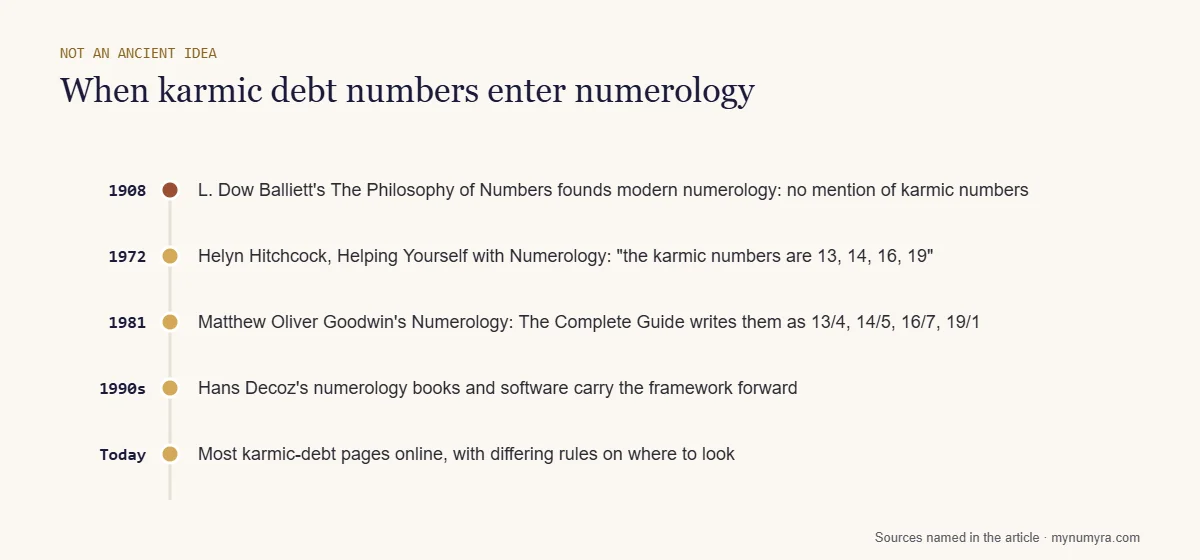
The earliest use we could verify is Helyn Hitchcock’s Helping Yourself with Numerology, published in 1972, which already lists the same four numbers and has a section telling readers they “must pay the karmic debt”:
“Remember, the karmic numbers are 13, 14, 16, 19.”
— Helyn Hitchcock, Helping Yourself with Numerology (Parker Publishing, 1972)
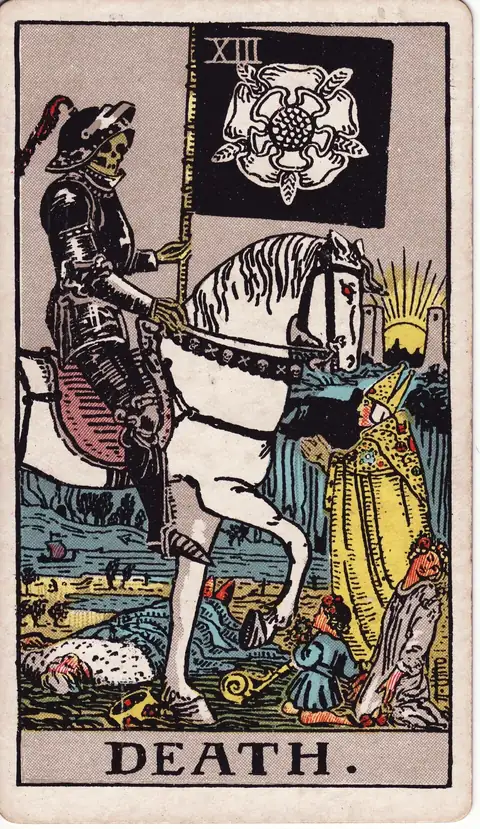
Hitchcock also calls 13 a “malific or karmic number” and connects it to the Tarot: in the major arcana, card XIII is Death. Goodwin’s 1981 guide then systematized the idea, writing each debt alongside the digit it reduces to and checking for it across the Life Path, Expression and Birthday. Hans Decoz’s numerology books and software from the 1990s onward carried that framework to the websites that dominate the topic today. None of this makes the readings meaningless, but it does make them a late-20th-century addition to numerology, not an ancient teaching.
Karmic debt vs. karmic lessons
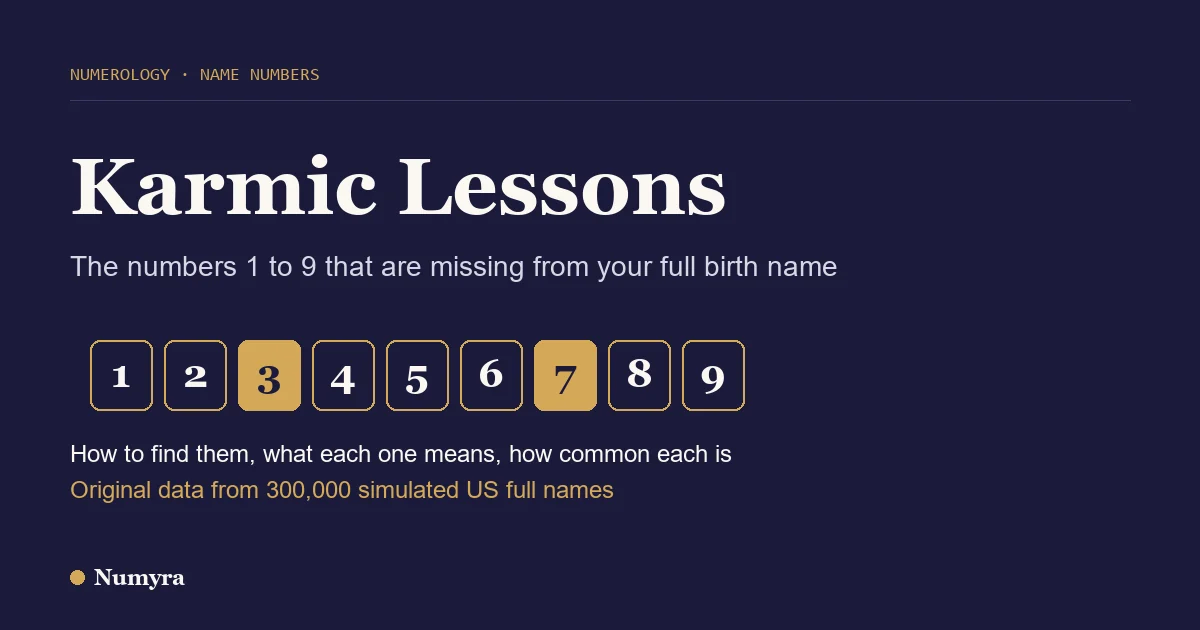
The two are often confused, and Hitchcock was already separating them in 1972. A karmic debt is one of the four numbers 13, 14, 16 or 19 appearing in a calculation. A karmic lesson is a number from 1 to 9 that is missing from your full name (the karmic lessons guide covers how to find yours), which is read as a quality you have not yet developed. They come from different calculations and answer different questions; karmic lessons deserve their own explanation rather than a footnote here.
Can a karmic debt be “cleared”?
Within the tradition, a karmic debt is not something you remove: it is a theme you work on. The usual advice for each number is simply its lesson from the table above, practised over time. Some writers go further and suggest avoiding the numbers in daily life; Decoz, for example, writes that “You should avoid Karmic Debts in your address or phone number.” That use is covered in our house numerology guide. Nothing in the documented sources suggests a debt disappears from a birth date or a birth name, since neither can change. If a reading leaves you anxious rather than reflective, that is a good reason to treat it lightly.
Frequently asked questions
How do I know if I have a karmic debt number?
Work out your core numbers and watch every step of each sum. If 13, 14, 16 or 19 appears on the way to the final digit, that position carries a karmic debt under the usual rule. Our Life Path and Name Numerology calculators show every step, so you can see where one appears.
Which birth dates are karmic?
Under the strictest rule, anyone born on the 13th, 14th, 16th or 19th of a month: about 13% of dates. Under the Life Path rule it depends on the whole date; with month, day and year reduced separately, about 24% of dates from 1950 to 2009 pass through a karmic number.
What does karmic debt number 13 mean?
13/4 is traditionally read as a debt of avoided effort, with the lesson of steady, patient work. It is also the most common karmic number in names: about 9% of US full names pass through 13 when the whole name is added at once.
Is karmic debt the same as a master number?
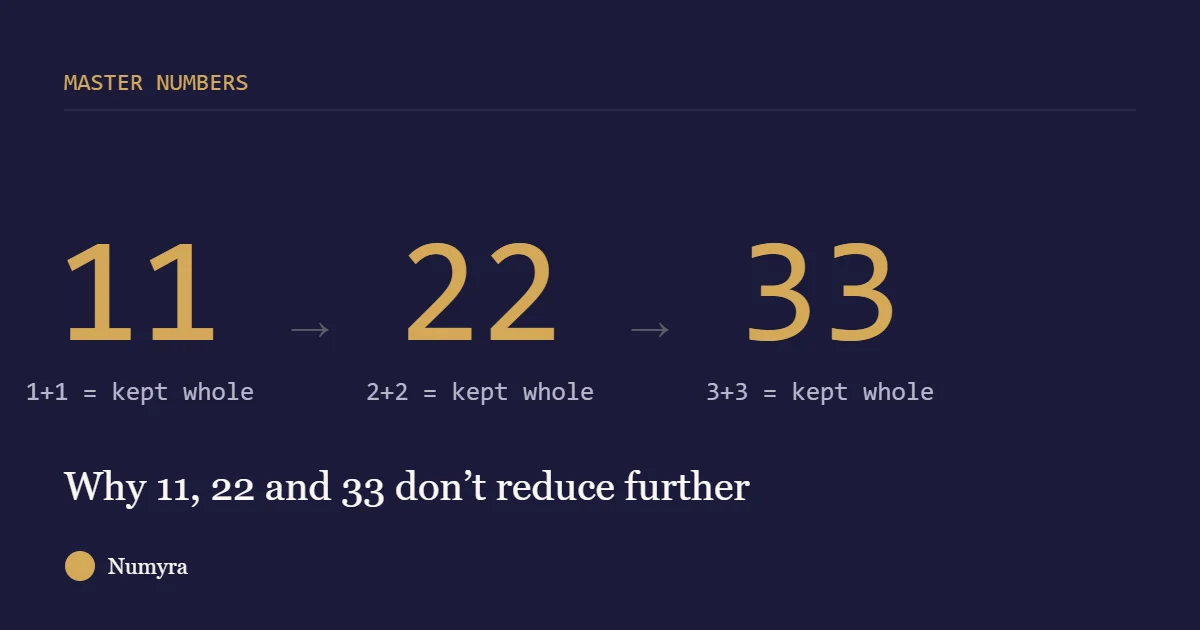
No. Master numbers (11, 22 and 33) are kept whole instead of being reduced; karmic debt numbers are reduced as normal but noted on the way. See why 11, 22 and 33 are treated as master numbers.
Can my Personal Year be a karmic debt year?
Some sources, such as Numerologist.com, count Personal Years too; others only look at the core numbers. This site reduces Personal Year numbers straight to 1 to 9 and does not mark karmic years.
Is karmic debt numerology an ancient practice?
No. It does not appear in Balliett’s 1908 book that founded modern numerology. The earliest source we could verify is Helyn Hitchcock’s 1972 Helping Yourself with Numerology, and Matthew Oliver Goodwin’s 1981 guide gave it the 13/4-style notation used today.
Do karmic debt numbers work in the Chaldean system?
The same four numbers are used, but the Chaldean letter chart gives different letter values, so a name can pass through a karmic number in one system and not the other. Every figure in this article uses the Pythagorean chart.
Sources
- Hitchcock, Helyn. Helping Yourself with Numerology. West Nyack, NY: Parker Publishing, 1972. Internet Archive. Source of the quote above.
- Goodwin, Matthew Oliver. Numerology: The Complete Guide, vol. 2: Advanced Personality Analysis and Reading the Past, Present, and Future. North Hollywood, CA: Newcastle Publishing, 1981. Source of the quote above.
- Balliett, L. Dow. The Philosophy of Numbers: Their Tone and Colors. 1908. Checked in full; contains no reference to karmic numbers.
- Decoz, Hans. “Karmic Debt Numbers.” World Numerology. Quoted in the table above.
- Andrews, Blair. “Karmic Numerology Guide.” Numerologist.com. Quoted in the table above.
- Regan, Sarah. “Karmic Debt Numbers.” mindbodygreen, July 26, 2023. Quoted in the table above.
- US Social Security Administration baby-name data (1950–2008) and US Census Bureau 2000 surname data, used for the 200,000-name simulation.
- Numyra Methodology Desk. All date and name figures calculated by us with the Pythagorean chart; month, day and year reduced separately unless stated.