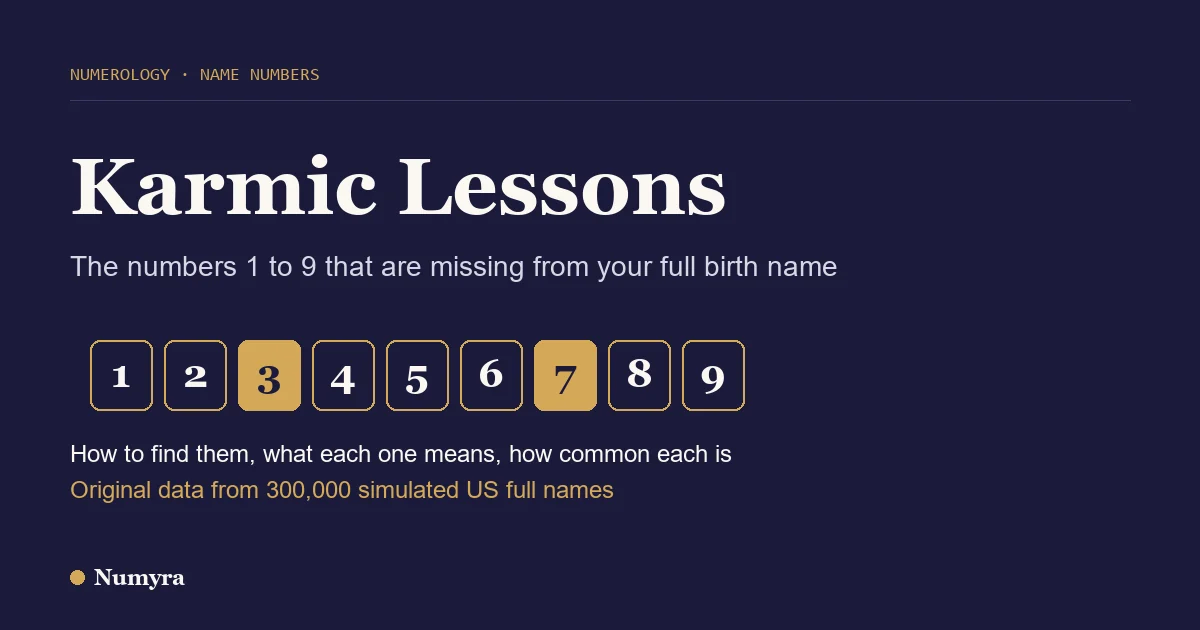
Karmic lessons in numerology are the numbers from 1 to 9 that do not appear anywhere in your full birth name once every letter is converted to its Pythagorean value. Numerologists read each missing number as a quality you have had less practice with, not as a punishment. To find yours, convert each letter (A, J and S are 1; B, K and T are 2; up to I and R as 9), count how many times each number appears, and list the ones with a count of zero. Among 300,000 simulated US full names, 87% had at least one lesson, the average was 1.6, and the most common missing number was 8. Karmic lessons are a traditional interpretive idea, not a tested science, so treat them as prompts for reflection.
Key takeaways
- A karmic lesson is a missing number, not a calculation: you count how often 1 to 9 appears in your birth name, and any number with a count of zero is a lesson. No adding or reducing is involved.
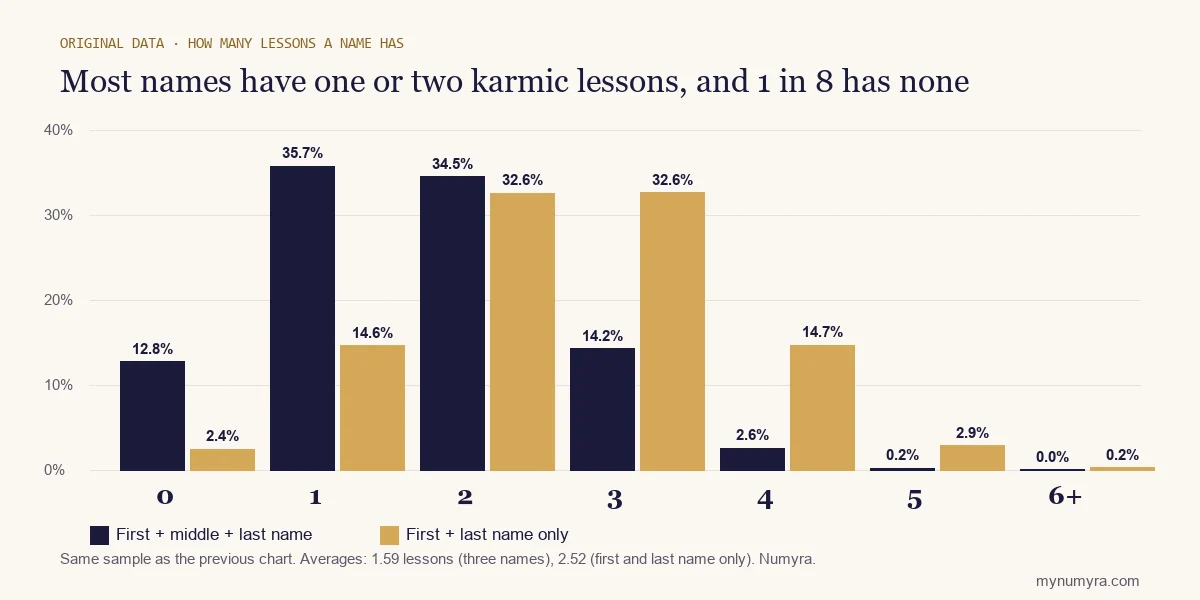
- Original data: in 300,000 simulated US names (first, middle and last), 12.75% had no lessons, 35.7% had one, 34.5% had two and 17.0% had three or more. The average was 1.59 lessons.
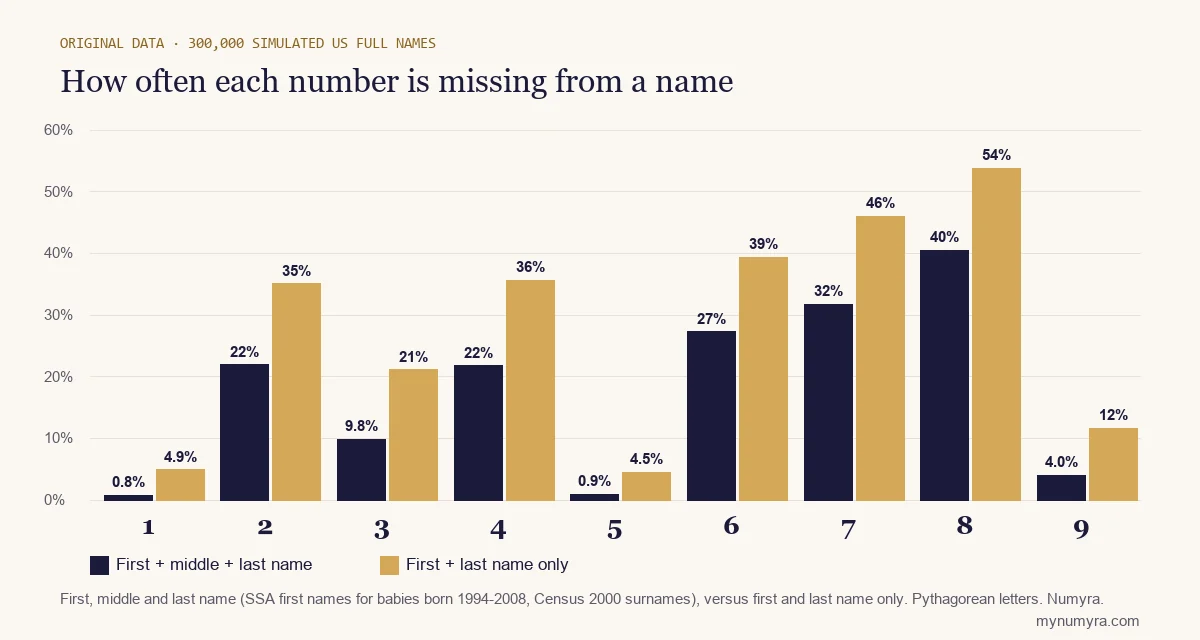
- The most often missing number is 8 (40.5% of names), then 7 (31.7%) and 6 (27.3%). The rarest to be missing are 1 (0.78%) and 5 (0.94%), because A, J, S, E, N and W are very common letters.
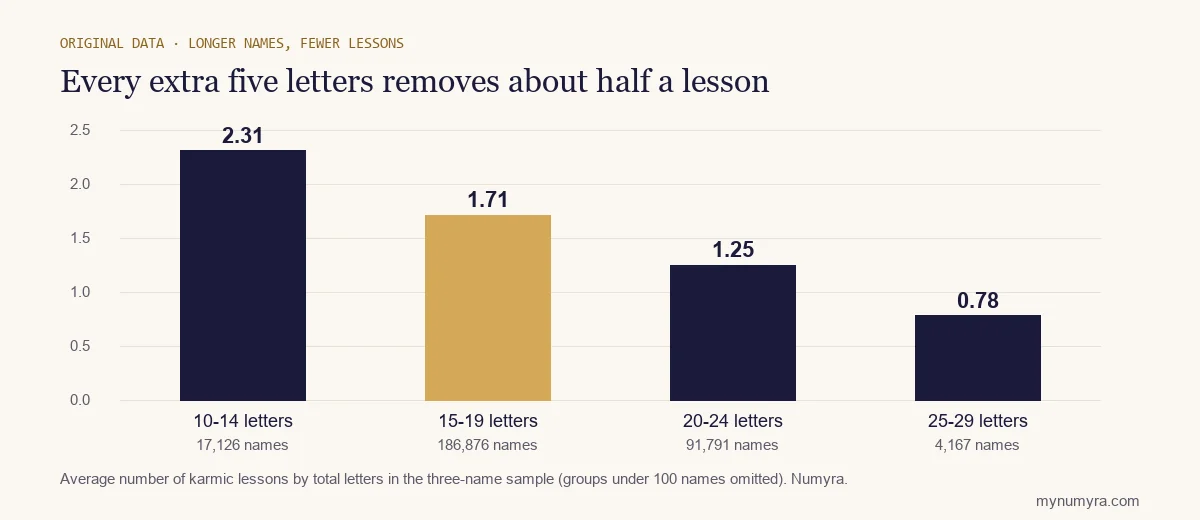
- Name length matters most. With only a first and last name the average rises to 2.52 lessons and only 2.4% of names have none; every extra five letters removes roughly half a lesson.
- Karmic lessons are different from karmic debt (13, 14, 16 and 19): lessons come from letters missing in your name, debts from certain totals in your calculations. See our guide to karmic debt numbers.
In this guide
- What karmic lessons are
- How to find your karmic lessons
- Worked examples with fictional names
- What each karmic lesson number means
- How common each lesson is (original data)
- How many lessons is typical?
- Lessons and your core numbers
- The opposite of a lesson: the Hidden Passion
- Karmic lessons versus karmic debt
- Frequently asked questions
What karmic lessons are
Most name numbers in numerology, such as the Expression, Soul Urge and Personality numbers, add letters together. Karmic lessons do the opposite: they look for what is absent. Hans Decoz, whose site publishes a widely used set of numerology references, describes the idea in terms of a workshop.
Missing numbers, those that are not represented in the letters in your name, imply tools that are unavailable, and must be learned and mastered during this lifetime.
Hans Decoz, Karmic Lessons, World Numerology
So the tradition reads a lesson as a gap in experience, a quality you did not get for free from your name and may have to build on purpose. Decoz is careful to say lessons are not bad news, and calls them motivators. Other sites, such as Numerologist.com, make the same distinction between a missing number and a flaw. We could not trace who first attached the phrase “karmic lessons” to missing numbers, so this guide describes the tradition as it is published today rather than its origin.
Everything that follows rests on one choice: the letter values. Numyra uses the standard Pythagorean chart, the same one in our Destiny Number calculator and explained in our comparison of Pythagorean and Chaldean numerology. The sources we read for this article use the Pythagorean chart.
How to find your karmic lessons
You need your full name as given at birth (the name on your birth certificate, not a nickname) and the letter chart below. If you want the full routine for the rest of your chart, our guide to calculating a numerology chart by hand covers it, including why the birth name is used.
| Value | Letters |
|---|---|
| 1 | A, J, S |
| 2 | B, K, T |
| 3 | C, L, U |
| 4 | D, M, V |
| 5 | E, N, W |
| 6 | F, O, X |
| 7 | G, P, Y |
| 8 | H, Q, Z |
| 9 | I, R |
- Write out the full birth name. First, middle and last names, spelled as on the certificate.
- Convert every letter to its value. Every letter counts, including Y; there is no vowel and consonant split here.
- Tally the nine numbers. Count how many letters fall on 1, on 2, and so on through 9. Decoz draws this tally as a square divided into nine boxes, and Numerologist.com calls it the Inclusion Table.
- List the zeros. Each number with a count of zero is a karmic lesson. If every number has at least one letter, you have no lessons.
Spelling matters, because one extra or missing letter can fill or open a gap. In our own counts we ignore hyphens and apostrophes. Once you have your name written out, the Name Numerology Calculator gives your Destiny, Soul Urge and Personality numbers from the same name, which is a handy cross-check that you spelled it consistently.
Worked examples with fictional names
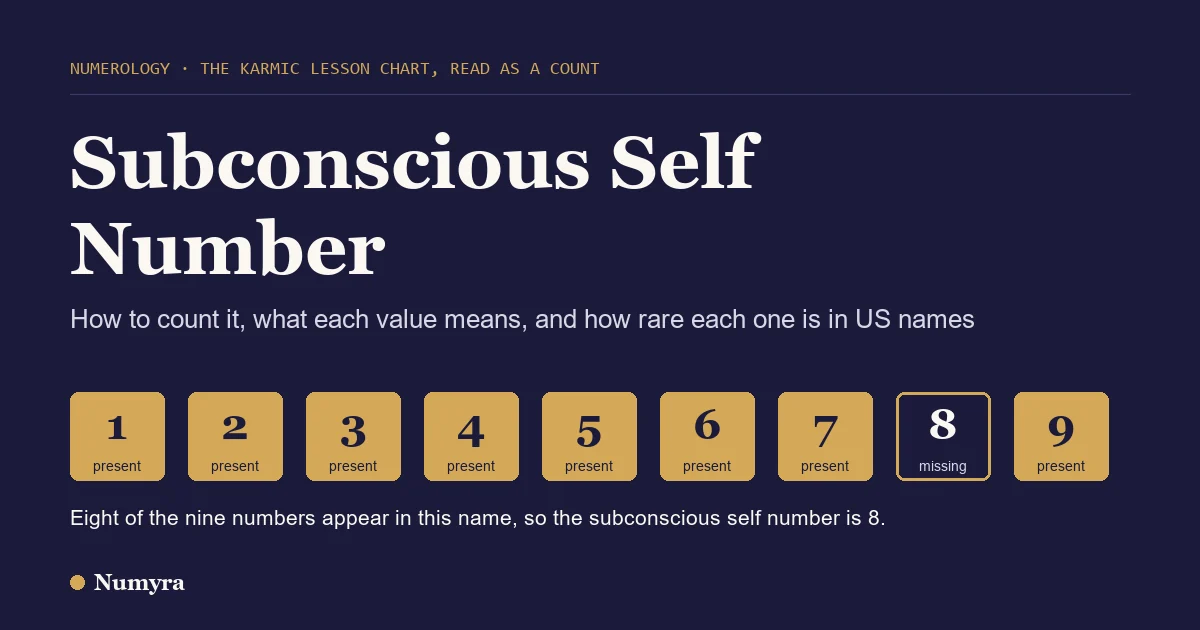
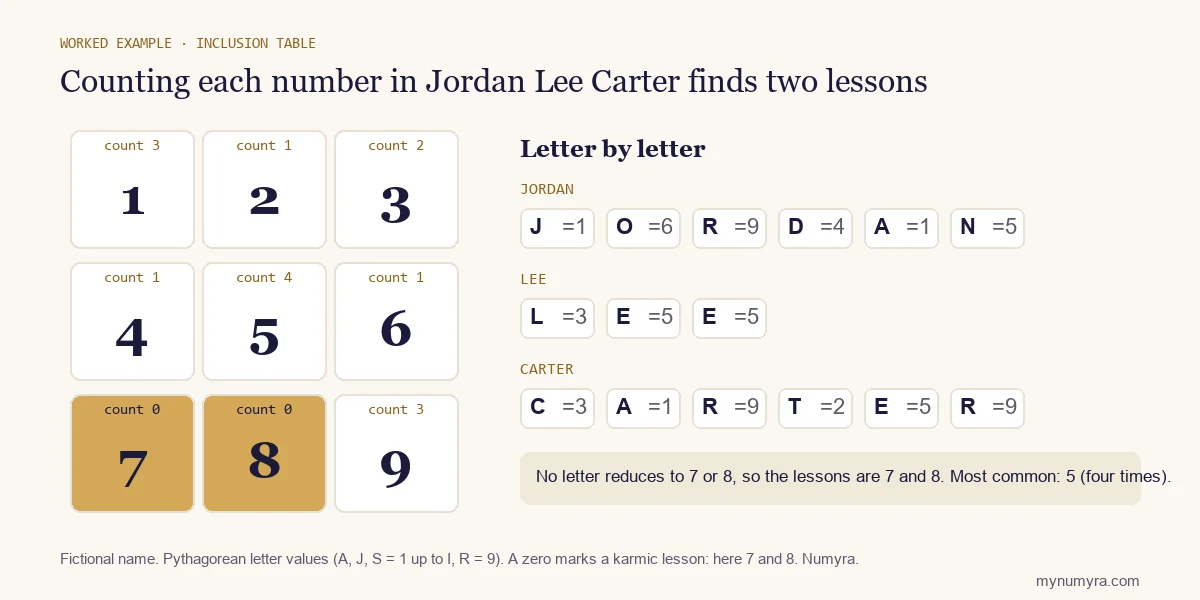
The figure below counts a fictional name, Jordan Lee Carter, letter by letter. Its 15 letters land on 1 three times, on 2 once, on 3 twice, on 4 once, on 5 four times, on 6 once and on 9 three times, but never on 7 or 8. Those two zeros are the karmic lessons.
- Maya Rose Thompson (16 letters): 1 appears 4 times, 2 once, 4 twice, 5 twice, 6 three times, 7 twice, 8 once and 9 once. Only 3 is missing, so the single lesson is 3. This is the same fictional name used in our maturity number guide.
- Olivia Grace Bennett (18 letters): every number from 1 to 9 appears except 8, so the lesson is 8, the most common single result in our data (10.1% of names have 8 as their only lesson).
- Eli Fox Hill (10 letters): only 3, 5, 6, 8 and 9 appear. The lessons are 1, 2, 4 and 7, four of them, which shows how a short name leaves more gaps.
None of these names is a real person. If a name produces no zeros, that is also an answer: Decoz notes that having none does not mean having no karmic issues, only that none is tied to the core name numbers.
What each karmic lesson number means
These are the traditional readings in plain words, drawn from the descriptions on Decoz’s site and Numerologist.com. Each is a theme to consider, never a forecast. Some older descriptions are written in a fatalistic tone, with promises of loneliness or lost money; we do not repeat those, because there is no evidence behind them. The percentage under each heading is how often the number is missing from a three-name US birth name in our data below.
Lesson 1: initiative and independence (missing in 0.78% of names)
Without a 1, the tradition says self-starting does not come automatically. The lesson is to make your own decisions, trust your own judgment and stop waiting for permission or approval.
Lesson 2: cooperation and tact (21.9%)
A missing 2 points to patience, sensitivity to other people and the ability to work as part of a team. The theme is learning to listen and to take a supporting role without feeling smaller for it.
Lesson 3: self-expression (9.8%)
Decoz reads a missing 3 as a tendency to judge your own performance harshly, and links it to creativity and communication that take effort. The lesson is to share yourself without demanding perfection first.
Lesson 4: structure and discipline (21.8%)
Missing the 4 is described as having less natural sense of routine, organization and follow-through. The lesson is to build slowly, one reliable step at a time.
Lesson 5: change and adaptability (0.94%)
Here the theme is comfort with the unfamiliar: welcoming new experiences and flexing when plans change. Numerologist.com adds that 5 is such a common value in English names that some practitioners treat a count of one or two fives as functionally absent; in our sample that would flag 22.4% of names.
Lesson 6: responsibility and commitment (27.3%)
A missing 6 is read as a theme around close relationships, family and long-term commitment: learning to give, to stay and to be honest about feelings.
Lesson 7: depth and inner life (31.7%)
Without a 7, the tradition points to study, reflection and mastery of a craft rather than surface knowledge. The lesson is to look beneath the obvious and to build a quiet inner life.
Lesson 8: money, power and limits (40.5%)
The 8 governs the material world in numerology, so a missing 8 is read as learning to manage resources, ambition and boundaries in balance. It is the single most common lesson, which is one reason it appears on every list.
Lesson 9: compassion and perspective (4.0%)
A missing 9 stands for broadening your view past your own circle: tolerance, generosity and the willingness to let things end. It is uncommon because both I and R, two of the most frequent letters in American names, carry the value 9.
How common each lesson is (original data)
None of the pages we read says how often any lesson actually occurs, so we measured it. The method: we built 300,000 simulated US full names. First and middle names were drawn at random in proportion to their popularity in Social Security Administration baby-name lists for babies born 1994 to 2008, and surnames in proportion to their counts in the 2000 Census surname list. We converted every letter with the Pythagorean chart and listed the missing numbers. We also repeated the exercise with only a first and last name, because many people have no middle name.
What this is not: it is not a survey of real birth certificates. The names are simulated, they use only names in the SSA top-1,000 lists and the Census surname file, they cover the United States only, and people who use hyphens, accents or non-English spellings are outside the data.
| Missing number | First + middle + last name | First + last name only | Share of letters on this value |
|---|---|---|---|
| 1 | 0.78% | 4.87% | 20.8% |
| 2 | 21.92% | 35.04% | 8.0% |
| 3 | 9.83% | 21.15% | 12.0% |
| 4 | 21.76% | 35.63% | 7.5% |
| 5 | 0.94% | 4.52% | 20.4% |
| 6 | 27.31% | 39.33% | 6.6% |
| 7 | 31.74% | 46.03% | 5.6% |
| 8 | 40.46% | 53.78% | 4.7% |
| 9 | 4.01% | 11.66% | 14.5% |
Three results stand out. First, 8 is the number most often missing, in two of every five three-name names, because H, Q and Z make up only 4.7% of letters. Numerologist.com makes the same claim about 8, and the data agrees. Second, 1 and 5 are almost never missing (under 1%), because A, S, J, E, N and W together make up about 41% of all letters. Third, 9 is rarer than the middle of the table (4.0%) but less rare than 1 or 5, so a claim that a missing 9 is exceptional is true in kind but not the rarest case.
The most common exact combinations of lessons in the three-name sample are: only 8 (10.1% of names), only 7 (7.1%), only 4 (5.7%), only 6 (5.7%), 7 and 8 together (5.1%), 6 and 8 (4.4%), only 2 (4.3%), and 2 and 8 (3.5%).
How many lessons is typical?
Decoz states a figure that can be checked directly.
The average number of Karmic Lessons (not to be confused with Karmic Debts) is two, but four or even five isn’t that uncommon, nor is it unusual to have no Karmic Lessons at all.
Hans Decoz, Karmic Lessons, World Numerology
Our simulation lands close to this, but with a caveat that depends on the name. With a first, middle and last name (an average of 18.4 letters), the mean was 1.59 lessons: 12.75% of names had none, 35.72% had one, 34.51% had two, 14.24% had three, 2.58% had four and 0.18% had five. Having four or more is therefore uncommon (2.8%), rather than ordinary. With only a first and last name (an average of 12.4 letters), the mean was 2.52, so Decoz’s average of two sits between the two cases, and having no lessons drops to 2.4%.
Name length explains most of this. In the three-name sample, names of 10 to 14 letters averaged 2.31 lessons, names of 15 to 19 letters averaged 1.71, names of 20 to 24 letters 1.25, and names of 25 to 29 letters 0.78. Each extra five letters removes roughly half a lesson. The practical lesson of the numbers is that a person with a short name will usually have more, which says something about spelling and nothing about the person. Numerologist.com says most people have one to three lessons and that none is rare; in our data 84.5% of three-name names have one to three, and none is uncommon (1 in 8) rather than rare, but with a short name it is rare indeed.
Lessons and your core numbers
Many practitioners soften a lesson when the same number shows up elsewhere in the chart. Decoz writes that the effect of a lesson is diminished if you have it among your core numbers, and Numerologist.com calls this a modified karmic lesson: the gap in the name remains, but the number is present in your life path, expression, soul urge, personality or birthday number. You can find these with our Life Path, Destiny, Soul Urge and Personality calculators; the guide to the three name numbers explains how they differ, and the maturity number is another derived core number.
How often does that overlap happen? Taking the Life Path from 85.4 million US births (1994 to 2014) and assuming it is independent of the name, about 11.1% of lessons coincide with the Life Path number (counting a Life Path of 11, 22 or 33 as 2, 4 or 6). That counts only the Life Path, one of the five core numbers Decoz lists, so the full overlap is higher.
The opposite of a lesson: the Hidden Passion
The same tally that shows what is missing also shows what is most frequent. Decoz calls the most frequent number the Hidden Passion.
The number that is most often found in your full name at birth represents your specific field of expertise, or a concentrated talent – this is called your Hidden Passion.
Hans Decoz, The Hidden Passion, World Numerology
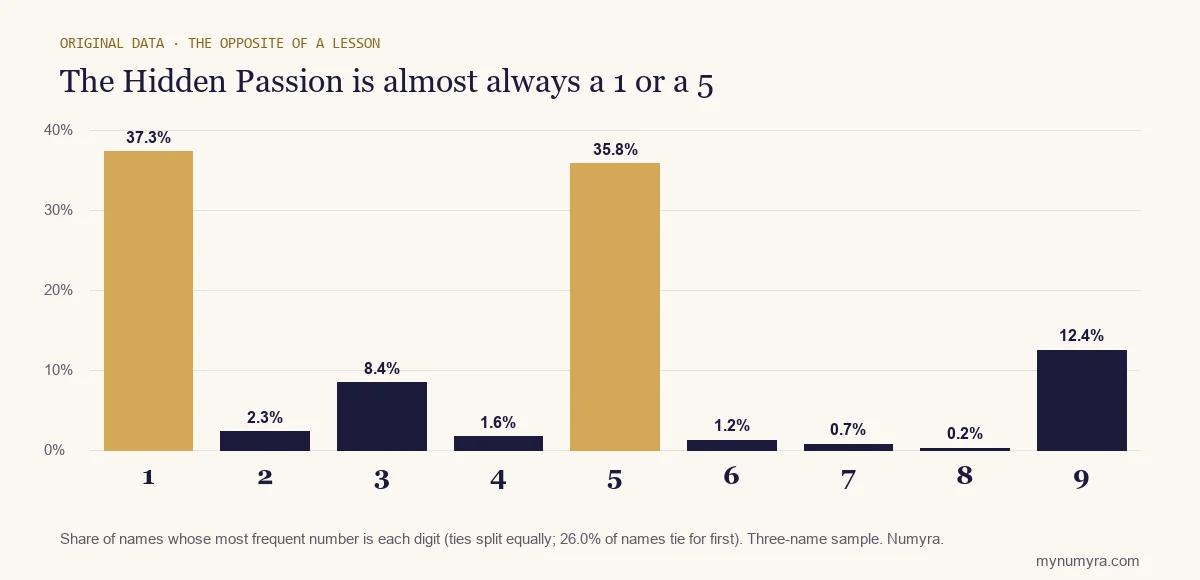
A number cannot be both a lesson and a Hidden Passion: one has a count of zero, the other the highest count in the name. In our three-name sample the Hidden Passion was most often 1 (37.3% of names) or 5 (35.8%), then 9 (12.5%) and 3 (8.4%), and almost never 8 (0.2%) or 7 (0.7%). Decoz notes you can have more than one Hidden Passion, and 26.0% of the names in our sample tied for first place. So the typical American name leans on 1 and 5 and lacks 8 and 7, and that mirrors the lessons above.
Karmic lessons versus karmic debt
The two ideas are often confused because both carry the word karmic. Karmic debt numbers are four specific totals, 13, 14, 16 and 19, that show up on the way to a core number, and tradition reads them as a past misuse of energy to be corrected. A karmic lesson needs no total and no reduction: it is just a missing number in the name, read as a quality not yet developed. A person can have both, either or neither. For the debt side, including where the idea comes from, see our guide to karmic debt numbers: what 13, 14, 16 and 19 mean.
Numerology is a symbolic tradition. Nothing in this guide, including the meanings and the idea that a name reflects lessons carried from earlier lives, is scientifically validated or a prediction about you, and our disclaimer applies. Our calculation rules are set out on the methodology page.
Frequently asked questions
What are karmic lessons in numerology?
They are the numbers from 1 to 9 that do not appear in your full birth name when each letter is converted with the Pythagorean chart. Tradition reads each one as a quality you have not yet developed.
How do I find my karmic lessons?
Convert every letter of your birth name to its value, count how many times each number from 1 to 9 appears, and list the numbers with a count of zero. No addition or reduction is needed.
Do karmic lessons use my birth name or my current name?
Traditionally the full name given at birth. If you use a changed name, you can calculate it separately, but the result will differ because the letters differ.
How many karmic lessons is normal?
In our simulated US names the average was 1.59 for a first, middle and last name and 2.52 for a first and last name. Hans Decoz gives an average of two. Having none is uncommon with a short name.
Which karmic lesson is the most common?
8. It is missing from 40.5% of three-name names in our data, followed by 7 (31.7%) and 6 (27.3%). The least common are 1 (0.78%) and 5 (0.94%).
Is it bad to have karmic lessons?
Not in the tradition. Decoz calls lessons motivators and says life is not automatically easier without them; Numerologist.com says a lesson is not a flaw. In our data 87% of three-name names have at least one.
What is the difference between karmic lessons and karmic debt?
Lessons are missing numbers in your name; debts are the totals 13, 14, 16 and 19 appearing in a calculation. They come from different methods and can occur together or separately.
What is a Hidden Passion number?
It is the number that appears most often in your full name, read as a concentrated talent. It is the opposite of a lesson, and in our sample it was 1 or 5 for about 73% of names (ties split equally).
Are karmic lessons scientifically valid?
No. They are a traditional interpretive system with no tested evidence behind the meanings or the link to past lives. Use them as a prompt for reflection, not as a prediction.
Sources
- Decoz, Hans. Karmic Lessons. World Numerology. Source of the definition, the average-of-two statement and both quotes about lessons above.
- Decoz, Hans. The Hidden Passion. World Numerology. Source of the Hidden Passion definition.
- Andrews, Blair. Karmic Lessons: What the Missing Numbers in Your Name Reveal. Numerologist.com. Cited for the inclusion table, the modified-lesson idea and the claims about 5, 8 and 9.
- FiveThirtyEight. US births data, 1994 to 2014, from the CDC National Center for Health Statistics and the Social Security Administration. Life Path counts for the core-number overlap.
- Hadley Wickham. data-baby-names, a copy of the Social Security Administration top-1000 baby name lists. First and middle name frequencies for the simulated names.
- US Census Bureau. Frequently Occurring Surnames from the 2000 Census. Surname frequencies for the simulated names.