Chinese Zodiac Calculator: What Is My Chinese Zodiac Sign?
Your Chinese zodiac sign is the animal of the Chinese year you were born in, and that year starts at Lunar New Year, between January 21 and February 20, not on January 1. Enter your birth date to get your animal, its element, yin or yang, the stem-branch name of the year and the exact dates it began and ended. Add a birth time and place to see whether the date in China or the start of spring (Lichun) gives a different animal, and to get your hour animal.
Your Chinese zodiac sign
Key takeaways
- The zodiac year starts at Lunar New Year, which fell between January 21 and February 20 in every year from 1900 to 2100. Of 85.4 million US births from 1994 to 2014, 9.1% came before that year’s New Year, so a chart that goes by birth year alone gives them the wrong animal.
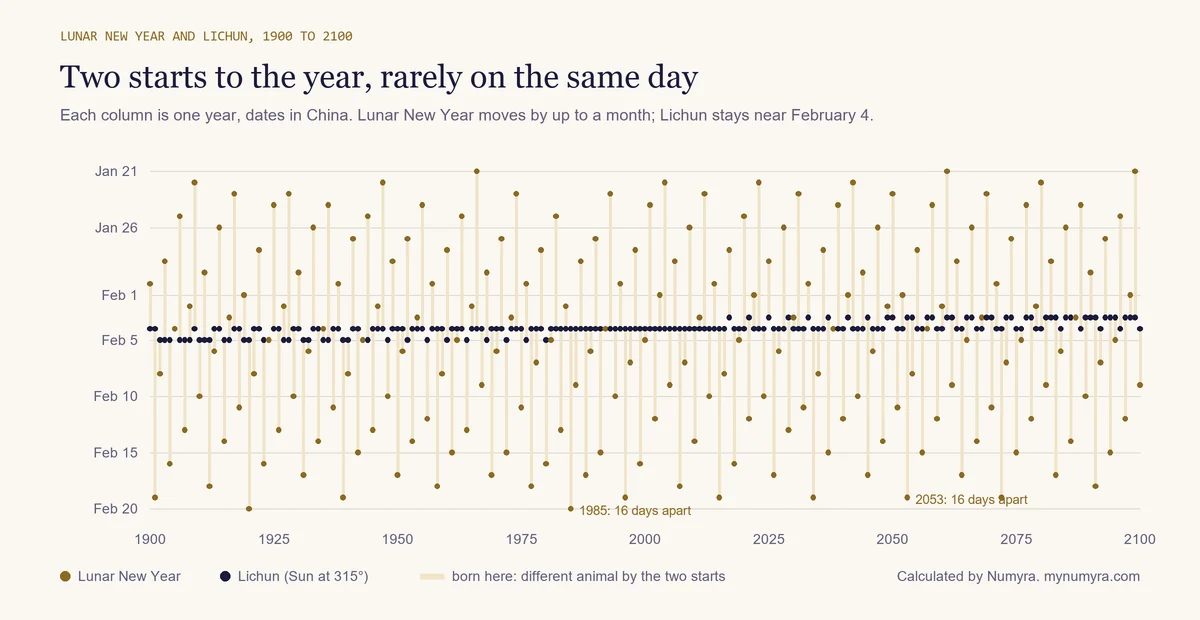
- Four Pillars (BaZi) astrology starts the year at Lichun instead, the moment the Sun reaches 315 degrees in early February. The two starts give different animals for 1.97% of US births, about 80,000 people a year.
- Lichun is not always February 4. In New York it fell on February 3 in 104 of the 201 years from 1900 to 2100 and on February 2 in five, so the calculator uses the exact moment on your birthplace’s clock.
- The Chinese calendar counts its days in China’s time. Lunar New Year starts at 11 a.m. Eastern and 8 a.m. Pacific on the US date before it, and about 5,700 to 7,000 US babies a year are born in those hours: New Year’s Eve at home, New Year’s Day in China. The calculator shows both readings.
- Our year table matches the Hong Kong Observatory’s tables on all 200 New Year dates, Lichun dates and stem-branch names from 1901 to 2100, and the calculator passed all 380,420 checks of its time zone and boundary logic.
For entertainment and self-reflection. Numerology and astrology are cultural traditions, not sciences, and nothing here is medical, financial, legal, or psychological advice.
How the animal, element and yin or yang fit together
Each Chinese year has a two-part name from two cycles that run side by side. The ten heavenly stems carry the five elements, Wood, Fire, Earth, Metal and Water, two years each, first yang and then yin. The twelve earthly branches carry the animals, from the Rat to the Pig. Both move on by one every year, so a pair returns only after 60 years: the sexagenary cycle, whose current round began with Jia-zi, a yang Wood Rat year, in 1984.
| Last digit of the Chinese year | Heavenly stem | Element | Yin or yang |
|---|---|---|---|
| 0 | Geng 庚 | Metal | Yang |
| 1 | Xin 辛 | Metal | Yin |
| 2 | Ren 壬 | Water | Yang |
| 3 | Gui 癸 | Water | Yin |
| 4 | Jia 甲 | Wood | Yang |
| 5 | Yi 乙 | Wood | Yin |
| 6 | Bing 丙 | Fire | Yang |
| 7 | Ding 丁 | Fire | Yin |
| 8 | Wu 戊 | Earth | Yang |
| 9 | Ji 己 | Earth | Yin |
Yang stems always meet the six yang animals (Rat, Tiger, Dragon, Horse, Monkey, Dog) and yin stems the six yin ones, so each animal meets each element once in 60 years: a Fire Horse in 1966 and 2026, an Earth Horse in 1978 and 2038.
The last-digit rule works only once you know your Chinese year. January 20, 2026 suggests Fire from the 6, but that date belongs to the year that began on January 29, 2025: a Wood Snake, not a Fire Horse. The calculator finds the Chinese year first.
Born in January or February? Why the exact date matters
Lunar New Year is the first day of the first month of the Chinese calendar, the day of a new moon in late January or February. Our Chinese New Year 2027 guide explains how the date of Chinese New Year is set, exceptions included. From 1900 to 2100 it falls between January 21 (1966, 2061 and 2099) and February 20 (1920 and 1985), and in 71 of the 201 years it comes in January.
So a birthday from January 1 to 20 always takes the previous year’s animal, and one from February 21 on takes the birth year’s animal. In between, it depends on the year: January 23, 2001 is a Metal Dragon birthday, and January 24, 2001, that year’s New Year, a Metal Snake.
This catches a lot of people. Of 85,386,227 US births from 1994 to 2014, 7,777,928, or 9.1%, came before that year’s Lunar New Year, so a year chart alone gives about one American in eleven the following year’s animal.
A Chinese year has 12 lunar months and 353 to 355 days, or 13 months and 383 to 385 days with a leap month, as in 74 of the 201 years from 1900 to 2100. The result gives the first and last day of your zodiac year.
Lunar New Year or Lichun: two ways to start the year
The Chinese calendar also follows the Sun through 24 solar terms. The first, Lichun (立春), “the start of spring”, is the moment the Sun reaches 315 degrees along the ecliptic, in early February. The festival, family custom and most zodiac charts start the year at Lunar New Year. Four Pillars (BaZi) astrology counts years and months by the solar terms instead, so its year, and its first month, the Tiger month, begin at Lichun.
The two starts rarely coincide. From 1900 to 2100 Lichun came before Lunar New Year in 103 years, on the same day in 6 and after it in 92; the gap averaged 7.4 days and reached 16 in 1985 and 2053. Births inside the gap get neighboring animals by the two conventions: 2.03% of all days, and 1.97% of US births from 1994 to 2014, 1.68 million babies. February 10, 2015, for example, came after Lichun (February 4) but before Lunar New Year (February 19): a Wood Goat by Lichun, a Wood Horse by Lunar New Year.
Lichun is often given as “February 4”, but that is only China’s most common date. The moment is the same everywhere, so its date depends on the clock:
| Clock | February 2 | February 3 | February 4 | February 5 |
|---|---|---|---|---|
| China (UTC+8; Beijing local time before 1929) | 0 | 39 | 128 | 34 |
| New York (US Eastern) | 5 | 104 | 91 | 1 |
| Los Angeles (US Pacific) | 11 | 116 | 74 | 0 |
In 2027 Lichun comes at 9:46 a.m. on February 4 in China, which is 8:46 p.m. on February 3 in New York and 5:46 p.m. in Los Angeles, so a New Yorker born at 9 p.m. that evening is already a Goat by Lichun. The calculator converts the moment to your birthplace’s clock.
Born on Lunar New Year’s Eve outside China: whose date counts?
The Chinese calendar is calculated for one meridian. Since 1929 that is 120 degrees east, China Standard Time (UTC+8); before then it was Beijing’s:
“Before 1929, times were based on the Beijing meridian (116°25' East), which has a time difference of about 14 minutes with respect to the times based on the meridian of 120°E.”
So Lunar New Year’s Day begins at midnight in China: 11 a.m. Eastern and 8 a.m. Pacific Standard Time on the US date before. A baby born in Los Angeles at 8 p.m. on February 5, 2027 is born on New Year’s Eve by the birth certificate, a Fire Horse, but at noon on New Year’s Day, February 6, in China, which makes a Fire Goat by China’s date.
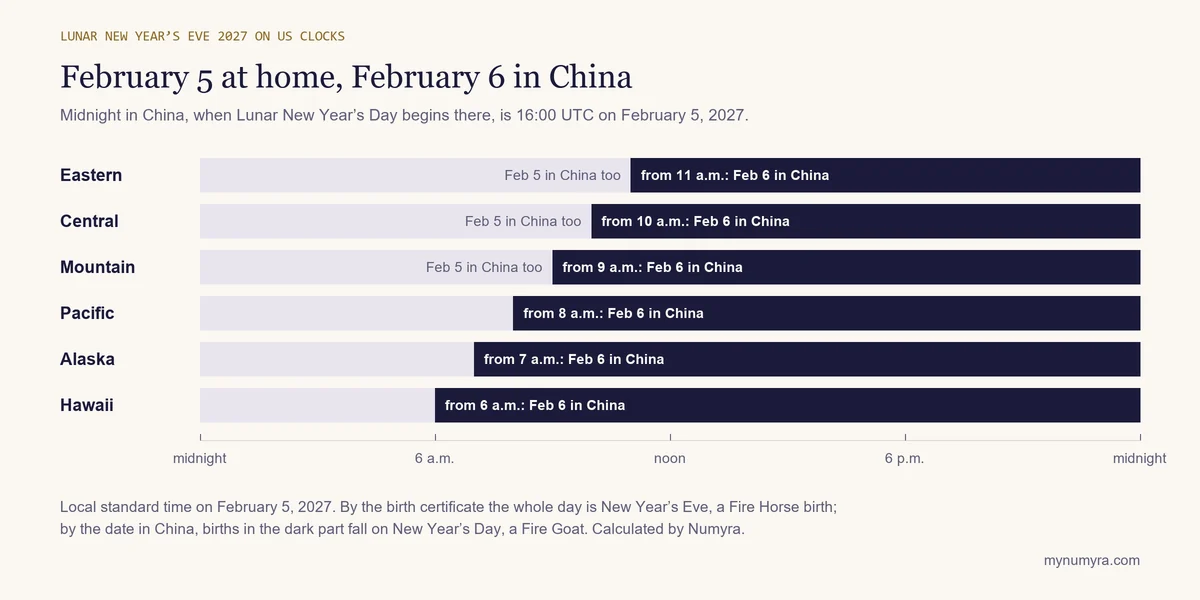
We found no rule that settles which date a birth outside China should use. The usual practice, and the one almost every calculator online follows, compares the date on the birth certificate with Lunar New Year, so that is the main answer here. A stricter reading converts the birth moment to China’s clock, where the calendar’s days begin, and the calculator shows it whenever it gives a different animal. Lichun has no such problem: it is one instant everywhere.
It is not rare. Assuming births spread evenly over the day, 119,271 (Eastern time) to 146,795 (Pacific time) US births from 1994 to 2014 fell on the US date of New Year’s Eve after midnight in China, about 5,700 to 7,000 a year.
Other lunar calendars use their own clock. North Vietnam moved from UTC+8 to UTC+7 in 1967, and in 1985 Vietnam’s Tết came on January 21, a month before China’s New Year. Our UTC+7 recalculation starts the year on a different day from China’s in 6 years from 1968 to 2100 (1968, 1969, 1985, 2007, 2030 and 2053). This calculator follows the Chinese calendar.
Your hour animal: the twelve double hours
The branches also name the hours: twelve double hours of two clock hours each, starting with the Rat hour at 11 p.m. Give a birth time and the calculator names your hour animal, the branch of the hour pillar in Four Pillars astrology. Your year animal is still the one people mean by their Chinese zodiac sign.
| Hour animal | Earthly branch | Clock hours |
|---|---|---|
| Rat | Zi 子 | 11 p.m. to 1 a.m. |
| Ox | Chou 丑 | 1 to 3 a.m. |
| Tiger | Yin 寅 | 3 to 5 a.m. |
| Rabbit | Mao 卯 | 5 to 7 a.m. |
| Dragon | Chen 辰 | 7 to 9 a.m. |
| Snake | Si 巳 | 9 to 11 a.m. |
| Horse | Wu 午 | 11 a.m. to 1 p.m. |
| Goat | Wei 未 | 1 to 3 p.m. |
| Monkey | Shen 申 | 3 to 5 p.m. |
| Rooster | You 酉 | 5 to 7 p.m. |
| Dog | Xu 戌 | 7 to 9 p.m. |
| Pig | Hai 亥 | 9 to 11 p.m. |
Two cautions. Daylight saving time runs an hour ahead of standard time, so 7:30 p.m. on a summer evening is 6:30 p.m. standard time: the Rooster hour, not the Dog. When daylight time was in force, including year-round war time in 1942 to 1945 and the US winter of 1974, the calculator shows both. Some practitioners also correct to local solar time, four minutes for every degree from the zone’s meridian (Detroit, at 83 degrees west on Eastern time, runs about 32 minutes behind). We do not, so a birth near an even clock hour deserves a second look.
How this calculator works, and how we checked it
The calculator holds a table of every Lunar New Year, leap month and Lichun moment for the Chinese years 1899 to 2101, computed with the Swiss Ephemeris by the calendar’s rules: each month begins on the day of a new moon, the 11th month contains the winter solstice, in a 13-month year the first month without a major solar term is the leap month, and days are counted in China Standard Time from 1929 and Beijing local time before. Birth times are converted with your browser’s time zone history, daylight saving included. Everything runs in your browser.
We checked the table against the Hong Kong Observatory’s Gregorian-Lunar conversion tables for 1901 to 2100, read on our server:
| Check | Result |
|---|---|
| Lunar New Year, 1901 to 2100, vs the Hong Kong Observatory | 200 of 200 dates match. With China Standard Time used before 1929 as well, 199 would: the Beijing meridian decides 1916 |
| Start of every lunar month, 1901 to 2100 | 2,471 of 2,474 match. The other three (April 1906, September 2057, August 2097) are new moons within 7 minutes of midnight in China; none starts a year |
| Lichun dates, year names and leap months | 200 of 200 Lichun dates, 200 of 200 stem-branch names and all 73 leap months match |
| Lichun moments, 1899 to 2101, vs an independent Sun position | Median 6 seconds, largest 19.9 seconds (1956), over 203 years, against a VSOP87 Sun from Meeus |
| Calculator logic, in Node vs Python’s zoneinfo | 380,420 checks, all passed: 347,328 birth moments around Lunar New Year in 12 time zones, 9,648 clock times either side of Lichun, 2,412 New Year turnover times, 20,000 random dates and every year boundary from 1900 to 2100 |
Three limits. The Observatory’s tables start in 1901, so the New Years of 1899 and 1900 were checked against Academia Sinica’s calendar converter, and the end of the 2100 year rests on our calculation alone. Lichun moments late this century depend on how Earth’s rotation will vary, so a birth within minutes of one is a close call. And before 1929 the calendar used the Beijing meridian, which decides one New Year: February 3, 1916, as the Observatory has it, not February 4.
A tradition, not a forecast
Naming years after animals is old. The Victoria and Albert Museum traces the custom of pairing an animal with each year of a 12-year cycle to at least the Han dynasty (201 BC to 220 AD). Reading character from the animal is younger, as the museum notes:
“In Chinese folklore, each animal has particular characteristics, but using the animal of someone's birth year to say something about their character is a more recent development. There is no mention of such a belief in ancient Chinese texts.”
So treat the animal and element as a cultural calendar and a way to connect with a tradition, not as a prediction. The 12 Chinese zodiac animals in order covers each animal, its birth years and the legend of the race, and Chinese New Year 2027 covers the coming Fire Goat year. For the Western side, the zodiac sign calculator gives your Sun sign and the birth chart calculator your whole chart.
Frequently asked questions
What is my Chinese zodiac sign?
It is the animal of the Chinese year you were born in: Rat, Ox, Tiger, Rabbit, Dragon, Snake, Horse, Goat, Monkey, Rooster, Dog or Pig. The Chinese year starts at Lunar New Year, not January 1, so enter your full birth date above to get the right animal with its element and yin or yang.
I was born in January or February. Which animal am I?
If you were born from January 1 to 20, you belong to the previous year’s animal. From February 21 on, you belong to your birth year’s animal. From January 21 to February 20 it depends on the date of Lunar New Year in your birth year, which the calculator looks up for every year from 1900 to 2100.
Does the Chinese zodiac year start on Lunar New Year or on February 4?
Both conventions are in use. The popular calendar and the festival start the year at Lunar New Year. Four Pillars (BaZi) astrology starts it at Lichun, the start of spring, which falls on February 2 to 5 depending on the year and the clock. The calculator gives your animal by Lunar New Year and tells you when Lichun gives a different one.
Does my birth time change my Chinese zodiac sign?
Not by the usual reading, which compares your birth date with the date of Lunar New Year. The time matters for the two other readings: Lichun, which is a moment rather than a date, and the date in China, if you were born outside China around Lunar New Year. A birth time also gives your hour animal, the branch of the double hour you were born in, which is separate from your year animal.
I was born in the US on Chinese New Year’s Eve. Which animal am I?
By the date on your birth certificate, the usual reading, you are the animal of the old year. But the Chinese calendar counts its days in China’s time, and the new year begins there at 11 a.m. Eastern or 8 a.m. Pacific on the US date before it, so a birth later that day falls on New Year’s Day in China. Enter your birth time and place and the calculator shows both readings.
How do I find my Chinese zodiac element?
Work out the Chinese year you were born in first, then use its last digit: 0 or 1 is Metal, 2 or 3 Water, 4 or 5 Wood, 6 or 7 Fire and 8 or 9 Earth, with even years yang and odd years yin. For a January or February birthday before Lunar New Year, use the previous year’s digit.
Is the Chinese zodiac the same in other countries?
The custom of naming years after animals spread from China across East and Central Asia, and some animals changed on the way: the Victoria and Albert Museum notes that Vietnam has a water buffalo instead of the ox and a cat instead of the rabbit. Countries that keep a lunar calendar also compute it for their own clock, so Vietnam’s New Year occasionally falls on a different day from China’s, as in 1985. This calculator follows the Chinese calendar.
Is my birth information stored or sent anywhere?
No. The calculation runs in your browser, and your birth details are not sent to our servers, stored, or placed in cookies. The text you can copy contains only your animal and this page’s address, never your birth date, time, place or element.
Sources
- Hong Kong Observatory. Gregorian-Lunar Calendar Conversion Table, yearly files for 1901 to 2100: New Year, every lunar month, “Spring Commences” (Lichun) and the stem-branch name of each year, compared with our calculation.
- Academia Sinica. Two-thousand-year Chinese-Western calendar converter (兩千年中西曆轉換): the New Years of 1899 and 1900.
- Yuk Tung Liu. Rules for the Chinese Calendar and Sexagenary Cycle: the calendar rules, the 1929 change of meridian, national standard GB/T 33661-2017, the stems, branches and double hours.
- Astrodienst. Swiss Ephemeris, version 2.10 (Moshier mode): new moons, solar terms and Lichun for every year.
- Jean Meeus. Astronomical Algorithms, 2nd ed. (Willmann-Bell, 1998), chapter 25: the independent Sun position used to cross-check every Lichun moment.
- IANA. Time Zone Database. The history of local time and daylight saving rules your browser uses to convert birth times.
- Victoria and Albert Museum. “The lunar zodiac” (last updated April 17, 2024).
- Wikipedia. Vietnamese calendar. The 1967 change to UTC+7 and Tết 1985.
- FiveThirtyEight. US births data, 1994 to 2014, from the CDC National Center for Health Statistics and the Social Security Administration. Dates only.