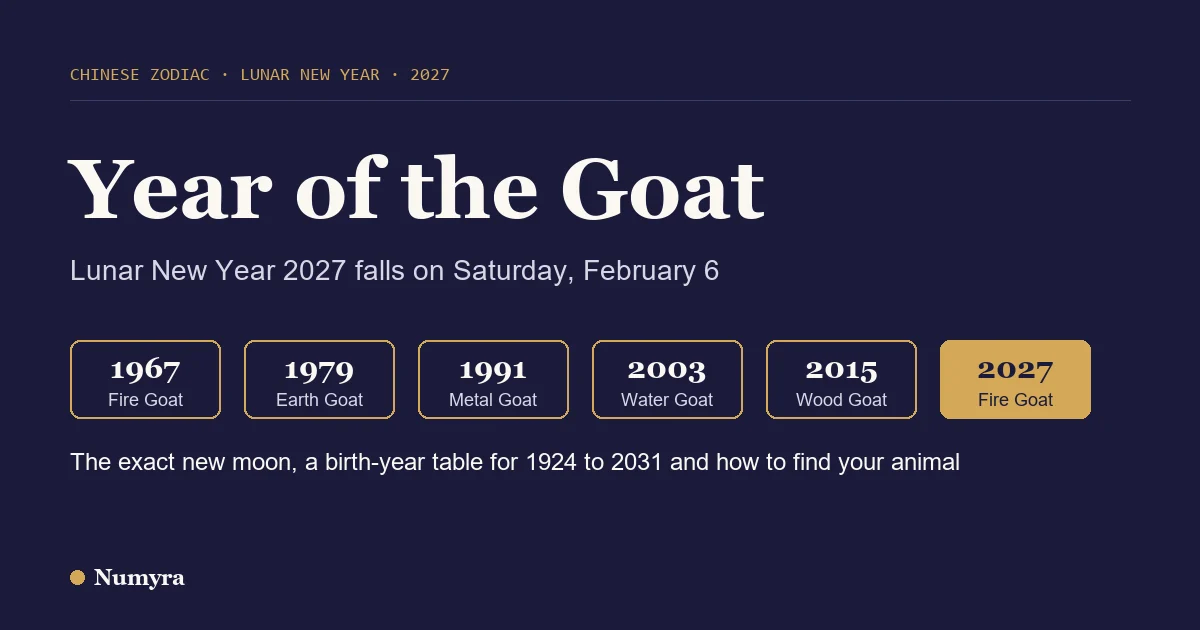
Chinese New Year 2027 falls on Saturday, February 6, 2027, and it starts the year of the Goat, specifically the Fire Goat, in the Chinese zodiac. That year begins on the day of Lunar New Year and ends on January 25, 2028. The same animal is called the Sheep or the Ram in English; the Chinese character covers all three. A baby born in January 2027 or on February 1 to 5 will belong to the previous animal, the Fire Horse. This page gives the exact moment the new year begins in China, Eastern and Pacific time, explains why that date is not the same everywhere, and lists the Lunar New Year start date for every year from 1924 to 2031, so people born in January or February can find their animal. The Chinese zodiac is a cultural calendar with centuries of tradition behind it, not a forecast, and this page treats it that way.
Key takeaways
- Lunar New Year 2027 is Saturday, February 6. The new moon that starts it arrives at 15:56 UTC, which is 23:56 in China, 10:56 a.m. Eastern and 7:56 a.m. Pacific, all on February 6. In China it is four minutes before midnight, the closest call of the 108 years in our table.
- The Goat year of 2027 is yin Fire: the stem-and-branch name is Ding-wei. The last Fire Goat year began on February 9, 1967, and the cycle repeats every 60 years, so the next is 2087. The next Goat year of any element is 2039, an Earth Goat.
- The date rule is the second new moon after the winter solstice, in China Standard Time. We calculated it for 1924 to 2031 and every date matched the Hong Kong Observatory conversion tables, and every new moon time matched the US Naval Observatory to within a minute.
- The US date of the new moon differs from the Chinese date in some years: in 2030 the new moon falls on February 2 in the United States but February 3 in China, and in 2031 on January 22 against January 23. For the festival and for your zodiac animal, the China date is the one that counts.
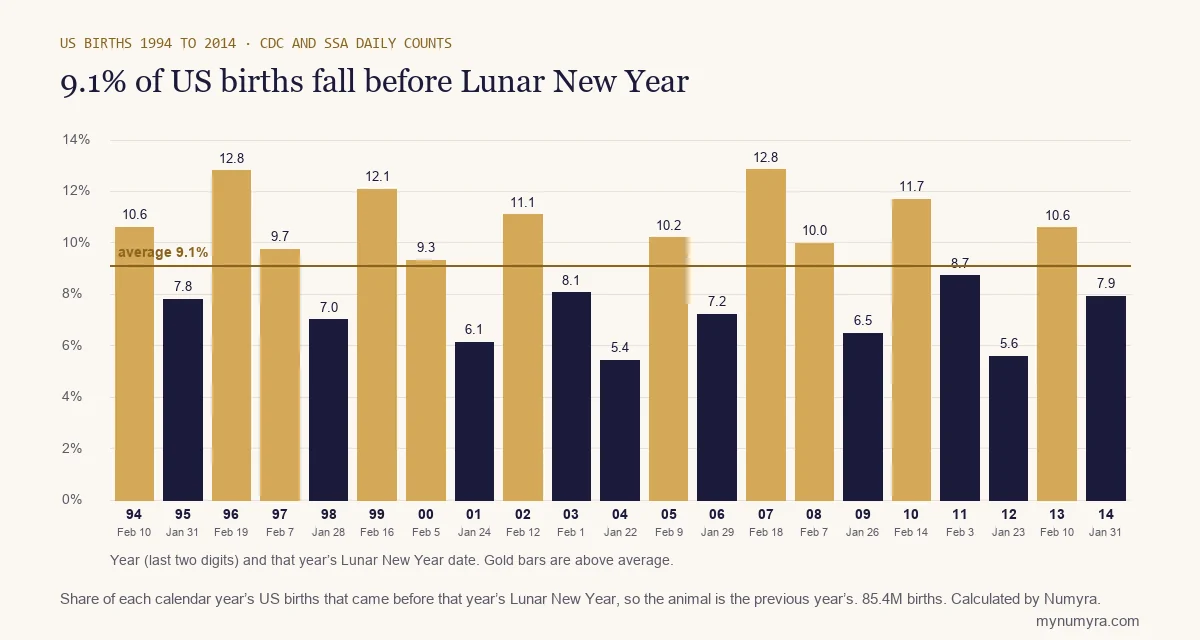
- About 9.1% of US births from 1994 to 2014, roughly 7.8 million of 85.4 million, came before that year’s Lunar New Year, so their animal differs from the one for their birth year on the calendar.
In this guide
- When Chinese New Year 2027 starts, to the minute
- How the date of Chinese New Year (Lunar New Year) is set
- Why the US date can differ from China’s
- The Fire Goat: element, yin and yang
- Goat, sheep or ram?
- Find your animal: every birth year, 1924 to 2031
- Lunar New Year or the first day of spring?
- What the Goat year means in tradition, and what it does not
- Frequently asked questions
When Chinese New Year 2027 starts, to the minute
The Year of the Goat starts on the first day of the first lunar month. In 2027 that is Saturday, February 6, the date the Hong Kong Observatory’s conversion table marks as the “1st Lunar Month” for 2027. The festival that follows lasts 15 days and ends with the Lantern Festival on February 20, 2027. The Congressional Research Service says in its Lunar New Year fact sheet that the holiday is observed “in late January or early February” in most years.
The astronomical event behind the date is a new moon, the instant the Moon passes between Earth and the Sun. The table lists it with the two events that fix the month before it. All times are calculated with the Swiss Ephemeris and match the US Naval Observatory’s published times for the same events.
| Event | UTC | China (UTC+8) | US Eastern (EST) | US Pacific (PST) |
|---|---|---|---|---|
| Winter solstice, 2026 | Dec 21, 20:50 | Dec 22, 04:50 | Dec 21, 3:50 p.m. | Dec 21, 12:50 p.m. |
| First new moon after the solstice | Jan 7, 20:24 | Jan 8, 04:24 | Jan 7, 3:24 p.m. | Jan 7, 12:24 p.m. |
| Second new moon: Lunar New Year 2027 | Feb 6, 15:56 | Feb 6, 23:56 | Feb 6, 10:56 a.m. | Feb 6, 7:56 a.m. |
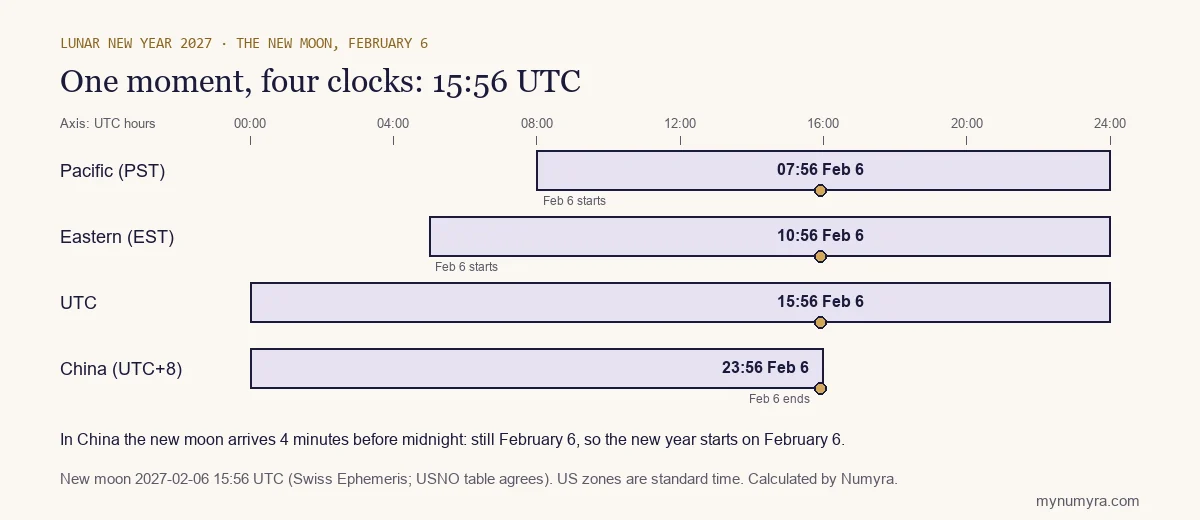
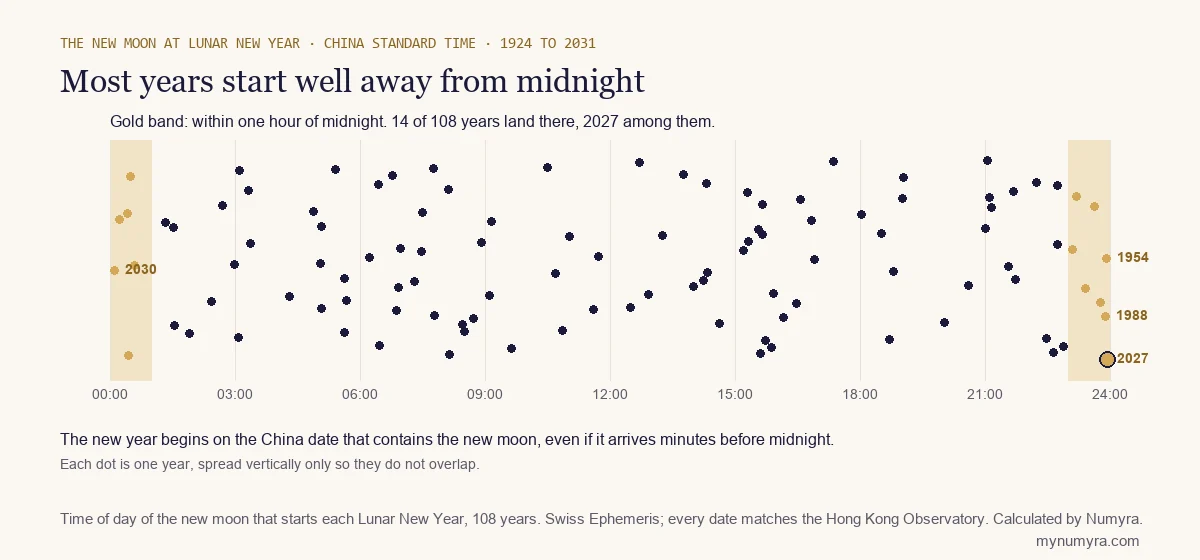
February 6 is the date everywhere in the Chinese calendar, because the calendar counts days in China. The detail worth knowing is how narrow the margin is. The new moon arrives at 23:56 China time, 3 minutes and 51 seconds before the date changes, so a new moon four minutes later would have pushed Lunar New Year to February 7. Both our calculation and the US Naval Observatory table give 15:56 UTC, and the official Hong Kong Observatory table confirms February 6, so there is no doubt about the date. Of the 108 years from 1924 to 2031, 2027 is the one where the new moon comes closest to midnight.
The same new moon is an annular solar eclipse. NASA’s eclipse table lists it with the greatest eclipse at 16:00:47 Terrestrial Dynamical Time and a path across Chile, Argentina and the Atlantic, with a partial eclipse over parts of South America, Antarctica and southern and western Africa. It is not visible from China or the United States, and it has no bearing on the calendar date; the two events coincide because every solar eclipse happens at a new moon. Our guide to the 2027 eclipses and the 2027 new Moon and full Moon calendar cover the Western astrology side, and our piece on how Moon phases affect astrology and mood separates tradition from testing.
How the date of Chinese New Year (Lunar New Year) is set
The Chinese calendar is lunisolar: its months follow the Moon and its years are kept in step with the Sun. Each month begins on the day of a new moon, and the winter solstice always falls in the 11th month. The Library of Congress explains that the lunar calendar is based on the monthly phases of the moon, which cycle every 29 or 30 days, and that this is why Lunar New Year is on a different day every year of the Gregorian calendar. The Congressional Research Service states the rule for the new year directly:
“The Lunar New Year starts on the second new moon after the winter solstice and falls between January 21 and February 19 on the Gregorian calendar used in the United States.”
Congressional Research Service, Lunar New Year: Fact Sheet, R46674, updated January 21, 2025
For 2027 the rule works like this. The winter solstice is December 21, 2026 at 20:50 UTC, which is already December 22 in China. The first new moon after it is January 7, 2027 (January 8 in China) and the second is February 6. The new moon of December 9, 2026 came before the solstice, so it started the 11th month that contains it, and the 12th month began on January 8. The Hong Kong Observatory table shows the same sequence.
The plain rule has two exceptions. The first is a new moon on the same China date as the winter solstice: that day starts the solstice month itself, so the new year comes with the third new moon after the solstice moment, not the second. In our calculation this happened in 1985 and 2015 (Lunar New Year fell on February 20, 1985 and February 19, 2015). The second is the leap month. A solar year is about 11 days longer than 12 lunar months, so every two or three years the calendar adds a 13th month. By the standard rule the leap month is the first month with no major solar term in it. In our calculation, 40 of the 108 spans from one winter-solstice month to the next had 13 months. A leap month before the new year is the reason Lunar New Year is occasionally the third new moon after the solstice, not the second.
The calendar is calculated for China Standard Time, not for a local clock in each country. Wikipedia’s article on the Chinese calendar notes that the baseline is China Standard Time and that the modern calendar follows the national standard GB/T 33661-2017. That clock matters for the next section.
How we checked every date
We did not copy dates from other websites. We calculated every Lunar New Year from 1924 to 2031 from the Sun’s and Moon’s positions, using the Swiss Ephemeris (Moshier mode) and the rule above in China Standard Time, then compared the result with two published sources:
- Hong Kong Observatory. Its Gregorian-Lunar conversion tables name the first day of the 1st lunar month for each year. All 108 dates in our table, and the following years up to 2032, matched exactly. The simple rule and the official date never differed in any year, including the earliest, 1924 to 1928.
- US Naval Observatory. Its moon-phase tables give each new moon to the minute. Our times matched within 0.6 minute, which is the rounding in the published table. The same service’s seasons table gives the December 2026 solstice as 20:50 UTC, which also matches our calculation.
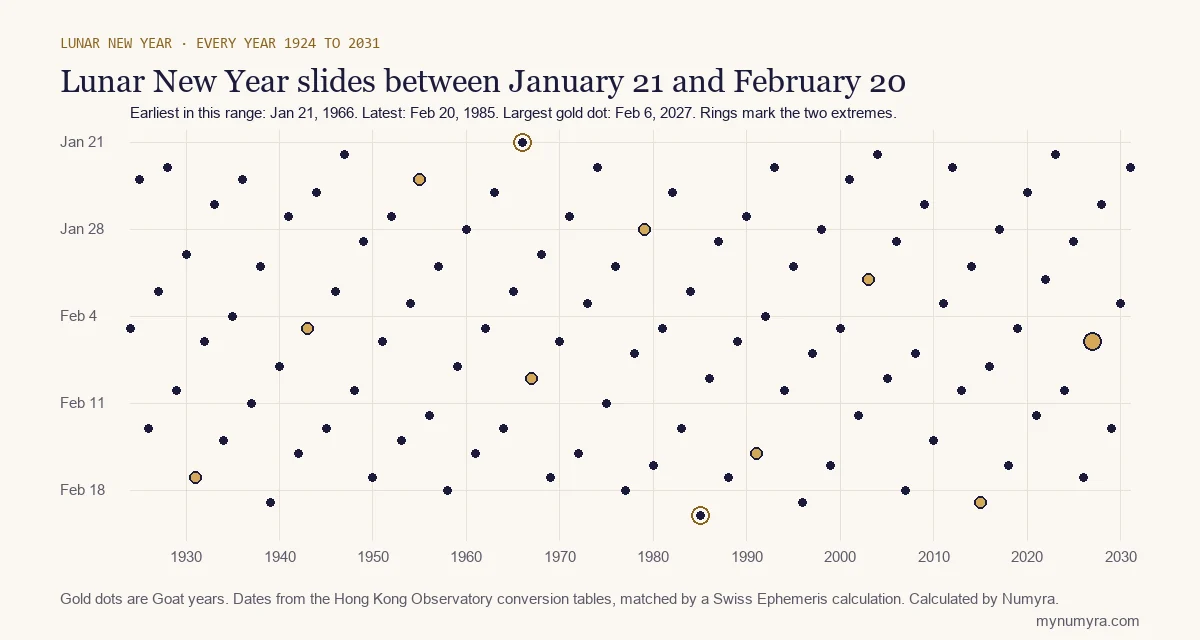
The earliest Lunar New Year in the 108 years was January 21, 1966 and the latest was February 20, 1985. Published guides give different upper limits for the range: the Congressional Research Service says February 19, Wikipedia says February 20 and the Farmers’ Almanac says February 21. February 20 happened in 1985, so for these decades the CRS figure is a day short.
Why the US date can differ from China’s
China is 13 hours ahead of US Eastern Standard Time and 16 hours ahead of Pacific Standard Time. A new moon that happens in the first 13 hours of a Chinese day therefore happens on the previous calendar day in New York, and one in the first 16 hours happens on the previous day in Los Angeles. This table shows the next six years, using US standard time, which is in effect on every one of these dates.
| Year | New moon, China time | New moon, US Eastern | New moon, US Pacific | Lunar New Year (China date) | US date matches? |
|---|---|---|---|---|---|
| 2026 | Feb 17, 20:01 | Feb 17, 7:01 a.m. | Feb 17, 4:01 a.m. | Feb 17, 2026 | Yes |
| 2027 | Feb 6, 23:56 | Feb 6, 10:56 a.m. | Feb 6, 7:56 a.m. | Feb 6, 2027 | Yes |
| 2028 | Jan 26, 23:12 | Jan 26, 10:12 a.m. | Jan 26, 7:12 a.m. | Jan 26, 2028 | Yes |
| 2029 | Feb 13, 18:31 | Feb 13, 5:31 a.m. | Feb 13, 2:31 a.m. | Feb 13, 2029 | Yes |
| 2030 | Feb 3, 00:07 | Feb 2, 11:07 a.m. | Feb 2, 8:07 a.m. | Feb 3, 2030 | No: one day earlier |
| 2031 | Jan 23, 12:30 | Jan 22, 11:30 p.m. | Jan 22, 8:30 p.m. | Jan 23, 2031 | No: one day earlier |
The pattern is that the date of the festival stays the Chinese date while the moment of the new moon is a separate fact. In 2030 the new moon falls at 00:07 on February 3 in China and so starts that day, but it is 11:07 a.m. on February 2 in New York. In 2031 the new moon is at 11:30 p.m. Eastern on January 22 but 12:30 p.m. in China on January 23. Celebrations in the United States follow the Chinese date: San Francisco, for example, holds a festival and parade that the CRS fact sheet says has been described as “the largest celebration of its kind in the world.”
Countries on other clocks can split from China. Wikipedia’s article on Tet lists February 2, 2030 as the Vietnamese new year, one day before China’s February 3, and our calculation shows why: Vietnam is one hour behind China, so the new moon at 00:07 China time is 23:07 on February 2 there. In 2027 the new moon is at 22:56 in Vietnam on February 6, so the date is the same.
Our data also show how rare the close calls are. Only 14 of 108 years have a new moon within an hour of midnight in China.
The Fire Goat: element, yin and yang
Each year in the Chinese calendar has two labels that run in different cycles. One is the animal, one of twelve in order: Rat, Ox, Tiger, Rabbit, Dragon, Snake, Horse, Goat, Monkey, Rooster, Dog and Pig. The other is one of ten “heavenly stems”, each tied to an element and to yin or yang. The Library of Congress puts it simply:
“In the Chinese zodiac, each year is represented by one of twelve animals and one of five elements.”
Library of Congress, Celebrating Lunar New Year with the Library of Congress’s Collections, February 9, 2024
The stems go in pairs: two years of Wood, two of Fire, two of Earth, two of Metal and two of Water, with yang first and yin second. That gives a rule you can use without any table. The last digit of the year sets the element (0 and 1 Metal, 2 and 3 Water, 4 and 5 Wood, 6 and 7 Fire, 8 and 9 Earth), and an even last digit is yang while an odd one is yin. We checked this against the stem-and-branch names the Hong Kong Observatory gives for each of the 108 years, and they agree.
The year 2027 ends in 7, so it is yin Fire, the stem called Ding, and the Goat is the branch called wei. Together they are Ding-wei, the name in the Observatory’s 2027 table. The Goat is always a yin animal, so a Goat can only ever pair with a yin stem. That leaves five Goat years in each 60-year cycle, one per element:
| Goat year | Element | Stem and branch | Starts | Ends |
|---|---|---|---|---|
| 1931 (Metal Goat) | Metal | Xin-wei | Feb 17, 1931 | Feb 5, 1932 |
| 1943 (Water Goat) | Water | Gui-wei | Feb 5, 1943 | Jan 24, 1944 |
| 1955 (Wood Goat) | Wood | Yi-wei | Jan 24, 1955 | Feb 11, 1956 |
| 1967 (Fire Goat) | Fire | Ding-wei | Feb 9, 1967 | Jan 29, 1968 |
| 1979 (Earth Goat) | Earth | Ji-wei | Jan 28, 1979 | Feb 15, 1980 |
| 1991 (Metal Goat) | Metal | Xin-wei | Feb 15, 1991 | Feb 3, 1992 |
| 2003 (Water Goat) | Water | Gui-wei | Feb 1, 2003 | Jan 21, 2004 |
| 2015 (Wood Goat) | Wood | Yi-wei | Feb 19, 2015 | Feb 7, 2016 |
| 2027 (Fire Goat) | Fire | Ding-wei | Feb 6, 2027 | Jan 25, 2028 |
| 2039 (Earth Goat) | Earth | Ji-wei | Jan 24, 2039 | Feb 11, 2040 |
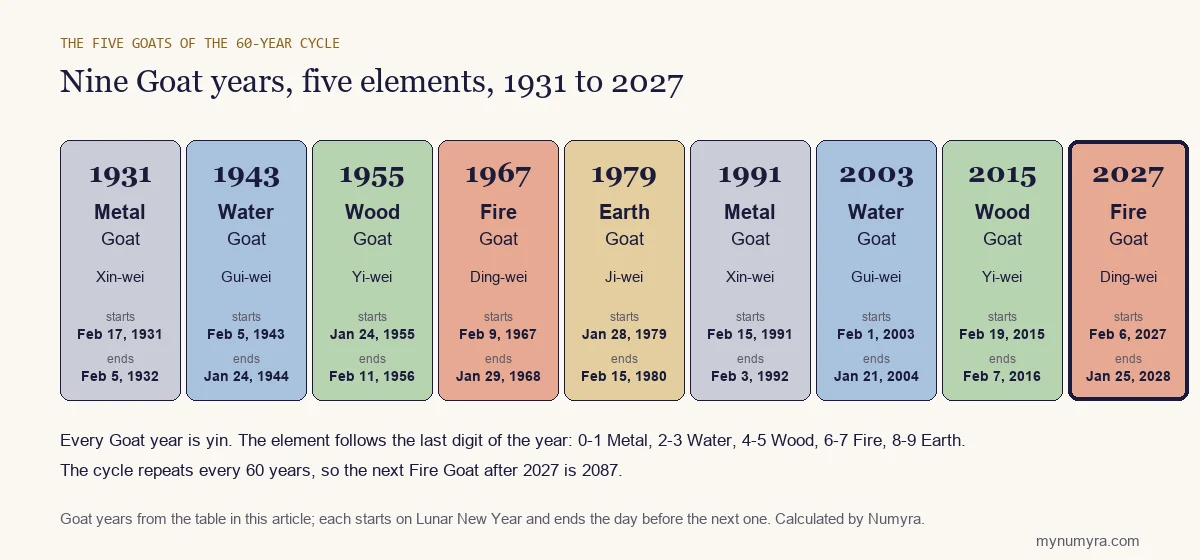
The Farmers’ Almanac notes that the last Fire Goat year was 1967. The 1967 year began on February 9 and ended on January 29, 1968. Chinese elements are a separate set from the four classical elements of Western astrology, which are Fire, Earth, Air and Water, and they work differently: the Chinese set has five and includes Wood and Metal. Our guide to the four elements and three modalities covers the Western set.
Goat, sheep or ram?
All three English names are in use because of one Chinese character. That’s Mandarin, a language school, explains the origin:
“the Chinese character 羊 (yáng) can refer to several members of the sheep and goat family”
That’s Mandarin, Year of the Goat 2027: Chinese Zodiac Meaning, Personality and Lucky Signs, July 1, 2026
Guides that name a preference tend to choose Goat. China Highlights says most Chinese people and folklore experts believe the animal is the Goat, not the Sheep, and That’s Mandarin says Year of the Goat is the most commonly used translation in English. Other countries that use the same twelve-animal cycle make different choices. Wikipedia notes that Korean and Japanese calendars use the Sheep, and the Congressional Research Service says the Vietnamese zodiac uses the buffalo, cat and goat where the Chinese one has the ox, rabbit and sheep. Whether you say Goat, Sheep or Ram, the year and its dates are the same.
Find your animal: every birth year, 1924 to 2031
The Chinese zodiac year does not begin on January 1, so anyone born in January or February needs the table. Find your birth year and compare your date with the start date. If you were born before that date, your animal belongs to the previous row. The last column is the start of spring (Lichun), which a second tradition uses instead; the section after the table explains it.
| Year | Animal | Element and polarity | Stem and branch | Starts (Lunar New Year) | Ends | Start of spring |
|---|---|---|---|---|---|---|
| 1924 | Rat | Wood Yang | Jia-zi | Feb 5, 1924 | Jan 23, 1925 | Feb 5, 1924 |
| 1925 | Ox | Wood Yin | Yi-chou | Jan 24, 1925 | Feb 12, 1926 | Feb 4, 1925 |
| 1926 | Tiger | Fire Yang | Bing-yin | Feb 13, 1926 | Feb 1, 1927 | Feb 4, 1926 |
| 1927 | Rabbit | Fire Yin | Ding-mao | Feb 2, 1927 | Jan 22, 1928 | Feb 5, 1927 |
| 1928 | Dragon | Earth Yang | Wu-chen | Jan 23, 1928 | Feb 9, 1929 | Feb 5, 1928 |
| 1929 | Snake | Earth Yin | Ji-si | Feb 10, 1929 | Jan 29, 1930 | Feb 4, 1929 |
| 1930 | Horse | Metal Yang | Geng-wu | Jan 30, 1930 | Feb 16, 1931 | Feb 4, 1930 |
| 1931 | Goat | Metal Yin | Xin-wei | Feb 17, 1931 | Feb 5, 1932 | Feb 5, 1931 |
| 1932 | Monkey | Water Yang | Ren-shen | Feb 6, 1932 | Jan 25, 1933 | Feb 5, 1932 |
| 1933 | Rooster | Water Yin | Gui-you | Jan 26, 1933 | Feb 13, 1934 | Feb 4, 1933 |
| 1934 | Dog | Wood Yang | Jia-xu | Feb 14, 1934 | Feb 3, 1935 | Feb 4, 1934 |
| 1935 | Pig | Wood Yin | Yi-hai | Feb 4, 1935 | Jan 23, 1936 | Feb 5, 1935 |
| 1936 | Rat | Fire Yang | Bing-zi | Jan 24, 1936 | Feb 10, 1937 | Feb 5, 1936 |
| 1937 | Ox | Fire Yin | Ding-chou | Feb 11, 1937 | Jan 30, 1938 | Feb 4, 1937 |
| 1938 | Tiger | Earth Yang | Wu-yin | Jan 31, 1938 | Feb 18, 1939 | Feb 4, 1938 |
| 1939 | Rabbit | Earth Yin | Ji-mao | Feb 19, 1939 | Feb 7, 1940 | Feb 5, 1939 |
| 1940 | Dragon | Metal Yang | Geng-chen | Feb 8, 1940 | Jan 26, 1941 | Feb 5, 1940 |
| 1941 | Snake | Metal Yin | Xin-si | Jan 27, 1941 | Feb 14, 1942 | Feb 4, 1941 |
| 1942 | Horse | Water Yang | Ren-wu | Feb 15, 1942 | Feb 4, 1943 | Feb 4, 1942 |
| 1943 | Goat | Water Yin | Gui-wei | Feb 5, 1943 | Jan 24, 1944 | Feb 5, 1943 |
| 1944 | Monkey | Wood Yang | Jia-shen | Jan 25, 1944 | Feb 12, 1945 | Feb 5, 1944 |
| 1945 | Rooster | Wood Yin | Yi-you | Feb 13, 1945 | Feb 1, 1946 | Feb 4, 1945 |
| 1946 | Dog | Fire Yang | Bing-xu | Feb 2, 1946 | Jan 21, 1947 | Feb 4, 1946 |
| 1947 | Pig | Fire Yin | Ding-hai | Jan 22, 1947 | Feb 9, 1948 | Feb 4, 1947 |
| 1948 | Rat | Earth Yang | Wu-zi | Feb 10, 1948 | Jan 28, 1949 | Feb 5, 1948 |
| 1949 | Ox | Earth Yin | Ji-chou | Jan 29, 1949 | Feb 16, 1950 | Feb 4, 1949 |
| 1950 | Tiger | Metal Yang | Geng-yin | Feb 17, 1950 | Feb 5, 1951 | Feb 4, 1950 |
| 1951 | Rabbit | Metal Yin | Xin-mao | Feb 6, 1951 | Jan 26, 1952 | Feb 4, 1951 |
| 1952 | Dragon | Water Yang | Ren-chen | Jan 27, 1952 | Feb 13, 1953 | Feb 5, 1952 |
| 1953 | Snake | Water Yin | Gui-si | Feb 14, 1953 | Feb 2, 1954 | Feb 4, 1953 |
| 1954 | Horse | Wood Yang | Jia-wu | Feb 3, 1954 | Jan 23, 1955 | Feb 4, 1954 |
| 1955 | Goat | Wood Yin | Yi-wei | Jan 24, 1955 | Feb 11, 1956 | Feb 4, 1955 |
| 1956 | Monkey | Fire Yang | Bing-shen | Feb 12, 1956 | Jan 30, 1957 | Feb 5, 1956 |
| 1957 | Rooster | Fire Yin | Ding-you | Jan 31, 1957 | Feb 17, 1958 | Feb 4, 1957 |
| 1958 | Dog | Earth Yang | Wu-xu | Feb 18, 1958 | Feb 7, 1959 | Feb 4, 1958 |
| 1959 | Pig | Earth Yin | Ji-hai | Feb 8, 1959 | Jan 27, 1960 | Feb 4, 1959 |
| 1960 | Rat | Metal Yang | Geng-zi | Jan 28, 1960 | Feb 14, 1961 | Feb 5, 1960 |
| 1961 | Ox | Metal Yin | Xin-chou | Feb 15, 1961 | Feb 4, 1962 | Feb 4, 1961 |
| 1962 | Tiger | Water Yang | Ren-yin | Feb 5, 1962 | Jan 24, 1963 | Feb 4, 1962 |
| 1963 | Rabbit | Water Yin | Gui-mao | Jan 25, 1963 | Feb 12, 1964 | Feb 4, 1963 |
| 1964 | Dragon | Wood Yang | Jia-chen | Feb 13, 1964 | Feb 1, 1965 | Feb 5, 1964 |
| 1965 | Snake | Wood Yin | Yi-si | Feb 2, 1965 | Jan 20, 1966 | Feb 4, 1965 |
| 1966 | Horse | Fire Yang | Bing-wu | Jan 21, 1966 | Feb 8, 1967 | Feb 4, 1966 |
| 1967 | Goat | Fire Yin | Ding-wei | Feb 9, 1967 | Jan 29, 1968 | Feb 4, 1967 |
| 1968 | Monkey | Earth Yang | Wu-shen | Jan 30, 1968 | Feb 16, 1969 | Feb 5, 1968 |
| 1969 | Rooster | Earth Yin | Ji-you | Feb 17, 1969 | Feb 5, 1970 | Feb 4, 1969 |
| 1970 | Dog | Metal Yang | Geng-xu | Feb 6, 1970 | Jan 26, 1971 | Feb 4, 1970 |
| 1971 | Pig | Metal Yin | Xin-hai | Jan 27, 1971 | Feb 14, 1972 | Feb 4, 1971 |
| 1972 | Rat | Water Yang | Ren-zi | Feb 15, 1972 | Feb 2, 1973 | Feb 5, 1972 |
| 1973 | Ox | Water Yin | Gui-chou | Feb 3, 1973 | Jan 22, 1974 | Feb 4, 1973 |
| 1974 | Tiger | Wood Yang | Jia-yin | Jan 23, 1974 | Feb 10, 1975 | Feb 4, 1974 |
| 1975 | Rabbit | Wood Yin | Yi-mao | Feb 11, 1975 | Jan 30, 1976 | Feb 4, 1975 |
| 1976 | Dragon | Fire Yang | Bing-chen | Jan 31, 1976 | Feb 17, 1977 | Feb 5, 1976 |
| 1977 | Snake | Fire Yin | Ding-si | Feb 18, 1977 | Feb 6, 1978 | Feb 4, 1977 |
| 1978 | Horse | Earth Yang | Wu-wu | Feb 7, 1978 | Jan 27, 1979 | Feb 4, 1978 |
| 1979 | Goat | Earth Yin | Ji-wei | Jan 28, 1979 | Feb 15, 1980 | Feb 4, 1979 |
| 1980 | Monkey | Metal Yang | Geng-shen | Feb 16, 1980 | Feb 4, 1981 | Feb 5, 1980 |
| 1981 | Rooster | Metal Yin | Xin-you | Feb 5, 1981 | Jan 24, 1982 | Feb 4, 1981 |
| 1982 | Dog | Water Yang | Ren-xu | Jan 25, 1982 | Feb 12, 1983 | Feb 4, 1982 |
| 1983 | Pig | Water Yin | Gui-hai | Feb 13, 1983 | Feb 1, 1984 | Feb 4, 1983 |
| 1984 | Rat | Wood Yang | Jia-zi | Feb 2, 1984 | Feb 19, 1985 | Feb 4, 1984 |
| 1985 | Ox | Wood Yin | Yi-chou | Feb 20, 1985 | Feb 8, 1986 | Feb 4, 1985 |
| 1986 | Tiger | Fire Yang | Bing-yin | Feb 9, 1986 | Jan 28, 1987 | Feb 4, 1986 |
| 1987 | Rabbit | Fire Yin | Ding-mao | Jan 29, 1987 | Feb 16, 1988 | Feb 4, 1987 |
| 1988 | Dragon | Earth Yang | Wu-chen | Feb 17, 1988 | Feb 5, 1989 | Feb 4, 1988 |
| 1989 | Snake | Earth Yin | Ji-si | Feb 6, 1989 | Jan 26, 1990 | Feb 4, 1989 |
| 1990 | Horse | Metal Yang | Geng-wu | Jan 27, 1990 | Feb 14, 1991 | Feb 4, 1990 |
| 1991 | Goat | Metal Yin | Xin-wei | Feb 15, 1991 | Feb 3, 1992 | Feb 4, 1991 |
| 1992 | Monkey | Water Yang | Ren-shen | Feb 4, 1992 | Jan 22, 1993 | Feb 4, 1992 |
| 1993 | Rooster | Water Yin | Gui-you | Jan 23, 1993 | Feb 9, 1994 | Feb 4, 1993 |
| 1994 | Dog | Wood Yang | Jia-xu | Feb 10, 1994 | Jan 30, 1995 | Feb 4, 1994 |
| 1995 | Pig | Wood Yin | Yi-hai | Jan 31, 1995 | Feb 18, 1996 | Feb 4, 1995 |
| 1996 | Rat | Fire Yang | Bing-zi | Feb 19, 1996 | Feb 6, 1997 | Feb 4, 1996 |
| 1997 | Ox | Fire Yin | Ding-chou | Feb 7, 1997 | Jan 27, 1998 | Feb 4, 1997 |
| 1998 | Tiger | Earth Yang | Wu-yin | Jan 28, 1998 | Feb 15, 1999 | Feb 4, 1998 |
| 1999 | Rabbit | Earth Yin | Ji-mao | Feb 16, 1999 | Feb 4, 2000 | Feb 4, 1999 |
| 2000 | Dragon | Metal Yang | Geng-chen | Feb 5, 2000 | Jan 23, 2001 | Feb 4, 2000 |
| 2001 | Snake | Metal Yin | Xin-si | Jan 24, 2001 | Feb 11, 2002 | Feb 4, 2001 |
| 2002 | Horse | Water Yang | Ren-wu | Feb 12, 2002 | Jan 31, 2003 | Feb 4, 2002 |
| 2003 | Goat | Water Yin | Gui-wei | Feb 1, 2003 | Jan 21, 2004 | Feb 4, 2003 |
| 2004 | Monkey | Wood Yang | Jia-shen | Jan 22, 2004 | Feb 8, 2005 | Feb 4, 2004 |
| 2005 | Rooster | Wood Yin | Yi-you | Feb 9, 2005 | Jan 28, 2006 | Feb 4, 2005 |
| 2006 | Dog | Fire Yang | Bing-xu | Jan 29, 2006 | Feb 17, 2007 | Feb 4, 2006 |
| 2007 | Pig | Fire Yin | Ding-hai | Feb 18, 2007 | Feb 6, 2008 | Feb 4, 2007 |
| 2008 | Rat | Earth Yang | Wu-zi | Feb 7, 2008 | Jan 25, 2009 | Feb 4, 2008 |
| 2009 | Ox | Earth Yin | Ji-chou | Jan 26, 2009 | Feb 13, 2010 | Feb 4, 2009 |
| 2010 | Tiger | Metal Yang | Geng-yin | Feb 14, 2010 | Feb 2, 2011 | Feb 4, 2010 |
| 2011 | Rabbit | Metal Yin | Xin-mao | Feb 3, 2011 | Jan 22, 2012 | Feb 4, 2011 |
| 2012 | Dragon | Water Yang | Ren-chen | Jan 23, 2012 | Feb 9, 2013 | Feb 4, 2012 |
| 2013 | Snake | Water Yin | Gui-si | Feb 10, 2013 | Jan 30, 2014 | Feb 4, 2013 |
| 2014 | Horse | Wood Yang | Jia-wu | Jan 31, 2014 | Feb 18, 2015 | Feb 4, 2014 |
| 2015 | Goat | Wood Yin | Yi-wei | Feb 19, 2015 | Feb 7, 2016 | Feb 4, 2015 |
| 2016 | Monkey | Fire Yang | Bing-shen | Feb 8, 2016 | Jan 27, 2017 | Feb 4, 2016 |
| 2017 | Rooster | Fire Yin | Ding-you | Jan 28, 2017 | Feb 15, 2018 | Feb 3, 2017 |
| 2018 | Dog | Earth Yang | Wu-xu | Feb 16, 2018 | Feb 4, 2019 | Feb 4, 2018 |
| 2019 | Pig | Earth Yin | Ji-hai | Feb 5, 2019 | Jan 24, 2020 | Feb 4, 2019 |
| 2020 | Rat | Metal Yang | Geng-zi | Jan 25, 2020 | Feb 11, 2021 | Feb 4, 2020 |
| 2021 | Ox | Metal Yin | Xin-chou | Feb 12, 2021 | Jan 31, 2022 | Feb 3, 2021 |
| 2022 | Tiger | Water Yang | Ren-yin | Feb 1, 2022 | Jan 21, 2023 | Feb 4, 2022 |
| 2023 | Rabbit | Water Yin | Gui-mao | Jan 22, 2023 | Feb 9, 2024 | Feb 4, 2023 |
| 2024 | Dragon | Wood Yang | Jia-chen | Feb 10, 2024 | Jan 28, 2025 | Feb 4, 2024 |
| 2025 | Snake | Wood Yin | Yi-si | Jan 29, 2025 | Feb 16, 2026 | Feb 3, 2025 |
| 2026 | Horse | Fire Yang | Bing-wu | Feb 17, 2026 | Feb 5, 2027 | Feb 4, 2026 |
| 2027 | Goat | Fire Yin | Ding-wei | Feb 6, 2027 | Jan 25, 2028 | Feb 4, 2027 |
| 2028 | Monkey | Earth Yang | Wu-shen | Jan 26, 2028 | Feb 12, 2029 | Feb 4, 2028 |
| 2029 | Rooster | Earth Yin | Ji-you | Feb 13, 2029 | Feb 2, 2030 | Feb 3, 2029 |
| 2030 | Dog | Metal Yang | Geng-xu | Feb 3, 2030 | Jan 22, 2031 | Feb 4, 2030 |
| 2031 | Pig | Metal Yin | Xin-hai | Jan 23, 2031 | Feb 10, 2032 | Feb 4, 2031 |
Two worked examples show how it goes wrong when you use the calendar year alone. A person born on January 15, 2000 sees “2000” and expects a Dragon, but 2000 began on February 5, so the birth falls in the Rabbit year that started on February 16, 1999. A person born on February 10, 1985 falls before that year’s start date of February 20, which is the latest in the table, so the animal is the Rat of 1984, not the Ox.
This is a real share of people. Using real daily US birth counts for 1994 to 2014 (the CDC National Center for Health Statistics for 1994 to 2003 and the Social Security Administration for 2004 to 2014), we counted the births in each calendar year that came before that year’s Lunar New Year. Of 85,386,227 births, 7,777,928 or 9.1% came before it, so about one American in 11 born in those years has a different animal from the one the birth year suggests. The share ranges from 5.4% for 2004 births, when Lunar New Year was January 22, to 12.8% for 1996 and 2007, when it fell on February 19 and February 18.
A note on method: the table compares your birth date as written with the Chinese date of Lunar New Year. For a birth in the hours around the start of the new year, the time zone can move the date by a day. For a birth on the exact day, check the new moon time in the table above for the year in question.
Lunar New Year or the first day of spring?
Two conventions are in use for where the zodiac year begins. The popular one, used for the table above, starts it on Lunar New Year. A second, used in some astrological systems of Chinese origin, starts it at Lichun, the start of spring, which the Hong Kong Observatory lists in its conversion tables as “Spring Commences”. Wikipedia’s Chinese zodiac article describes both schools of thought.
In our 108 years Lichun fell on February 3, 4 or 5 every time. It came before Lunar New Year in 55 years, on the same day in 3, and after it in 50. In 105 of the 108 years the two conventions disagree about people born in the gap between them, which averages 7.4 days and reached 16 days in 1985 (Lichun on February 4, Lunar New Year on February 20). For 2027 the gap is two days: Lichun is February 4 and Lunar New Year is February 6, so a baby born on February 4 or 5 is a Horse by the first convention and a Goat by the second.
This is a matter of convention, not a mistake in either. The Western parallel is the difference between the tropical and sidereal zodiacs, where two traditions mark the sign boundaries differently; our sidereal vs. tropical explainer covers it. Where the traditions overlap, this page uses Lunar New Year, because it is the date used in the festival and by the Chinese calendar itself.
What the Goat year means in tradition, and what it does not
Guides to the Goat year describe the animal as gentle, creative and patient, and also as sensitive and indecisive. Those lists, from China Highlights and That’s Mandarin among others, repeat popular tradition and cite no studies. We did not find a test showing that the animal of your birth year predicts personality, and we do not offer predictions for 2027. The zodiac is best read as a cultural calendar, in the same way the Western signs are a tradition and not a measurement.
One tradition is worth knowing if you are a Goat. The Farmers’ Almanac describes the Ben Ming Nian, the year of your own animal that comes once every 12 years, which traditional belief says calls for extra caution. In 2027 that applies to people born in Goat years such as 1967, 1979, 1991, 2003 and 2015. Treat it as a custom, not a rule that anything depends on.
If you came here for the astrology of the same year, the Western tradition is separate, with its own twelve zodiac sign profiles: our guides to where the 12 zodiac signs came from and the 2027 zodiac sign dates cover it, and the numerology of 2027 is another system again. None of them is a forecast. Nothing on this page is financial, health or legal advice.
For US readers the practical side of the holiday is simpler than the astronomy. The Congressional Research Service reports that Lunar New Year is not a federal holiday, that California, Colorado and New Jersey have passed laws recognizing it, and that New York treats it as a public-school holiday. Because February 6, 2027 is a Saturday, it will not close any weekday school. The CRS also puts the US population of Chinese descent at about 5.4 million, the largest single Asian American group, based on the Census Bureau’s 2022 American Community Survey.
Frequently asked questions
What Chinese zodiac animal is 2027?
The Goat, also called the Sheep or Ram, and specifically a Fire Goat (stem and branch Ding-wei). The year starts on Saturday, February 6, 2027 and ends on January 25, 2028.
When is Chinese New Year in 2027?
Saturday, February 6, 2027. The new moon that starts the year is at 15:56 UTC, which is 23:56 in China, 10:56 a.m. US Eastern and 7:56 a.m. US Pacific on the same date. The Lantern Festival ends the festival on February 20.
I was born in January or February. Which animal am I?
Look up your birth year in the table above and compare your date with the Lunar New Year start date. If you were born before it, your animal is the one for the previous year. For example, a birth on February 10, 1985 is a Rat, because Lunar New Year 1985 was February 20.
Is it the Year of the Goat, Sheep or Ram?
All three names are used for the same animal, because the Chinese character 羊 covers goats, sheep and rams. Goat is the most common English translation, and the dates are identical whichever word you use.
What is a Fire Goat?
A Goat year whose stem is yin Fire. The element follows the last digit of the year: years ending in 6 or 7 are Fire. Fire Goat years began on February 9, 1967 and February 6, 2027, and they recur every 60 years.
When was the last Year of the Goat, and when is the next?
The last was 2015 (a Wood Goat, February 19, 2015 to February 7, 2016). After 2027 the next Goat year is 2039, an Earth Goat that runs from January 24, 2039 to February 11, 2040.
Why does Chinese New Year fall on a different date each year?
It follows the Moon, not the Gregorian calendar. It begins on the second new moon after the winter solstice, with two exceptions (a leap month, or a new moon on the solstice date itself), so it moves between January 21 and February 20 in the years 1924 to 2031.
Does the Chinese zodiac year start on Lunar New Year or on February 4?
It depends on the tradition. The popular convention starts it on Lunar New Year; some astrological systems start it at Lichun, the start of spring, which falls on February 3 to 5. For 2027 the two dates are February 6 and February 4.
Is the Year of the Goat lucky or unlucky?
That is a matter of tradition, not evidence. Popular guides say different things, and we found no test of such claims. Tradition does say Goat people are in their Ben Ming Nian in 2027 and should take extra care, but it is a belief and not a prediction.
Sources
- Hong Kong Observatory. Gregorian-Lunar Calendar Conversion Tables, 1901 to 2100: the yearly files for 1924 to 2032 and 2039 were read for the first day of the 1st lunar month, the stem-and-branch name and the Spring Commences date.
- US Naval Observatory. Phases of the Moon and its solstice and equinox data: new moon and solstice times, 1924 to 2031 and 2026 to 2027.
- Congressional Research Service. Lunar New Year: Fact Sheet (R46674, updated January 21, 2025): the date rule, state recognition and population figures.
- Library of Congress. Celebrating Lunar New Year with the Library of Congress’s Collections (February 9, 2024).
- NASA. Solar Eclipses: 2021 to 2030 (Eclipse Predictions by Fred Espenak, NASA’s GSFC): the annular eclipse of February 6, 2027.
- Wikipedia. Chinese calendar (China Standard Time baseline, GB/T 33661-2017, month 11 and the leap-month rule), Chinese zodiac and Tet.
- That’s Mandarin. Year of the Goat 2027 and China Highlights. Year of the Goat: the Goat, Sheep and Ram naming.
- Farmers’ Almanac. When Is Lunar New Year 2027?: the last Fire Goat year and the Ben Ming Nian tradition.
- Astrodienst. Swiss Ephemeris. New moon and solstice times for all calculations on this page (calculations by the Numyra Methodology Desk).
- FiveThirtyEight. US births data, 1994 to 2014, from the CDC National Center for Health Statistics and the Social Security Administration. Dates only.