Zodiac Sign Calculator: What Is My Zodiac Sign?
Your zodiac sign is the sign the Sun was in at the moment you were born. Enter your birth date to get it, with its symbol, element, modality and ruling planet. On the 12 days a year the Sun changes sign, the date alone is not enough, so the calculator shows both possible signs and the exact minute of the change in your time zone.
Your zodiac sign
Key takeaways
- For 96.7% of the 85.4 million US births from 1994 to 2014, the birth date alone settles the zodiac sign. The other 3.3% were born on one of the 12 days a year the Sun changes sign, and for them the birth time decides it.
- The usual date list (Aries March 21 to April 19, and so on) is a rounding. Checked against the exact moment the Sun entered each sign, it gives the wrong sign to about 1 in 98 people born in US Eastern time and 1 in 89 born in Pacific time, most often people born on March 20, July 22 and December 21.
- The calculator finds the minute the Sun changes sign. Against the US Naval Observatory, its equinox and solstice times for 1900 to 2100 are all within one minute, and against the Swiss Ephemeris all 2,412 sign changes are within 23 seconds.
- It uses the tropical zodiac, the Western standard tied to the equinoxes. Vedic (sidereal) astrology counts from the stars and gives most people the previous sign.
- Your zodiac sign is your Sun sign. Your Moon and rising signs are usually different, and they need a birth time and place.
For entertainment and self-reflection. Numerology and astrology are cultural traditions, not sciences, and nothing here is medical, financial, legal, or psychological advice.
What your zodiac sign result shows
The headline is your Sun sign, the 30-degree slice of the zodiac the Sun was crossing when you were born. Under it the calculator lists the four facts every sign carries in Western astrology, the same ones on each of our zodiac sign profiles:
Symbol. The figure the sign is named for, such as the Ram for Aries or the Water-Bearer for Aquarius. Most come from the constellations the Babylonians and Greeks saw along the Sun’s path, a story told in where the 12 zodiac signs came from.
Element. Fire, earth, air or water. The four elements run in order around the zodiac, so each one returns every fourth sign: Aries, Leo and Sagittarius are fire; Taurus, Virgo and Capricorn are earth; Gemini, Libra and Aquarius are air; Cancer, Scorpio and Pisces are water. The four elements and three modalities, explained covers what astrologers read into each.
Modality. Cardinal, fixed or mutable. The names go back to the seasons. The cardinal signs (Aries, Cancer, Libra, Capricorn) are the four that begin at an equinox or a solstice; the fixed signs follow them, in mid-season; the mutable signs close each season. Ptolemy, writing in the second century, explained the first group by what the Sun does there:
“Two signs are called equinoctial, the one which is first from the spring equinox, Aries, and the one which begins with the autumnal equinox, Libra; and they too again are named from what happens there, because when the sun is at the beginning of these signs he makes the nights exactly equal to the days.”
Ruling planet. The planet traditionally said to “rule” the sign. The calculator gives the traditional ruler first; for Scorpio, Aquarius and Pisces it adds the modern co-ruler (Pluto, Uranus and Neptune) that astrologers assigned after those planets were discovered.
The result also gives the exact dates the Sun spent in your sign in your birth year, and says whether the usual date list agrees with the sky for your birthday. All of it is tradition, offered for reflection, not a prediction about you.
The 12 signs and their usual dates
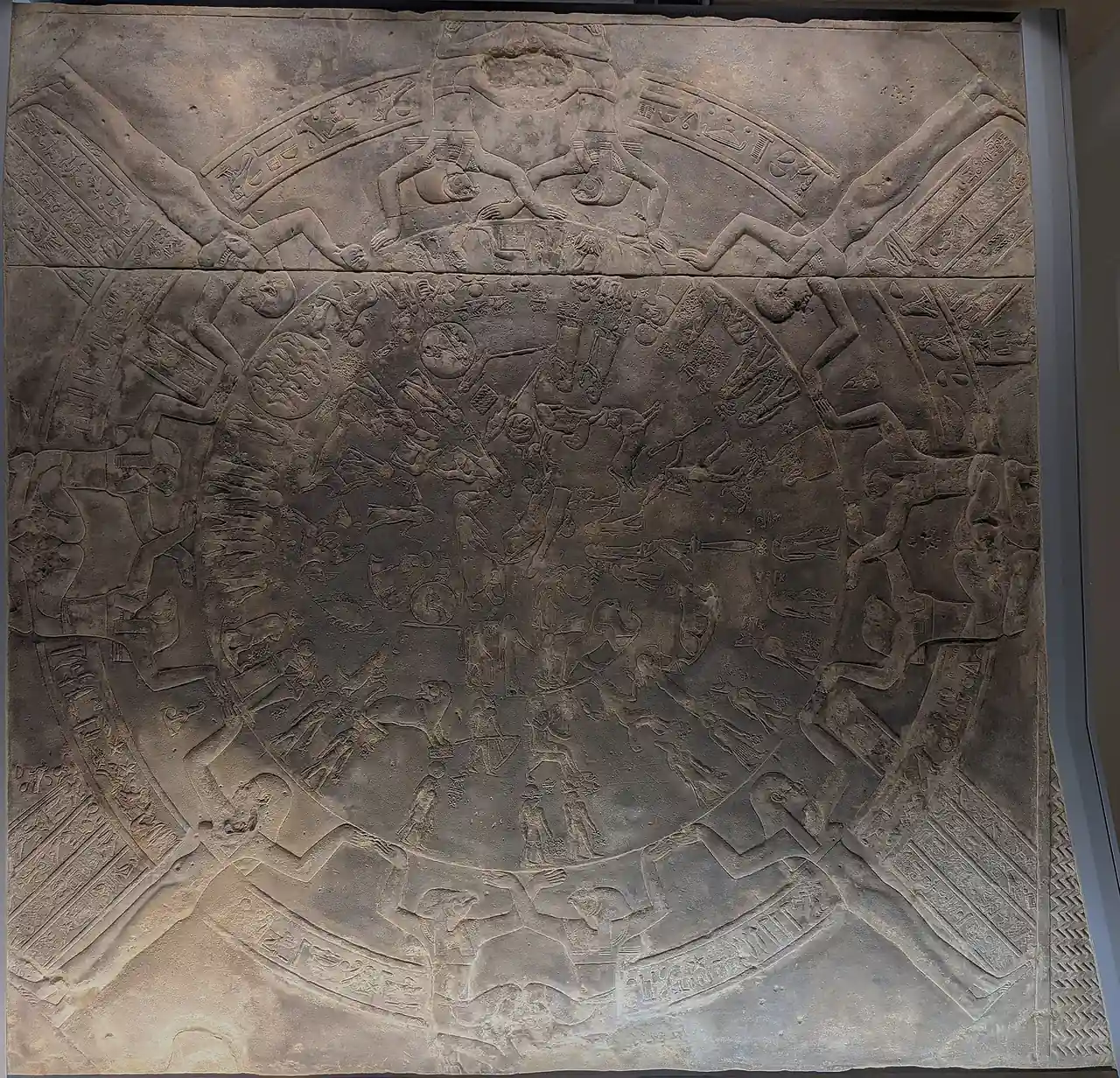
The zodiac starts with Aries at the March equinox and runs through the year in this order. The dates are the usual ones; the next section shows why your own birthday may not fit them.
| Sign | Usual dates | Symbol | Element | Modality | Ruling planet |
|---|---|---|---|---|---|
| 1. Aries | Mar 21 to Apr 19 | Ram | Fire | Cardinal | Mars |
| 2. Taurus | Apr 20 to May 20 | Bull | Earth | Fixed | Venus |
| 3. Gemini | May 21 to Jun 20 | Twins | Air | Mutable | Mercury |
| 4. Cancer | Jun 21 to Jul 22 | Crab | Water | Cardinal | The Moon |
| 5. Leo | Jul 23 to Aug 22 | Lion | Fire | Fixed | The Sun |
| 6. Virgo | Aug 23 to Sep 22 | Maiden | Earth | Mutable | Mercury |
| 7. Libra | Sep 23 to Oct 22 | Scales | Air | Cardinal | Venus |
| 8. Scorpio | Oct 23 to Nov 21 | Scorpion | Water | Fixed | Mars (Pluto) |
| 9. Sagittarius | Nov 22 to Dec 21 | Archer | Fire | Mutable | Jupiter |
| 10. Capricorn | Dec 22 to Jan 19 | Sea-Goat | Earth | Cardinal | Saturn |
| 11. Aquarius | Jan 20 to Feb 18 | Water-Bearer | Air | Fixed | Saturn (Uranus) |
| 12. Pisces | Feb 19 to Mar 20 | Fish | Water | Mutable | Jupiter (Neptune) |
For the full profile of each sign, with traits and history, see all 12 zodiac signs side by side.
Born on the cusp: when the date is not enough
A cusp is the border between two signs. Some writers stretch it to the last or first few days of a sign, but the sky has no such zone: the Sun crosses the border at one instant, and before it you have one sign and after it the next. That instant falls on 12 days each year. On any other day the Sun stays in one sign from midnight to midnight and the birth time changes nothing.
“The equinox marks the exact moment when the center of the Sun crosses the plane of our planet’s equator.”
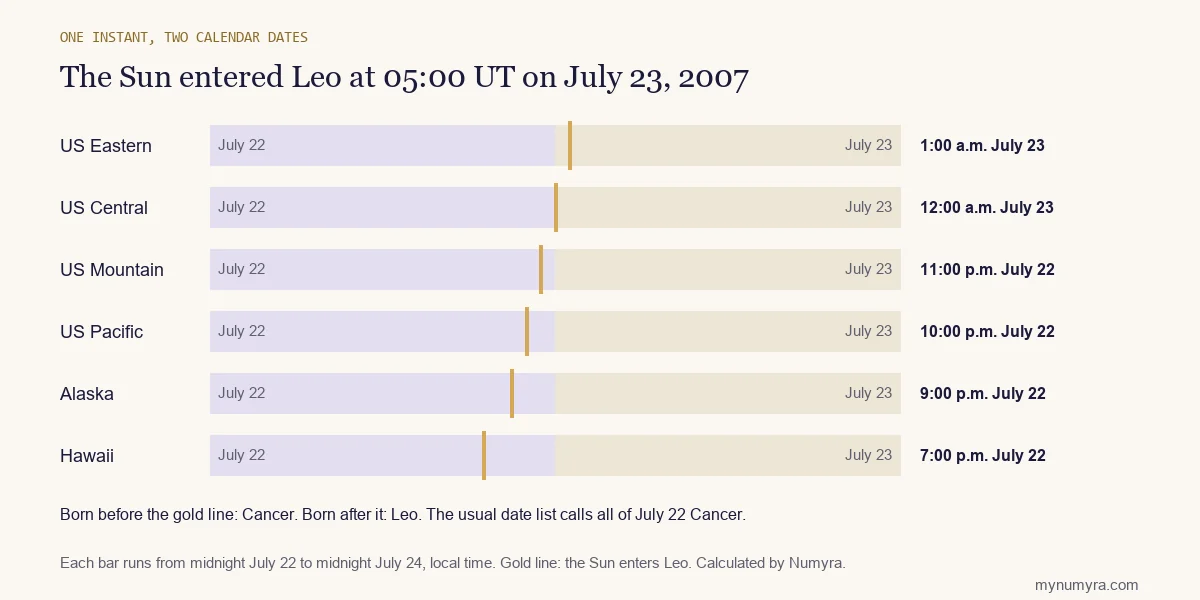
Two things make the cusp hard to read from a date list. The first is the time of day: the Sun entered Leo at 1:00 a.m. Eastern time on July 23, 2007, so a baby born in New York on July 22 was a Cancer all day. The second is the time zone: that same moment was 10:00 p.m. on July 22 in Los Angeles, so a baby born there at 11 p.m. on July 22 was a Leo, even though every date list puts July 22 in Cancer. That is why the calculator asks for a city when you give a time, and why, with no city, it shows the changeover in every US time zone.
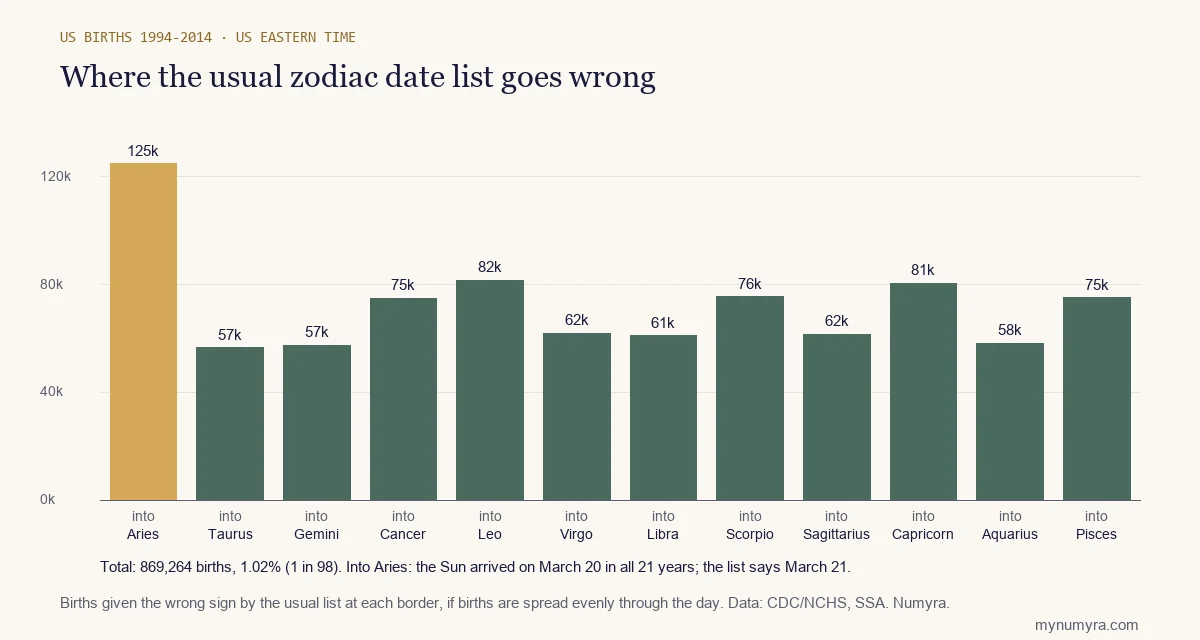
To see how often the usual list goes wrong, we compared it with the exact sign changes for every one of the 85.4 million US births from 1994 to 2014 (CDC and Social Security Administration counts), assuming births are spread evenly through each day. In US Eastern time the list gives the wrong sign to 1.02% of births, about 869,000 people or 1 in 98. In Pacific time it is 1.12%, 1 in 89, because the changeover falls three hours earlier on the clock.
| Sign border | Usual first day | Day the Sun actually entered, 1994 to 2014 | Births the usual list mislabels |
|---|---|---|---|
| Pisces to Aries | Mar 21 | Mar 20 (21 of 21 years) | 124,847 (0.146%) |
| Aries to Taurus | Apr 20 | Apr 19 (11), Apr 20 (10) | 56,558 (0.066%) |
| Taurus to Gemini | May 21 | May 20 (12), May 21 (9) | 57,433 (0.067%) |
| Gemini to Cancer | Jun 21 | Jun 21 (16), Jun 20 (5) | 74,955 (0.088%) |
| Cancer to Leo | Jul 23 | Jul 22 (16), Jul 23 (5) | 81,592 (0.096%) |
| Leo to Virgo | Aug 23 | Aug 23 (11), Aug 22 (10) | 61,841 (0.072%) |
| Virgo to Libra | Sep 23 | Sep 22 (12), Sep 23 (9) | 61,017 (0.071%) |
| Libra to Scorpio | Oct 23 | Oct 23 (16), Oct 22 (5) | 75,556 (0.088%) |
| Scorpio to Sagittarius | Nov 22 | Nov 22 (14), Nov 21 (7) | 61,553 (0.072%) |
| Sagittarius to Capricorn | Dec 22 | Dec 21 (16), Dec 22 (5) | 80,568 (0.094%) |
| Capricorn to Aquarius | Jan 20 | Jan 20 (14), Jan 19 (7) | 58,266 (0.068%) |
| Aquarius to Pisces | Feb 19 | Feb 18 (16), Feb 19 (5) | 75,078 (0.088%) |
The worst border is Pisces to Aries. The list starts Aries on March 21, but in Eastern time the Sun entered Aries on March 20 in all 21 years, so everyone born on March 20 after the changeover was an Aries the list calls Pisces. Leo, Capricorn and Pisces follow the same pattern, each starting a day before the list in most of those years. Who is born on a cusp is also not rare: 3.3% of births, about one person in 30, fell on a day the Sun changed sign.
Why the sign dates shift from year to year
The Sun takes about 365.24 days to go round the zodiac once, and a calendar year has 365 or 366. Each year the Sun reaches a sign border about six hours later on the clock than the year before, and every leap day pulls it back by a day. Because 2000 was a leap year, every fourth year from 1904 to 2096 has a leap day, which is slightly too many: the calendar gains about 11 minutes a year on the Sun, so the changeover creeps about three quarters of a day earlier each century, until 2100 skips its leap day. The table follows the start of Aries at the March equinox every 20 years; Zodiac Sign Dates 2027 lists every exact start time for 2027 and explains the four-year cycle in detail.
| Year | US Naval Observatory (UT) | This calculator (UT) | US Eastern time |
|---|---|---|---|
| 1940 | 18:24 | 18:23:49 | March 20, 1:23 p.m. EST |
| 1960 | 14:43 | 14:42:44 | March 20, 9:42 a.m. EST |
| 1980 | 11:10 | 11:09:49 | March 20, 6:09 a.m. EST |
| 2000 | 07:35 | 07:35:24 | March 20, 2:35 a.m. EST |
| 2020 | 03:50 | 03:49:43 | March 19, 11:49 p.m. EDT |
| 2040 | 00:11 | 00:11:39 | March 19, 8:11 p.m. EDT |
Across the century the start of Aries moves from early afternoon on March 20 to the evening of March 19 in Eastern time. A list that rounds it to March 21 is out of date for anyone born in the last few decades.
How this calculator works, and how accurate it is
The calculator works out where the Sun appeared in the sky at any moment from 1900 to 2100, using the planetary theory VSOP87 in the shortened form published by the astronomer Jean Meeus, with the small corrections for the wobble of Earth’s axis (nutation) and for the travel time of light (aberration). It then searches for the instant the Sun reached each 30-degree border and converts it to your time zone, with daylight saving time as it applied in that year, from the time zone database your browser carries. Nothing you type leaves your device.
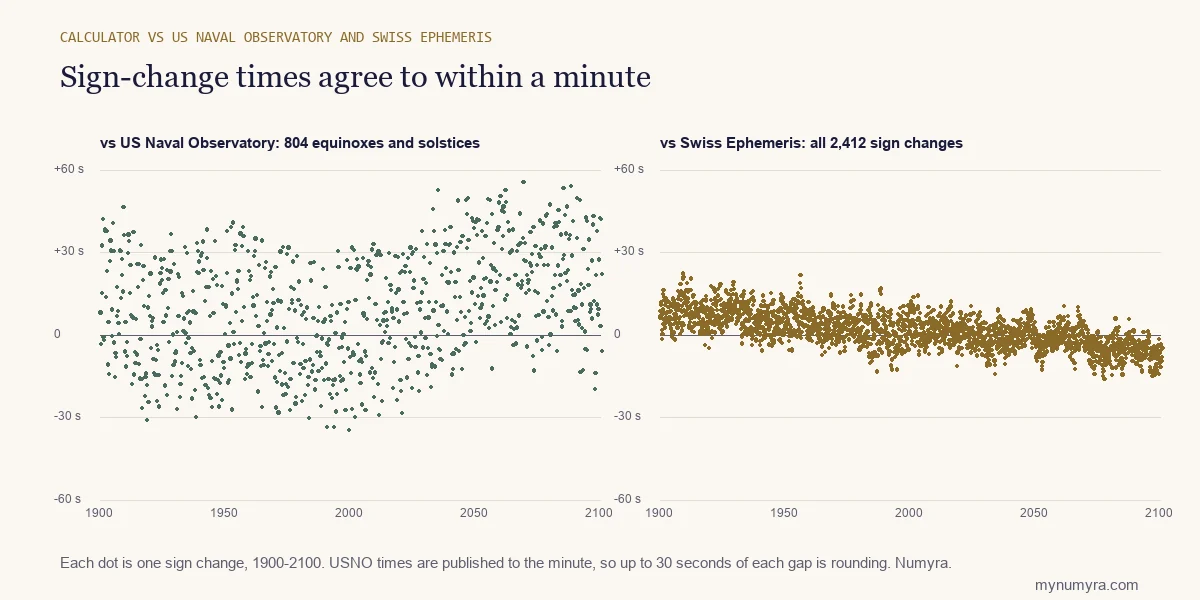
We checked it two ways. The US Naval Observatory publishes the equinoxes and solstices, which are the starts of Aries, Cancer, Libra and Capricorn, to the minute. For all 804 of them from 1900 to 2100 our time is within one minute of the Observatory’s, with a median difference of 16 seconds, about the same as the Swiss Ephemeris shows against the same table. Against the Swiss Ephemeris, the reference behind professional astrology software, all 2,412 sign changes match within 23 seconds.
| Check | Result |
|---|---|
| Equinoxes and solstices, 1900 to 2100, vs the US Naval Observatory | 804 compared; all within 1 minute; median 16 seconds, largest 56 seconds (the Swiss Ephemeris: largest 56 seconds) |
| Every Sun sign change, 1900 to 2100, vs the Swiss Ephemeris | 2,412 compared; median 4 seconds, 95th percentile 13, largest 22.4 seconds |
| Sun position at random moments vs the Swiss Ephemeris | 20,000 compared; median 0.18″, largest 1.02″ (arcseconds); sign matched every time |
| Calculator answers vs the Swiss Ephemeris and the time zone database | 7,871 birth moments, 5,808 birth dates with a place and 468 dates without one, including every sign change of 13 test years in six cities; all matched |
The simpler method our planet calculators use places these changes up to 27 minutes off, fine for Mars or Venus but too coarse for a page whose whole job is the changeover minute, so this calculator uses the longer theory. A birth time within two minutes of a sign change is flagged as a close call, because published times differ by up to a minute and birth certificates round to the minute.
The signs here are tropical: they are measured from the March equinox, the convention Western astrology has followed since Ptolemy. Because Earth’s axis slowly wobbles, the constellations have drifted about 24 degrees from those signs, and Vedic astrology, which follows the stars, places most people one sign earlier. Sidereal vs. tropical zodiac explains the two systems, and Ophiuchus and the 13th zodiac sign covers the “new sign” claim.
Your Sun sign is one of three
What people call their zodiac sign is the Sun sign. A birth chart has two more that astrologers weigh as heavily. The Moon changes sign every two to three days, so your Moon sign needs the birth date and usually the time. The rising sign, the sign on the eastern horizon, changes about every two hours and needs the exact time and place. The birth chart calculator finds all three, and Sun sign vs. Moon sign vs. rising sign explains how they differ.
If you wonder how many people share your sign, we counted that too: the most common zodiac sign among 85 million US births ranks all 12.
Frequently asked questions
What is my zodiac sign?
It is the sign the Sun was in when you were born. Enter your birth date above: for most dates that gives one sign, shown with its symbol, element, modality and ruling planet. If the Sun changed sign on your birth date, the calculator shows both signs and the exact time of the change, and your birth time settles it.
Do I need my birth time to find my zodiac sign?
Only if you were born on one of the 12 days a year the Sun changes sign. That was true for 3.3% of US births from 1994 to 2014, about one person in 30. For everyone else the date is enough, because the Sun stays in one sign all day.
What zodiac sign am I if I was born on the cusp?
You have one sign, not a blend: the Sun is in one sign or the other at any instant. If you were born before the changeover you have the earlier sign, and at or after it the later one. Enter your birth time and city to find which side you are on. Some astrologers read a Sun close to the border as carrying a flavor of the neighboring sign, which is a tradition, not a measurement.
Why does another website give me a different zodiac sign?
Most sites use a fixed date list, which rounds the changeover to a day and is wrong for about 1 in 98 people in US Eastern time. Others use Universal Time instead of your local time, or the sidereal (Vedic) zodiac, which puts most people one sign earlier. This calculator uses the exact changeover in your own time zone and the tropical zodiac.
Can my zodiac sign change?
No. Your Sun sign is fixed by where the Sun was at your birth. Headlines about a “new” sign come from the slow drift of the constellations or from the constellation Ophiuchus, but Western astrology measures signs from the equinox, not from the stars, so your tropical sign stays the same.
Is my zodiac sign the same as my Sun sign or star sign?
Yes. Zodiac sign, Sun sign and star sign all mean the sign the Sun was in at your birth. Your Moon sign and rising sign are separate placements and are usually different signs.
What are the 12 zodiac signs in order?
Aries, Taurus, Gemini, Cancer, Leo, Virgo, Libra, Scorpio, Sagittarius, Capricorn, Aquarius and Pisces. The order starts with Aries at the March equinox and follows the Sun through the year.
Is my sign the same in Vedic astrology?
Usually not. Vedic astrology uses the sidereal zodiac, which is tied to the stars and sits about 24 degrees behind the tropical zodiac used here, so for most birth dates the Vedic Sun sign is the previous sign.
Is my birth information stored or sent anywhere?
No. The calculation runs in your browser, and your birth details are not sent to our servers, stored, or placed in cookies. The text you can copy contains only your sign and this page’s address, never your birth date.
Sources
- Jean Meeus. Astronomical Algorithms, 2nd ed. (Willmann-Bell, 1998), chapters 22 and 25 and appendix III: the VSOP87 series for the Earth, nutation and aberration used by the calculator.
- P. Bretagnon and G. Francou. “Planetary theories in rectangular and spherical variables: VSOP87 solutions.” Astronomy and Astrophysics 202 (1988), 309.
- US Naval Observatory. Earth’s Seasons: Equinoxes, Solstices, Perihelion, and Aphelion, 1700 to 2100. All 804 equinoxes and solstices from 1900 to 2100, used to test the calculator.
- Astrodienst. Swiss Ephemeris. Version 2.10, Moshier mode: every Sun sign change 1900 to 2100 and 20,000 random positions, used to test the calculator.
- IANA. Time Zone Database. The history of local time and daylight saving rules your browser uses to convert birth times.
- FiveThirtyEight. US births data, 1994 to 2014, compiled from the CDC National Center for Health Statistics and the Social Security Administration.
- Ptolemy. Tetrabiblos, Book I, chapter 11, translated by F. E. Robbins (Loeb Classical Library, 1940), via LacusCurtius (public domain).
- NASA Science. “Embracing the Equinox.” September 2026.