Moon Sign Calculator: What Is My Moon Sign?
Your Moon sign is the zodiac sign the Moon was in at the moment you were born. Enter your birth date and city to find it, with its element, modality and the Moon’s exact degree when you add a birth time. The Moon changes sign every two and a quarter days on average, so on 44% of dates the birth time decides it: the calculator then shows both possible signs and the exact minute of the change in your time zone.
Your Moon sign
Key takeaways
- Of the 85.4 million US births from 1994 to 2014, 43.9% (37.5 million people) were born on a day the Moon changed sign, so their birth time decides their Moon sign. For everyone else the date and time zone are enough.
- The Moon changed sign 32,244 times from 1900 to 2100, about 160 times a year. It stays in a sign for 2 days, 6 hours and 38 minutes on average, but anywhere from 46 hours 52 minutes to 61 hours 7 minutes.
- If a birth time is unknown, calculators that quietly assume noon give the wrong Moon sign to about 1 person in 9. This one shows both signs and the minute of the change instead.
- The calculator places every Moon sign change from 1900 to 2100 within 23 seconds of the Swiss Ephemeris. In a sample of 600 checked against NASA JPL Horizons, every change from 1900 to 2026 was within 17 seconds. A birth within 2 minutes of a change is flagged as a close call.
- It uses the tropical zodiac of Western astrology. A Vedic (sidereal) Moon sign, or rashi, is the previous sign about 79% of the time.
For entertainment and self-reflection. Numerology and astrology are cultural traditions, not sciences, and nothing here is medical, financial, legal, or psychological advice.
What your Moon sign result shows
The headline is the sign the Moon occupied at your birth, measured along the ecliptic, the Sun’s yearly path through the zodiac. Under it the calculator lists the same facts each of our Moon sign profiles starts from:
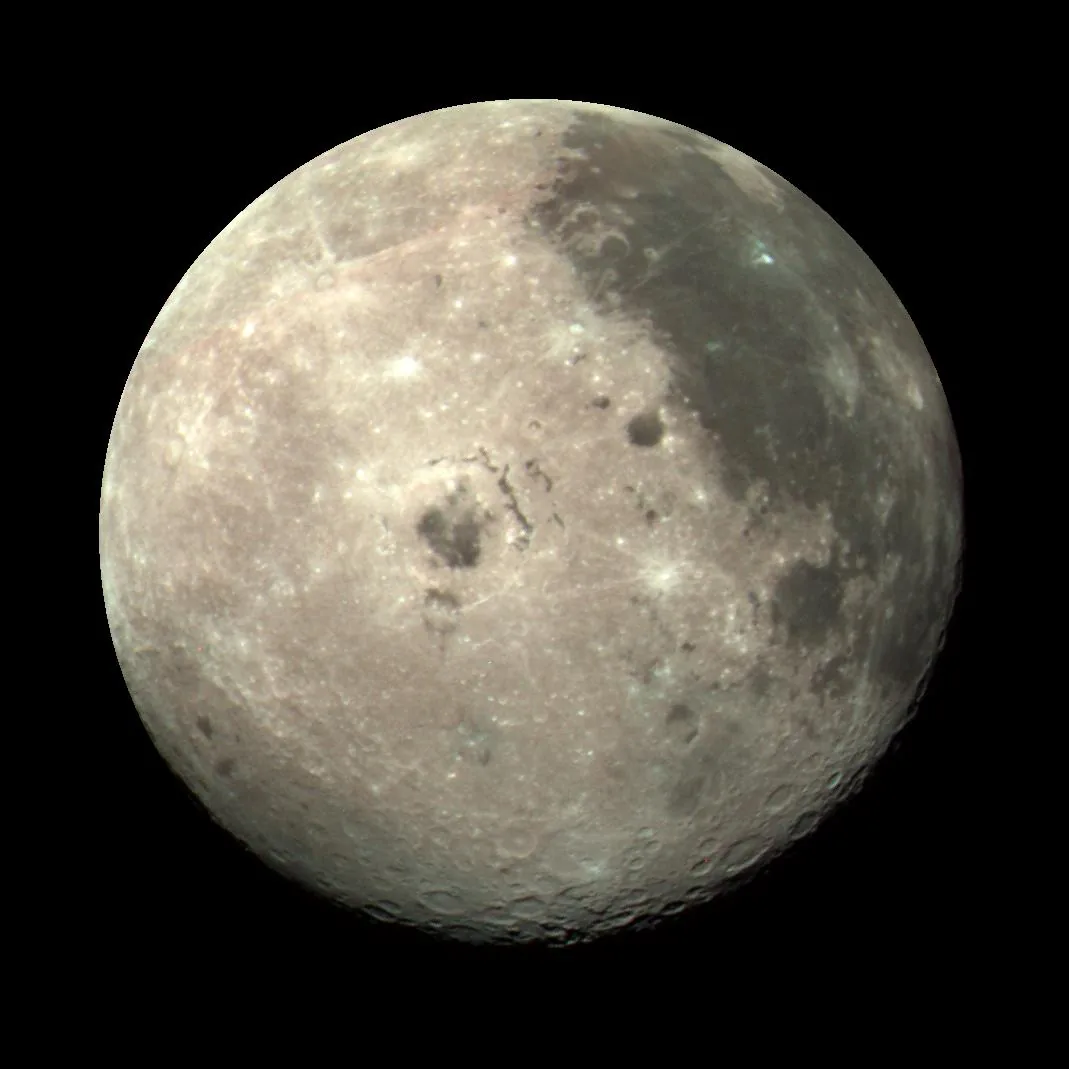
Degree. With a birth time and city, you also get the Moon’s position inside the sign, from 0° to 29°59′. The Moon covers about half a degree an hour, so a degree near 0° or 29° means you were born within a day or so of a sign change.
Element and modality. Fire, earth, air or water, and cardinal, fixed or mutable. They belong to the sign, not to the Moon, and work the same way for the Sun and the planets; the four elements and three modalities explains what astrologers read into each.
Sign ruler and dignity. The planet that traditionally rules the sign, and how tradition rates the Moon there. The Moon rules Cancer and is exalted in Taurus; it is in its detriment in Capricorn and its fall in Scorpio, the signs opposite. In the other eight it has no dignity by sign. Essential dignities covers the full scoring system.
The Moon’s stay. The exact local times the Moon entered and left your sign, and how long it stayed. If the Moon changed sign on your birth date, you get both stays and the share of the day each sign held.
Each result ends with a short traditional reading and a link to the full profile of that Moon sign. These are readings from astrological tradition, offered for reflection, not predictions about you.
Why the birth time matters so much for the Moon
The Sun moves about one degree a day and changes sign 12 times a year. The Moon moves 12 to 15 degrees a day and changes sign about 160 times a year. In our count of every change from 1900 to 2100, 43.9% of calendar days had one. A calendar day never had two, because the shortest stay in a sign was 46 hours 52 minutes.
We checked what that means for real people. Of the 85,386,227 US births from 1994 to 2014 in the CDC and Social Security Administration counts, 37,450,108 (43.86% in US Eastern time, almost the same in the other zones) fell on a date when the Moon changed sign. For those people the date gives two candidates, and only the birth time picks one.
| You enter | The calculator can give |
|---|---|
| Birth date only | Your Moon sign on the 56% of dates the Moon stays in one sign; both candidates and the change in every US time zone on the rest |
| Date and city or time zone | The same, in your own time zone, with the share of the day each sign held |
| Date, time and city | One Moon sign and its degree, with a close-call flag within 2 minutes of a change |
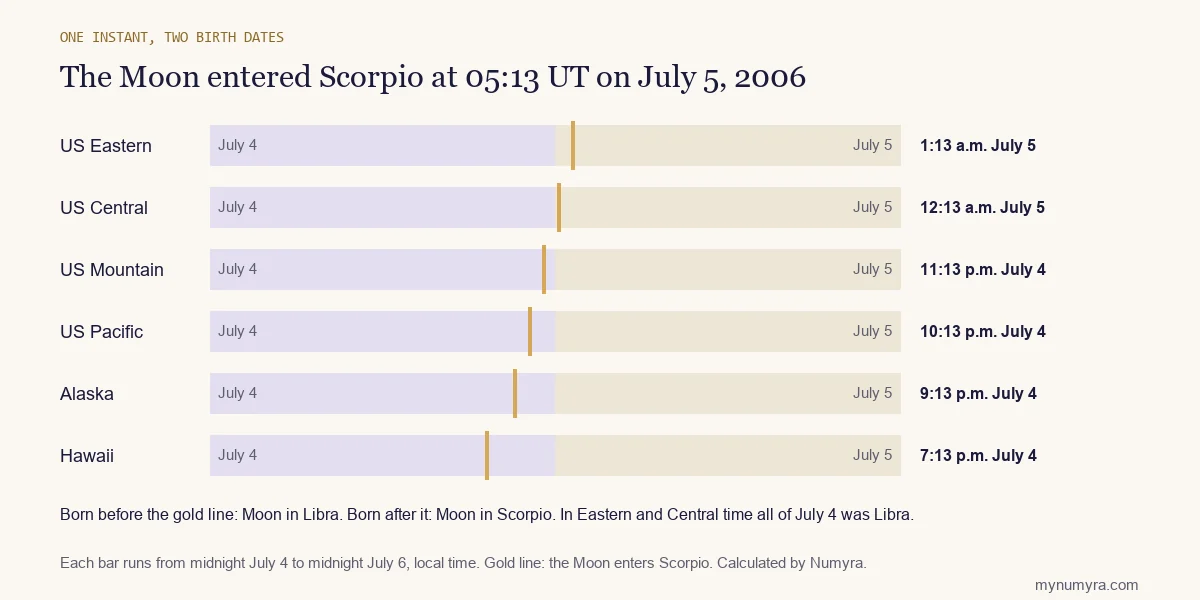
The time zone matters too, because the same instant falls on different dates across the country. On July 4, 2006 the Moon left Libra for Scorpio at 05:13 Universal Time on July 5. In New York that was 1:13 a.m. on July 5, so every baby born there on the Fourth had the Moon in Libra. In Los Angeles it was 10:13 p.m. on July 4, so a baby born there at 11 p.m. on the Fourth had the Moon in Scorpio. That is why the calculator asks for a city, and why it shows every US time zone when you leave the city out.
No birth time? What the date alone can tell you
Leave the time empty and the calculator checks your whole birth date, from local midnight to midnight. On 56% of dates the Moon stays in one sign all day and you get a single answer that no birth time could change. On the other 44% you get both signs, the minute of the change, and how much of the day each sign held: if the Moon changed sign at 9 p.m., about seven births in eight that day had the earlier sign.
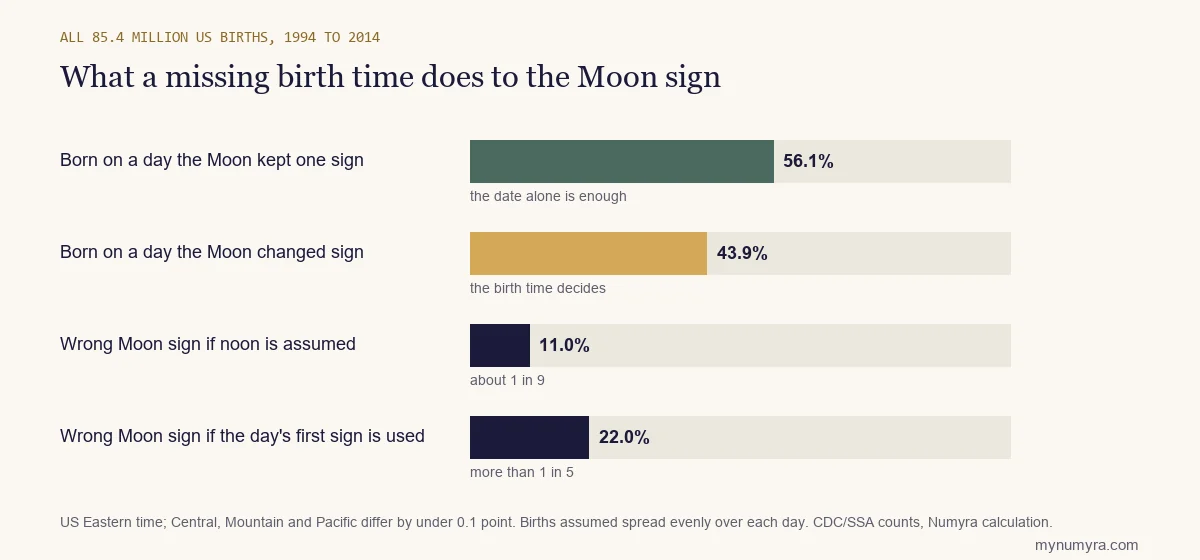
Some calculators handle a missing time by assuming noon, or midnight, without saying so. We measured what that costs, again assuming births are spread evenly over each day. Over all US births from 1994 to 2014, a noon default gives the wrong Moon sign to 11.0% of people, about 1 in 9. Using the sign at the start of the birth date is worse: 22.0%, more than 1 in 5.
If your Moon sign depends on a time you do not know, the birth certificate is the best place to look; US certificates usually record the time to the minute. A common piece of advice is to read both Moon signs and see which one feels familiar. That can be an interesting exercise, but it is a matter of self-recognition, not a calculation.
How long the Moon stays in each sign
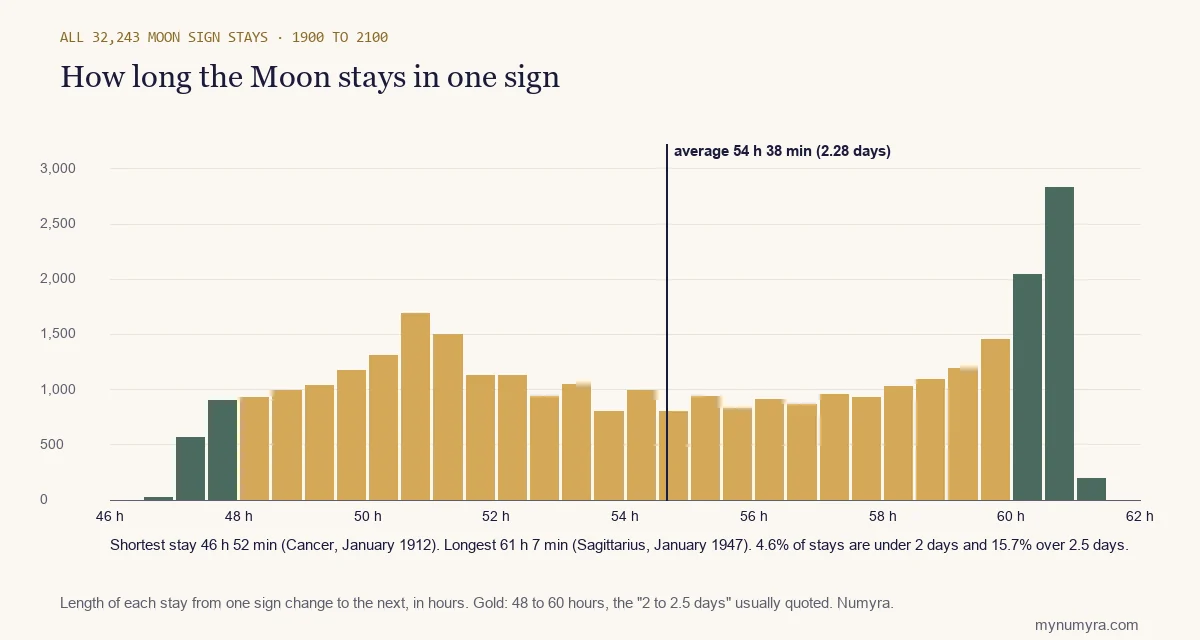
The usual answer is two to two and a half days. Over the 32,243 complete stays from 1900 to 2100 the average was 2 days, 6 hours and 38 minutes, but 4.6% of stays were shorter than two days and 15.7% longer than two and a half. The length depends on where the Moon is in its orbit, which is not a circle:
“During every 27-day orbit around Earth, the Moon reaches both its perigee, about 226,000 miles (363,300 km) from Earth, and its farthest point, or apogee, about 251,000 miles (405,500 km) from Earth.”
Near perigee the Moon moves fastest, up to about 15.4 degrees a day at a sign change, and crosses a 30-degree sign in under two days. Near apogee it slows to about 11.8 degrees a day and needs more than two and a half. Because it lingers near apogee, the most common stays are the long ones, just over 60 hours.
| Measure | Value | Notes |
|---|---|---|
| Average stay | 54 hours 38 minutes | All 32,243 complete stays, 1900 to 2100 |
| Shortest stay | 46 hours 52 minutes | Moon in Cancer, January 3 to 5, 1912 (Universal Time) |
| Longest stay | 61 hours 7 minutes | Moon in Sagittarius, January 17 to 19, 1947 (Universal Time) |
| Stays under 2 days | 4.6% | The Moon near perigee, its closest point to Earth |
| Stays over 2.5 days | 15.7% | The Moon near apogee, its farthest point |
| Calendar days with a sign change | 43.9% | Never two changes on one day |
The Moon spends almost exactly the same time in every sign over the long run: the averages by sign differ by about 7 minutes across these two centuries. Among US births the 12 Moon signs are close to equal, from 8.23% to 8.43% each. For the dates the Moon changes sign in the year ahead, our Full Moon and New Moon calendar and each Moon sign profile list them, and the void of course Moon explains the hours before a change that some astrologers watch.
The Moon sign in astrological tradition
The Sun and the Moon are the two “luminaries”, and astrologers have read them as a pair for about two thousand years: the Sun for the conscious, outward self, the Moon for the instinctive, inward one. The idea is already in Ptolemy, whose second-century textbook assigns the reasoning mind to Mercury and the feeling side of the character to the Moon:
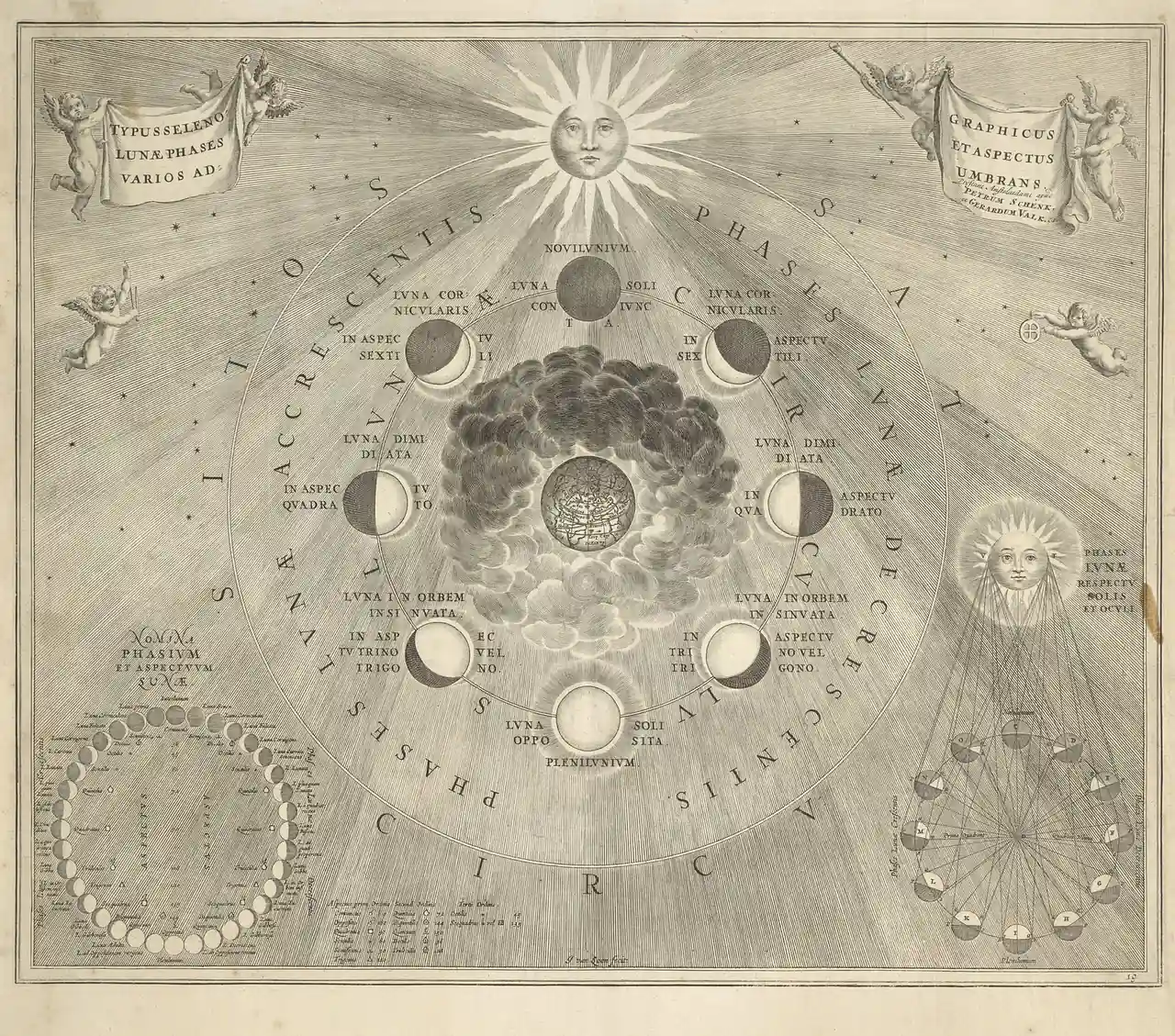
“the qualities of the sensory and irrational part are discovered from the one of the luminaries which is the more corporeal, that is, the moon”
Modern Western astrology keeps that division. The Moon sign is read as the emotional nature: what makes you feel safe, how you react before you think, and what you need from home and the people closest to you. Moon signs: what each one means compares all twelve, and the table links each profile.
| Moon sign | Element | Modality | Dignity | Traditional reading |
|---|---|---|---|---|
| Moon in Aries | Fire | Cardinal | No dignity by sign | Read as feelings that arrive fast, show at once and pass quickly, with a strong need for independence to feel secure. |
| Moon in Taurus | Earth | Fixed | Exaltation | Read as the steadiest Moon: comfort, routine and familiar surroundings settle it, and its feelings change slowly once formed. |
| Moon in Gemini | Air | Mutable | No dignity by sign | Read as a Moon that works out what it feels by talking and thinking it through, and that needs variety and conversation. |
| Moon in Cancer | Water | Cardinal | Domicile (its own sign) | The Moon’s own sign in tradition: read as protective, nurturing and attached to home, family and memory. |
| Moon in Leo | Fire | Fixed | No dignity by sign | Read as warm, generous and proud, needing affection that is shown openly and returned in kind. |
| Moon in Virgo | Earth | Mutable | No dignity by sign | Read as caring through practical help and attention to detail, with a tendency to worry and to fix things. |
| Moon in Libra | Air | Cardinal | No dignity by sign | Read as seeking calm through partnership, fairness and pleasant surroundings, and as uneasy with open conflict. |
| Moon in Scorpio | Water | Fixed | Fall | Read as intense, private and slow to trust, with deep loyalty once trust is given. Tradition calls this the Moon’s fall. |
| Moon in Sagittarius | Fire | Mutable | No dignity by sign | Read as needing freedom, movement and honesty, and as restless when it feels fenced in. |
| Moon in Capricorn | Earth | Cardinal | Detriment | Read as reserved, dutiful and self-controlled, showing care through commitment. Tradition calls this the Moon’s detriment. |
| Moon in Aquarius | Air | Fixed | No dignity by sign | Read as independent and friendly at a slight distance, processing feelings through ideas and causes. |
| Moon in Pisces | Water | Mutable | No dignity by sign | Read as sensitive, imaginative and compassionate, quick to absorb the moods of the people around it. |
Tropical or sidereal: why a Vedic Moon sign often differs
This calculator uses the tropical zodiac, the Western standard, which starts Aries at the March equinox. Vedic astrology uses the sidereal zodiac, tied to the stars, and the Moon sign there (rashi) is the central placement. The two zodiacs drift apart by about one degree every 72 years and are now about 24 degrees apart, so the Vedic Moon sign is usually the sign before the Western one.
We measured how often, using the Lahiri reference point that most Indian calculators use. From 1900 to 2100 the sidereal Moon sign was the previous sign 79.4% of the time and the same sign 20.6% of the time; for births in 2026 the first figure is 80.9%. If another site gives you a different Moon sign, check which zodiac it uses before anything else. Sidereal vs. tropical zodiac explains both systems, and the 27 nakshatras covers the lunar mansions Vedic astrology reads alongside the rashi.
How this calculator works, and how accurate it is
The Moon is the hardest body in the birth chart to place, because the Sun and Earth pull its orbit around constantly. The calculator uses the lunar theory ELP2000-82, developed at the Bureau des Longitudes in Paris, in the shortened form published by the astronomer Jean Meeus: the 60 largest periodic terms in longitude plus three small corrections, the wobble of Earth’s axis (nutation), and the difference between atomic time and Earth’s rotation (Delta T). It then searches for the instant the Moon reaches each 30-degree border and converts it to your time zone, with daylight saving time as it applied in that year, from the time zone database your browser carries. Nothing you type leaves your device.
We tested it against two references. Against the Swiss Ephemeris, the library used by much professional astrology software, all 32,244 Moon sign changes from 1900 to 2100 came out in the same order and within 23 seconds, with a median of 3 seconds. Against NASA JPL Horizons, the ephemeris service of the Jet Propulsion Laboratory, we sampled 600 changes across the same two centuries: from 1900 to 2026 all were within 17 seconds.
| Check | Result |
|---|---|
| Every Moon sign change, 1900 to 2100, vs the Swiss Ephemeris | 32,244 compared; median 3.2 seconds, 95th percentile 9.4, 99th percentile 12.8, largest 22.8 seconds |
| Moon sign changes vs NASA JPL Horizons (DE441), 1900 to 2026 | 379 sampled; median 3.2 seconds, 95th percentile 10.5, largest 16.4 seconds |
| Moon sign changes vs NASA JPL Horizons, 2027 to 2100 | 221 sampled; median 9.6 seconds, largest 43.2 seconds, mostly from the forecast of Earth’s rotation (the Swiss Ephemeris differs from JPL by up to 25.8 seconds here) |
| Moon position at random moments vs the Swiss Ephemeris | 20,000 compared; median 1.7″, largest 12.1″ (arcseconds) |
| Calculator answers vs the Swiss Ephemeris and the time zone database | 11,280 birth moments, 4,060 birth dates with a place (including 360 daylight saving change days) and 300 dates without one, in all 7 US zones; every answer matched, except 39 birth moments within half a minute of a change, all of them flagged as close calls |
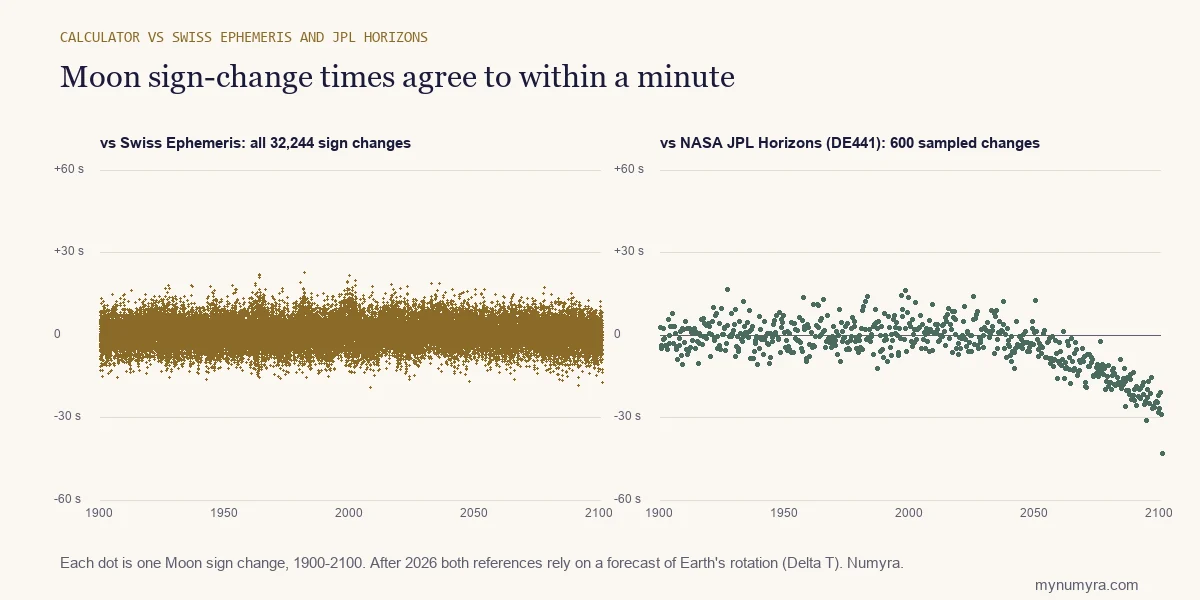
Dates after 2026 carry one more uncertainty that no calculator can remove: Earth’s rotation has to be forecast. JPL and the Swiss Ephemeris use different forecasts, and by 2100 they disagree by up to about 26 seconds on when the Moon changes sign; our largest difference from JPL there was 43 seconds. For births, which are in the past, that does not apply. A birth time within 2 minutes of a change is flagged as a close call, because a recorded time is usually rounded to the minute.
The simpler method in our birth chart calculator places Moon sign changes up to 10 minutes off, with a median of 2 minutes. That is fine for a whole chart, but this page’s job is the changeover minute, so it uses the longer theory.
Your Moon sign is one of three
Astrologers usually start a chart with three signs. The Sun sign, what most people call their zodiac sign, needs only the birth date except on the 12 days a year the Sun changes sign: the zodiac sign calculator finds it to the minute. The Moon sign, on this page, needs the date and often the time. The rising sign, the sign on the eastern horizon at birth, changes about every two hours and needs the exact time and place; the birth chart calculator finds all three at once. Sun sign vs. Moon sign vs. rising sign explains how the three are read together.
The Moon also carries a fourth piece of information, its phase, which depends on the angle between the Moon and the Sun rather than on the sign: find your birth Moon phase. And astrologers who follow the Moon after birth watch the progressed Moon, which moves into a new sign about every two to two and a half years.
Frequently asked questions
What is my Moon sign?
It is the zodiac sign the Moon was in at the moment you were born. Enter your birth date and city above: on most dates that gives one sign, with its element and modality, and with a birth time it also gives the Moon’s exact degree. If the Moon changed sign on your birth date, the calculator shows both signs and the time of the change.
Can I find my Moon sign without my birth time?
Often, yes. On about 56% of dates the Moon stays in one sign from midnight to midnight, and the date and time zone are enough. On the other 44% it changes sign during the day, and only the birth time can tell which side of the change you were born on. Among US births from 1994 to 2014, 43.9% fell on such a day.
What if the Moon changed sign on the day I was born?
Then you have one of two Moon signs: the earlier one if you were born before the change, the later one if you were born at or after it. The calculator gives the exact local time of the change and how much of the day each sign held. Your birth certificate usually records the time to the minute.
How long does the Moon stay in each sign?
About 2 days and 6.6 hours on average. From 1900 to 2100 the shortest stay was 46 hours 52 minutes and the longest 61 hours 7 minutes, because the Moon moves faster when it is closer to Earth.
Why do two calculators give me different Moon signs?
The usual reasons are a different zodiac (a Vedic or sidereal calculator puts the Moon one sign earlier about 80% of the time), a missing birth time quietly replaced by noon, or a birth time converted with the wrong time zone or daylight saving rule. If you were born within a few minutes of a sign change, small differences between ephemerides can also matter, which is why this calculator flags those cases.
Is my Vedic Moon sign (rashi) the same?
Usually not. Vedic astrology measures the Moon against the stars, about 24 degrees behind the tropical zodiac used here, so the rashi is the previous sign about 4 times in 5 and the same sign about 1 time in 5.
What is the difference between my Moon sign and my Sun sign?
Your Sun sign comes from where the Sun was at birth and is read as your outward, conscious identity. Your Moon sign comes from where the Moon was and is read as your emotional nature and needs. The Sun spends about a month in each sign and the Moon about two and a quarter days, so the two are different signs for most people.
Does the city I was born in change my Moon sign?
Only through the time zone. The Moon’s sign is the same everywhere on Earth at a given instant, but the local date and clock time of that instant depend on where you were born. On a day the Moon changes sign, a birth in New York and a birth in Los Angeles at the same clock time can have different Moon signs.
Is my birth information stored or sent anywhere?
No. The calculation runs in your browser, and your birth details are not sent to our servers, stored, or placed in cookies. The text you can copy contains only your Moon sign and this page’s address, never your birth date.
Sources
- Jean Meeus. Astronomical Algorithms, 2nd ed. (Willmann-Bell, 1998), chapters 22 and 47: the periodic terms of the Moon and the nutation used by the calculator.
- M. Chapront-Touzé and J. Chapront. “The lunar ephemeris ELP 2000.” Astronomy and Astrophysics 124 (1983), 50-62.
- NASA Jet Propulsion Laboratory. Horizons System, ephemeris DE441: the Moon’s apparent ecliptic longitude at 600 sign changes from 1900 to 2100, used to test the calculator.
- Astrodienst. Swiss Ephemeris. Version 2.10, Moshier mode: every Moon sign change 1900 to 2100, 20,000 random positions and the Lahiri sidereal zodiac, used for the tests and the figures on this page.
- IANA. Time Zone Database. The history of local time and daylight saving rules your browser uses to convert birth times.
- FiveThirtyEight. US births data, 1994 to 2014, compiled from the CDC National Center for Health Statistics and the Social Security Administration.
- Ptolemy. Tetrabiblos, Book III, chapter 13, translated by F. E. Robbins (Loeb Classical Library, 1940), via LacusCurtius (public domain).
- NASA Science. “Supermoons.”