Nodal Return Calculator
Enter your birth date to get the date and age of each nodal return, at about 18.6, 37.2, 55.8 and 74.4 years, and each half return, at about 9.3, 27.9, 46.5 and 65.1. You get the mean node date, which is the same age for everyone, and every pass of the true node, which can differ by up to about two months.
Key takeaways
- A nodal return is the day the Moon's North Node comes back to the zodiac degree it held at your birth; a half return is the nodes arriving on the opposite points. The calculator finds all eight, with your age at each.
- The mean node returns at 18.61, 37.23, 55.84 and 74.45 years for everyone; the true node lands within about two months of those ages and may cross your degree three or five times.
- Tested against the Swiss Ephemeris: mean-node dates matched within 5 minutes for all 368,168 events from 46,021 birth dates; 99.7% of true-node passes matched within a day.
- Nothing here is medical, financial, legal, or psychological advice; this is a cultural tradition, presented for entertainment and reflection.
Your nodal returns and half returns
For entertainment and self-reflection. Numerology is a cultural tradition, not a science, and nothing here is medical, financial, legal, or psychological advice.
What your result shows
Your result starts with where the North Node stood when you were born, by the true node and by the mean node. Each event card then gives the mean node date and your age that day, and the true node date or dates with the age range. The cards are marked as already happened, next, or ahead, and the line above them tells you which event is coming up.
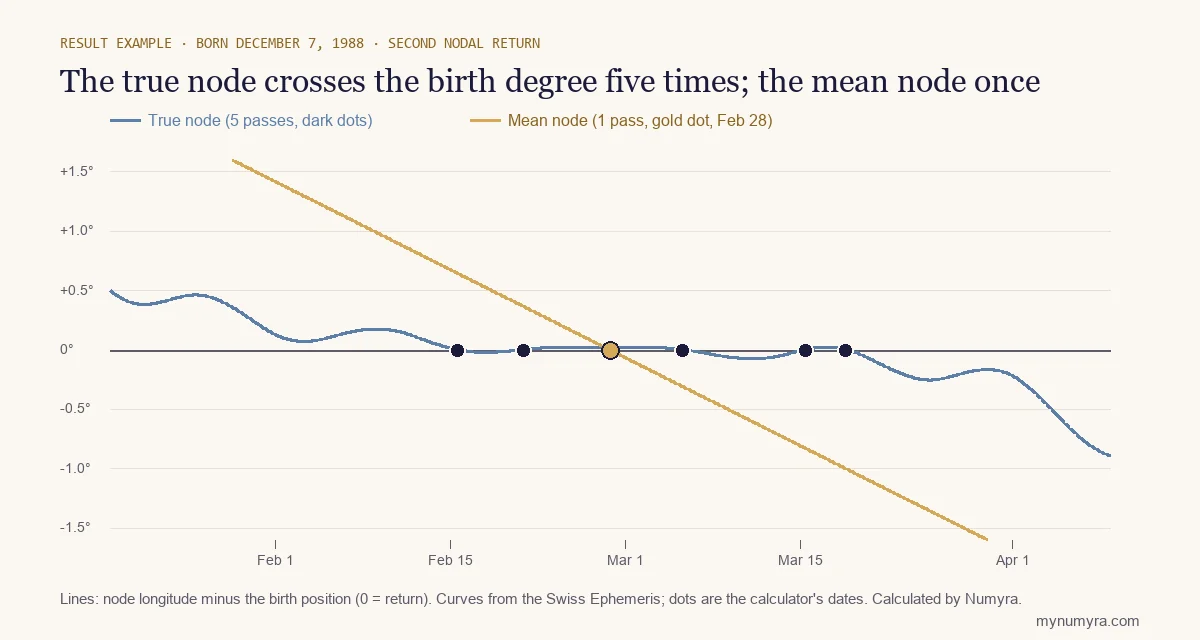
The true node wobbles because it follows the Moon's real, perturbed orbit, so it can run ahead of or behind the steady mean node and sometimes moves forward. That is why one return can show several passes: treat the whole stretch, usually a few weeks, as the return. For the meaning astrologers give returns and half returns, and the data behind the ages, see our nodal return guide. To see where your own nodes sit, use the Birth Chart Calculator.
Who has a nodal return in 2026, 2027 and 2028?
Each calendar year brings one return or half return to roughly one year of births, shifted for each of the eight events. The table gives the birth dates, by the mean node, whose return or half return falls in each year. The true node moves each edge by up to two months.
| Event | Falls in 2026: born | Falls in 2027: born | Falls in 2028: born |
|---|---|---|---|
| Fourth return, about 74 | Jul 20, 1951 to Jul 18, 1952 | Jul 19, 1952 to Jul 18, 1953 | Jul 19, 1953 to Jul 19, 1954 |
| Half return, about 65 | Nov 9, 1960 to Nov 8, 1961 | Nov 9, 1961 to Nov 7, 1962 | Nov 8, 1962 to Nov 8, 1963 |
| Third return, about 56 | Mar 1, 1970 to Feb 28, 1971 | Mar 1, 1971 to Feb 28, 1972 | Feb 29, 1972 to Feb 28, 1973 |
| Half return, about 46 | Jun 21, 1979 to Jun 19, 1980 | Jun 20, 1980 to Jun 19, 1981 | Jun 20, 1981 to Jun 20, 1982 |
| Second return, about 37 | Oct 10, 1988 to Oct 9, 1989 | Oct 10, 1989 to Oct 9, 1990 | Oct 10, 1990 to Oct 10, 1991 |
| Half return, about 28 | Jan 30, 1998 to Jan 29, 1999 | Jan 30, 1999 to Jan 29, 2000 | Jan 30, 2000 to Jan 29, 2001 |
| First return, about 18 | May 23, 2007 to May 21, 2008 | May 22, 2008 to May 21, 2009 | May 22, 2009 to May 22, 2010 |
| Half return, about 9 | Sep 11, 2016 to Sep 10, 2017 | Sep 11, 2017 to Sep 10, 2018 | Sep 11, 2018 to Sep 11, 2019 |
These are the windows from our nodal return guide, and the calculator reproduces all 24 edges exactly. The 2026 to 2028 windows include first returns for people turning 18 or 19, second returns for people in their late 30s and half returns for people around 28, 46 and 65.
How this calculator works, and how accurate it is
The mean node uses Jean Meeus's formula from Astronomical Algorithms, chapter 47, with the nutation correction so it is measured the way the Swiss Ephemeris and most astrology software measure it. The true node adds 30 periodic terms to the mean node: the five largest are Meeus's, and we fitted 25 smaller ones to the Swiss Ephemeris true node (on 60,000 random dates, then checked on 20,000 others: largest difference 0.019°). Your natal node is taken at noon Universal Time on your birth date. The calculator then searches the 14 months around each expected date for every time the node crosses your natal degree (minus 180° for a half return), and narrows each crossing to the minute. It all runs in your browser, so nothing you enter leaves your device. To check it, we compared it with the Swiss Ephemeris:
| Check | Result |
|---|---|
| Mean node: events compared (every birth date 1900 to 2025, 8 events each) | 368,168 |
| Mean node: largest difference in time | 4.8 minutes (median about 1 minute); the calendar day differed for 0.24% of events that fall within minutes of midnight |
| True node: birth dates (every day, 1900 to 2010) / events / passes compared | 40,542 / 324,336 / 350,079 |
| True node: same date within 6 hours / 12 hours / 1 day | 95.4% / 98.7% / 99.7% |
| True node: median / 95th / 99th percentile difference | 1.0 / 5.6 / 13.4 hours; largest 39.6 days, inside a cluster of passes |
| True node: same number of passes as the Swiss Ephemeris | 98.9% of events; the calculator flagged 3,488 of the 3,489 disagreements (and 11.5% of all events) |
| Independent random check: 1,500 birth dates, 1900 to 2025 | 99.8% of passes within a day; 128 of 128 pass-count disagreements flagged |
| Natal true node, largest difference (random check) | 1.0′ (arcminutes) |
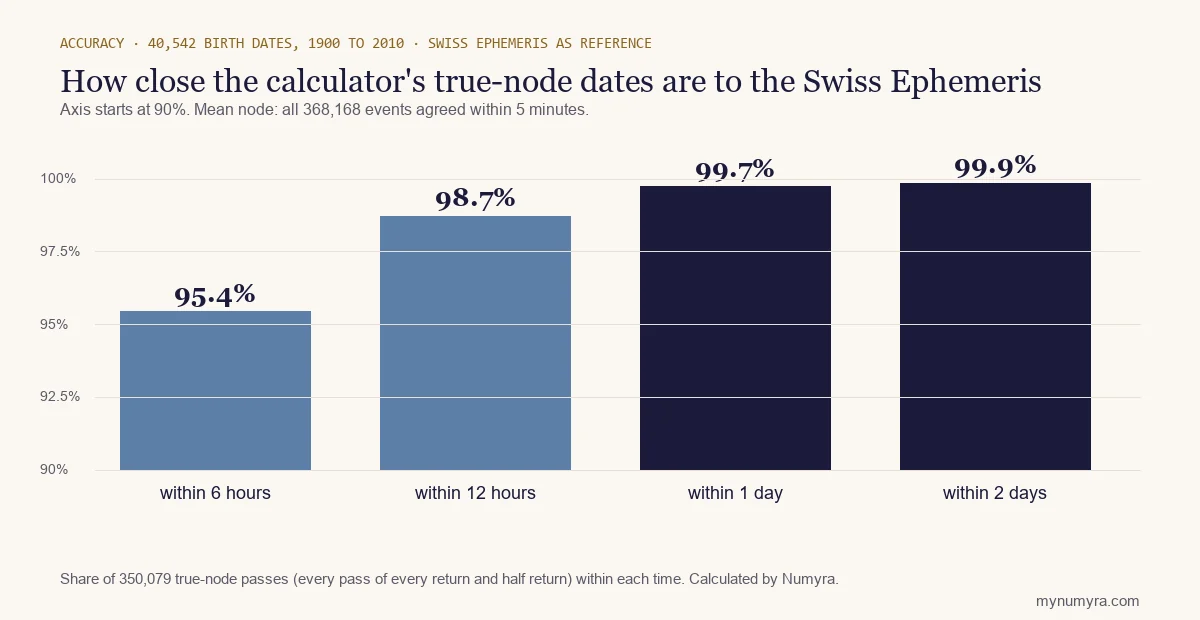
The mean node is a smooth, steady curve, so the match is almost exact. The true node is harder: where it only just touches your birth degree, a difference of a few hundredths of a degree can add or remove a pass, so the true-node pass count can differ from other software. The calculator marks every result where the true node comes within 0.035° of your degree without clearly crossing it. That mark covered all but one of the disagreements we found, but it also appears on about one result in nine that were right, so treat it as a caution, not an error. The true node is our own fitted approximation, so we do not recommend it for anything that needs more than day-level precision.
Frequently asked questions
At what age is the first nodal return?
At 18.61 years by the mean node, which is 18 years and about 7 months. By the true node it falls between 18.5 and 18.8 years for birth dates from 1900 to 2010. The second, third and fourth returns come at 37.23, 55.84 and 74.45 years by the mean node.
What is a half return or nodal reversal?
It is when the transiting North Node reaches your natal South Node, and the transiting South Node reaches your natal North Node. It comes halfway between nodal returns, at about 9.3, 27.9, 46.5 and 65.1 years.
Should I use the true node or the mean node?
Either is acceptable. The mean node moves at a perfectly steady rate, so everyone gets the same ages and one clean date. The true node follows the actual orbit of the Moon and can differ from the mean node by up to about two months, and it can cross your degree more than once. The calculator shows both.
Why does it show three or five dates for the true node?
The true node sometimes moves forward and crosses your natal degree, backs over it and crosses again. In our 1900 to 2010 data about 4.9% of returns and half returns had three or more passes, all within about 42 days of each other, so the whole stretch is the return.
Who has a nodal return in 2026, 2027 and 2028?
By the mean node: first returns for births from about May 2007 to May 2010, second returns from October 1988 to October 1991, third returns from March 1970 to March 1973 and fourth returns from July 1951 to July 1954. Half returns fall for births around 1960 to 1963, 1979 to 1982, 1998 to 2001 and 2016 to 2019. The table above has exact dates.
Do I need my birth time?
No. The nodes move only 0.053 degrees a day, so a birth time shifts each date by less than a day and does not change your ages or the year. The calculator assumes a birth at noon Universal Time.
How accurate is this calculator?
The mean-node dates matched the Swiss Ephemeris within 5 minutes for all 368,168 events from 46,021 birth dates. True-node dates matched within a day for 99.7% of the 350,079 passes tested across 40,542 birth dates; in 1.1% of events the number of passes differed, and the calculator flagged all but one of those cases.
Does a nodal return predict anything?
The dates are astronomical facts, but the meanings are astrological tradition, and there is no evidence that nodal returns predict events. Treat the interpretations as a prompt for reflection, not a forecast.
Sources
- Meeus, Jean. Astronomical Algorithms, 2nd edition. Willmann-Bell. Chapter 47, longitude of the Moon's mean ascending node and its periodic corrections; chapter 22, nutation.
- Astrodienst. Swiss Ephemeris. Reference used to test the calculator and to fit the true-node terms (Moshier ephemeris).
- NASA Eclipse Web Site. Moon's Orbit. Node motion of 0.05295° per day and the 18.6-year rotation.
- Numyra Methodology Desk. Nodal return: exact ages and 2026 to 2028 windows. The ages and windows this calculator reproduces.
- Numyra Methodology Desk. Astrology calculation standard.