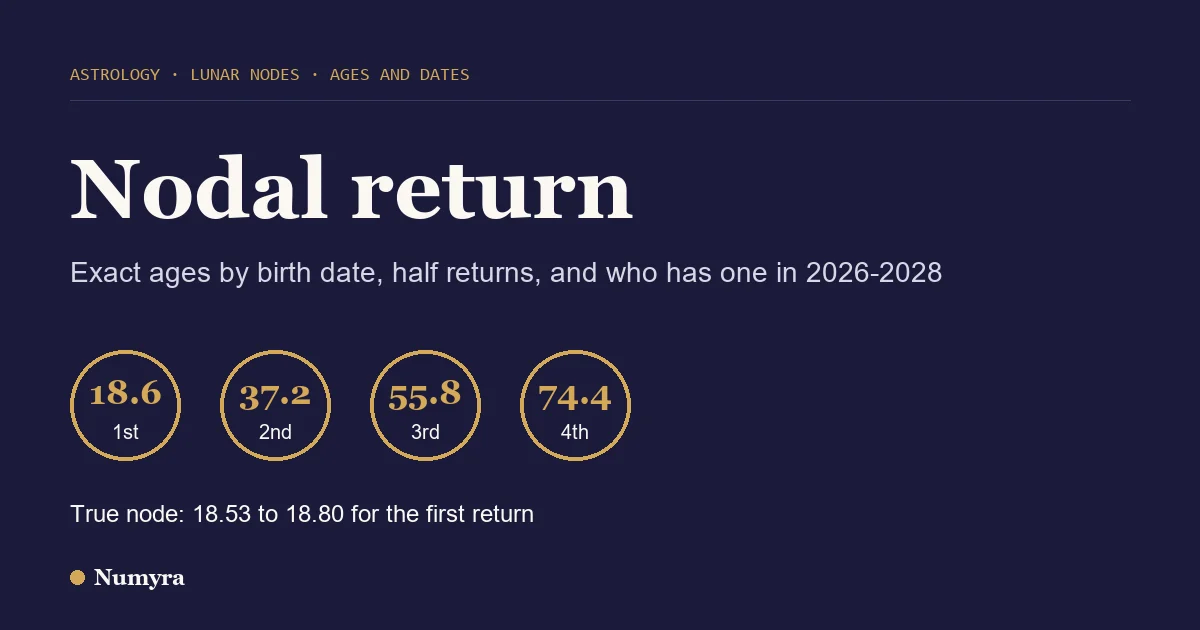
A nodal return is the moment the Moon’s nodes come back to the zodiac degree they held when you were born. It happens at about 18.6, 37.2, 55.8 and 74.4 years of age, and a half return (the nodes on the opposite points) falls midway, at about 9.3, 27.9, 46.5 and 65.1. We calculated 40,542 birth dates from 1900 to 2010 to pin the ages down: by the true node the first return always lands between 18.53 and 18.80, so it is never later than 18 years and 10 months.
Key takeaways
- The mean node returns at exactly the same age for everyone: 18.61, 37.23, 55.84 and 74.45 years (18 y 7 m, 37 y 3 m, 55 y 10 m, 74 y 5 m). The true node lands within about two months either side of those ages.
- Half returns, also called nodal reversals or inverted nodes, come at about 9.3, 27.9, 46.5 and 65.1. The “age 56” often quoted for the third return is really 55 years and about 10 months.
- The true node wobbles, so 4.9% of the 324,336 returns and half returns we checked involve three or more passes over your natal degree, typically within a few weeks of each other.
- In 2026 to 2028 the windows are: first return for births from about May 2007 to May 2010, half return at 28 for 1998 to 2001, second return for October 1988 to October 1991, half return at 46 for 1979 to 1982, third return for 1970 to 1973, half return at 65 for 1960 to 1963 and fourth return for 1951 to 1954 (mean node; exact dates below).
- Of the 85.4 million US births from 1994 to 2014, 28.9% (24.7 million people) have a nodal return or half return in 2026 to 2028.
In this guide
- What a nodal return and a half return are
- The exact ages, from 40,542 birth dates
- True node or mean node: how far apart the dates are
- One pass or three: when the true node crosses your degree repeatedly
- Your return by birth year, 1940 to 2020
- Who has a nodal return in 2026, 2027 and 2028
- What astrologers say about returns and reversals
- How we checked the numbers
- Frequently asked questions
What a nodal return and a half return are
The lunar nodes are the two points where the Moon’s orbit crosses the Sun’s path in the sky; our guide to the North Node, what it is and what each sign is read as covers what they are. They move backward through the zodiac, and NASA gives the cycle length in its description of the Moon’s orbit:
“One complete rotation of the ascending node about the ecliptic requires 18.6 years (6793.48 days) with respect to the fixed stars.”
NASA Eclipse Web Site, Moon’s Orbit
A nodal return is when the transiting North Node reaches the degree of your natal North Node. Because the South Node is always opposite, the South Node returns to your natal South Node at the same moment. A half return is when the transiting nodes sit on your natal nodes the wrong way round: the transiting North Node on your natal South Node. Astrologers also call it a nodal reversal, a nodal opposition, a reverse nodal return or inverted nodes. It arrives halfway through each cycle, about 9.3 years after a return.
We measure the zodiac the way most Western astrology does, tropically, so the cycle is slightly shorter than NASA’s star-based figure: our Swiss Ephemeris mean node takes 6,798.4 days (18.613 years) to go once around the tropical zodiac. NASA’s rate of 0.05295° per day multiplied by our 6,798.4 days is 360°, so the two agree.
The exact ages, from 40,542 birth dates
For every birth date from January 1, 1900 to December 31, 2010 (noon UT, 40,542 days) we found the exact age at each of the first four returns and half returns, using both the mean node and the true node. The result is that the age barely depends on when you were born:
| Event | Mean node age | True node, range | True node, average | One pass (true) |
|---|---|---|---|---|
| Half return | 9.31 (9 y 3.7 m) | 9.15 to 9.42 | 9.29 | 97.1% |
| 1st return | 18.61 (18 y 7.4 m) | 18.53 to 18.80 | 18.64 | 95.9% |
| Half return | 27.92 (27 y 11.0 m) | 27.73 to 27.97 | 27.89 | 94.5% |
| 2nd return | 37.23 (37 y 2.7 m) | 37.11 to 37.38 | 37.23 | 97.3% |
| Half return | 46.53 (46 y 6.4 m) | 46.50 to 46.72 | 46.56 | 90.5% |
| 3rd return | 55.84 (55 y 10.1 m) | 55.67 to 55.94 | 55.82 | 96.7% |
| Half return | 65.15 (65 y 1.8 m) | 65.06 to 65.32 | 65.17 | 96.5% |
| 4th return | 74.45 (74 y 5.4 m) | 74.27 to 74.50 | 74.42 | 92.2% |
Ages are in years from the date of birth; “y m” is years and months. The mean node’s age varies by less than a day across all 40,542 birth dates. The true node never strays more than 0.19 years (about 10 weeks) from the mean-node age, which is why published ages such as 18.6, 37.2, 55.8 and 74.4 hold for everyone to within about two months.
One practical correction: the third return at 55.67 to 55.94 happens when you are 55 years old, in your 56th year, so “age 56” and “age 55” are both common ways of writing the same event. The same goes for the 18-, 37- and 74-year ages: they mean the year of life, not a birthday. Some guides round the third and fourth returns to 56 to 57 and 75 to 76; our numbers put them a year or so earlier.
True node or mean node: how far apart the dates are
The mean node is a smoothed average that moves backward at a perfectly steady rate. The true node follows the Moon’s real, wobbling orbit, so it runs ahead of and behind the mean node. Which one an astrologer uses is a matter of choice, and many software defaults and most published calendars use the true node. For your return dates the difference is up to about two months:
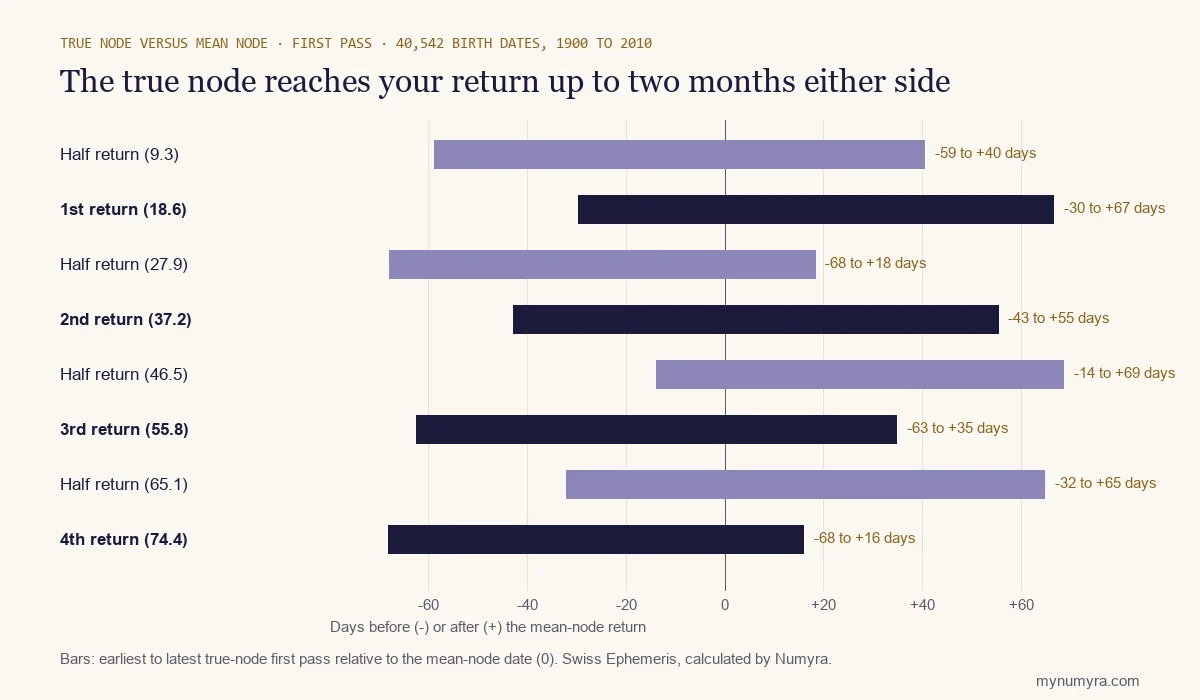
For the first return the true node comes between 30 days earlier and 67 days later than the mean node; across all eight events the typical gap is 15 to 29 days. The true node is the more precise guide to where the Moon’s orbit really crosses the ecliptic, but neither version is “the” correct nodal return: they answer slightly different questions. Our North Node in Aquarius guide shows the same gap for the 2026 sign change, three weeks between the true and mean node.
One pass or three: when the true node crosses your degree repeatedly
Because the true node sometimes moves forward, it can cross your natal degree, back over it and forward again. Of the 324,336 returns and half returns we checked, 95.1% were a single clean pass, 4.5% had three passes, 0.3% five and 0.04% seven or more, up to nine. The true node moves forward on about 26% of days in our 1900 to 2095 calculation, the same figure we found for 2026 to 2028 in the Aquarius guide. The mean node always makes exactly one pass.
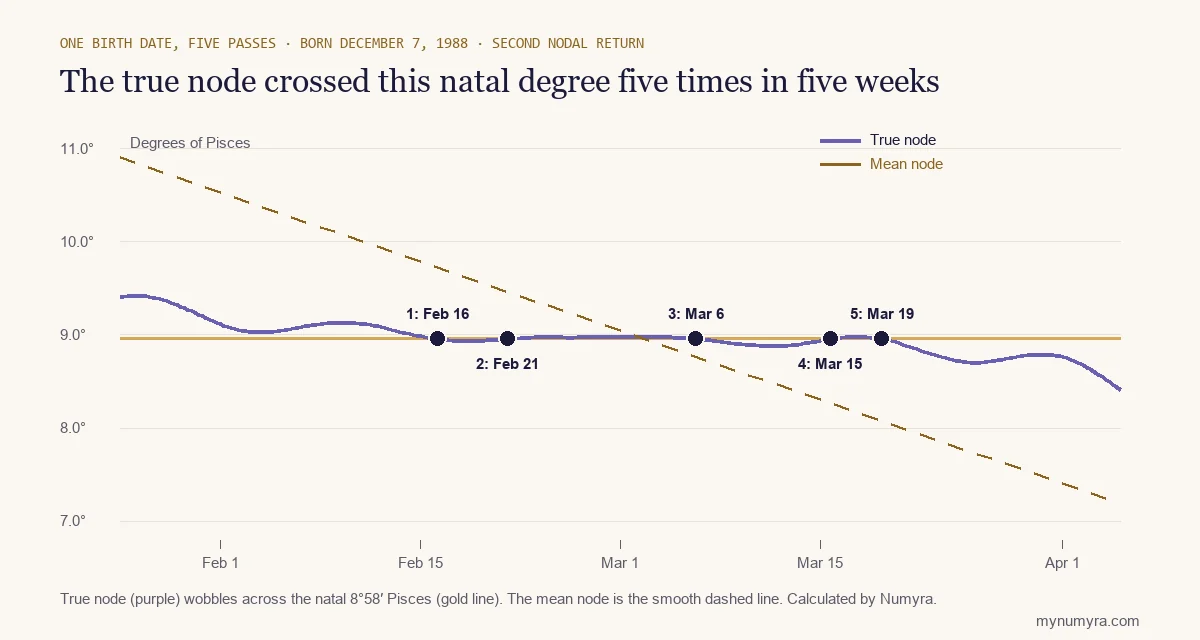
The example is a person born on December 7, 1988, whose natal node sits at 8°58′ Pisces. In early 2026 the true node reaches that degree on February 16, backs away, returns on February 21, March 6, March 15 and March 19. The mean node crosses it only once, in early March. The multiple passes always sit within about 42 days of one another (the widest gap between first and last pass in our data), so for planning purposes the whole cluster is “the return”.
| Event | Single pass | Three passes | Five or more | Longest span, first to last pass |
|---|---|---|---|---|
| Half return (about 9.3) | 97.1% | 2.6% | 0.2% | 33 days |
| 1st return (about 18.6) | 95.9% | 3.8% | 0.3% | 42 days |
| Half return (about 27.9) | 94.5% | 5.1% | 0.4% | 42 days |
| 2nd return (about 37.2) | 97.3% | 2.5% | 0.2% | 42 days |
| Half return (about 46.5) | 90.5% | 8.8% | 0.7% | 42 days |
| 3rd return (about 55.8) | 96.7% | 3.0% | 0.3% | 42 days |
| Half return (about 65.1) | 96.5% | 3.2% | 0.3% | 33 days |
| 4th return (about 74.5) | 92.2% | 7.3% | 0.5% | 33 days |
The half return at about 46.5 and the fourth return at about 74.4 are the most likely to have several passes (9.5% and 7.8% of birth dates). A planet’s retrograde loops produce the same multiple passes, as our Uranus opposition guide shows for Uranus.
Your return by birth year, 1940 to 2020
Since the age is almost fixed, what changes with your birth year is the calendar year. Find your birth year and read across: the cell is the calendar year, or the two calendar years, in which your return or half return falls, by the true node. Years after 2026 are calculated forward with the same ephemeris.
| Born | Half return (about 9) | 1st return (about 18.6) | Half return (about 28) | 2nd return (about 37.2) | Half return (about 46.5) | 3rd return (about 55.8) | Half return (about 65) | 4th return (about 74.4) |
|---|---|---|---|---|---|---|---|---|
| 1940 | 1949-50 | 1958-59 | 1967-68 | 1977-78 | 1986-87 | 1995-96 | 2005-06 | 2014-15 |
| 1941 | 1950-51 | 1959-60 | 1968-69 | 1978-79 | 1987-88 | 1996-97 | 2006-07 | 2015-16 |
| 1942 | 1951-52 | 1960-61 | 1969-70 | 1979-80 | 1988-89 | 1997-98 | 2007-08 | 2016-17 |
| 1943 | 1952-53 | 1961-62 | 1970-71 | 1980-81 | 1989-90 | 1998-99 | 2008-09 | 2017-18 |
| 1944 | 1953-54 | 1962-63 | 1971-72 | 1981-82 | 1990-91 | 1999-00 | 2009-10 | 2018-19 |
| 1945 | 1954-55 | 1963-64 | 1972-73 | 1982-83 | 1991-92 | 2000-01 | 2010-11 | 2019-20 |
| 1946 | 1955-56 | 1964-65 | 1973-74 | 1983-84 | 1992-93 | 2001-02 | 2011-12 | 2020-21 |
| 1947 | 1956-57 | 1965-66 | 1974-75 | 1984-85 | 1993-94 | 2002-03 | 2012-13 | 2021-22 |
| 1948 | 1957-58 | 1966-67 | 1975-76 | 1985-86 | 1994-95 | 2003-04 | 2013-14 | 2022-23 |
| 1949 | 1958-59 | 1967-68 | 1976-77 | 1986-87 | 1995-96 | 2004-05 | 2014-15 | 2023-24 |
| 1950 | 1959-60 | 1968-69 | 1977-78 | 1987-88 | 1996-97 | 2005-06 | 2015-16 | 2024-25 |
| 1951 | 1960-61 | 1969-70 | 1978-79 | 1988-89 | 1997-98 | 2006-07 | 2016-17 | 2025-26 |
| 1952 | 1961-62 | 1970-71 | 1979-80 | 1989-90 | 1998-99 | 2007-08 | 2017-18 | 2026-27 |
| 1953 | 1962-63 | 1971-72 | 1980-81 | 1990-91 | 1999-00 | 2008-09 | 2018-19 | 2027-28 |
| 1954 | 1963-64 | 1972-73 | 1981-82 | 1991-92 | 2000-01 | 2009-10 | 2019-20 | 2028-29 |
| 1955 | 1964-65 | 1973-74 | 1982-83 | 1992-93 | 2001-02 | 2010-11 | 2020-21 | 2029-30 |
| 1956 | 1965-66 | 1974-75 | 1983-84 | 1993-94 | 2002-03 | 2011-12 | 2021-22 | 2030-31 |
| 1957 | 1966-67 | 1975-76 | 1984-85 | 1994-95 | 2003-04 | 2012-13 | 2022-23 | 2031-32 |
| 1958 | 1967-68 | 1976-77 | 1985-86 | 1995-96 | 2004-05 | 2013-14 | 2023-24 | 2032-33 |
| 1959 | 1968-69 | 1977-78 | 1986-87 | 1996-97 | 2005-06 | 2014-15 | 2024-25 | 2033-34 |
| 1960 | 1969-70 | 1978-79 | 1987-88 | 1997-98 | 2006-07 | 2015-16 | 2025-26 | 2034-35 |
| 1961 | 1970-71 | 1979-80 | 1988-89 | 1998-99 | 2007-08 | 2016-17 | 2026-27 | 2035-36 |
| 1962 | 1971-72 | 1980-81 | 1989-90 | 1999-00 | 2008-09 | 2017-18 | 2027-28 | 2036-37 |
| 1963 | 1972-73 | 1981-82 | 1990-91 | 2000-01 | 2009-10 | 2018-19 | 2028-29 | 2037-38 |
| 1964 | 1973-74 | 1982-83 | 1991-92 | 2001-02 | 2010-11 | 2019-20 | 2029-30 | 2038-39 |
| 1965 | 1974-75 | 1983-84 | 1992-93 | 2002-03 | 2011-12 | 2020-21 | 2030-31 | 2039-40 |
| 1966 | 1975-76 | 1984-85 | 1993-94 | 2003-04 | 2012-13 | 2021-22 | 2031-32 | 2040-41 |
| 1967 | 1976-77 | 1985-86 | 1994-95 | 2004-05 | 2013-14 | 2022-23 | 2032-33 | 2041-42 |
| 1968 | 1977-78 | 1986-87 | 1995-96 | 2005-06 | 2014-15 | 2023-24 | 2033-34 | 2042-43 |
| 1969 | 1978-79 | 1987-88 | 1996-97 | 2006-07 | 2015-16 | 2024-25 | 2034-35 | 2043-44 |
| 1970 | 1979-80 | 1988-89 | 1997-98 | 2007-08 | 2016-17 | 2025-26 | 2035-36 | 2044-45 |
| 1971 | 1980-81 | 1989-90 | 1998-99 | 2008-09 | 2017-18 | 2026-27 | 2036-37 | 2045-46 |
| 1972 | 1981-82 | 1990-91 | 1999-00 | 2009-10 | 2018-19 | 2027-28 | 2037-38 | 2046-47 |
| 1973 | 1982-83 | 1991-92 | 2000-01 | 2010-11 | 2019-20 | 2028-29 | 2038-39 | 2047-48 |
| 1974 | 1983-84 | 1992-93 | 2001-02 | 2011-12 | 2020-21 | 2029-30 | 2039-40 | 2048-49 |
| 1975 | 1984-85 | 1993-94 | 2002-03 | 2012-13 | 2021-22 | 2030-31 | 2040-41 | 2049-50 |
| 1976 | 1985-86 | 1994-95 | 2003-04 | 2013-14 | 2022-23 | 2031-32 | 2041-42 | 2050-51 |
| 1977 | 1986-87 | 1995-96 | 2004-05 | 2014-15 | 2023-24 | 2032-33 | 2042-43 | 2051-52 |
| 1978 | 1987-88 | 1996-97 | 2005-06 | 2015-16 | 2024-25 | 2033-34 | 2043-44 | 2052-53 |
| 1979 | 1988-89 | 1997-98 | 2006-07 | 2016-17 | 2025-26 | 2034-35 | 2044-45 | 2053-54 |
| 1980 | 1989-90 | 1998-99 | 2007-08 | 2017-18 | 2026-27 | 2035-36 | 2045-46 | 2054-55 |
| 1981 | 1990-91 | 1999-00 | 2008-09 | 2018-19 | 2027-28 | 2036-37 | 2046-47 | 2055-56 |
| 1982 | 1991-92 | 2000-01 | 2009-10 | 2019-20 | 2028-29 | 2037-38 | 2047-48 | 2056-57 |
| 1983 | 1992-93 | 2001-02 | 2010-11 | 2020-21 | 2029-30 | 2038-39 | 2048-49 | 2057-58 |
| 1984 | 1993-94 | 2002-03 | 2011-12 | 2021-22 | 2030-31 | 2039-40 | 2049-50 | 2058-59 |
| 1985 | 1994-95 | 2003-04 | 2012-13 | 2022-23 | 2031-32 | 2040-41 | 2050-51 | 2059-60 |
| 1986 | 1995-96 | 2004-05 | 2013-14 | 2023-24 | 2032-33 | 2041-42 | 2051-52 | 2060-61 |
| 1987 | 1996-97 | 2005-06 | 2014-15 | 2024-25 | 2033-34 | 2042-43 | 2052-53 | 2061-62 |
| 1988 | 1997-98 | 2006-07 | 2015-16 | 2025-26 | 2034-35 | 2043-44 | 2053-54 | 2062-63 |
| 1989 | 1998-99 | 2007-08 | 2016-17 | 2026-27 | 2035-36 | 2044-45 | 2054-55 | 2063-64 |
| 1990 | 1999-00 | 2008-09 | 2017-18 | 2027-28 | 2036-37 | 2045-46 | 2055-56 | 2064-65 |
| 1991 | 2000-01 | 2009-10 | 2018-19 | 2028-29 | 2037-38 | 2046-47 | 2056-57 | 2065-66 |
| 1992 | 2001-02 | 2010-11 | 2019-20 | 2029-30 | 2038-39 | 2047-48 | 2057-58 | 2066-67 |
| 1993 | 2002-03 | 2011-12 | 2020-21 | 2030-31 | 2039-40 | 2048-49 | 2058-59 | 2067-68 |
| 1994 | 2003-04 | 2012-13 | 2021-22 | 2031-32 | 2040-41 | 2049-50 | 2059-60 | 2068-69 |
| 1995 | 2004-05 | 2013-14 | 2022-23 | 2032-33 | 2041-42 | 2050-51 | 2060-61 | 2069-70 |
| 1996 | 2005-06 | 2014-15 | 2023-24 | 2033-34 | 2042-43 | 2051-52 | 2061-62 | 2070-71 |
| 1997 | 2006-07 | 2015-16 | 2024-25 | 2034-35 | 2043-44 | 2052-53 | 2062-63 | 2071-72 |
| 1998 | 2007-08 | 2016-17 | 2025-26 | 2035-36 | 2044-45 | 2053-54 | 2063-64 | 2072-73 |
| 1999 | 2008-09 | 2017-18 | 2026-27 | 2036-37 | 2045-46 | 2054-55 | 2064-65 | 2073-74 |
| 2000 | 2009-10 | 2018-19 | 2027-28 | 2037-38 | 2046-47 | 2055-56 | 2065-66 | 2074-75 |
| 2001 | 2010-11 | 2019-20 | 2028-29 | 2038-39 | 2047-48 | 2056-57 | 2066-67 | 2075-76 |
| 2002 | 2011-12 | 2020-21 | 2029-30 | 2039-40 | 2048-49 | 2057-58 | 2067-68 | 2076-77 |
| 2003 | 2012-13 | 2021-22 | 2030-31 | 2040-41 | 2049-50 | 2058-59 | 2068-69 | 2077-78 |
| 2004 | 2013-14 | 2022-23 | 2031-32 | 2041-42 | 2050-51 | 2059-60 | 2069-70 | 2078-79 |
| 2005 | 2014-15 | 2023-24 | 2032-33 | 2042-43 | 2051-52 | 2060-61 | 2070-71 | 2079-80 |
| 2006 | 2015-16 | 2024-25 | 2033-34 | 2043-44 | 2052-53 | 2061-62 | 2071-72 | 2080-81 |
| 2007 | 2016-17 | 2025-26 | 2034-35 | 2044-45 | 2053-54 | 2062-63 | 2072-73 | 2081-82 |
| 2008 | 2017-18 | 2026-27 | 2035-36 | 2045-46 | 2054-55 | 2063-64 | 2073-74 | 2082-83 |
| 2009 | 2018-19 | 2027-28 | 2036-37 | 2046-47 | 2055-56 | 2064-65 | 2074-75 | 2083-84 |
| 2010 | 2019-20 | 2028-29 | 2037-38 | 2047-48 | 2056-57 | 2065-66 | 2075-76 | 2084-85 |
| 2011 | 2020-21 | 2029-30 | 2038-39 | 2048-49 | 2057-58 | 2066-67 | 2076-77 | 2085-86 |
| 2012 | 2021-22 | 2030-31 | 2039-40 | 2049-50 | 2058-59 | 2067-68 | 2077-78 | 2086-87 |
| 2013 | 2022-23 | 2031-32 | 2040-41 | 2050-51 | 2059-60 | 2068-69 | 2078-79 | 2087-88 |
| 2014 | 2023-24 | 2032-33 | 2041-42 | 2051-52 | 2060-61 | 2069-70 | 2079-80 | 2088-89 |
| 2015 | 2024-25 | 2033-34 | 2042-43 | 2052-53 | 2061-62 | 2070-71 | 2080-81 | 2089-90 |
| 2016 | 2025-26 | 2034-35 | 2043-44 | 2053-54 | 2062-63 | 2071-72 | 2081-82 | 2090-91 |
| 2017 | 2026-27 | 2035-36 | 2044-45 | 2054-55 | 2063-64 | 2072-73 | 2082-83 | 2091-92 |
| 2018 | 2027-28 | 2036-37 | 2045-46 | 2055-56 | 2064-65 | 2073-74 | 2083-84 | 2092-93 |
| 2019 | 2028-29 | 2037-38 | 2046-47 | 2056-57 | 2065-66 | 2074-75 | 2084-85 | 2093-94 |
| 2020 | 2029-30 | 2038-39 | 2047-48 | 2057-58 | 2066-67 | 2075-76 | 2085-86 | 2094-95 |
Two years are given when your birthday decides which year you land in: someone born in January 1990 has the first return in 2008, one born in December 1990 in 2009. Here are five sample birth dates with the exact dates, true node first and mean node beneath:
| Born | 1st return | 2nd return | 3rd return | 4th return |
|---|---|---|---|---|
| Mar 15, 1960 | Nov 18, 1978 mean: Oct 25, 1978 |
Jun 8, 1997 mean: Jun 6, 1997 |
Jan 6, 2016 mean: Jan 16, 2016 |
Aug 2, 2034 to Aug 8, 2034 (3 passes) mean: Aug 28, 2034 |
| Jul 4, 1975 | Jan 30, 1994 mean: Feb 12, 1994 |
Aug 28, 2012 mean: Sep 24, 2012 |
Mar 19, 2031 mean: May 6, 2031 |
Nov 7, 2049 to Dec 9, 2049 (5 passes) mean: Dec 16, 2049 |
| Jan 1, 1990 | Oct 4, 2008 mean: Aug 12, 2008 |
Apr 25, 2027 mean: Mar 25, 2027 |
Nov 23, 2045 mean: Nov 3, 2045 |
Jun 15, 2064 mean: Jun 15, 2064 |
| Jun 15, 2000 | Mar 13, 2019 to Mar 17, 2019 (3 passes) mean: Jan 25, 2019 |
Oct 11, 2037 mean: Sep 6, 2037 |
Apr 28, 2056 mean: Apr 17, 2056 |
Nov 29, 2074 mean: Nov 28, 2074 |
| Jul 1, 2008 | Apr 5, 2027 mean: Feb 10, 2027 |
Oct 30, 2045 mean: Sep 22, 2045 |
May 18, 2064 mean: May 3, 2064 |
Dec 17, 2082 mean: Dec 14, 2082 |
For your own date, the Birth Chart Calculator gives your natal node position to compare with the transiting nodes, and the table above gives the age window. The planetary returns follow the same logic with different cycle lengths: see the Jupiter return, Saturn return and Chiron return guides.
Who has a nodal return in 2026, 2027 and 2028
Three years of events means three years of birth dates. Each calendar year of 2026, 2027 and 2028 brings one return or half return to roughly one year of births, shifted for each of the eight events. The table gives the exact birth dates, by the mean node, whose return or half return falls in each calendar year, and the true-node window for the three years together (its edges move by up to two months because of the wobble).

| Event | Falls in 2026: born | Falls in 2027: born | Falls in 2028: born | True node, all three years: born |
|---|---|---|---|---|
| 4th return, about 74 | Jul 20, 1951 to Jul 18, 1952 | Jul 19, 1952 to Jul 18, 1953 | Jul 19, 1953 to Jul 19, 1954 | Jul 16, 1951 to Aug 18, 1954 |
| Half return, about 65 | Nov 9, 1960 to Nov 8, 1961 | Nov 9, 1961 to Nov 7, 1962 | Nov 8, 1962 to Nov 8, 1963 | Dec 3, 1960 to Oct 28, 1963 |
| 3rd return, about 56 | Mar 1, 1970 to Feb 28, 1971 | Mar 1, 1971 to Feb 28, 1972 | Feb 29, 1972 to Feb 28, 1973 | Apr 20, 1970 to Mar 17, 1973 |
| Half return, about 46 | Jun 21, 1979 to Jun 19, 1980 | Jun 20, 1980 to Jun 19, 1981 | Jun 20, 1981 to Jun 20, 1982 | Jun 24, 1979 to May 23, 1982 |
| 2nd return, about 37 | Oct 10, 1988 to Oct 9, 1989 | Oct 10, 1989 to Oct 9, 1990 | Oct 10, 1990 to Oct 10, 1991 | Nov 20, 1988 to Oct 9, 1991 |
| Half return, about 28 | Jan 30, 1998 to Jan 29, 1999 | Jan 30, 1999 to Jan 29, 2000 | Jan 30, 2000 to Jan 29, 2001 | Jan 26, 1998 to Feb 25, 2001 |
| 1st return, about 18 | May 23, 2007 to May 21, 2008 | May 22, 2008 to May 21, 2009 | May 22, 2009 to May 22, 2010 | Jun 6, 2007 to Apr 29, 2010 |
| Half return, about 9 | Sep 11, 2016 to Sep 10, 2017 | Sep 11, 2017 to Sep 10, 2018 | Sep 11, 2018 to Sep 11, 2019 | Nov 1, 2016 to Sep 27, 2019 |
As of October 14, 2026 the 2026 column is mostly done: the mean-node first return has already happened for people born up to early March 2008, and those born from March 2008 to May 2008 have it in the last weeks of 2026. The year 2027 brings the first return to people born from May 22, 2008, who are turning 18 or 19, and the second return to people born in 1989 and 1990, who are 37.
The age groups overlap, which is why the sign change in 2026 to 2028 matters beyond teenagers: the North Node’s passage through Aquarius carries first returns for the 2007 to 2010 births, the half return for those born 1998 to 2001, second returns for the late 1980s to early 1990s and so on up. Eclipses on the same axis are listed in our 2027 eclipse guide.
US births give the scale. Using the 85,386,227 births in the CDC and Social Security Administration counts for 1994 to 2014, 24,662,014 (28.9%) have a return or half return between January 1, 2026 and December 31, 2028 by the true node, and 24,739,334 (29.0%) by the mean node. Only two of the eight windows fall inside those years of data: first returns (births from 2007 to 2010, 4.4 million in the 2026 window, 4.3 million in 2027 and 4.1 million in 2028 by the mean node) and half returns at about 28 (births from 1998 to 2001: 3.9 million, 4.0 million and 4.1 million). The other six windows, from the 1950s to 2019, are not covered by that data, so the real share is higher.
The wobble matters for 2026 to 2028 too: of the 8,619 birth dates in these windows, 373 (4.3%) have at least one event with several passes. The people born in December 1988 with five passes in February and March 2026 are one case; another is people born on December 9, 2007, whose first return passes on July 2, 6 and 8, 2026.
What astrologers say about returns and reversals
Everything above is astronomy and arithmetic. The meaning is tradition, and no study shows these transits predict life events. Contemporary guides, such as those from Girl and Her Moon, Kerykeion and Jessica Davidson (listed in the sources), treat the returns as checkpoints for the North Node’s themes: the first around 18 as the threshold into adulthood, the second near 37 as a midlife review and the third in the mid-50s as a time for reflection. They give the ages loosely, as 18 to 19, 37 and 55 to 57. The half return is read as the opposite emphasis, with the North and South Node roles swapped.
The ages also coincide with ordinary milestones such as finishing school, which makes the transit easy to match to a life after the fact; the first Saturn return near 29 falls close to the second half return at 27.9 for the same reason. For the interpretation of each North Node sign, see the North Node guide.
How we checked the numbers
All positions use the Swiss Ephemeris through the Python library pyswisseph with its Moshier ephemeris, sampled every six hours with linear interpolation between samples, and a birth time of noon UT. A birth time hours away from noon moves the natal degree by about 0.03° (0.5 day of node motion), enough to shift a return by half a day but not to change the ages above. A return is a crossing of the unwrapped node longitude over your natal longitude minus 180° times the event number; every crossing in a window of 0.6 years around the expected date counts as a pass.
- NASA: its Moon’s Orbit page gives the node’s motion as 0.05295° per day and one rotation as 18.6 years (6793.48 days) against the stars, and its eclipse page says the nodes regress westward by 19.3° per year. Our mean node moves 19.34° per year, which rounds to NASA’s 19.3.
- Meeus: the mean-node formula in Jean Meeus’s Astronomical Algorithms agrees with our mean node to within 0.0052° across 144 dates between 1900 and 2095, about two and a half hours of node motion.
- JPL Horizons: Horizons gives the Moon’s osculating orbital elements, whose ascending-node longitude is the true node. Converted from its J2000 ecliptic to the ecliptic of date, 63 comparison dates between 1990 and 2030 differ from our true node by 0.045° at most (0.014° on average), under one day of node motion. Horizons has no mean lunar node, so the mean-node check is Meeus. On four test birth dates, Horizons agreed with our return dates to within 2 days, including all five passes for December 7, 1988. For the December 9, 2007 case Horizons showed one of our three passes (July 2, 2026); the node only just touches that natal degree, so a difference of a hundredth of a degree can change the count of passes.
Frequently asked questions
At what age is the first nodal return?
At 18.61 years by the mean node, which is 18 years and about 7 months. By the true node it falls between 18.53 and 18.80 years (18 y 6 m to 18 y 10 m) for every birth date from 1900 to 2010.
When are the second, third and fourth nodal returns?
The mean node gives 37.23, 55.84 and 74.45 years. The true node gives 37.11 to 37.38, 55.67 to 55.94 and 74.27 to 74.50. In plain years of life, that is 37, 55 and 74.
Is the third nodal return at 55 or 56?
Both are used for the same event. The return arrives at 55.67 to 55.94 years, so you are 55 for most of it and about to turn 56, which is why guides write either number.
What is a half return or nodal reversal?
It is when the transiting North Node reaches your natal South Node, and the transiting South Node reaches your natal North Node. It comes halfway between nodal returns, at about 9.3, 27.9, 46.5 and 65.1 years.
Should I use the true node or the mean node?
Either is acceptable; they differ by up to about two months. The mean node gives the same age for everyone and a clean date; the true node follows the Moon’s actual orbit and can cross your degree more than once.
Why does my software show three or five nodal return dates?
The true node sometimes moves forward and crosses your natal degree several times. About 4.9% of returns and half returns in our 1900 to 2010 data had three or more passes, all within about 42 days of each other.
Who has a nodal return in 2026 to 2028?
First returns: births from about May 2007 to May 2010. Second returns: about October 1988 to October 1991. Third returns: about March 1970 to March 1973. Fourth returns: about July 1951 to July 1954. Half returns fall for births around 1960 to 1963, 1979 to 1982, 1998 to 2001 and 2016 to 2019. The table above has exact dates.
Do I need my birth time to find my nodal return?
No. Only the birth date matters to within about half a day, because the nodes move 0.053° a day. A birth time changes the return date by hours, not the age or the year.
Does a nodal return predict anything?
The dates are astronomical facts; the meanings are astrological tradition, and there is no evidence that nodal returns predict events. Treat the interpretations as a prompt for reflection, not a forecast.
Sources
- NASA Eclipse Web Site. Moon’s Orbit. Node motion of 0.05295° per day and the 18.6-year (6,793.48-day) rotation.
- NASA Eclipse Web Site. Periodicity of Solar Eclipses. Nodal regression of 19.3° per year.
- NASA JPL. Horizons System. Osculating elements of the Moon used to check the true node.
- Astrodienst. Swiss Ephemeris. The calculation library used here (Moshier ephemeris).
- Jean Meeus. Astronomical Algorithms. Willmann-Bell, 2nd edition. Mean longitude of the Moon’s ascending node.
- Girl and Her Moon. What is a Nodal Return in Astrology? (October 7, 2025) and What is a Nodal Reversal?. Approximate ages and interpretation in a contemporary guide.
- Jessica Davidson. Exploring the Meaning of the Nodal Return (April 2026).
- Kerykeion. The Nodal Return: When the Lunar Nodes Complete Their Cycle.
- CDC National Center for Health Statistics (1994 to 1999) and Social Security Administration (2000 to 2014) daily US birth counts, as used in our other calculations.
- Numyra Methodology Desk. All ages, windows and shares in this article, calculated by us.