Saturn Return Calculator
Enter your birth date and city to get the exact dates Saturn comes back to its birth position, for your first, second and third Saturn returns. For every birth date from 1930 to 2010, the first return landed between ages 28.4 and 29.9, and for over a third of people it comes in three separate passes.
Key takeaways
- A Saturn return is the day Saturn reaches the exact degree it held at your birth; the calculator finds every such pass, plus when Saturn enters and leaves your Saturn sign.
- Across every birth date from 1930 to 2010, the first exact return fell between ages 28.4 and 29.9, the second between 58.2 and 59.0.
- Tested against the Swiss Ephemeris on 5,911 exact passes: 78% matched within 6 hours and 98% within a day.
- Nothing here is medical, financial, legal, or psychological advice — this is a cultural tradition, presented for entertainment and reflection.
Your Saturn returns
For entertainment and self-reflection. Numerology is a cultural tradition, not a science, and nothing here is medical, financial, legal, or psychological advice.
What your result shows
Your result starts with Saturn's position at your birth, its sign and degree. Everything else is measured against that one point. For each return you get three things: the date the "window" opens, when Saturn first enters your Saturn sign; the exact dates Saturn crosses your birth degree; and the date the window closes, when Saturn finally leaves the sign.
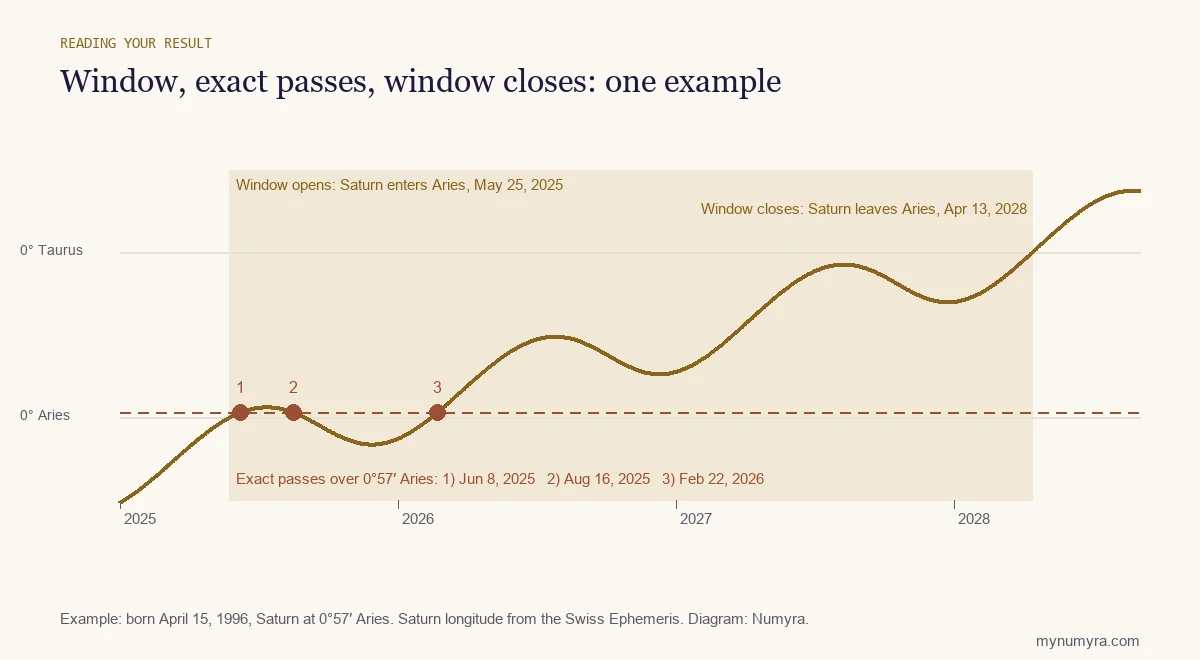
Many astrologers count the whole window, usually about two and a half years, as your Saturn return, and the exact dates as its peak. Whether you get one exact date or three depends on Saturn's retrograde loop. Each year Saturn appears to move backward for about four and a half months, the same illusion behind Mercury retrograde. If that loop happens right over your birth degree, Saturn crosses it three times. The figure was already in the textbooks in the 17th century:
"He continueth Retrograde 140 dayes."
William Lilly, Christian Astrology, London, 1647, chapter VIII, p. 58
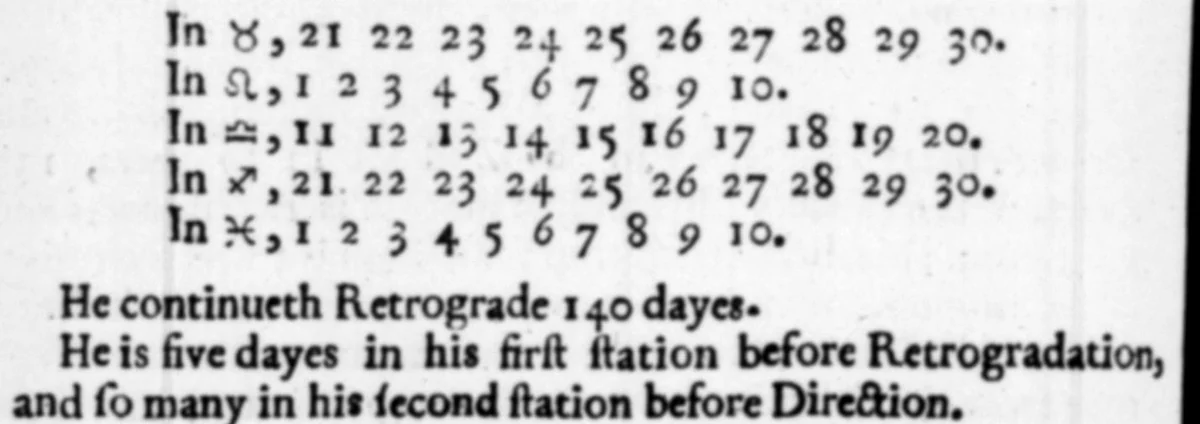
Lilly was close: measured with the Swiss Ephemeris, Saturn's retrograde lasts 134 to 142 days. The line under your result also places your first return among everyone born from 1930 to 2010, so you can see whether yours comes early or late. For the full story of what the return is said to mean, see our Saturn return guide.
Who is having a Saturn return right now?
Saturn moves into Aries on February 14, 2026 and stays there until April 13, 2028, even through its retrograde loops. In 2026, people born between March 7, 1996 and January 21, 1998, except May 7 to November 8, 1997, have an exact first return: about 5.3 million US births. People born from May 1966 to March 1968, with a gap in late 1966, are having their second. Aries is the sign where Saturn is traditionally in its fall, its weakest placement in the system of essential dignities.
How this calculator works, and how accurate it is
Saturn's position comes from Paul Schlyter's published method, the same engine as our stellium calculator, including the main correction for Jupiter's pull on Saturn. The calculator steps through every day from about three and a half years before each expected return to three and a half years after, then narrows each crossing down to the minute. NASA gives Saturn's tropical orbit period, a full lap of the zodiac, as 29.42 years. It all runs in your browser, so nothing you enter leaves your device. To check it, we ran the same code for 1,500 random birth dates from 1930 to 2010 and compared every exact pass with the Swiss Ephemeris:
| Check | Result |
|---|---|
| Exact passes compared | 5,911 (first and second returns) |
| Same date within 6 hours | 78.1% |
| Same date within 1 day | 97.8% |
| Largest difference | 4.4 days, at a retrograde turning point |
| Saturn at birth, largest difference | 2.7′ (arcminutes) |
| One pass vs three disagreed | 0.3% of returns, all flagged by the calculator's warning |
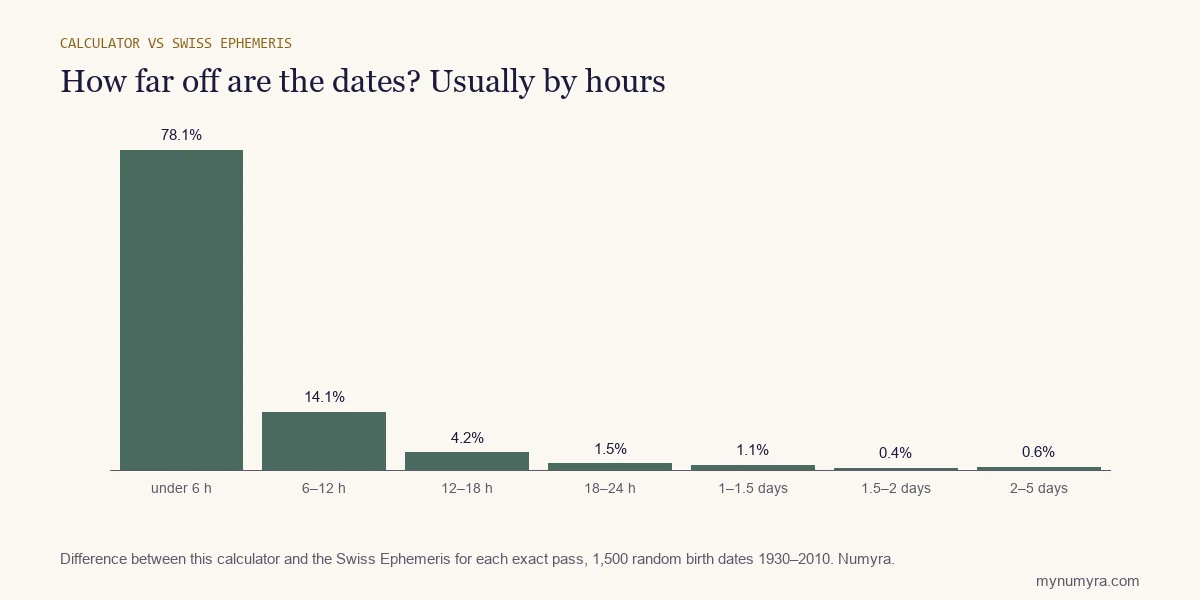
The biggest differences come where Saturn is almost standing still at a turning point, so a tiny difference in position moves the crossing by days. When Saturn turns around within a tenth of a degree of your birth position, two programs can even disagree on whether you get one pass or three; the calculator tells you when that applies. If you were born within a day of a boundary, a birth time helps, and the calculator checks whether it would change your dates.
Frequently asked questions
How do I figure out my Saturn return?
Find the degree Saturn held when you were born, then the dates Saturn comes back to it about 29 years later. The calculator above does both: enter your birth date, city and, if you know it, your birth time.
At what age do you have a Saturn return?
The first exact return comes between ages 28.4 and 29.9 for every birth date from 1930 to 2010, the second between 58.2 and 59.0 and the third between 87.3 and 88.8. Saturn usually enters your Saturn sign a year or two earlier, at 27 or 28.
Who is currently in their Saturn return?
In 2026, people born between March 7, 1996 and January 21, 1998 (except May 7 to November 8, 1997) have an exact first return, and people born between May 5, 1966 and March 30, 1968 (except September 20, 1966 to January 28, 1967) an exact second return.
Why do I get three dates?
For about 37% of people, Saturn turns retrograde right over their birth degree, so it crosses it forward, back and forward again. All three count as the exact return; they usually fall within about nine months.
Do I need my exact birth time?
Usually not. Saturn moves so slowly that a whole day changes its position only slightly, so most birth dates give the same dates whatever the time. The calculator checks this for you and says when the time would make a difference.
Why is a Saturn return so difficult?
In astrology Saturn stands for limits, responsibility and time, so its return is read as a test of whether the life you have built fits you. That reputation is a tradition, not a measured effect, and many people describe the period as clarifying rather than unlucky.
How accurate is this calculator?
We compared it with the Swiss Ephemeris for 1,500 random birth dates: 78% of exact pass dates matched within 6 hours and 98% within a day. In 0.3% of cases, where Saturn turns around right on the birth degree, programs can disagree on one pass or three, and the calculator warns you when that applies.
Sources
- Schlyter, Paul. How to Compute Planetary Positions. The position method used by this calculator.
- Astrodienst. Swiss Ephemeris. Reference used to test the calculator and to compute the ages of every return from 1930 to 2010.
- NASA Space Science Data Coordinated Archive. Saturn Fact Sheet. Tropical orbit period 10,746.94 days.
- Lilly, William. Christian Astrology. London, 1647. Chapter VIII, p. 58. Internet Archive scan of the first edition.
- Numyra Methodology Desk. Astrology calculation standard.