Planetary Hours Calculator
Pick a date and a city to get sunrise, sunset and all 24 planetary hours with their ruling planets and local start and end times. Day and night are each cut into 12 hours that are rarely 60 minutes long: in New York on October 14, 2026, a day hour lasts 55.9 minutes and a night hour 64.2.
Key takeaways
- A planetary hour is one twelfth of the daylight or of the night, ruled in turn by Saturn, Jupiter, Mars, Sun, Venus, Mercury and Moon, starting with the planet of the weekday at sunrise.
- The planetary day runs from sunrise to the next sunrise, so hours after midnight still belong to the previous weekday. When the date is today, the calculator highlights the current hour using your device's clock.
- Tested against the Swiss Ephemeris on 1,200 sunrise and sunset times: half within 3.2 seconds, 95% within 6.5 seconds, none off by more than 13 seconds.
- Planetary hours are a tradition, not a measured effect. This is for entertainment and reflection, not advice.
Your planetary hours
For entertainment and self-reflection. Numerology and astrology are cultural traditions, not sciences, and nothing here is medical, financial, legal, or psychological advice.
What your result shows
The summary gives sunrise, sunset and the next sunrise, then the length of one day hour and one night hour. The table lists all 24 hours of the planetary day, from sunrise to the next sunrise. Hour 1 belongs to the planet that rules the weekday, and each hour after it passes to the next planet in the Chaldean order: Saturn, Jupiter, Mars, Sun, Venus, Mercury, Moon, then back to Saturn.
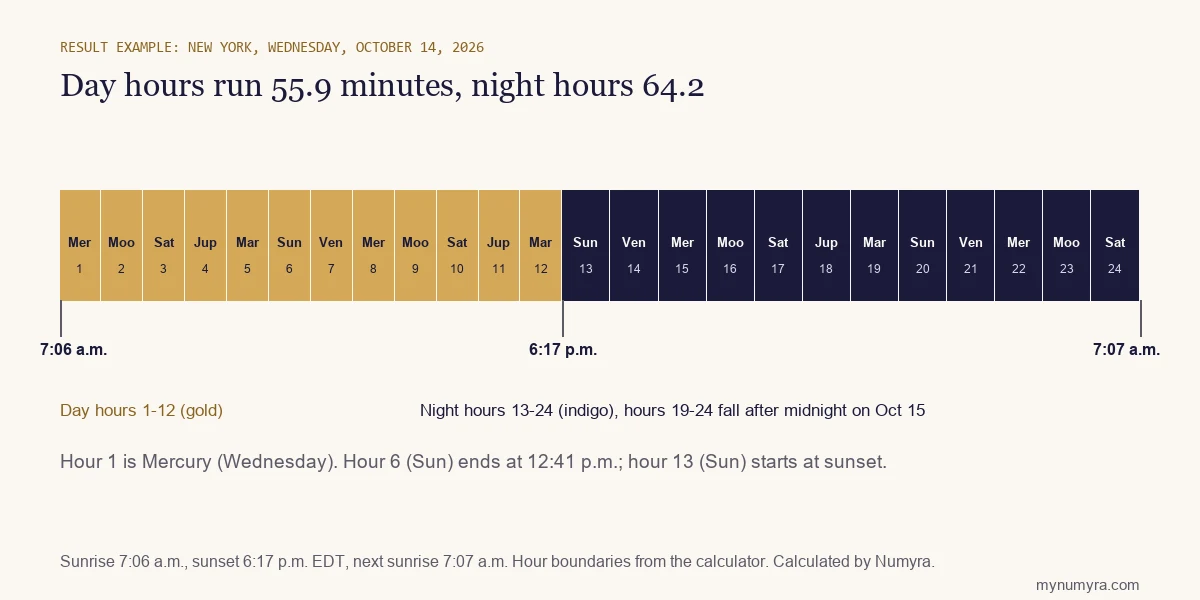
When you choose today's date, the calculator reads your device's clock and highlights the hour you are in. Because the planetary day starts at sunrise, a time before dawn is still part of yesterday's planetary day. The full explanation, with the weekday grid and the traditional uses of each planet's hour, is in our planetary hours guide.
How this calculator works, and how accurate it is
Sunrise and sunset come from the NOAA solar position method: the Sun's declination and the equation of time for the date give the hour angle at which the Sun's upper edge meets the horizon, allowing for standard atmospheric refraction. The calculator then divides the daylight into 12 equal parts and the night into 12 equal parts. Local times use your browser's time zone data, so daylight saving time is applied correctly for any date from 1900 to 2100. It all runs in your browser, so nothing you enter leaves your device. To check it, we ran the same code for 400 random dates and cities and compared every time with the Swiss Ephemeris:
| Check | Result |
|---|---|
| Times compared with the Swiss Ephemeris | 1,200 (sunrise, sunset and next sunrise, 1900 to 2100) |
| Median difference | 3.2 seconds |
| 95th percentile | 6.5 seconds |
| 99th percentile / largest | 8.5 / 13.4 seconds |
| US Naval Observatory, 72 times in six US cities | median 12.5 s, largest 31 s (the Observatory prints whole minutes) |
| Latitudes 60° to 70°, 309 times | median 7.0 s, 95% within 21 s, largest 134 s |
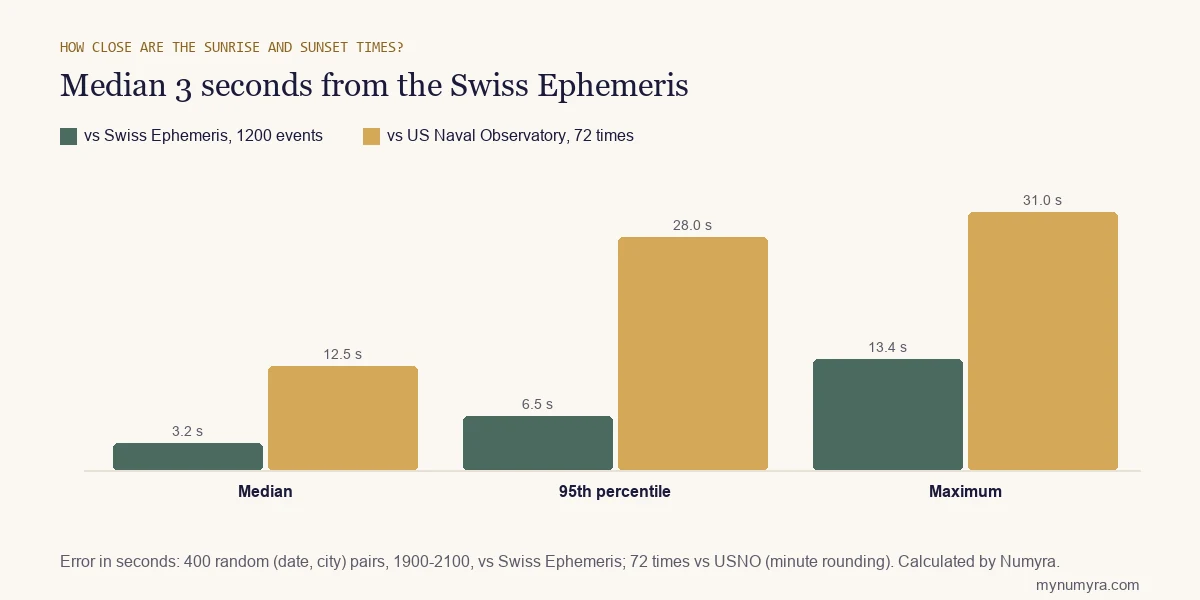
Our guide's worked example (New York, October 14, 2026) is reproduced within five seconds: the calculator gives sunrise at 7:06:10 a.m. and sunset at 6:17:08 p.m., the same day hour of 55.9 minutes and night hour of 64.2 minutes. Where the Sun never rises or never sets, which can happen beyond about 65° latitude, there is no sunrise to measure from, so the calculator says so and shows only a labeled convention of equal hours from 6:00 to 18:00. Real sunrise also depends on weather, local hills and your height above sea level, which can move it by a minute or more.
Frequently asked questions
How do I find the current planetary hour?
Pick today's date and your city, then press the button. When the date is today, the current hour is highlighted in the table and named above it, and it updates every 30 seconds while the page is open. Before sunrise you are still in the previous weekday's planetary day.
How are planetary hours calculated?
The time from sunrise to sunset is divided into 12 equal day hours, and the time from sunset to the next sunrise into 12 equal night hours. The planets are assigned in the Chaldean order, Saturn, Jupiter, Mars, Sun, Venus, Mercury, Moon, starting with the ruler of the weekday at sunrise.
Why is a planetary hour not 60 minutes?
Because day and night are each cut into 12 parts, the hours stretch and shrink with the seasons. In New York a day hour runs from about 46 minutes in late December to about 75 minutes in late June. Only on about two days a year are the day hours and night hours both close to 60 minutes.
Which planet rules the first hour of each day?
The planet the weekday is named for: Sun on Sunday, Moon on Monday, Mars on Tuesday, Mercury on Wednesday, Jupiter on Thursday, Venus on Friday and Saturn on Saturday. That planet also rules hour 8, hour 15 and hour 22 of the planetary day.
Does the planetary day start at midnight?
No. It runs from sunrise to the next sunrise. The night hours after midnight, and before sunrise, belong to the previous weekday, so at 3 a.m. on a Thursday you are in the last hours of Wednesday's planetary day. The calculator shows these hours with a +1 day note.
How accurate are the sunrise and sunset times?
We compared the calculator with the Swiss Ephemeris for 400 random dates and cities from 1900 to 2100: half of the 1,200 times were within 3.2 seconds, 95% within 6.5 seconds and the largest difference was 13.4 seconds. Against the US Naval Observatory's published times, which are rounded to the minute, the largest difference was 31 seconds. Weather, hills and the exact observer height can move real sunrise by a minute or more.
What happens near the poles, where the Sun does not rise?
Where the Sun stays above or below the horizon all day, there is no sunrise or sunset to measure from, so the calculator says so and shows a clearly labeled convention only: equal 60-minute hours from 6:00 to 18:00 and 18:00 to 6:00. Beyond about 60 degrees latitude the times are less exact; in our test at latitudes 60 to 70 degrees the median difference was 7 seconds and the largest 134 seconds.
Do planetary hours really affect what I do?
There is no scientific evidence that they do. Planetary hours are a traditional astrological system used to choose moments for actions, and this calculator is for entertainment and self-reflection, not advice of any kind.
Sources
- NOAA Global Monitoring Laboratory. Solar Calculation Details. The sunrise and sunset method used by this calculator.
- Astrodienst. Swiss Ephemeris. Reference used to test the calculator.
- U.S. Naval Observatory. Rise, Set, and Twilight Data. Published times used for the 72-time cross-check.
- Numyra Editorial Desk. Planetary Hours. The order, the weekday grid and the worked example.
- Numyra Methodology Desk. Astrology calculation standard.