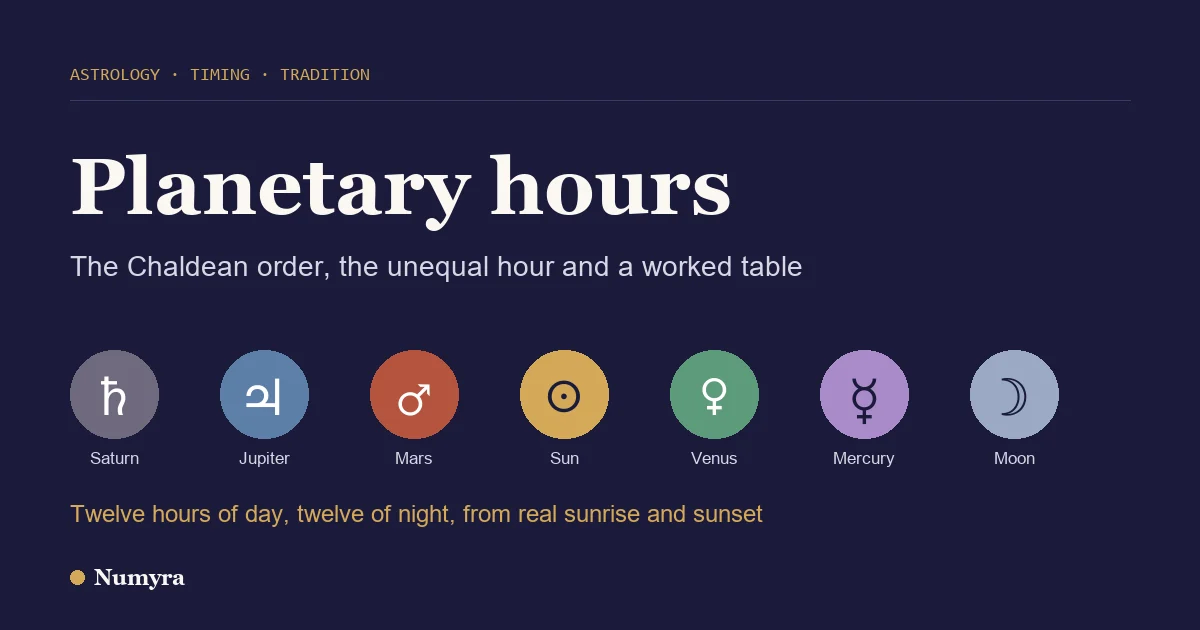
Planetary hours are the traditional astrological way of cutting the daylight and the darkness into twelve unequal hours each, with every hour ruled by one of the seven classical planets in a fixed repeating order: Saturn, Jupiter, Mars, Sun, Venus, Mercury, Moon. The first hour after sunrise belongs to the planet that rules the weekday. On Wednesday, October 14, 2026 in New York, that is Mercury, whose hour runs from 7:06 a.m. to 8:02 a.m. because a daytime hour that day lasts 55.9 minutes, not 60. Below are the order, the arithmetic, a worked table for that date, and how long an hour really is in six US cities through the year.
Key takeaways
- Day and night are each divided into 12 equal parts, so a planetary hour is 60 minutes only on about two days a year. In New York a daytime hour runs from 46.3 minutes (December 21) to 75.5 minutes (June 21); in Seattle, from 42.1 to 79.9.
- The planets follow the Chaldean order (Saturn, Jupiter, Mars, Sun, Venus, Mercury, Moon), and the first hour after sunrise belongs to the day’s ruler: Sun on Sunday, Moon on Monday, Mars on Tuesday, Mercury on Wednesday, Jupiter on Thursday, Venus on Friday, Saturn on Saturday.
- The night hours are the leftover time: night hour = 120 minus day hour, within about 0.2 minute. William Lilly stated the same rule in 1647.
- The planetary day runs from sunrise to the next sunrise, not midnight to midnight. At 3 a.m. on Thursday you are still in Wednesday’s planetary day.
- Tradition says what each hour is good for; there is no scientific evidence that it works. The numbers on this page come from our own Swiss Ephemeris sunrise and sunset calculations, checked against 72 US Naval Observatory times.
In this guide
- What planetary hours are
- The Chaldean order and why the weekdays follow it
- How to calculate planetary hours from sunrise and sunset
- Worked example: New York, October 14, 2026
- How long a planetary hour is, by city and month
- What tradition says each hour is for
- Common mistakes
- Frequently asked questions
What planetary hours are
A planetary hour is one of 24 slices of the day-and-night cycle, each assigned to a planet. The system uses the seven bodies ancient astronomers could see moving against the stars: the Sun, the Moon, Mercury, Venus, Mars, Jupiter and Saturn. The slices are “unequal” or “seasonal” hours. The stretch from sunrise to sunset is split into 12 equal parts, and the stretch from sunset to the next sunrise is split into 12 equal parts. Because daylight is long in summer and short in winter, a daytime hour stretches and shrinks with the seasons, and the night hours do the opposite.
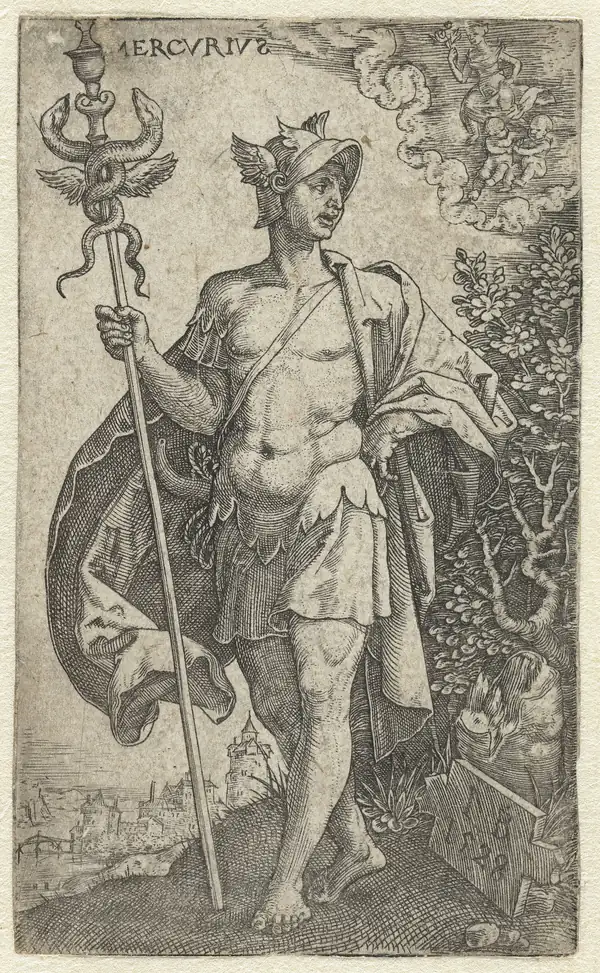
The system is old. The Roman historian Cassius Dio, writing in the early third century, already calls the practice of tying days to the planets a custom “instituted by the Egyptians” and says it had by then spread widely, and the seventeenth-century English astrologer William Lilly still taught it in his textbook. The same planetary order underlies the names of the weekdays. Planetary hours belong to what astrologers call electional astrology, choosing a good moment to begin something, and to horary astrology, where the hour of the question is checked against the chart. They are a tradition and not a measured effect; the section on what each hour is for says where the claims come from.
The Chaldean order and why the weekdays follow it
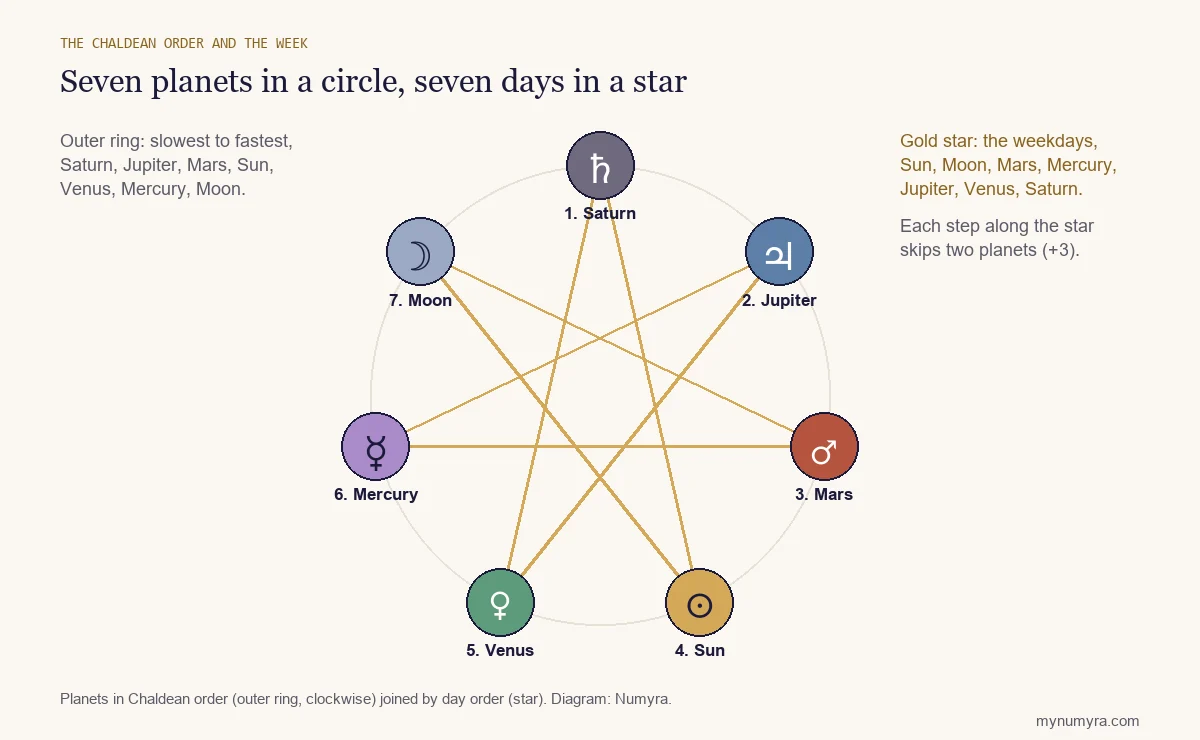
The “Chaldean order” lists the seven planets from the slowest-moving against the stars to the fastest: Saturn, Jupiter, Mars, Sun, Venus, Mercury, Moon. Saturn takes about 29 years to circle the zodiac and the Moon about 27 days, and the order matches how the planets were pictured, from the outermost sphere inward. It is also the order our own page on the Chaldean decan faces uses, and it has nothing to do with Chaldean numerology, which is a separate letter-to-number system.
Planetary hours hand the planets out in that order, one per hour, looping after the Moon back to Saturn. Cassius Dio, in his Roman History, gives exactly this count as one of two explanations for the weekday names:
“If you begin at the first hour to count the hours of the day and of the night, assigning the first to Saturn, the next to Jupiter, the third to Mars, the fourth to the Sun, the fifth to Venus, the sixth to Mercury, and the seventh to the Moon, according to the order of the cycles which the Egyptians observe, and if you repeat the process, you will find that the first hour of the following day comes to the Sun.”
Cassius Dio, Roman History, Book 37, chapter 19, Loeb Classical Library edition (1914), trans. Earnest Cary, via LacusCurtius
The arithmetic behind that sentence is short. There are 24 hours in a day and the cycle has 7 planets, and 24 leaves a remainder of 3 after dividing by 7. So if Saturn has hour 1 of one day, hour 25, the first hour of the next day, falls on the planet three places further along the order, which is the Sun. Step three places each day and you get Saturn, Sun, Moon, Mars, Mercury, Jupiter, Venus, and back to Saturn: the order of the week as we say it, with the day named for the planet that opens it.
The grid below shows the whole week at once. Read across a row and the symbols march through the Chaldean order; read down column 1 and each weekday’s ruler is three steps from the one before. Two things fall out of it that most summaries skip. The ruler of the 13th hour, the first one after sunset, is never the day ruler. And every planet rules each of the 24 positions exactly once per week, so each planet rules 24 of the 168 hours.
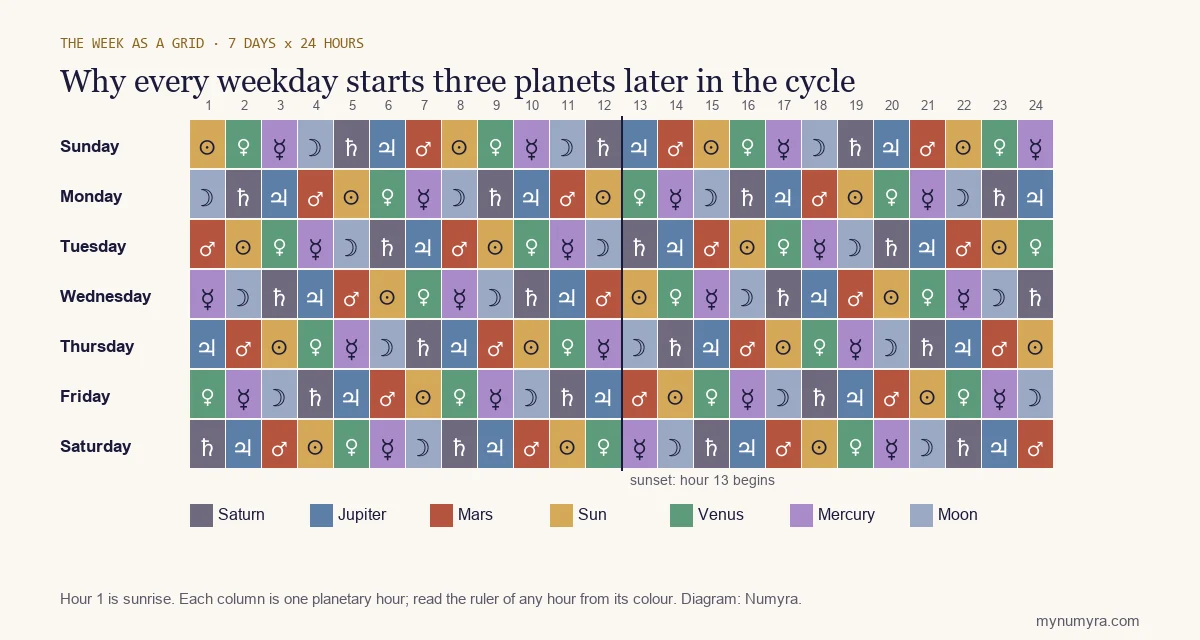
| Day | Day ruler (hour 1, at sunrise) | Hour 12 (last before sunset) | Hour 13 (first after sunset) | Hour 24 (last before next sunrise) |
|---|---|---|---|---|
| Sunday | Sun | Saturn | Jupiter | Mercury |
| Monday | Moon | Sun | Venus | Jupiter |
| Tuesday | Mars | Moon | Saturn | Venus |
| Wednesday | Mercury | Mars | Sun | Saturn |
| Thursday | Jupiter | Mercury | Moon | Sun |
| Friday | Venus | Jupiter | Mars | Moon |
| Saturday | Saturn | Venus | Mercury | Mars |
Not every ancient writer started the day at sunrise. A summary on Wikipedia of the second-century astrologer Vettius Valens says he counted the first hour of the day from sunset, following Greek and Babylonian custom. We did not read Valens in the original for this page, so treat that as a pointer rather than a quotation. Lilly, writing about 1,500 years later, starts at sunrise, and so does modern practice.
How to calculate planetary hours from sunrise and sunset
You need three times: today’s sunrise, today’s sunset, and tomorrow’s sunrise, all in local time for your location. Then:
- Daytime hour length. Subtract sunrise from sunset and divide by 12.
- Night hour length. Subtract sunset from tomorrow’s sunrise and divide by 12. This is the same as 120 minutes minus the daytime hour, to within about 0.2 minute, because the full cycle is 24 hours.
- Hour boundaries. Add one daytime hour to sunrise to get the end of hour 1, add another for hour 2, and so on to sunset. Then do the same from sunset with night hours.
- Rulers. Hour 1 goes to the weekday’s planet; each later hour takes the next planet in the Chaldean order, continuing through the night without a break.
William Lilly describes exactly this method in Christian Astrology (1647), in a chapter on finding “what Planet ruleth every hour of the Day or Night”:
“for all that space of time which is contained from Sun rise to Sun-set, they divide into twelve equall pars, whereof the one halfe containes the hours before Noon, the rest the hours after Noon”
William Lilly, Christian Astrology (London, 1647), chapter 97, p. 482 (spelling as printed)

Lilly’s half-before-noon detail is a good test of your own table: the sixth daytime hour should end at local solar noon, which is the midpoint between sunrise and sunset to within a minute. He gives the night rule on the next pages: when the daytime hour is longer than sixty minutes, the night hour falls short of sixty by the same amount. And he notes the one time the hour is sixty minutes exactly, the day the Sun enters Aries or Libra, which he treats as the equinox. With modern sunrise definitions the equal-hour day arrives a few days earlier in spring and later in autumn, because sunrise and sunset are timed by the Sun’s upper edge and include atmospheric refraction. In New York the daytime hour is 60.05 minutes on March 17 and 59.88 on September 26, while on the equinox dates themselves (March 20, 2026 at 10:46 a.m. EDT and September 22 at 8:05 p.m. EDT) it is about 60.7 and 60.8 minutes. Lilly’s statement holds to within a minute.
Use sunrise and sunset from a reliable source for your own latitude. We computed ours with the Swiss Ephemeris, using the Sun’s upper edge and standard refraction, and compared 72 sunrise and sunset times (six cities, six dates) with the US Naval Observatory’s sunrise and sunset tables. All 72 agreed to within the one-minute rounding the Observatory prints, with a largest difference of 0.5 minute.
Worked example: New York, October 14, 2026
October 14, 2026 is a Wednesday, so Mercury rules hour 1. In New York the Sun rises at 7:06:15 a.m. EDT and sets at 6:17:07 p.m., so daylight lasts 11 hours 10 minutes 51 seconds and each daytime hour is 55.9 minutes. The next sunrise, on October 15, is at 7:07:20 a.m., so the night lasts 12 hours 50 minutes 13 seconds and each night hour is 64.2 minutes. The sixth hour, Sun, ends at 12:41:41 p.m., about 18 seconds before the Sun crosses the meridian at 12:41:59. The table rounds every time to the nearest minute.
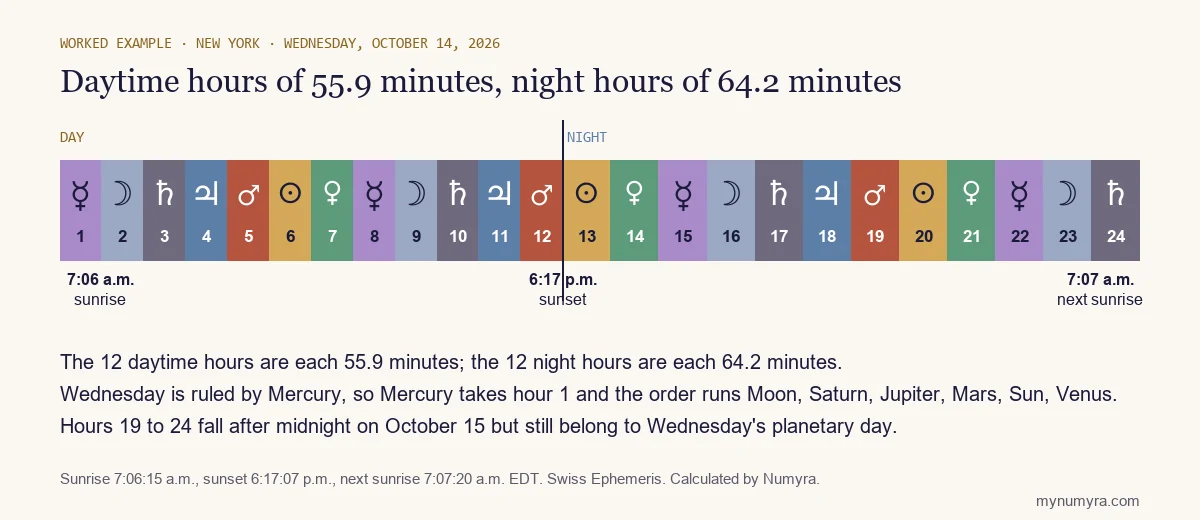
| Hour | Part of day | Ruler | Starts | Ends |
|---|---|---|---|---|
| 1 | Day | Mercury | 7:06 a.m. | 8:02 a.m. |
| 2 | Day | Moon | 8:02 a.m. | 8:58 a.m. |
| 3 | Day | Saturn | 8:58 a.m. | 9:54 a.m. |
| 4 | Day | Jupiter | 9:54 a.m. | 10:50 a.m. |
| 5 | Day | Mars | 10:50 a.m. | 11:46 a.m. |
| 6 | Day | Sun | 11:46 a.m. | 12:42 p.m. |
| 7 | Day | Venus | 12:42 p.m. | 1:38 p.m. |
| 8 | Day | Mercury | 1:38 p.m. | 2:33 p.m. |
| 9 | Day | Moon | 2:33 p.m. | 3:29 p.m. |
| 10 | Day | Saturn | 3:29 p.m. | 4:25 p.m. |
| 11 | Day | Jupiter | 4:25 p.m. | 5:21 p.m. |
| 12 | Day | Mars | 5:21 p.m. | 6:17 p.m. |
| 13 | Night | Sun | 6:17 p.m. | 7:21 p.m. |
| 14 | Night | Venus | 7:21 p.m. | 8:25 p.m. |
| 15 | Night | Mercury | 8:25 p.m. | 9:30 p.m. |
| 16 | Night | Moon | 9:30 p.m. | 10:34 p.m. |
| 17 | Night | Saturn | 10:34 p.m. | 11:38 p.m. |
| 18 | Night | Jupiter | 11:38 p.m. | 12:42 a.m. (Oct 15) |
| 19 | Night | Mars | 12:42 a.m. (Oct 15) | 1:46 a.m. (Oct 15) |
| 20 | Night | Sun | 1:46 a.m. (Oct 15) | 2:51 a.m. (Oct 15) |
| 21 | Night | Venus | 2:51 a.m. (Oct 15) | 3:55 a.m. (Oct 15) |
| 22 | Night | Mercury | 3:55 a.m. (Oct 15) | 4:59 a.m. (Oct 15) |
| 23 | Night | Moon | 4:59 a.m. (Oct 15) | 6:03 a.m. (Oct 15) |
| 24 | Night | Saturn | 6:03 a.m. (Oct 15) | 7:07 a.m. (Oct 15) |
Hours 19 to 24 fall after midnight on October 15, but they still belong to Wednesday’s planetary day, which ends at Thursday’s sunrise. The same date in other cities gives different hours, because both the sunrise times and the length of the day change with latitude:
| City (October 14, 2026) | Sunrise | Sunset | Daytime hour | Night hour |
|---|---|---|---|---|
| New York | 7:06 a.m. EDT | 6:17 p.m. EDT | 55.9 min | 64.2 min |
| Miami | 7:19 a.m. EDT | 6:53 p.m. EDT | 57.9 min | 62.1 min |
| Chicago | 7:01 a.m. CDT | 6:10 p.m. CDT | 55.7 min | 64.4 min |
| Denver | 7:09 a.m. MDT | 6:21 p.m. MDT | 56.0 min | 64.0 min |
| Los Angeles | 6:57 a.m. PDT | 6:19 p.m. PDT | 56.9 min | 63.2 min |
| Seattle | 7:27 a.m. PDT | 6:22 p.m. PDT | 54.6 min | 65.5 min |
All times are local with daylight saving time in force. Wednesday’s first hour is Mercury’s in each of these cities, but “when” is a different clock time in each: Mercury’s hour starts at 6:57 a.m. in Los Angeles and 7:27 a.m. in Seattle.
How long a planetary hour is, by city and month
We calculated the daytime hour for the 15th of every month in 2026 in six cities. Add the matching night hour by subtracting from 120. The 2026 numbers are good for other years too: the difference between 2026 and 2027 on the same dates is under 0.1 minute in every city we checked.
| 15th of | Miami | Los Angeles | Denver | New York | Chicago | Seattle |
|---|---|---|---|---|---|---|
| January | 53.5 | 50.7 | 48.4 | 48.0 | 47.4 | 44.4 |
| February | 56.5 | 55.0 | 53.7 | 53.4 | 53.1 | 51.5 |
| March | 60.0 | 59.8 | 59.6 | 59.6 | 59.6 | 59.4 |
| April | 63.9 | 65.2 | 66.3 | 66.5 | 66.8 | 68.2 |
| May | 67.0 | 69.7 | 71.9 | 72.3 | 72.8 | 75.7 |
| June | 68.7 | 72.1 | 74.8 | 75.4 | 76.0 | 79.8 |
| July | 68.0 | 71.0 | 73.5 | 74.0 | 74.6 | 77.9 |
| August | 65.2 | 67.1 | 68.6 | 68.9 | 69.3 | 71.3 |
| September | 61.5 | 61.9 | 62.2 | 62.3 | 62.4 | 62.8 |
| October | 57.8 | 56.7 | 55.8 | 55.7 | 55.5 | 54.4 |
| November | 54.4 | 51.9 | 49.9 | 49.6 | 49.1 | 46.5 |
| December | 52.7 | 49.5 | 46.9 | 46.4 | 45.8 | 42.3 |
Minutes in one daytime planetary hour (sunrise to sunset divided by 12). Night hour = 120 minus the figure shown, within about 0.2 minute.
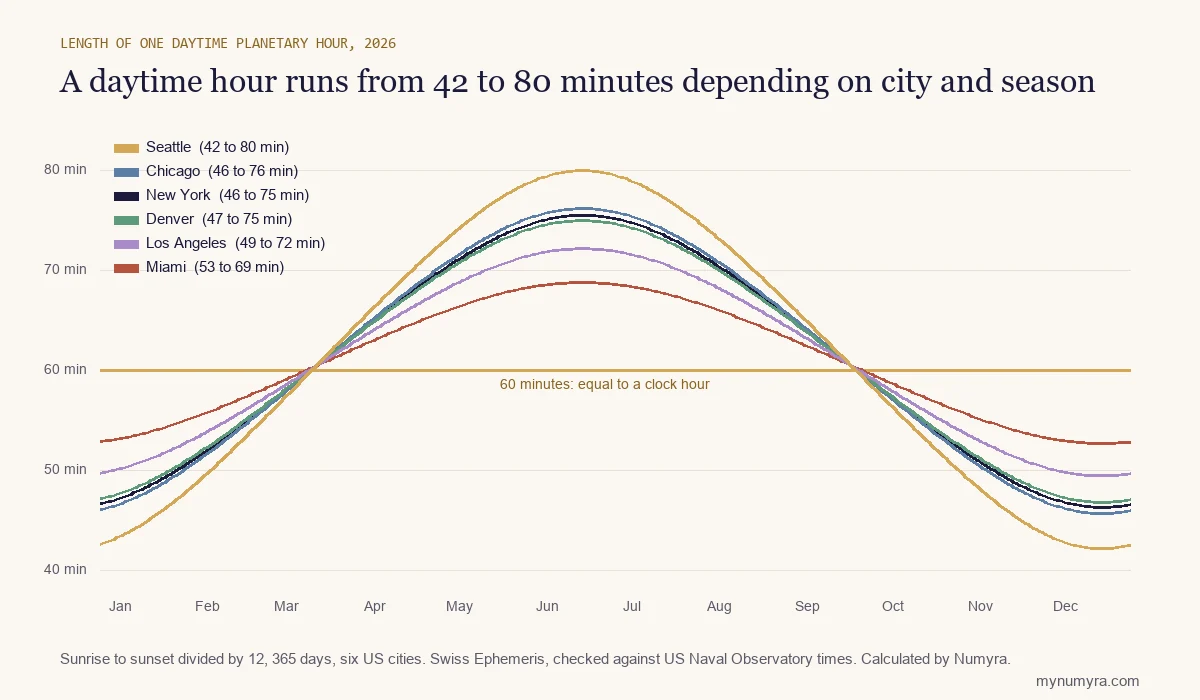
Latitude does most of the work. Miami, the southernmost city, never strays more than about 9 minutes from 60. Seattle, the northernmost, swings by almost 38 minutes between its shortest and longest daytime hour. The extremes land on the solstices:
| City | Shortest daytime hour | Longest daytime hour | Swing | Days a year with a daytime hour over 60 min |
|---|---|---|---|---|
| Miami | 52.6 min (December 21) | 68.7 min (June 21) | 16.1 min | 196 |
| Los Angeles | 49.4 min (December 21) | 72.1 min (June 21) | 22.7 min | 193 |
| Denver | 46.8 min (December 21) | 74.9 min (June 21) | 28.2 min | 193 |
| New York | 46.3 min (December 21) | 75.5 min (June 21) | 29.2 min | 193 |
| Chicago | 45.6 min (December 21) | 76.1 min (June 21) | 30.5 min | 193 |
| Seattle | 42.1 min (December 21) | 79.9 min (June 20) | 37.8 min | 192 |
The equal-hour days fall about three days before the March equinox and three days after the September one, so daytime hours run longer than 60 minutes on 192 to 196 days of 2026 depending on the city, a little over half the year. The shortest night hour is the mirror of the longest day hour: in New York about 44.6 minutes on June 20, and the longest night hour is 73.8 minutes on December 21.
What tradition says each hour is for
The assignment of tasks to hours is the part of the system that rests on tradition alone. Ptolemy’s Tetrabiblos (second century) is the standard ancient source for the planets’ natures, and it sorts them into helpful and harmful:

“the ancients accepted two of the planets, Jupiter and Venus, together with the moon, as beneficent because of their tempered nature and because they abound in the hot and the moist, and Saturn and Mars as producing effects of the opposite nature”
Ptolemy, Tetrabiblos, Book I, chapter 5, trans. F. E. Robbins (Loeb Classical Library, 1940), via LacusCurtius
Ptolemy does not list hours or tasks, and the passage on the hours in Lilly’s book gives no task table either. Lilly says only, on p. 485, that “without exact knowledge of the Astrologicall planetary hour, no worthy work can be done”, naming giving physic, collecting herbs and framing sigils, images and lamens, a claim of his and not a measurement. The tidy task-by-task lists online come from later, mostly modern, practitioner traditions. The table gathers the commonest associations from two modern guides we read for this page, one from a magic-practice school and one from an astrology-education site, and from the Ptolemaic helpful/harmful sorting above.
| Planet | Ptolemy’s sorting | Hours are usually recommended for |
|---|---|---|
| Sun | Both (common nature) | Leadership, visibility, big decisions, asking favors of authorities |
| Moon | Beneficent | Home, rest, reflection, self-care, dealings with the public |
| Mars | Maleficent | Exercise, courage, decisive or forceful action, ending things |
| Mercury | Both (common nature) | Writing, study, meetings, errands, buying and selling |
| Jupiter | Beneficent | Learning, money matters, optimism, settling disputes |
| Venus | Beneficent | Romance, friendship, art, beauty, gifts, social events |
| Saturn | Maleficent | Discipline, planning, repairs, long projects, patience |
Modern authors differ on the details and generally call these starting points. One guide pairs the Moon with Mercury for travel, for example, and the lists differ on whom to ask favors from. The planet’s own sign and house in your birth chart can matter more to some astrologers than the hour, and a Saturn hour is not a ban on activity so much as a reminder of its nature. Our guides to essential dignities and the void-of-course Moon cover two other traditional ways of judging a moment.
Common mistakes
- Counting seven hours. There are 24 planetary hours in a planetary day, and the seven planets repeat through them: each planet rules three or four hours every day.
- Starting the day at midnight. Hours after midnight and before sunrise belong to the previous weekday’s planetary day. Our worked example shows hours 19 to 24 falling on the next calendar date.
- Using 60-minute hours. A daytime hour in New York on December 21 is 46.3 minutes. Mark the boundaries from sunrise.
- Using the wrong location or time zone. Sunrise moves by about four minutes for every degree of longitude, and the shift between standard and daylight time changes every printed time. Convert sunrise and sunset to the same clock before you divide.
- Confusing the order with the weekdays. The hours go Saturn, Jupiter, Mars, Sun, Venus, Mercury, Moon. The weekdays go Sun, Moon, Mars, Mercury, Jupiter, Venus, Saturn. They are the same cycle read at different step sizes.
- Treating a table of tasks as fact. The hour lists are modern tradition. See the sorting above and the caveats in the FAQ.
If you want to continue from here, the closest related guides on the site are the astrological houses guide, for the chart-based side of timing, Part of Fortune, which also changes between day and night charts, and the Mercury retrograde guide for the planet whose hour is most often used for writing and meetings. If you need a quick lookup rather than the arithmetic, a planetary-hours calculator that takes your location does the sunrise-and-sunset work for you.
Frequently asked questions
What are planetary hours?
A traditional astrological system that divides the day from sunrise to sunset into 12 equal hours and the night into 12 equal hours, and gives each hour to one of the seven classical planets in the Chaldean order. Because day and night change length through the year, the hours are unequal in minutes.
Are planetary hours 60 minutes long?
Rarely. They are 60 minutes only when day and night are equal, which in 2026 means about March 17 and September 26 in New York. In New York a daytime hour runs from 46.3 minutes on December 21 to 75.5 minutes on June 21, and night hours are the reverse.
What is the Chaldean order of the planets?
Saturn, Jupiter, Mars, Sun, Venus, Mercury, Moon: from the slowest-moving planet against the stars to the fastest. Planetary hours step through it one planet per hour, and after the Moon it returns to Saturn.
Which planet rules which day?
Sunday: Sun. Monday: Moon. Tuesday: Mars. Wednesday: Mercury. Thursday: Jupiter. Friday: Venus. Saturday: Saturn. The ruler of a day also rules its first planetary hour, the one that begins at sunrise.
How do I work out the planetary hour right now?
Find today’s sunrise, sunset and tomorrow’s sunrise for your location. Divide the daylight into 12 and the night into 12, number the hours from sunrise, and give hour 1 to the weekday’s planet, then continue through the Chaldean order. If it is before sunrise, use the previous day’s hours, since the planetary day began at yesterday’s sunrise.
Does the planetary day start at midnight or at sunrise?
At sunrise in the tradition Lilly describes and in modern practice, and it runs to the next sunrise. At 2 a.m. on a Thursday you are still in Wednesday’s planetary day. Some ancient sources are reported to start the day at sunset, so check which convention a table follows.
Why does a planet rule hours on days it does not rule?
Every planet rules some hours of every day, because the cycle repeats every seventh hour. On Wednesday, for example, Jupiter rules the 4th, 11th and 18th hours. The day’s own ruler takes hours 1, 8, 15 and 22.
Is there any evidence that planetary hours work?
No scientific evidence supports the idea that an hour’s ruling planet affects events. The system is a tradition from Hellenistic and later astrology. Use it as a timing ritual or a planning habit if it appeals to you, not as a predictor.
Sources
- Cassius Dio. Roman History, Book 37, chapters 18 and 19, Loeb Classical Library edition (1914), via LacusCurtius. The explanation of the weekdays by the hours.
- William Lilly. Christian Astrology (London, 1647), chapter 97, pp. 482 to 485. Scan from the Internet Archive; public domain.
- Ptolemy. Tetrabiblos, Book I, chapters 4 to 7, trans. F. E. Robbins (Loeb Classical Library, 1940), via LacusCurtius. The beneficent and maleficent planets.
- US Naval Observatory. Rise, Set and Transit data for one year. Independent check on our sunrise and sunset times.
- Astrodienst. Swiss Ephemeris. Sunrise, sunset, solar noon and equinox calculations (by the Numyra Methodology Desk, converted with historical US time-zone rules).
- Wikipedia. Planetary hours. Summary of the history, including the reported sunset convention of Vettius Valens.
- Learn Astrology (Kerykeion). How to Calculate Planetary Hours and School of Magic and Mastery. Planetary Hours. The two modern guides compared for the table of recommended activities.