Part of Fortune Calculator
Enter your birth date, time and place to get your Part of Fortune by both traditional formulas, plus your Ascendant, Sun, Moon, whether your chart is a day or night chart, and the whole-sign house of each. The Part of Fortune is the Ascendant plus the Moon minus the Sun; the Hellenistic method reverses it in night charts, which changes the sign for about 46% of people.
Key takeaways
- Day chart (Sun above the horizon): Ascendant + Moon − Sun. Night chart: the Hellenistic method uses Ascendant + Sun − Moon, while Ptolemy, William Lilly and most software use the day formula for every chart. The calculator shows both.
- The point moves about 15 degrees an hour, so a birth time off by 4 minutes moves it about 1 degree. The calculator needs a birth time.
- Tested against the Swiss Ephemeris on 1,000 random US births from 1900 to 2010: the Part of Fortune was within 3.4 arcminutes for 95% of births and never off by more than 6.1. The Moon's error sets that limit.
- Tradition links the point to the body, health and material circumstances. That is an interpretation, not a measured effect; this is for entertainment and reflection.
Your Part of Fortune
For entertainment and self-reflection. Numerology and astrology are cultural traditions, not sciences, and nothing here is medical, financial, legal, or psychological advice.
What your result shows
Your result starts with the chart's sect: a day chart if the Sun is above the horizon at birth, a night chart if it is below. Then come the Ascendant, Sun and Moon, and two Part of Fortune lines. The day formula (Ascendant + Moon − Sun) is the same in every chart. The Hellenistic line equals the day formula in a day chart and the reversal (Ascendant + Sun − Moon) in a night chart, so the two lines differ only for night births. Each point also gets its whole-sign house, counted from the sign of your Ascendant.
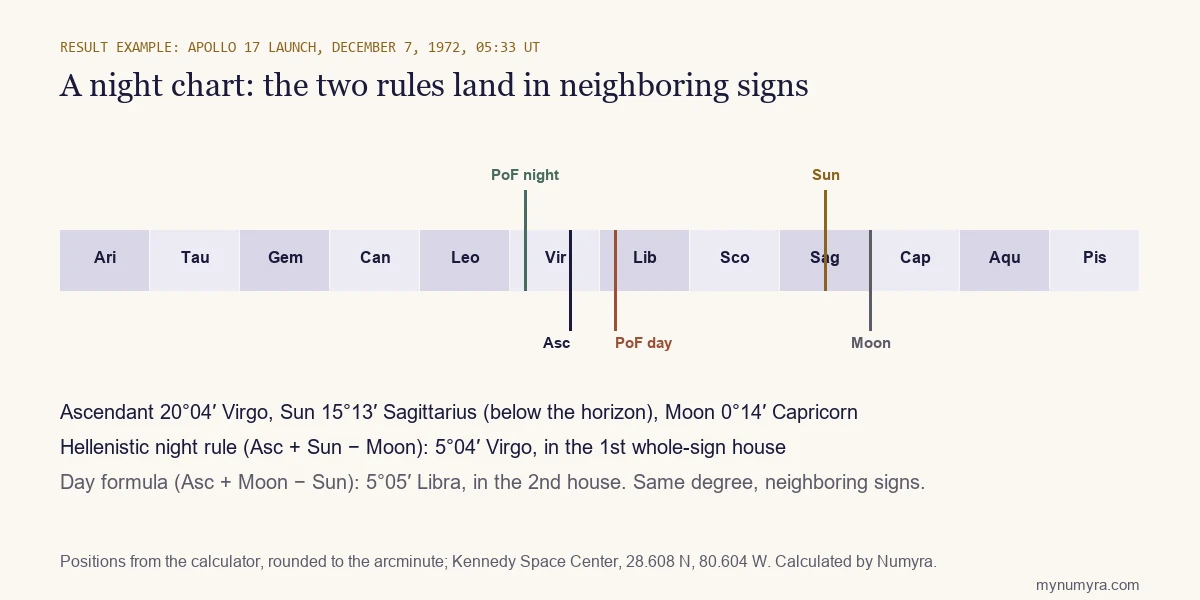
The same strip for the Apollo 11 launch (July 16, 1969, 13:32 UT) gives a day chart with the Part of Fortune at 22°21′ Virgo, where both formulas agree. Lilly's chapter on the Part of Fortune, and why astrologers disagree about night charts, are explained in our Part of Fortune guide. For the pieces the formula uses, see our birth chart calculator and the guides to rising signs and Moon signs.
How this calculator works, and how accurate it is
The Sun and Moon positions come from Paul Schlyter's published method, the same one as our birth chart calculator, and the Ascendant from sidereal time and the obliquity of the ecliptic at your birth place. The Part of Fortune is then plain arithmetic on three longitudes. It all runs in your browser, so nothing you enter leaves your device. To check it, we ran the same code for 1,000 random birth moments from 1900 to 2010 in 35 US cities and compared each point with the Swiss Ephemeris. Errors are in arcminutes (60 arcminutes are one degree):
| Point | Median | 95th percentile | Largest |
|---|---|---|---|
| Ascendant | 0.2′ | 0.5′ | 2.1′ |
| Sun | 0.4′ | 0.8′ | 1.0′ |
| Moon | 1.1′ | 3.2′ | 6.1′ |
| Part of Fortune | 1.2′ | 3.4′ | 6.1′ |
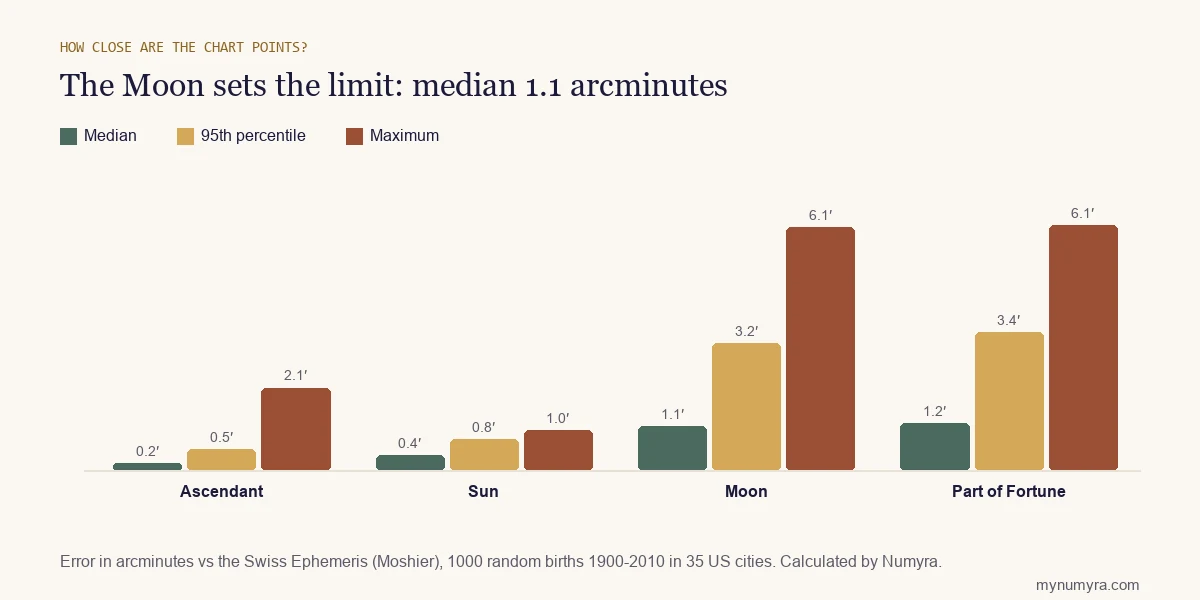
The Part of Fortune inherits the Moon's error, because the Moon is the least precise of the three inputs: the Part of Fortune differed from the Swiss Ephemeris by a median of 1.2 arcminutes and never by more than 6.1, about a tenth of a degree. The day or night call matched in every test, and the Hellenistic Part of Fortune landed in the same sign in 99.9% of them. The Moon's error is small beside the uncertainty of the birth time: the Part of Fortune shifts a median of 0.23 degree per minute of birth time, and up to 1.1 degrees per minute at some times and places, so a birth time rounded to the nearest 15 minutes can move it by several degrees. Houses here are whole-sign; other house systems can place the same degree in a different house. We tested the 35 US cities on the list (latitudes 21° to 61° north); custom coordinates are accepted up to 66° north or south, but we did not test them.
Frequently asked questions
What is the Part of Fortune?
The Part of Fortune, or Lot of Fortune, is a calculated point rather than a planet: the distance from the Sun to the Moon, measured out from the Ascendant. By the day formula that is Ascendant + Moon − Sun. Tradition links it to the body, health and material circumstances; that is an interpretation, not a measured effect.
How do I calculate my Part of Fortune?
Enter your birth date, time and place. The calculator finds your Ascendant, Sun and Moon, decides whether your chart is a day or night chart, and applies both formulas. By hand, convert each position to degrees from 0° Aries, add the Ascendant to the Moon, subtract the Sun, and bring the answer back into 0 to 360.
Why do two websites give different Part of Fortune signs?
Usually because of the night rule. Ptolemy, William Lilly and most modern software use Ascendant + Moon − Sun for every chart, while the Hellenistic method reverses it to Ascendant + Sun − Moon in night charts. The calculator shows both, so you can match whichever your source uses.
Is my chart a day chart or a night chart?
It is a day chart if the Sun is above the horizon at birth (houses 7 to 12) and a night chart if it is below (houses 1 to 6). The calculator checks the Sun's exact degree against the Ascendant, so a birth within minutes of sunrise or sunset needs an accurate birth time.
Do I need my exact birth time?
Yes, and to the minute if you can. The Ascendant turns around the chart once a day, so the Part of Fortune moves about 15 degrees an hour: a median of 0.23 degree per minute of birth time in our tests, and up to 1.1 degrees per minute at some times and places. Without a birth time the point cannot be found, so this calculator requires one.
Which house system does the calculator use?
Whole-sign houses: the sign of the Ascendant is the 1st house and each following sign is the next house. In other house systems, such as Placidus, the same degree can fall in a different house, so check the system before comparing.
How accurate is this calculator?
We compared it with the Swiss Ephemeris for 1,000 random US births from 1900 to 2010. The Ascendant was within 0.5 arcminute for 95% of births, the Sun within 0.8 and the Moon within 3.2. The Part of Fortune inherits the Moon's error: median 1.2 arcminutes, 95% within 3.4, largest 6.1. The day or night call agreed in all 1,000 tests, and the Part of Fortune landed in the same sign 99.9% of the time.
Is the Part of Fortune lucky?
Its name is Fortune, and traditional astrologers read a well-placed Fortune as a sign of good material circumstances, but nothing has been shown to predict events. This calculator is for entertainment and self-reflection, not advice of any kind.
Sources
- Schlyter, Paul. How to Compute Planetary Positions. The Sun and Moon method used by this calculator.
- Astrodienst. Swiss Ephemeris. Reference used to test the calculator.
- Numyra Editorial Desk. Part of Fortune. The formulas, the two night rules and the Apollo 11 and Apollo 17 worked examples, with sources for Ptolemy and Lilly.
- Numyra Methodology Desk. Astrology calculation standard.