A stellium isn’t rare, and it isn’t something you find with just a birthday. Here’s what it actually is, how it’s really identified, and why a real answer needs more than a Sun sign.
Key takeaways
- A stellium is traditionally defined as three or more planets clustered in the same zodiac sign (or the same house) in a birth chart.
- With ten traditionally-tracked bodies (Sun through Pluto) spread across only twelve signs, some clustering is common, not a rare cosmic event — most full charts have at least a loose one.
- Identifying a real stellium needs a full birth chart — the exact position of every planet at your birth moment — not just your Sun sign.
- Traditionally read as concentrated energy: whatever that sign or house represents gets amplified and demands more attention in a person’s life themes.
- Nothing here is a claim that this framework predicts real-world outcomes — a cultural tradition, presented for reflection and entertainment.
In this guide
- What a stellium actually is
- How common is it, really?
- How to actually find out if you have one
- What a stellium is traditionally read as meaning
- Frequently asked questions
What a stellium actually is
In traditional astrology, a stellium is a cluster of three or more planets occupying the same zodiac sign, or the same one of the twelve houses, in a single birth chart. The word comes from the Latin stella (“star”), though what’s actually clustering are planets, not stars in the literal astronomical sense — “planet” in this traditional sense includes the Sun and Moon alongside Mercury through Pluto, ten bodies in total by the older convention still used across most Western astrology software and reference material.
A stellium isn’t itself a planet, a sign, or a house — it’s a pattern that emerges from where several of the ten traditionally-tracked bodies happen to land relative to each other at one specific moment: the moment of birth.
How common is it, really?
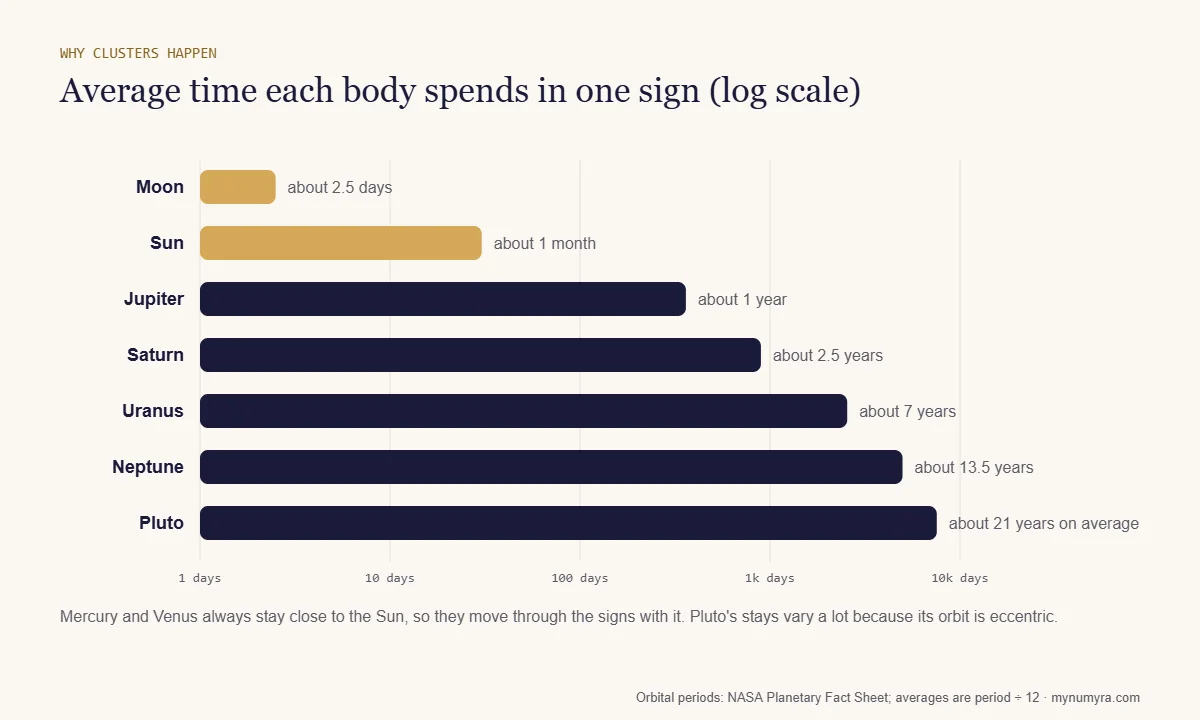
Here’s the honest statistical framing most explainers skip: with ten bodies distributed across only twelve signs, it doesn’t take an unusual arrangement for three or more to land close together. Planets don’t move independently and randomly — several move slowly enough (Jupiter, Saturn, Uranus, Neptune, Pluto) that they can sit in the same sign as each other for months or even years at a stretch, which structurally increases how often three-plus land together for anyone born in that window. A “loose” stellium — three planets in the same sign, even if not tightly clustered by exact degree — is genuinely common, not a rare placement reserved for a chosen few. A tight stellium, where several planets sit within just a few degrees of each other, is less common and traditionally read as more intensely focused.
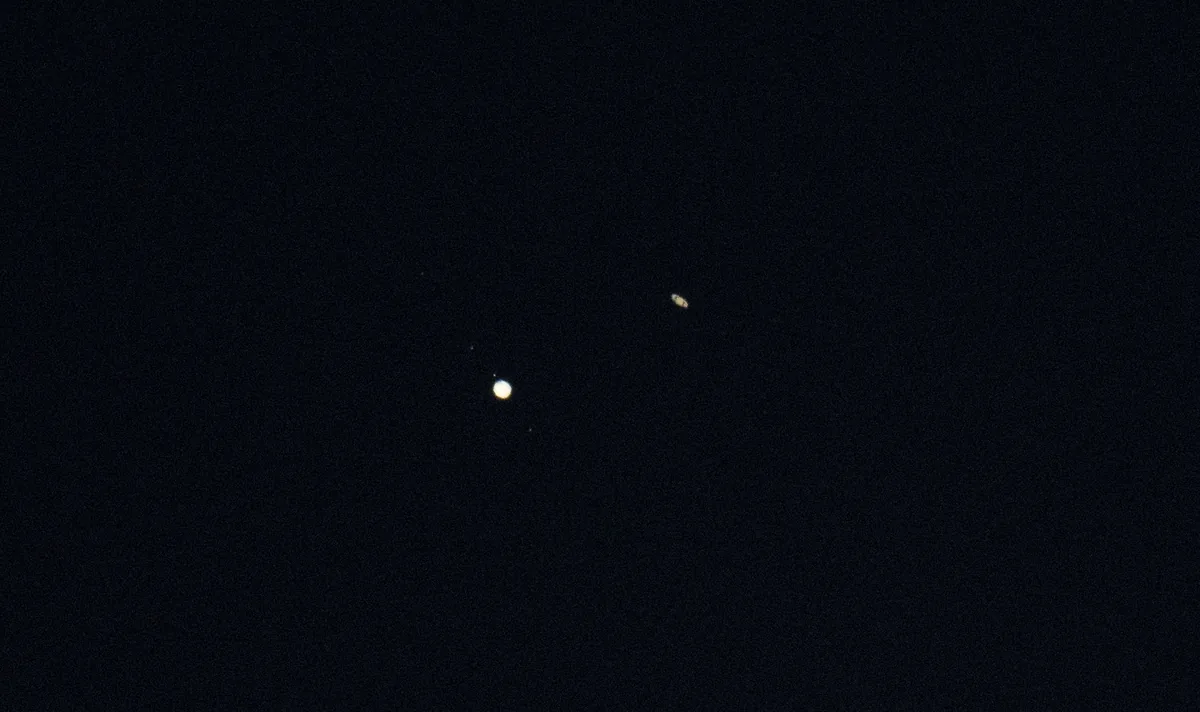
Slow planets are the reason. NASA’s planetary fact sheet gives Saturn an orbital period of 10,747 days, about 29.4 years, so it spends roughly two and a half years in each sign; Neptune takes 59,800 days, about 164 years, or roughly 13 and a half years per sign. Two slow planets meeting in the same part of the sky is a regular, predictable event. NASA’s explainer for the December 2020 meeting of Jupiter and Saturn put it this way:
“The planets regularly appear to pass each other in the solar system, with the positions of Jupiter and Saturn being aligned in the sky about once every 20 years.”
— NASA, “The ‘Great’ Conjunction of Jupiter and Saturn”, December 15, 2020
How to actually find out if you have one
This is the part a Sun-sign-only view genuinely cannot answer. Your Sun sign tells you where one body — the Sun — was on your birth date. A stellium is about where all ten traditionally-tracked bodies were, which needs your exact birth date, time, and location, the same three inputs a full birth chart requires. Once you have all ten positions, you check whether three or more land in the same sign (or, in a fuller reading, the same house — which additionally needs your exact birth time, since houses are calculated from that).
Numyra’s own Birth Chart calculator currently computes Sun, Moon, and rising sign from a real astronomical calculation — genuinely useful for those three specific placements, but not yet enough on its own to check for a stellium, since that needs Mercury through Pluto’s positions too, which the calculator doesn’t compute yet. We’d rather say that plainly than let the calculator imply it covers more than it does.
What a stellium is traditionally read as meaning
Traditionally, a stellium is read as a concentration point — whatever that sign or house represents in a chart gets amplified, demanding more focus and energy than a single planet placement would. The read is additive and thematic — several planets reinforcing one area rather than each pulling in a separate direction — not a claim that a stellium makes someone’s life more “important” or singles them out from people without one.
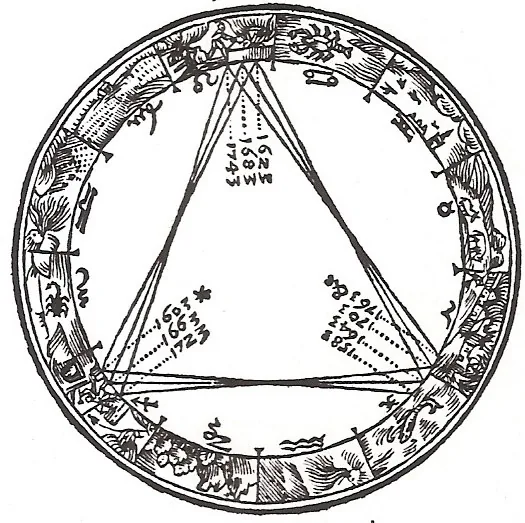
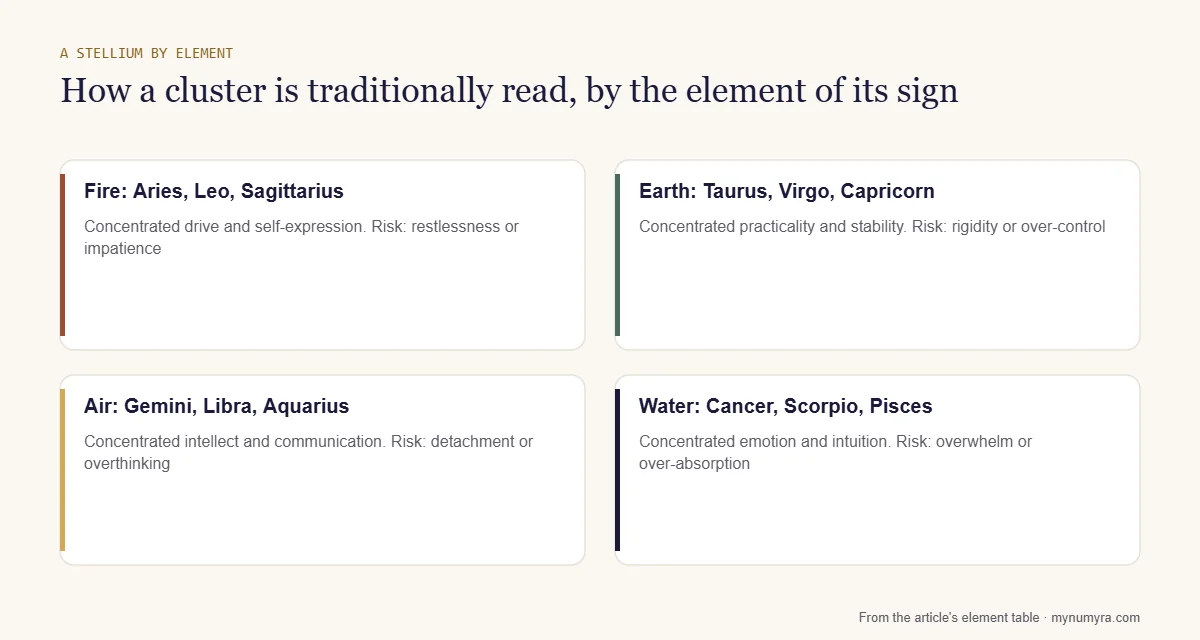
A stellium’s flavor traditionally follows the element of the sign it falls in — the same four-element framework covered in our Four Elements and Three Modalities guide, just intensified by having several planets reinforcing it at once:
| Element | Signs | A stellium here is traditionally read as |
|---|---|---|
| Fire | Aries, Leo, Sagittarius | Concentrated drive and self-expression, intensified to where restlessness or impatience is a real risk |
| Earth | Taurus, Virgo, Capricorn | Concentrated practicality and stability, intensified to where rigidity or over-control is a real risk |
| Air | Gemini, Libra, Aquarius | Concentrated intellect and communication, intensified to where detachment or overthinking is a real risk |
| Water | Cancer, Scorpio, Pisces | Concentrated emotion and intuition, intensified to where overwhelm or over-absorption is a real risk |
A stellium in the same house instead reads through that house’s area of life (the 4th house and home/family, the 10th house and career and public reputation, and so on) rather than through a sign’s temperament — the amplification principle is the same, just applied to a different layer of the chart.
One honest note on sourcing: unlike Mercury retrograde or void of course Moon, “stellium” doesn’t trace to one specific, findable historical text the way those two do — it’s a working term in general use across modern Western astrology without a single named originator, so this section reflects that general convention rather than one attributable source.
Frequently asked questions
Can I have a stellium from my Sun sign alone?
No — a stellium requires knowing where multiple planets were at your birth, not just the Sun. You need a full birth chart (date, time, and place) to check for one honestly.
Is a stellium always a good thing?
Traditional astrology reads it as intensity, not as inherently good or bad — a concentration of energy in one area that demands attention, for better or worse depending on the sign, house, and how it’s expressed.
What’s the difference between a stellium and a conjunction?
A conjunction is specifically two planets at (or very near) the same degree — the tightest possible aspect. A stellium is broader: three or more planets sharing a sign or house, even if they aren’t all in exact conjunction with each other.
Do the Sun and Moon count toward a stellium?
Yes, under the traditional ten-body convention used here — the Sun and Moon are counted alongside Mercury through Pluto for stellium purposes, even though technically neither is a planet in the modern astronomical sense.
Does Numyra’s Birth Chart calculator check for stelliums?
Not yet — it currently computes Sun, Moon, and rising sign only. A real stellium check needs all ten traditional bodies, which isn’t built yet. See the section above for exactly why.
Sources
- Numyra Methodology Desk. Astrology calculation standard.
- Numyra Birth Chart Calculator. Current scope: Sun, Moon and rising sign.
- NASA Space Science Data Coordinated Archive. Planetary Fact Sheet. Orbital periods of Saturn and Neptune.
- NASA. “The ‘Great’ Conjunction of Jupiter and Saturn.” December 15, 2020. Source of the quote above.