Numerology is real as a tradition: a set of rules for turning names and birth dates into numbers, each with a traditional meaning. As a way to predict personality or events it is not supported, because the few controlled tests that exist found nothing. The best-documented one counted the birth numbers of 806 Nobel laureates and found them no different from chance (p = 0.77), and its author wrote that he could find no earlier published test. We repeated it on 489 laureates born from 1920, ran the same question on 85.4 million US births, and re-ran the numbers in a 2024 life path study. None of it shows a pattern, and this page sets out what was tested, what was not, and what a fair test would need.
Key takeaways
- The only controlled test of birth numbers we found in the research literature, Genovese’s 2017 paper on 806 Nobel laureates, found no link (chi-square 4.92, 8 degrees of freedom, p = 0.77). Our repeat on 489 laureates born from 1920 also found none (p = 0.56), nor did the 180 awarded in 2011 to 2025, after his paper (p = 0.075).
- Across 85,386,227 US births from 1994 to 2014, each of the nine reduced life path numbers holds between 11.08% and 11.14% of births, against one ninth (11.11%). Master numbers look rare only because of the rule: 9.8% of births get an 11, 22 or 33 under our calculator’s rule and 12.1% under the all-digits rule.
- A 2024 paper on life path and perceived stress (100 people) concludes that life path numbers “significantly influence stress levels”. Its own table gives R² = 0.0377 and F = 1.90 (p = 0.155), and we reproduced its regression exactly: the life path slope is 0.03 points per number, and the 2.95 the paper prints for life path belongs to gender.
- Readings feel accurate for a known reason. In Forer’s class of 39 students, 34 rated a generic sketch 4 or 5 out of 5 for how well it described them, and the same text went to all of them.
- A fair test is a blind match of nine life path descriptions, where chance is one in nine. Detecting a 15% hit rate takes about 460 people. Numerology as a tradition is for reflection, not prediction or advice.
In this guide
- What “real” can mean for numerology
- What numerology claims, and which claims can be tested
- The research that exists
- Why a reading feels accurate: Forer and the Barnum effect
- Test 1: do life path numbers occur equally often in US births?
- Test 2: do Nobel laureates have unusual birth numbers?
- Test 3: re-running the 2024 life path and stress table
- A test that could settle it, and how big it must be
- How to use numerology without believing it predicts
- How we ran the tests
- Frequently asked questions
What “real” can mean for numerology
“Is it real?” has three different answers. As a historical and cultural practice, numerology is real: millions of people use it, and our guide to what numerology is traces the modern letter-and-birth-date method to early 20th-century America rather than to Pythagoras. As a system with internal rules, it is real too: the same birth date gives the same Life Path number every time, once you pick a reduction rule. The third meaning is the one most searchers want. Do those numbers describe your character or forecast your life better than chance? That is a question about evidence, and it is the one this page answers.
It cannot be answered once for “numerology”, because there are many systems. Pythagorean and Chaldean letter values differ (see our comparison of the two systems and the wider comparison with Kabbalah numerology), and so do the rules for master numbers; our guide to calculating a full chart by hand shows one set of rules step by step. A test only speaks for the exact rule it used, which is why we state ours below.
What numerology claims, and which claims can be tested
A claim is testable when it says something that could turn out false. Numerology makes claims of both kinds, and mixing them is how debates go round in circles. The table separates them and shows what research, if any, we found for each.
| Claim | What it would predict | Testable? | What we found |
|---|---|---|---|
| Your Life Path number describes your personality | People with different Life Paths differ on measured traits, in a blind comparison | Yes | One 2024 study of 100 people on stress; no study with a standard personality inventory |
| Birth numbers predict achievement | Achievers’ birth numbers differ from the calendar’s expectation | Yes | Genovese 2017 (806 laureates): no; our repeat (489): no |
| Master numbers 11, 22 and 33 mark special potential | More of them among high achievers than the calendar predicts | Yes | Our laureate count: 36 observed, 50.5 expected |
| Name numbers (Destiny, Soul Urge) reveal character | Name-number groups differ on measured traits | Yes, but spellings and letter tables vary | No controlled test found |
| Personal years and months forecast your cycles | Events cluster by personal year | Only if events are defined in advance | No test found |
| Numbers carry “vibrations” that act on people | A mechanism that can be measured | Not as stated | No mechanism is specified |
| A reading feels accurate to the person | High self-rated accuracy even for generic text | Yes | Forer 1949 and decades of Barnum research |
The research that exists
The literature is thin, and that is itself a finding. The most direct study is a 2017 paper by Jeremy Genovese of Cleveland State University in the Journal of Articles in Support of the Null Hypothesis. He calculated the birth number, the single digit you get by adding the digits of a birth date, for Nobel Prize winners from 1901 to 2010, and asked whether the distribution differed from chance. It did not: 806 laureates, chi-square 4.92 with 8 degrees of freedom, p = 0.77, and no difference between the six prize categories either (chi-square 28.9, 40 degrees of freedom, p = .90). He states his starting point plainly:
“As far as I am able to tell there are no previously published studies testing the claims of numerology.”
Jeremy Genovese, “A Test of Numerology: Do Birth Numbers Predict Nobel Prize Winners?”, Journal of Articles in Support of the Null Hypothesis, vol. 13, no. 2 (2017)
He also flags the limit: the study “cannot rule out” that some other numerological construct works. It tests one claim, the birth number, and he set 11 and 22 aside, noting that the order of addition decides whether you reach them.
The second source is a June 2024 paper in the journal Scope by Shreejeeta Kargupta and colleagues at the University of Engineering and Management, Kolkata, on life path numbers, gender and perceived stress in 100 people. It is the only recent study we found that puts life path numbers against a measured outcome, so we re-ran its table below. Skeptoid also reports two small tests, a 2012 comparison of a numerologist’s “diagnoses” with conventional diagnoses in 81 people, and a 1993 survey in which names adding to 7 were expected to be more common among self-described psychics. Skeptoid says neither showed a result. We could not find the original reports of either, so treat them as reported, not verified.
That is the whole evidence base we could verify for the central claim. Practitioners who write about this sometimes say as much. A numerologist’s essay on Numerologist.com, written to give the skeptical case its due, says:
“I do not know of anyone who has run that test properly, on numerology, with enough people to mean anything.”
Numerologist.com, “Is Numerology Real? The Science, History & Evidence”
“Not tested properly” is not the same as “tested and failed”, and the honest summary is both: the tests that exist found nothing, and there are too few of them to be the last word.
Why a reading feels accurate: Forer and the Barnum effect
Most people’s reason for believing a Life Path description is that it fits them. That experience is real, and psychologists have a name for it. In 1949 Bertram Forer published an experiment in the Journal of Abnormal and Social Psychology. His 39 students filled in a personality questionnaire and, a week later, each received a typed “personality sketch” with their name on it. Every sketch was identical, 13 statements, which in Forer’s words “came largely from a news stand astrology book”. The students rated it from zero to five. Five of 39 ratings of the sketch were below 4, only one rating of the questionnaire itself was below 4, and the class accepted 10.2 of the 13 statements as true of themselves on average. Forer’s definition of why it worked is worth keeping:
“A universally valid statement, then, is one which applies equally well to the majority or the totality of the population.”
Bertram R. Forer, “The Fallacy of Personal Validation: A Classroom Demonstration of Gullibility”, Journal of Abnormal and Social Psychology, 44(1), 1949
Later research named this the Barnum effect and tested what drives it. A 1985 review by D. H. Dickson and I. W. Kelly in Psychological Reports concluded that acceptance of such profiles depends on how relevant and how favorable they seem, and to some extent on the type of assessment. A 1987 review by A. Furnham and S. Schofield covered nearly 50 studies. The practical lesson is that “it describes me” cannot tell a valid system from a flattering one. Our guide to the newspaper horoscope column shows the same effect in sun-sign forecasts, and why you keep seeing the same number covers the related frequency illusion.
The Barnum effect does not prove a given description is empty. It means a personal sense of fit is the wrong kind of evidence, and that a fair test has to take the reader’s feelings out of the loop.
Test 1: do life path numbers occur equally often in US births?
One simple question we can answer from our own data is whether any Life Path number is meaningfully commoner or rarer among Americans than chance. We calculated the Life Path of every calendar day from 1994 to 2014 and weighted it by the daily births published by the CDC’s National Center for Health Statistics and the Social Security Administration, 85,386,227 births in all, the same files behind our most common zodiac sign study.
The nine single-digit classes come out almost exactly equal. Each holds between 11.075% and 11.140% of births, and one ninth is 11.111%, so the largest gap is under 0.04 percentage points. The small wobble is not mystical: births are not spread evenly across dates (our files average 11,500 to 12,800 births on a weekday and 7,600 to 8,600 on a weekend day), and with 85 million births even that tiny effect is statistically detectable (chi-square 415, 8 degrees of freedom, Cohen’s w 0.002), which is a good reminder that “significant” and “meaningful” are different words.
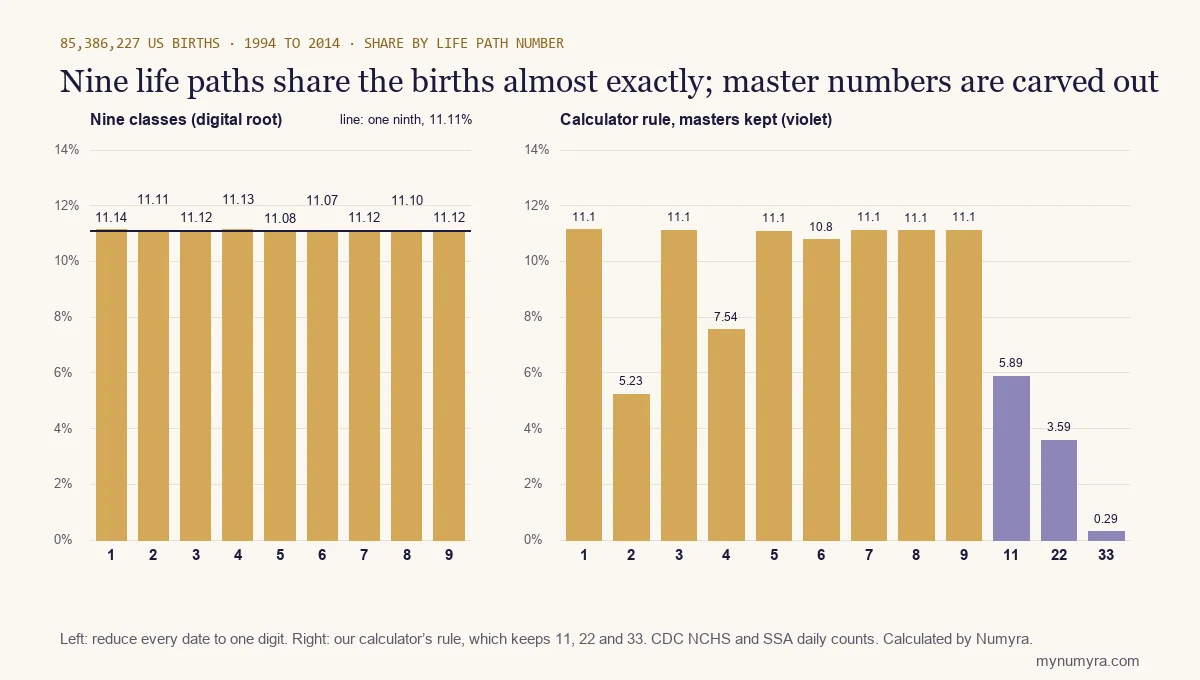
The right-hand panel shows what happens when the master numbers are kept, using the rule on our Life Path calculator: reduce the month, day and year separately, add them, and keep 11, 22 and 33. Numbers 2, 4 and 6 lose births to 11, 22 and 33, so 11 holds 5.89% of births, 22 holds 3.59% and 33 only 0.29%. Together that is 9.8% of Americans. Using the other common rule, adding every digit of the date and keeping a master number only at the end, the three hold 7.10%, 2.80% and 2.22%, which is 12.1%, and the two rules give a different Life Path for 8.4% of births. So “master numbers are rare” is true, but the rarity comes from the arithmetic of the rule you choose, and our guide to why 11, 22 and 33 are master numbers explains the convention.
Test 2: do Nobel laureates have unusual birth numbers?
If birth numbers mattered, high achievers should show it. Genovese’s design is easy to repeat with current data, so we did. We pulled every person with a Nobel Prize and a day-precise birth date from Wikidata through its public query service, 1,000 people in all, and kept the 489 born from 1920 onward, which sidesteps calendar-conversion problems in older records. We worked out each laureate’s birth number as Genovese defined it, and compared the counts with what the calendar of each laureate’s own birth year predicts.
| Group | Laureates | Chi-square (8 df) | p |
|---|---|---|---|
| Genovese 2017, prizes 1901 to 2010 | 806 | 4.92 | 0.77 |
| Ours: all laureates born 1920 or later | 489 | 6.78 | 0.560 |
| Ours: prizes 1901 to 2010, born 1920 or later | 309 | 10.66 | 0.222 |
| Ours: prizes 2011 to 2025, after the paper | 180 | 14.28 | 0.075 |
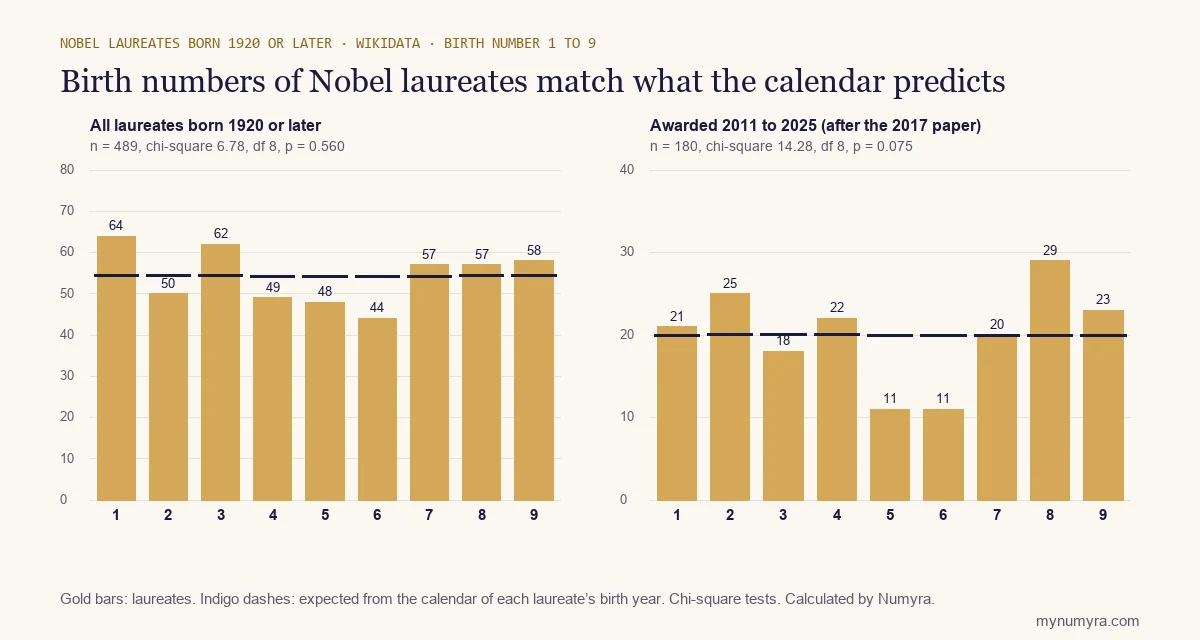
None is below the usual 0.05 line. The 2011 to 2025 group comes closest, at 0.075, and the chart shows why: laureates with birth numbers 5 and 6 are fewer than expected (11 each against 20) and number 8 is more (29 against 20). With nine categories, a gap like that appears by chance about one time in thirteen, and the larger group moves back toward chance (p = 0.56). We also checked the master-number claim, because Life Path 11 and 22 are described as marks of unusual potential. Among the 489, 36 laureates have a master number Life Path under our rule, where the calendar predicts 50.5. That is fewer, not more: a deficit that large would arise about 1.6% of the time by chance, but we looked after seeing the other tables, so we treat it as a lead for a pre-registered test, not as evidence in the other direction.
Test 3: re-running the 2024 life path and stress table
The Scope paper prints a table of all 100 participants: date of birth, life path number and Perceived Stress Scale score, 50 men and 50 women. We typed the rows into a script. Our first check was whether the table reproduces the paper’s own regression, because that would show we had read it correctly. It does, exactly: intercept 18.42 (standard error 1.52), R² 0.0377 and F 1.90. One thing differs. In our fit, the slope on life path number is 0.03 (standard error 0.17), and the slope on gender, coded 1 for women, is 2.95 (standard error 1.53). The paper’s coefficient table prints the same two numbers against the opposite labels, so by its own numbers life path moves stress by 0.03 points per number and women score about three points higher (p = 0.056).
| Check on the paper’s 100 rows | Result |
|---|---|
| Regression: stress on life path number and gender | R² = 0.0377, F = 1.90, p = 0.155 (2 and 97 df) |
| Life path slope | 0.03 points per number (SE 0.17), p = 0.87 |
| Gender slope (women) | 2.95 points (SE 1.53), p = 0.056 |
| Stress across the 12 life path groups as printed | One-way ANOVA F = 1.53, p = 0.136; Kruskal-Wallis p = 0.176; shuffling labels 20,000 times, p = 0.137 |
| Same data, 11, 22 and 33 merged into 2, 4 and 6 | F = 1.99, p = 0.056 |
| Life path numbers in the table that match our calculator’s rule | 98 of 100 |
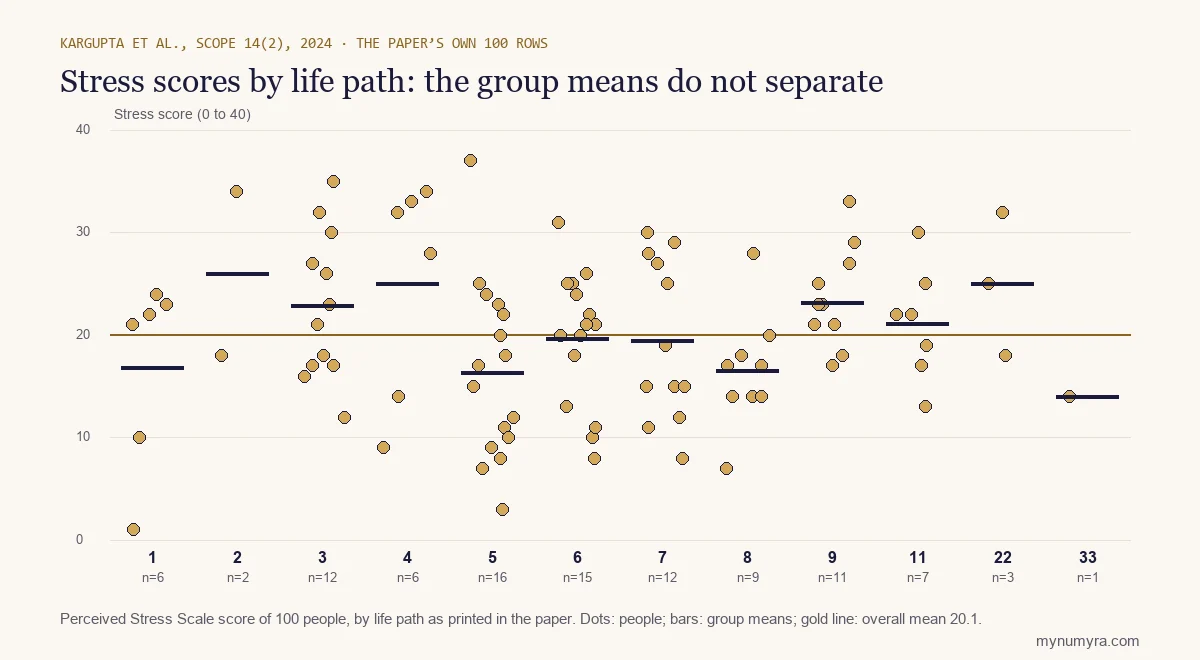
The group means do differ, from 14 (the single Life Path 33) to 26 (two people with Life Path 2), but that spread is what small groups of one to sixteen people produce. When we shuffled the life path labels at random 5,000 times, the gap between the highest and lowest group mean had a median of 12.3 points, and the real data show 12.0. The paper nonetheless concludes that life path numbers “profoundly affect” stress and builds an explanation for each group’s score. We have not contacted the authors; if we have misread the table, we will correct this page. Two male rows also print the same birth date, life path and score, which we left in. None of this shows that life path is unrelated to stress in a larger sample, only that this table does not show a relationship. It also illustrates a trap: with a dozen groups, a story can be told for any pattern.
A test that could settle it, and how big it must be
The cleanest test is the one the Numerologist.com essay proposes: take the nine Life Path descriptions, remove the numbers, and ask each person to pick the one that fits them, without knowing their own number. By chance one person in nine is right. This takes the reader’s flattery out of the loop, because the choice is between descriptions that all feel plausible. It also needs size. Our power calculation uses an exact one-sided binomial test at the 5% level with 80% power.
| If numerology really worked, hit rate of | People needed | Hits needed to beat chance |
|---|---|---|
| 15% (a small effect) | 460 | 63 |
| 20% | 100 | 17 |
| 25% | 49 | 10 |
| 33% (one in three) | 23 | 6 |
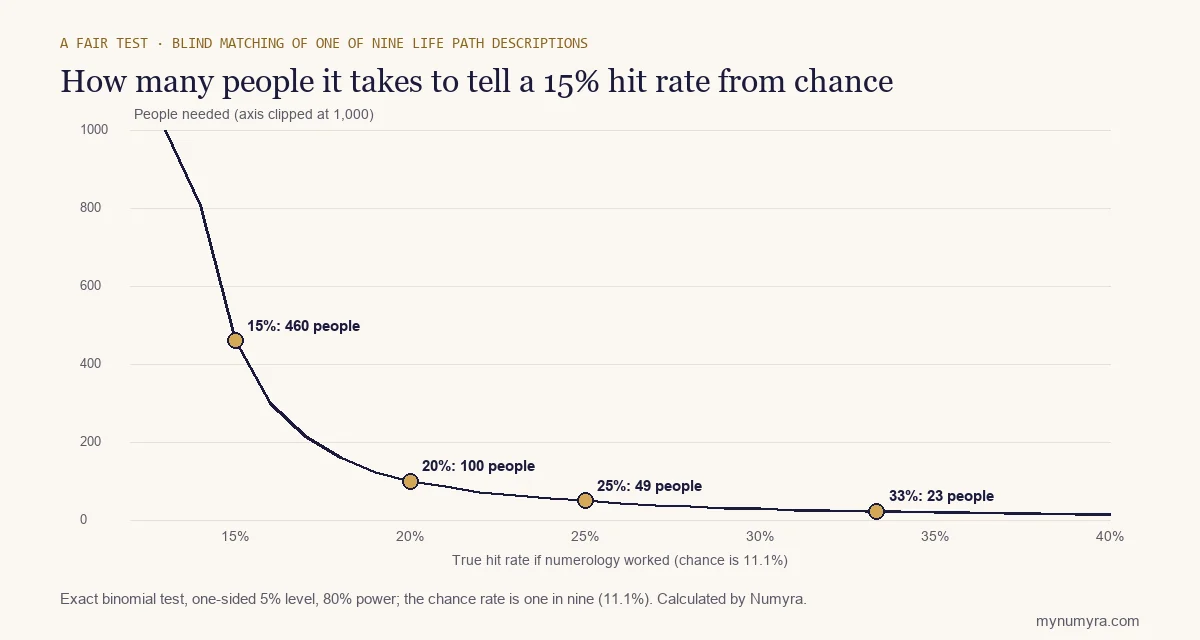
The same logic shows what earlier tests could and could not see. With 489 laureates, our Nobel test could only have detected a lopsided result, for example one birth number at about 16.6% of laureates against the 11.1% expected, so a small real effect would have slipped through. Genovese’s 806 laureates and the US births data are far larger, but the births data have no outcomes, so they can only test whether the numbers occur equally often, not whether they mean anything. A decisive study would need hundreds of volunteers, a pre-registered rule and descriptions written by a numerologist in advance. To our knowledge no one has run it.
How to use numerology without believing it predicts
None of this makes numerology useless, only mislabelled when sold as prediction. Reading a Life Path description is a prompt for thinking about your habits, in the way a journaling question is, and our Life Path meanings and name numerology calculator are built for that. The step that matters is keeping the line clear: a description that fits you is a reason to reflect, not a reason to take a job, end a relationship or spend money. This is educational information from a cultural tradition, not medical, financial, legal or psychological advice, and nothing on this site has been shown to predict an event in your life.
How we ran the tests
Life path. Our rule is the one on our methodology page: reduce the month, day and year separately, add them, reduce the total, and keep 11, 22 and 33 at every stage. For the nine-class counts and the Nobel test we used the digital root of day plus month plus year, the same single digit Genovese calls the birth number. US births. The daily counts are the CDC National Center for Health Statistics file for 1994 to 2003 and the Social Security Administration file for 2004 to 2014, as compiled by FiveThirtyEight, 7,670 days and 85,386,227 births. Each day’s Life Path was weighted by that day’s births and compared with every calendar date counted once.
Nobel laureates. Wikidata query service, humans with an award that is a Nobel Prize in Physics, Chemistry, Physiology or Medicine, Literature or Peace, or the Economics prize, retrieved October 22, 2026: 1,000 people, 962 with a birth date given to the day, 489 born from 1920 with an award year. The expected count for each birth number was the share of days in the laureate’s own birth year with that number. Wikidata is crowd-edited, so a few dates may be wrong, and we did not hand-check them. Scope paper. Rows typed from the PDF’s table; we reproduced its reported regression to the printed digits before doing anything else; p-values are from standard F, Kruskal-Wallis and permutation tests. Forer. The counts come from the paper’s own text, the version we read had no printed tables, and the mean of about 4.3 that other pages quote is not in it. Limits. We did not test name numbers, forecasts or any other numerology system, and we do not know of research on them.
Frequently asked questions
Is numerology real?
It is a real tradition with real rules, but there is no controlled evidence that the numbers it produces predict personality or events. The one journal test we found, on 806 Nobel laureates, found no link, and our repeat on 489 more found none.
Has science tested numerology?
Very little. Genovese wrote in 2017 that he found no earlier published tests, and we found one more, a 2024 study of 100 people whose own table does not show an effect of life path on stress. Every test we found was small, and more testing is possible.
Is numerology a pseudoscience?
It is usually classed as one, because it makes claims about the world without a tested mechanism or a record of passing tests. Genovese groups it with other pseudosciences in his paper. Calling it that describes the evidence, not the people who use it.
Is numerology 100% accurate?
No accuracy has been measured, and the felt accuracy people report is not evidence. In Forer’s class, 34 of 39 students rated an identical, generic sketch 4 or 5 out of 5 for how well it described them.
Why does my life path number description fit me so well?
Descriptions are written in broad, favorable terms that fit most people, which is the Barnum or Forer effect. Reviews by Dickson and Kelly (1985) and Furnham and Schofield (1987) found that acceptance rises when a profile seems relevant and flattering.
Are master numbers rare?
Yes, but because of the rule. Among 85.4 million US births, 11, 22 and 33 together are 9.8% of Life Paths under our calculator’s rule and 12.1% under the all-digits rule; 33 is only 0.29% under our rule.
Is numerology better than astrology?
Neither has shown predictive power in the tests we found. Astrology has had far more testing; Genovese cites a 1998 review by I. W. Kelly titled “Why astrology doesn’t work”. Numerology has been tested much less, so its record is thinner rather than better.
What would it take to prove numerology works?
A blind matching study: people pick their own Life Path description from the nine unlabelled descriptions, and chance is one in nine. Detecting a 15% hit rate would take about 460 people, and a 20% rate about 100.
Can numerology still be useful?
As a prompt for self-reflection, yes, in the way any structured question can be. It should not be used to make medical, financial, legal or relationship decisions, because nothing shows it predicts events.
Sources
- Genovese, J. “A Test of Numerology: Do Birth Numbers Predict Nobel Prize Winners?” Journal of Articles in Support of the Null Hypothesis, 13(2), 2017.
- Forer, B. R. “The Fallacy of Personal Validation: A Classroom Demonstration of Gullibility.” Journal of Abnormal and Social Psychology, 44(1), 118-123, 1949.
- Dickson, D. H., and Kelly, I. W. “The ‘Barnum Effect’ in Personality Assessment: A Review of the Literature.” Psychological Reports, 57(2), 367-382, 1985.
- Furnham, A., and Schofield, S. “Accepting personality test feedback: A review of the Barnum effect.” Current Psychology, 6(2), 162-178, 1987.
- Kargupta, S., Das Biswas, S., Das, P. K., and Bhakat, S. “The Influence of Life Path Numbers and Gender on Perceived Stress Levels: A Numerological Perspective.” Scope, 14(2), June 2024, pp. 1620-1635.
- Dunning, B. “Numerology.” Skeptoid, episode 626, June 5, 2018 (secondary report of two small tests).
- Numerologist.com. “Is Numerology Real? The Science, History & Evidence.”
- Wikidata Query Service, Nobel Prize laureates with birth dates, retrieved October 22, 2026.
- FiveThirtyEight. US births data, 1994 to 2014, from the CDC National Center for Health Statistics and the Social Security Administration. Dates only.