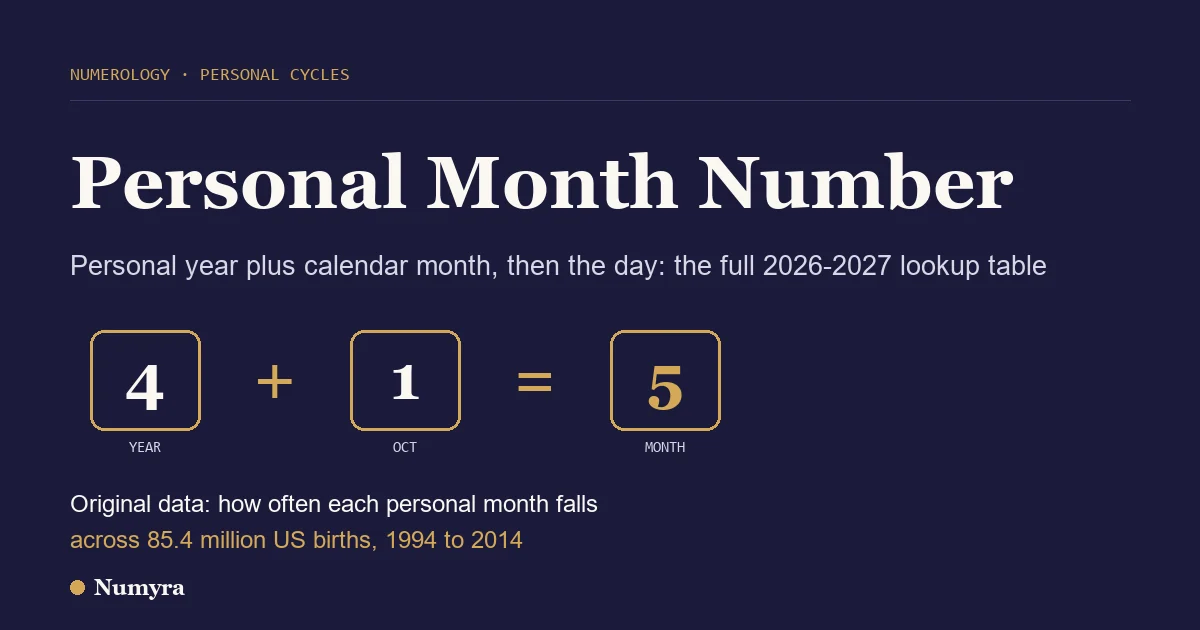
A personal month number in numerology is your personal year number plus the number of the calendar month, reduced to a single digit. Someone in a 4 personal year gets a 5 in October (4 + 1, because October is 10 and 1 + 0 = 1), then a 6 in November and a 7 in December. A personal day number repeats the step one level down: personal month plus the day of the month, reduced again. It is a traditional interpretive system, not a tested science, and nothing in it predicts events.
Key takeaways
- Personal month = personal year + calendar month, reduced. Personal day = personal month + day of the month, reduced. We checked our rule against the October 2026 personal months published by Hans Decoz’s World Numerology for all nine Sun Numbers, and all nine match.
- The lookup table is the same in every year: only your personal year changes. In 2026 a birth date’s personal year is its Sun Number (month plus day, reduced) plus 1; in 2027 it is plus 2. The full 9-by-12 table and both years are below.
- Three pairs of months always share a number (January and October, February and November, March and December), and September always repeats your personal year. So each year has three numbers that appear twice and six that appear once.
- Master numbers are the main disagreement. Reduced fully, an 11 never appears. If you stop at a total of 11, as some sources do, every personal year contains exactly one 11 month, and a 31-day month holds three to five master-number personal days.
- Original data from 85.4 million US births (1994 to 2014): in any month, each personal month number belongs to between 10.6% and 11.5% of people, so no number is rare.
In this guide
- How to calculate your personal month number
- The lookup table: personal month by personal year
- 2026 and 2027: find your personal months by birthday
- The nine-month and nine-day cycles
- Personal day numbers, with an October 2026 example
- Master numbers and where sources disagree
- When the personal month and personal year coincide
- What each personal month number means, by tradition
- How common each personal month number is (original data)
- Frequently asked questions
How to calculate your personal month number
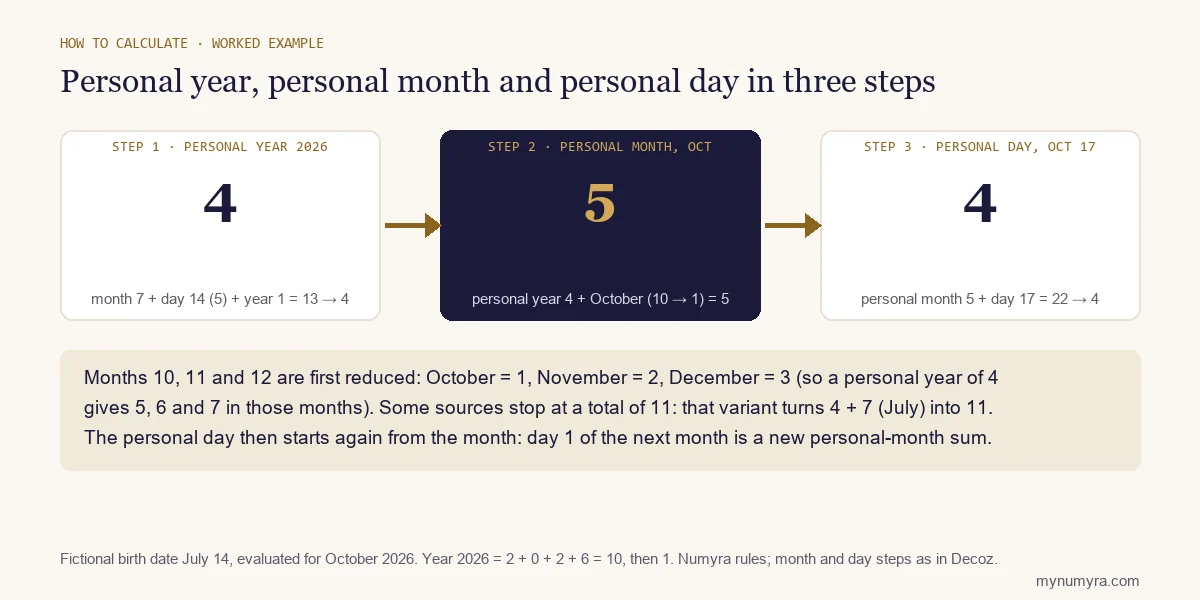
You need your personal year first. That is your birth month and birth day plus the current calendar year, each reduced to a single digit, then added and reduced again; our guide to personal year numbers and the nine-year cycle covers it, and the Personal Year calculator does it for you. For someone born on July 14, the 2026 personal year is 7 + 5 + 1 = 13, which reduces to 4. Then:
- Turn the calendar month into one digit. January to September are already 1 to 9. October is 1 + 0 = 1, November is 1 + 1 = 2 and December is 1 + 2 = 3.
- Add it to your personal year. A 4 personal year in October is 4 + 1 = 5.
- Reduce the total to one digit if it is 10 or more. A 4 year in August is 4 + 8 = 12, then 1 + 2 = 3.
The same method appears in the sources we read. Cafe Astrology states it in one line:
“To calculate a Personal Month Number, simply add the Personal Year Number to the numeral-equivalent of the month.”
The only real choice is what to do when a total lands on 11, which the section on master numbers covers. Everything else gives the same answer, because reducing a number to one digit is the same as taking it modulo 9 (with 9 in place of 0), so adding in a different order cannot change the result.
The lookup table: personal month by personal year
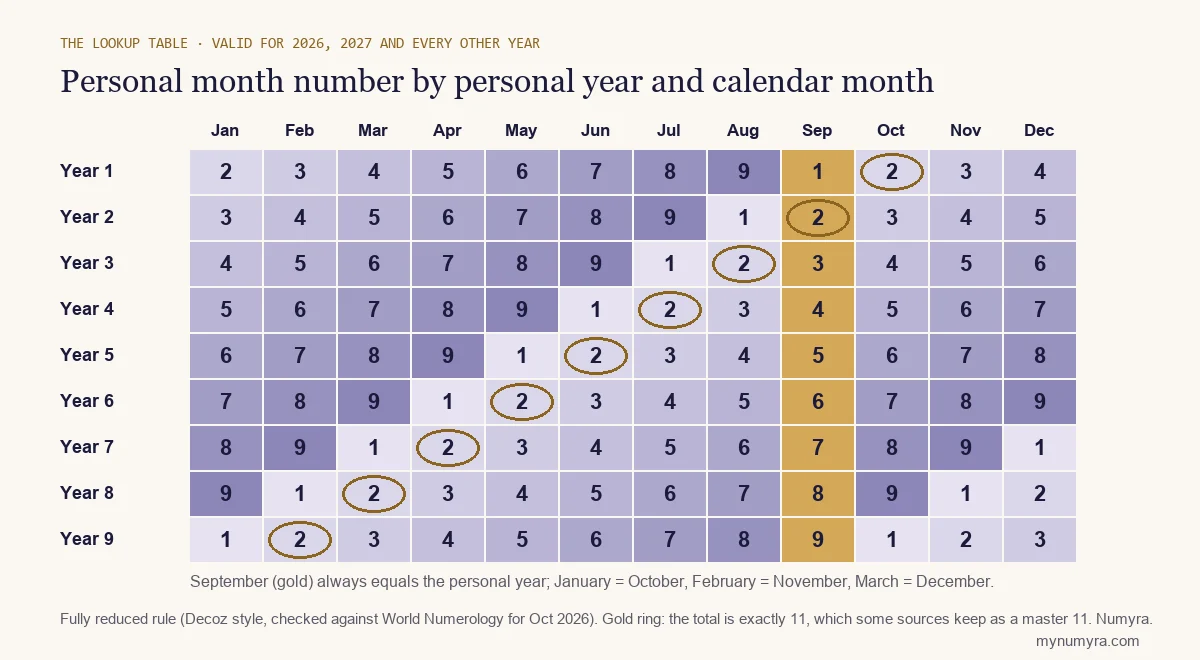
Because the month is added to a one-digit personal year, there are only 9 × 12 = 108 possible results, and they do not depend on the calendar year. This table works for 2026, 2027 and any other year; find your personal year in the left column and read across.
| Personal year | Jan | Feb | Mar | Apr | May | Jun | Jul | Aug | Sep | Oct | Nov | Dec |
|---|---|---|---|---|---|---|---|---|---|---|---|---|
| 1 | 2 | 3 | 4 | 5 | 6 | 7 | 8 | 9 | 1 | 2 | 3 | 4 |
| 2 | 3 | 4 | 5 | 6 | 7 | 8 | 9 | 1 | 2 | 3 | 4 | 5 |
| 3 | 4 | 5 | 6 | 7 | 8 | 9 | 1 | 2 | 3 | 4 | 5 | 6 |
| 4 | 5 | 6 | 7 | 8 | 9 | 1 | 2 | 3 | 4 | 5 | 6 | 7 |
| 5 | 6 | 7 | 8 | 9 | 1 | 2 | 3 | 4 | 5 | 6 | 7 | 8 |
| 6 | 7 | 8 | 9 | 1 | 2 | 3 | 4 | 5 | 6 | 7 | 8 | 9 |
| 7 | 8 | 9 | 1 | 2 | 3 | 4 | 5 | 6 | 7 | 8 | 9 | 1 |
| 8 | 9 | 1 | 2 | 3 | 4 | 5 | 6 | 7 | 8 | 9 | 1 | 2 |
| 9 | 1 | 2 | 3 | 4 | 5 | 6 | 7 | 8 | 9 | 1 | 2 | 3 |
Every row is the same run of numbers shifted along: a 1 year begins at 2 in January, a 2 year begins at 3, and a 9 year begins at 1. We confirmed every one of the 108 cells with a separate calculation that uses the modulo-9 shortcut instead of adding digits, and the two agree. The table also matches the October 2026 personal months that World Numerology publishes in its free monthly forecast, where a Sun Number 1 is in a 2 personal year and a 3 personal month, and a Sun Number 8 is in a 9 personal year and a 1 personal month.
2026 and 2027: find your personal months by birthday
To use the table you need your personal year, and that comes from your Sun Number: your birth month and day added and reduced to one digit (July 14 is 7 + 14 = 21, then 3). The year 2026 reduces to 1 (2 + 0 + 2 + 6 = 10), so your 2026 personal year is your Sun Number plus 1. The year 2027 reduces to 2 (the 11/2 universal year discussed in our guide to numerology in 2027), so your 2027 personal year is your Sun Number plus 2. Both use the calendar year, the convention Decoz follows; the personal year guide explains the alternative that starts the year on your birthday.
The rest of 2026
| Sun Number | Personal year 2026 | October 2026 | November 2026 | December 2026 |
|---|---|---|---|---|
| 1 | 2 | 3 | 4 | 5 |
| 2 | 3 | 4 | 5 | 6 |
| 3 | 4 | 5 | 6 | 7 |
| 4 | 5 | 6 | 7 | 8 |
| 5 | 6 | 7 | 8 | 9 |
| 6 | 7 | 8 | 9 | 1 |
| 7 | 8 | 9 | 1 | 2 |
| 8 | 9 | 1 | 2 | 3 |
| 9 | 1 | 2 | 3 | 4 |
Every month of 2027
| Sun Number | Year 2027 | Jan | Feb | Mar | Apr | May | Jun | Jul | Aug | Sep | Oct | Nov | Dec |
|---|---|---|---|---|---|---|---|---|---|---|---|---|---|
| 1 | 3 | 4 | 5 | 6 | 7 | 8 | 9 | 1 | 2 | 3 | 4 | 5 | 6 |
| 2 | 4 | 5 | 6 | 7 | 8 | 9 | 1 | 2 | 3 | 4 | 5 | 6 | 7 |
| 3 | 5 | 6 | 7 | 8 | 9 | 1 | 2 | 3 | 4 | 5 | 6 | 7 | 8 |
| 4 | 6 | 7 | 8 | 9 | 1 | 2 | 3 | 4 | 5 | 6 | 7 | 8 | 9 |
| 5 | 7 | 8 | 9 | 1 | 2 | 3 | 4 | 5 | 6 | 7 | 8 | 9 | 1 |
| 6 | 8 | 9 | 1 | 2 | 3 | 4 | 5 | 6 | 7 | 8 | 9 | 1 | 2 |
| 7 | 9 | 1 | 2 | 3 | 4 | 5 | 6 | 7 | 8 | 9 | 1 | 2 | 3 |
| 8 | 1 | 2 | 3 | 4 | 5 | 6 | 7 | 8 | 9 | 1 | 2 | 3 | 4 |
| 9 | 2 | 3 | 4 | 5 | 6 | 7 | 8 | 9 | 1 | 2 | 3 | 4 | 5 |
Notice that a Sun Number 8 is in a 9 personal year in 2026 and a 1 personal year in 2027, so the January 2027 personal month (2) follows the December 2026 personal month (3 for a 9 year, since 9 + 3 = 12) in a different cycle altogether. Your personal month number does not run on from December to January: it restarts from your new personal year. Our 2027 guide covers the related universal months, which use the year number alone instead of your birth date.
The nine-month and nine-day cycles
Numerology’s personal cycles all step through 1 to 9. Decoz calls the nine personal years “a complete Epicycle”:

“There are nine personal year numbers, which makes up a complete Epicycle.”
Months and days follow the same logic on a smaller scale. A personal month goes up by one each calendar month, so January to September run through all nine numbers once (a 1 year goes 2, 3, 4 up to 9, then 1 in September), and the cycle starts again in October. That is why the phrase “nine-month cycle” is a little loose: the calendar has twelve months, so a personal year holds one full nine-month run plus three months of the next one. Personal days work the same way inside a month: the personal day goes up by one each day, so days 1 to 9 run through the numbers, days 10 to 18 repeat them, and a 31-day month covers three full runs plus four days. A personal day number is therefore never independent: it is the month number moved along by the day of the month, in the same way that the month number is the year number moved along by the month.
Personal day numbers, with an October 2026 example
The usual rule is to add the personal month to the day of the month and reduce. One of the sites we read puts it as adding your personal month number to the current day of the month. The calendar below takes our fictional July 14 birth date, who has a 4 personal year in 2026 and a 5 personal month in October, and works out every day of October 2026.
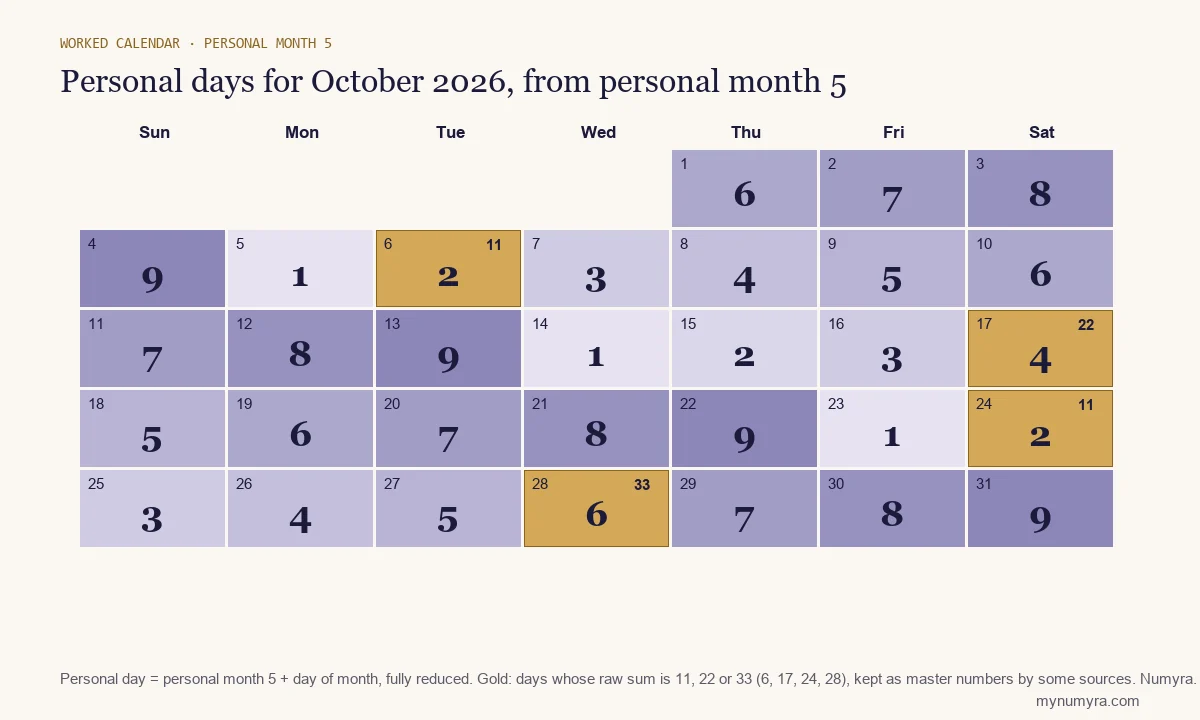
October 1 is 5 + 1 = 6, October 2 is 7, and the numbers climb to 9 on October 4, then restart at 1 on October 5. October 17 is 5 + 17 = 22, which reduces to 4. The last day, October 31, is 5 + 31 = 36, then 9. Two cautions apply. First, the cycle breaks at the end of the month: in November this person’s personal month becomes 6, so November 1 is 7, not the 1 that would follow a 9. Second, a different route to the same number exists. Some sites add the personal year, the calendar month and the day in one go; as long as everything is reduced the same way, the answer is the same, but the two-step route is easier to check. One of those sites gives two different personal day methods on the same page, so check which one a calculator uses.
If you only care about one day, the shortcut is the digit sum of the whole date. Add the digits of the year, month and day for the date and the digits of the birth month and day, and reduce: for July 14 and October 17, 2026, that is 7 + 1 + 4 + 1 + 0 + 1 + 7 + 2 + 0 + 2 + 6 = 31, then 4. The numbers match because every step is just addition.
Master numbers and where sources disagree
Numyra’s methodology keeps 11, 22 and 33 at every stage of the core birth-date numbers, but the personal year is the exception: it is always reduced to 1 to 9, as in the Personal Year calculator. For months and days there is no single standard, so we ran three versions through every cell of the table:
| Rule | How the month is added | When a master number appears | Cells in the 108 that change |
|---|---|---|---|
| A. Reduce fully (our default) | Month as one digit (Oct = 1, Nov = 2, Dec = 3), total reduced to 1 to 9 | Never | None; this is the table above |
| B. Plain month number, stop at 11 | Month as 1 to 12 (Oct = 10, Nov = 11, Dec = 12), total reduced but kept if exactly 11 | Total is exactly 11 | 9 cells become 11 instead of 2: year 1 in October, year 2 in September, year 3 in August, up to year 9 in February |
| C. Month reduced, November kept as 11 | Oct = 1, Nov = 11, Dec = 3, total stopping at 11 | Total is exactly 11 with the one-digit month | 9 cells: years 2 to 9 in the months 9 down to 2, plus year 8 in December |
Rule C follows how Decoz treats months elsewhere: in his article on period cycles he keeps November as a master 11 and reduces October to 1 and December to 3. We could not retrieve a Decoz page that states a rule for personal months with master numbers, and his free forecast shows only single digits for October 2026, so rule A is the one we could check against a published source. The other rules are our reading of how sources that mention master numbers would apply them. Among the sources we read on personal months, Cafe Astrology’s example lands on 11 (a 3 year plus an 8 month) and reduces it to 2 without comment, and a Substack guide tells you to keep master numbers in its final step but reduces November to 2 in an earlier one, so in practice neither shows a master-number month.
Two patterns are worth knowing. Under rule B every personal year contains exactly one 11 month: month number 11 minus your personal year (so a 3 year has it in August, an 8 year in March). Nothing can reach 22 or 33 for a month, since the largest possible total is 9 + 12 = 21. For days the story changes: with a personal month from 1 to 9 and a day up to 31, totals of 11, 22 and 33 all occur. In the October 2026 calendar above, the 6th, 17th, 24th and 28th add to 11, 22, 11 and 33. A 31-day month contains three master-number days for a 1 personal month, four for a 2 to 6, and five for a 7, 8 or 9. If your calculator reports “11” for a personal day, it uses the stop-at-master rule, and the number you get by full reduction is the 2 beneath it. Our pinnacle numbers guide compares the same disagreement for another cycle, and a reduction that passes through 13, 14, 16 or 19 on the way (26 of the 108 cells when the month is entered as 1 to 12) is the territory of the karmic debt numbers.
When the personal month and personal year coincide
Because the month is added to the year, the gap between the two numbers depends only on the calendar month. That gives a short list of coincidences that hold for every personal year:
| Calendar month | Jan | Feb | Mar | Apr | May | Jun | Jul | Aug | Sep | Oct | Nov | Dec |
|---|---|---|---|---|---|---|---|---|---|---|---|---|
| Personal month = year plus | 1 | 2 | 3 | 4 | 5 | 6 | 7 | 8 | 0 (equal) | 1 | 2 | 3 |
- September repeats your personal year. September is 9, and adding 9 changes nothing after reduction, so the personal month always equals the personal year. In a 6 year, September is a 6 month.
- January and October always match. October reduces to 1, the same as January, so these two months always have the same personal month number.
- February and November always match, and so do March and December. November reduces to 2 and December to 3.
The result is three numbers that appear twice in a year (your personal year plus 1, plus 2 and plus 3) and six that appear once. In a 4 year, 5, 6 and 7 each appear twice (January and October, February and November, March and December), while 8, 9, 1, 2, 3 and 4 appear once each, and September is the 4. Practitioners usually read a personal month together with its year, so a month that shares the year’s number is described as amplifying it, which is a reading from the tradition and has no evidence behind it. For the longer cycles above this one, see the pinnacle guide, the birthday number, which is the day of birth on its own, and the maturity number.
What each personal month number means, by tradition
The month meanings are a smaller-scale version of the personal year meanings: the same number, a shorter stretch. Decoz’s free monthly forecast, for example, describes a 3 personal month in October 2026 for a Sun Number 1 as a light, playful month with a need for a break to recharge. The summaries below are Numyra’s wording of the common tradition, not facts.
| Number | Theme of the month | Traditional reading |
|---|---|---|
| 1 | Beginning | A month for starting something, taking the lead or trying a new approach. |
| 2 | Partnership | A slower month for patience, cooperation and listening. |
| 3 | Expression | A sociable, creative month for sharing ideas and work. |
| 4 | Groundwork | A practical month for structure, routine and finishing tasks. |
| 5 | Change | A restless month of movement, variety and surprises. |
| 6 | Responsibility | A month centered on home, family and caring for others. |
| 7 | Reflection | An inward month for rest, study and thinking things through. |
| 8 | Achievement | A month for ambition, money matters and visible results. |
| 9 | Completion | A month for finishing, clearing out and letting go. |
| 11 (rule B or C only) | Intuition | Read as an intense, heightened-awareness version of a 2 month. |
Use these as prompts for reflection. Nothing about them is tested, and a personal month number does not tell you what will happen. Someone in a 1 month is not guaranteed a fresh start, and the same month number comes to millions of people at the same time (see the data below).
How common each personal month number is (original data)
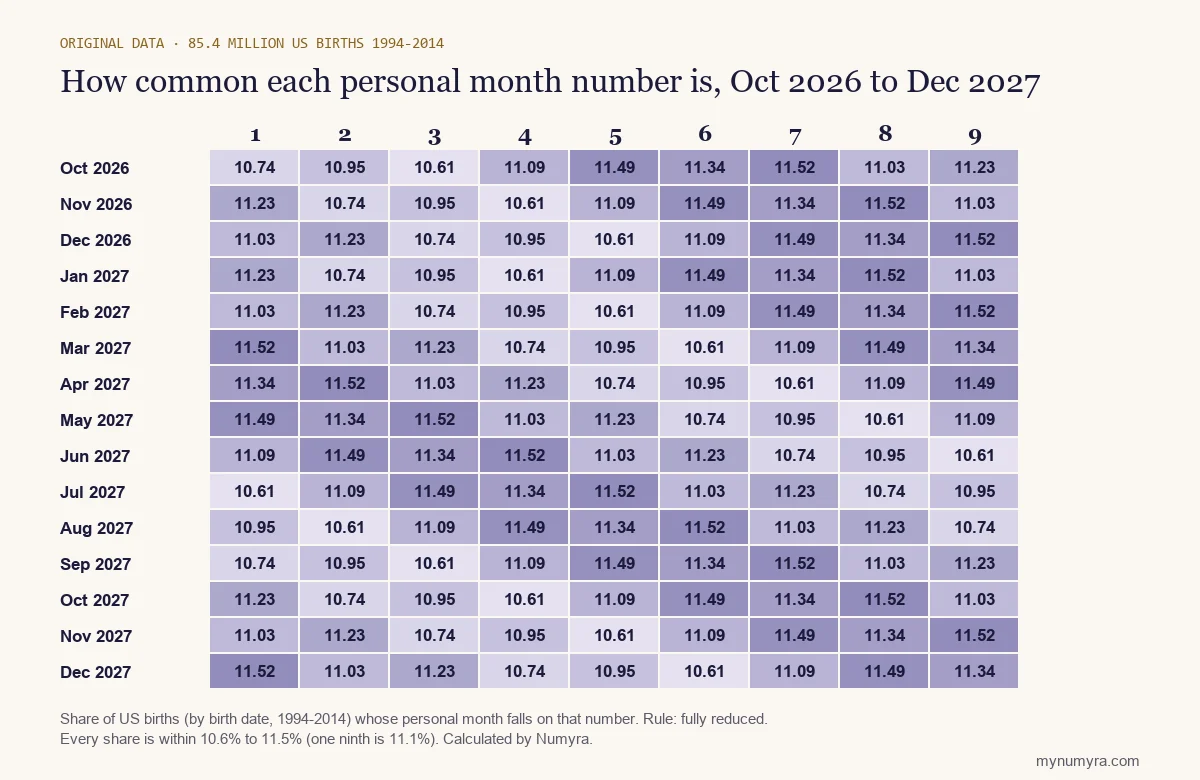
None of the pages we read says how many people share a given personal month, so we counted. The method: for every calendar day from January 1, 1994 to December 31, 2014 (7,670 days), we took the birth month and day, worked out the personal year for 2026 or 2027 with the rules above, added each month, and counted the result weighted by the number of babies born on that date, 85,386,227 births in all. The birth counts come from the CDC National Center for Health Statistics (1994 to 2003) and the Social Security Administration (2004 to 2014), as compiled by FiveThirtyEight. February 29 is included with its real counts, and the personal year uses the calendar year. We checked every share with a second program that iterates over the raw rows and uses the modulo-9 identity.
What this is not: it covers US births from 1994 to 2014 only, so it describes how those 21 birth years land in October 2026 or 2027, not the whole population or other countries. The personal year in the sample depends only on the birth month and day, so the shares follow the US birth-date calendar, in which some dates, such as the 13th and the 31st, are a little rarer than others.
| Month | 1 | 2 | 3 | 4 | 5 | 6 | 7 | 8 | 9 |
|---|---|---|---|---|---|---|---|---|---|
| Oct 2026 | 10.74% | 10.95% | 10.61% | 11.09% | 11.49% | 11.34% | 11.52% | 11.03% | 11.23% |
| Nov 2026 | 11.23% | 10.74% | 10.95% | 10.61% | 11.09% | 11.49% | 11.34% | 11.52% | 11.03% |
| Dec 2026 | 11.03% | 11.23% | 10.74% | 10.95% | 10.61% | 11.09% | 11.49% | 11.34% | 11.52% |
| Jan 2027 | 11.23% | 10.74% | 10.95% | 10.61% | 11.09% | 11.49% | 11.34% | 11.52% | 11.03% |
| Feb 2027 | 11.03% | 11.23% | 10.74% | 10.95% | 10.61% | 11.09% | 11.49% | 11.34% | 11.52% |
| Mar 2027 | 11.52% | 11.03% | 11.23% | 10.74% | 10.95% | 10.61% | 11.09% | 11.49% | 11.34% |
| Apr 2027 | 11.34% | 11.52% | 11.03% | 11.23% | 10.74% | 10.95% | 10.61% | 11.09% | 11.49% |
| May 2027 | 11.49% | 11.34% | 11.52% | 11.03% | 11.23% | 10.74% | 10.95% | 10.61% | 11.09% |
| Jun 2027 | 11.09% | 11.49% | 11.34% | 11.52% | 11.03% | 11.23% | 10.74% | 10.95% | 10.61% |
| Jul 2027 | 10.61% | 11.09% | 11.49% | 11.34% | 11.52% | 11.03% | 11.23% | 10.74% | 10.95% |
| Aug 2027 | 10.95% | 10.61% | 11.09% | 11.49% | 11.34% | 11.52% | 11.03% | 11.23% | 10.74% |
| Sep 2027 | 10.74% | 10.95% | 10.61% | 11.09% | 11.49% | 11.34% | 11.52% | 11.03% | 11.23% |
| Oct 2027 | 11.23% | 10.74% | 10.95% | 10.61% | 11.09% | 11.49% | 11.34% | 11.52% | 11.03% |
| Nov 2027 | 11.03% | 11.23% | 10.74% | 10.95% | 10.61% | 11.09% | 11.49% | 11.34% | 11.52% |
| Dec 2027 | 11.52% | 11.03% | 11.23% | 10.74% | 10.95% | 10.61% | 11.09% | 11.49% | 11.34% |
Three findings. First, every number is close to one ninth: across the 15 months in the table the shares run from 10.61% to 11.52%, so a 7 month is about as common as a 3 month. The tiny gap comes from the birth-date calendar, not from anything numerological. Second, the pattern is a rotation. Each month’s row is the previous month’s row shifted one place right, so in October 2026 the most common personal month is a 7 (11.52%, the same people who are in a 6 personal year) and the least common is a 3 (10.61%). Third, rule B’s “11 months” are as common as a personal year of the matching size: in October 2026, 10.95% of these births (the 1 personal years) would be in a 11 month under rule B, in February 2027 it would be 11.23% (the 9 personal years), and in November and December 2026 and in January, November and December 2027 nobody would be. The 2027 values by personal year are the 2026 values moved along one place, because 2027 adds 2 to a Sun Number where 2026 adds 1.
A realistic use for the data is as a sanity check: if a page says your personal month number is rare or special, the count above says about 1 in 9 people share it in the same month.
A calculator would help
Numyra does not yet have a personal month or personal day calculator; the tables above cover every case, and the Personal Year calculator stops at the year. Given how many sites sell this as a feature, one that takes a birth month and day and returns the year, the month and the next thirty days would be a reasonable addition.
Frequently asked questions
How do you calculate your personal month number?
Find your personal year, add the calendar month (reducing October to 1, November to 2 and December to 3), and reduce the total to one digit. A 4 personal year in October is 4 + 1 = 5.
What is my personal month number for October 2026?
It is your 2026 personal year plus 1. Your 2026 personal year is your Sun Number (birth month plus day, reduced) plus 1, so your October 2026 personal month is your Sun Number plus 2, reduced. A Sun Number 1 gets 3, and a Sun Number 8 gets 1.
How do you calculate a personal day number?
Add your personal month number to the day of the month and reduce. With a 5 personal month, the 17th is 5 + 17 = 22, then 4.
Do master numbers 11, 22 and 33 appear in personal months?
Only if you choose to stop at them. If you reduce every total, as Numyra does, a personal month is always 1 to 9. If you stop at 11, a month can be 11 whenever the personal year plus the month number is exactly 11, and 22 and 33 are impossible for months.
Why is my personal month in September the same as my personal year?
September is month 9, and adding 9 to a number and reducing it gives back the same number. Your September personal month always equals your personal year.
Does the personal month start on the 1st of the month or on my birthday?
The sources we read use the calendar month, and Decoz’s monthly forecast is labeled by calendar month. Some numerologists run the personal year from the birthday instead, which can shift which year number you use in the months before your birthday; see our personal year guide.
How many people share my personal month number?
About one in nine. In our sample of 85.4 million US births, every personal month number is shared by between 10.6% and 11.5% of people in any month.
Is there scientific evidence for personal months and days?
No. They are part of an interpretive tradition, and the rules differ between sources. Use them for reflection, not as a forecast.
Sources
- World Numerology (Hans Decoz). Free Monthly Numerology Forecast. October 2026 personal year and personal month for Sun Numbers 1 to 9, used to check our rule, and the statement that personal days sit within personal months.
- World Numerology (Hans Decoz). Your Personal Year Cycles. The nine-year Epicycle quote and the Sun Number method for the personal year.
- World Numerology (Hans Decoz). Period Cycles. The treatment of November as a master 11 and of October and December as 1 and 3.
- Cafe Astrology. Timing with Numerology. The personal month rule quoted above.
- Vassell, Laila Nicole. Build Your Numerology Chart Pt 7: How to Calculate Your Personal Month Number. Substack, May 5, 2025. Cited for the master-number wording in its calculation steps.
- Thomas, Helen. How to discover your personal day in numerology. Updated October 28, 2024. Cited for the “personal month plus day” rule and for its two conflicting personal day methods.
- FiveThirtyEight. US births data, 1994 to 2014, from the CDC National Center for Health Statistics and the Social Security Administration. Birth counts for the original data.