Nearly every article about Western astrology’s history mentions the Tetrabiblos in passing — “the ancient text that standardized it,” usually in one sentence, then moves on. Almost none of them actually quote it. The full public-domain English translation has been freely available for two centuries, and the book itself argues its case in more careful, more hedged language than most of the astrology written about it today.
Key takeaways
- The Tetrabiblos (“four books”) was written by Claudius Ptolemy in Alexandria in the 2nd century CE — the same astronomer who wrote the Almagest, and the same work that made the tropical zodiac the Western default.
- Ptolemy’s own opening chapters are more cautious than most modern summaries suggest — he directly states that astrology can never offer “positive or infallible rules,” a real, verifiable hedge in his own words.
- The standard English translation has a genuinely rocky history: an 1822 translator publicly tore apart the only English version that came before his, and his own version wasn’t even translated from Ptolemy’s original Greek.
- What actually persists today isn’t mystical — it’s structural: the tropical zodiac, the classical four elements applied to the twelve signs, and the basic Sun/Moon/planet framework this site’s own calculators and profile pages still use.
In this guide
- What the Tetrabiblos actually is
- What Ptolemy actually wrote, in his own words
- The argument Ptolemy actually made for astrology
- The English translation has a messier history than most people repeating it realize
- What actually survived — and what didn’t
- Frequently asked questions
What the Tetrabiblos actually is
Tetrabiblos is Greek for “four books,” and that’s a literal description — Claudius Ptolemy structured his astrological treatise in four parts. Book I lays out definitions and the basic mechanics (planets, signs, aspects). Book II covers what he called “mundane” astrology — weather, climates, and the fortunes of nations and rulers, not individuals. Books III and IV turn to natal astrology, reading an individual’s life from the moment of birth. It’s sometimes cited in Latin as the Quadripartitum (“four parts”) for the same reason.
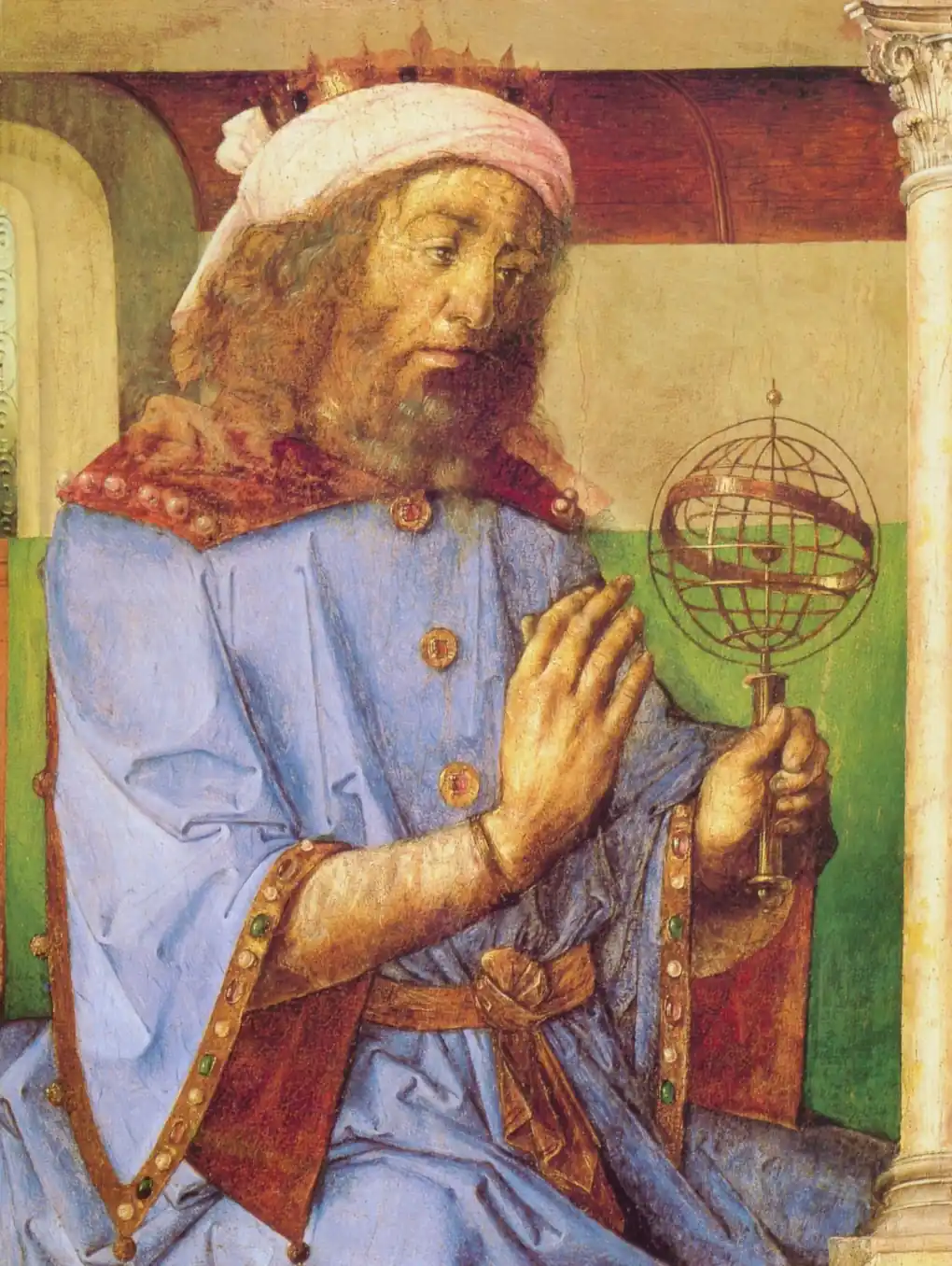
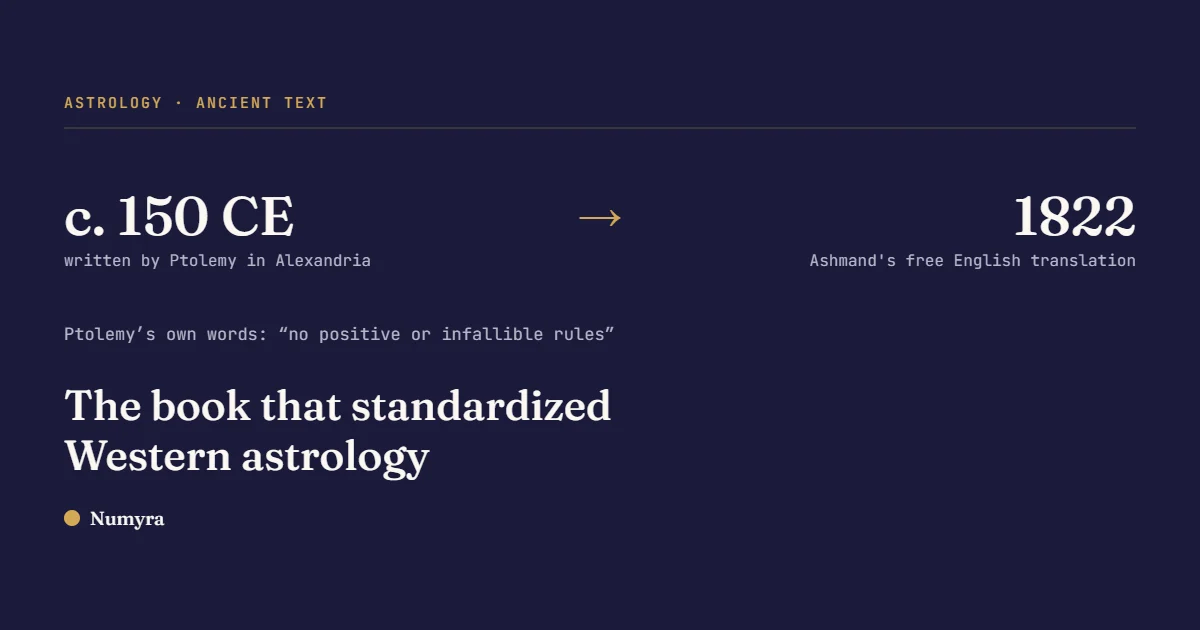
Ptolemy wrote it in Alexandria, in Roman Egypt, in the 2nd century CE — most sources place him working from roughly 100 to 170 CE. He’s better known today for the Almagest, his astronomical treatise on the movements of the sun, moon, and planets, which stayed the dominant model of the cosmos in the West for over a thousand years. The Tetrabiblos isn’t a separate project — in its own opening lines, Ptolemy directly calls it a companion volume, describing astronomy (predicting where the planets will be) and astrology (interpreting what those positions mean) as the two related “studies preliminary to astronomical prognostication,” with the first already covered in what he calls “the Syntaxis” — the work later known as the Almagest.
What Ptolemy actually wrote, in his own words
The full English text has been public domain for two centuries — the 1822 translation by J.M. Ashmand is freely readable online (see sources below) — and it’s worth reading the real opening rather than a modern paraphrase of it. Ptolemy opens Book I by directly distinguishing the two studies, then makes a case for astrology that’s noticeably more careful than most summaries suggest:
“The studies preliminary to astronomical prognostication, O Syrus! are two: the one, first alike in order and in power, leads to the knowledge of the figurations of the Sun, the Moon, and the stars… the other takes into consideration the changes which their aspects create, by means of their natural properties, in objects under their influence.”
A few paragraphs later, defending astrology against critics of his own era, Ptolemy makes a distinction that’s easy to miss if you’ve only seen the Tetrabiblos summarized rather than quoted: he openly admits the discipline can’t promise certainty.
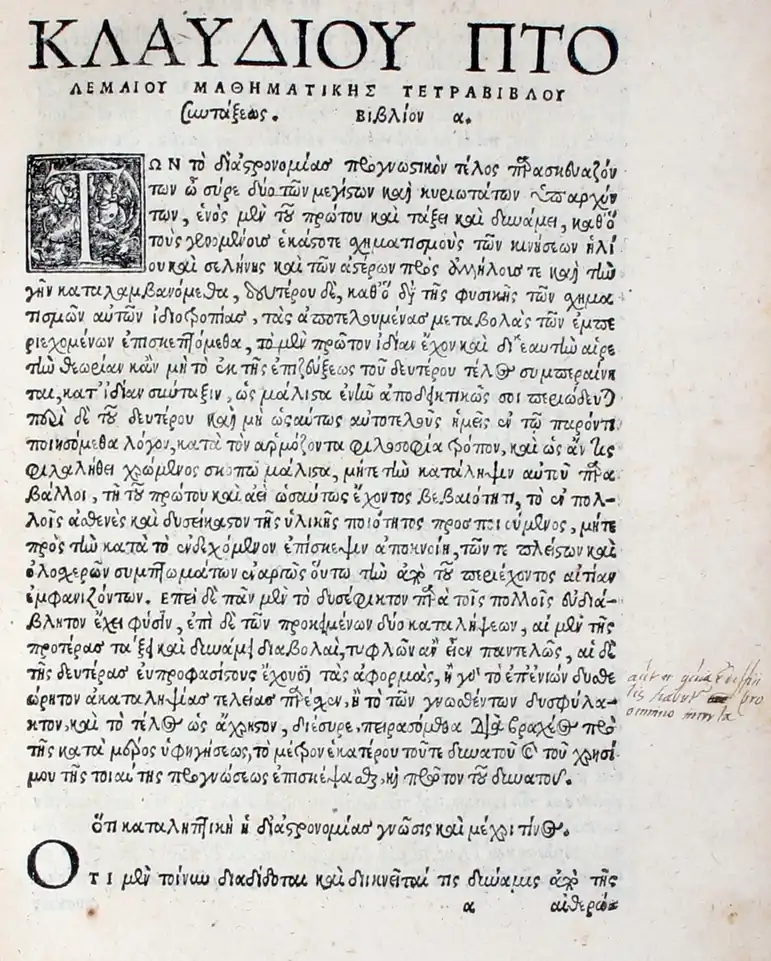
“It is not attempted to be denied that any individual, although he may have attained to the greatest possible accuracy in the science, must still be liable to frequent error, arising out of the very nature of his undertaking, and from the weakness of his limited capacity in comparison with the magnitude of his object… no positive or infallible rules… can be here set forth.”
That’s a real, direct hedge from the foundational text of Western astrology, not a modern disclaimer added on top of it — and it lines up with the honest, non-deterministic framing this site tries to apply to every calculator and profile page.
The argument Ptolemy actually made for astrology
One passage in Book I is a genuinely useful window into how Ptolemy pitched astrology to skeptics of his own time, and it’s rarely quoted anywhere. He starts from something uncontroversial — sailors reading weather signs — and argues astrology is a more rigorous version of the same basic act of prediction:
“Of this kind, are tempests and gales of wind, produced by certain aspects of the Moon, or the fixed stars, towards the Sun… the approach of which is usually foreseen by mariners. At the same time, prognostication made by persons of this class must be frequently fallacious, owing to their deficiency in science… When, therefore, a thorough knowledge of the motions of the stars… shall have been acquired… there seems no impediment to the formation of similar prognostication concerning the destiny and disposition of every human being.”
In other words: Ptolemy’s own case for astrology wasn’t mystical revelation — it was an argument that if imprecise, informal weather prediction (which nobody in his audience doubted) is possible from watching the sky, then a more disciplined, mathematically-grounded version of the same kind of observation should be possible too. Whether or not that argument holds up by modern standards, it’s a genuinely different pitch than “the stars speak to us,” and it’s the actual argument, in his actual words, not a summary of it.
The English translation has a messier history than most people repeating it realize
Every modern English-language astrology site owes its Tetrabiblos quotes, directly or indirectly, to a chain of translations — and that chain is worth naming honestly, because the version most commonly cited today (Ashmand’s 1822 translation, still the most widely available free text) wasn’t even translated from Ptolemy’s original Greek.
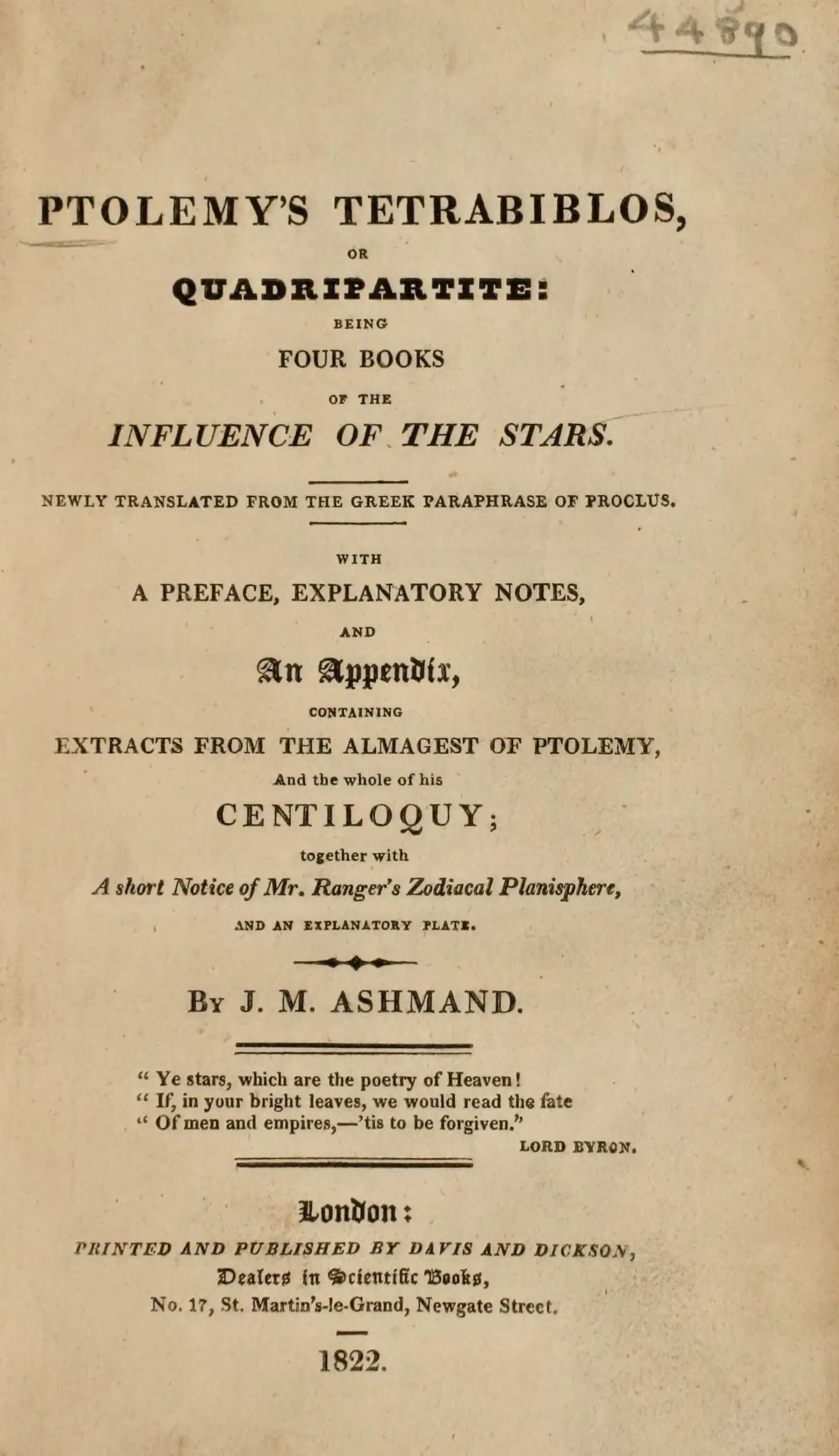
Ashmand says so himself, in his own preface, while giving one of history’s more blunt takedowns of a predecessor’s work:
“The only English translation of Ptolemy’s Tetrabiblos, hitherto published, appears to have been first set forth in 1701, under the name of ‘The Quadripartite.’ That publication has been long removed from general sale; and its gross misinterpretation of the author, caused by the carelessness or ignorance of Whalley and his assistants, by whom it was produced, has rendered most of its pages unintelligible.”
Ashmand goes on to note that a second edition of that same 1701 translation was reprinted in 1786 by Browne and Sibley “without being at all corrected” — meaning the errors he’s describing sat uncorrected in the only available English Tetrabiblos for over a century. His own 1822 version, still the one most freely available today, wasn’t translated directly from Ptolemy’s Greek either — by his own account, it was made from Proclus’s Greek paraphrase of Ptolemy’s original text, a summary written centuries after Ptolemy by a different (later) scholar.
The translation lineage doesn’t stop there. In 1940, Frank Egleston Robbins, a Greek professor at the University of Michigan, produced a new translation directly from Ptolemy’s original Greek for the Loeb Classical Library — a facing-page Greek/English edition still used as the standard academic reference. Starting in 1994, Robert Schmidt’s Project Hindsight undertook another full retranslation effort of Ptolemy and other Hellenistic astrological sources directly from the Greek, aimed specifically at correcting interpretive choices earlier translators had made. Three genuinely different translators, working from two different source texts, over roughly 300 years — worth knowing if you’ve ever seen two sites quote the “same” Tetrabiblos passage with slightly different wording.
What actually survived — and what didn’t
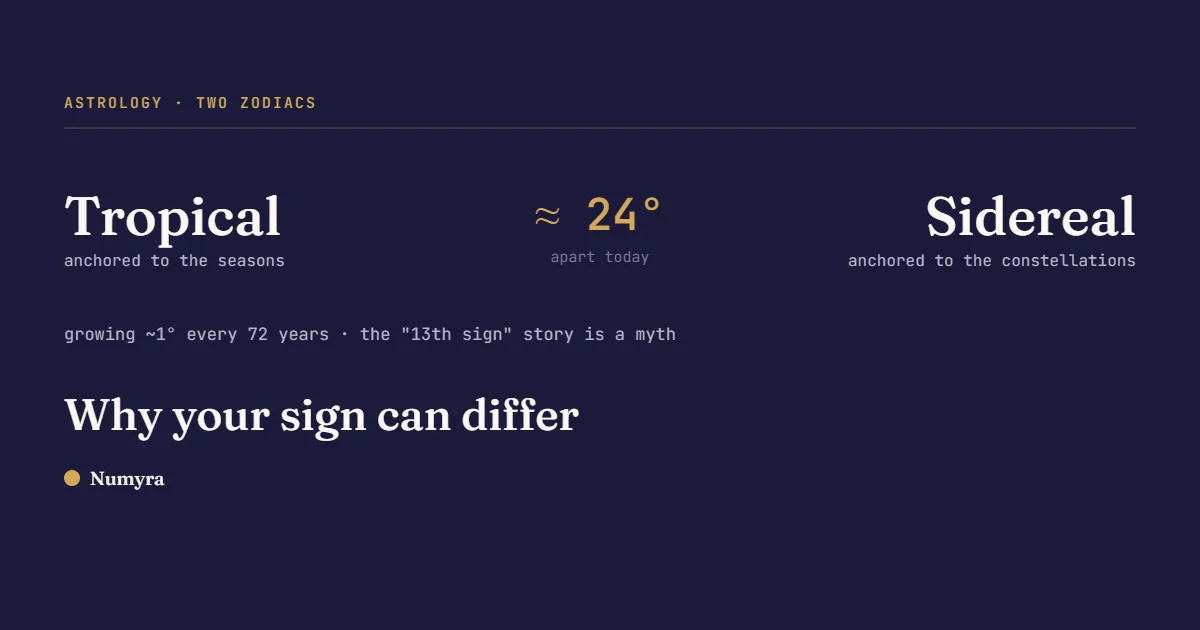
Most of what makes the Tetrabiblos historically important isn’t mystical content — it’s structural choices that quietly became the Western default. Ptolemy argued for the tropical zodiac (signs anchored to the seasons, starting at the spring equinox) over competing systems of his era, and that choice is still what most Western astrology sites — including this one’s own sidereal-vs-tropical explainer — use without necessarily naming where it came from. He also worked within the four-element, three-modality framework this site covers in full in its Four Elements and Three Modalities guide — a system Ptolemy inherited from earlier Greek philosophy rather than inventing himself, and applied systematically to all twelve signs in Book I.
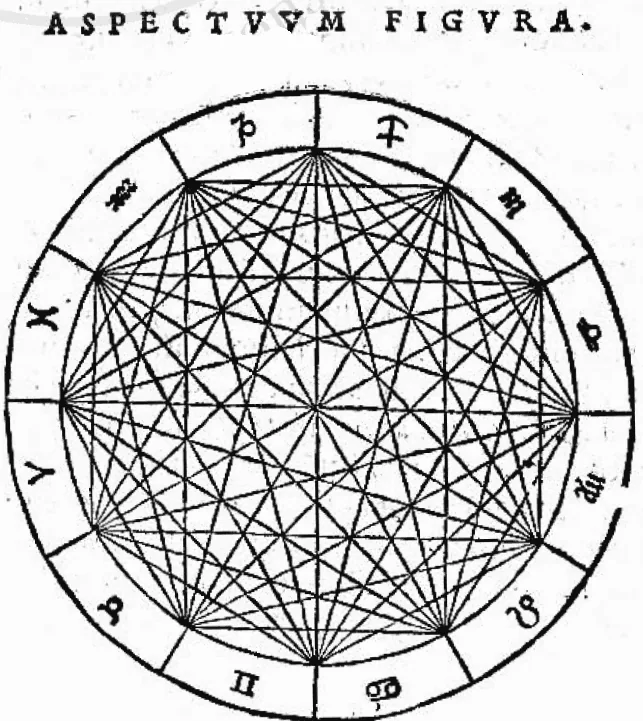
What mostly didn’t survive is Book II’s specific method for reading the fortunes of nations and rulers from planetary omens — a genre almost entirely absent from modern astrology, which is overwhelmingly personal/natal in focus, the exact opposite emphasis of where Ptolemy spent a quarter of his own book. And the fine mechanical details of his house-and-aspect calculations were themselves disputed and revised by later astrologers — the real, named rivalry between Vettius Valens’s whole-sign houses and the later Placidus system, covered in this site’s own Astrological Houses guide, shows that even within the classical tradition, Ptolemy’s specific methods were never treated as beyond revision.
Frequently asked questions
Is the Tetrabiblos the oldest astrology text?
No — Ptolemy drew on earlier Hellenistic astrologers, including Dorotheus of Sidon, whose own 1st-century work predates the Tetrabiblos. What makes the Tetrabiblos distinctive is how systematically it was organized and how long it stayed the dominant reference, not that it came first.
Can I read the actual Tetrabiblos for free?
Yes — the 1822 Ashmand English translation is public domain and freely readable online (see our sources below). It’s the version most modern astrology writing quotes, directly or indirectly.
Did Ptolemy believe astrology was completely accurate?
By his own written words, no — he explicitly states in Book I that even a skilled astrologer “must still be liable to frequent error” and that “no positive or infallible rules” can be given, a real hedge in his own text rather than a modern addition to it.
What’s the difference between the Tetrabiblos and the Almagest?
Ptolemy wrote both. The Almagest (which he calls “the Syntaxis” in the Tetrabiblos’s own opening lines) is his astronomical work on predicting the actual positions of the sun, moon, and planets. The Tetrabiblos is the companion volume on interpreting what those positions mean.
Why does this matter for a numerology and astrology site today?
Because the tropical zodiac and the four-element/three-modality framework this site’s own zodiac and compatibility content is built on trace directly back to choices Ptolemy made — and argued for, in hedged, non-absolute language — in this specific book, nearly 1,900 years ago.
Sources
- Ptolemy (trans. J.M. Ashmand). Tetrabiblos, or Quadripartite. 1822. Full free public-domain text — every direct quote above is taken verbatim from this edition, including Ashmand’s own translator’s preface.
- “Tetrabiblos.” Wikipedia. Background on structure and historical influence.
- Ptolemy (trans. F.E. Robbins). Tetrabiblos. Loeb Classical Library 435, Harvard University Press, 1940. The standard modern Greek/English academic edition (subscription access).
- Schmidt, Robert (trans.). Tetrabiblos, Book I. Project Hindsight, 1994. A modern direct-from-Greek retranslation effort; cited here for the translation-lineage history, not quoted directly.
- Numyra Editorial Desk. Sidereal vs. Tropical Zodiac: Why Your Sign Can Differ.
- Numyra Editorial Desk. The Four Elements and Three Modalities, Explained.
- Numyra Editorial Desk. What Are Astrological Houses? A Plain-English Guide.