Essential dignities are the traditional way of scoring how strong a planet is in the part of the zodiac it occupies. A planet is strongest in its own sign (its domicile), then in its exaltation, triplicity, terms and face, and weakest in its detriment or fall. William Lilly put numbers on the system in 1647, from +5 for a planet in its own sign to −5 for one in detriment, and his table is still widely used. Here is that table, checked line by line against the original printing, with worked scores you can follow.
Key takeaways
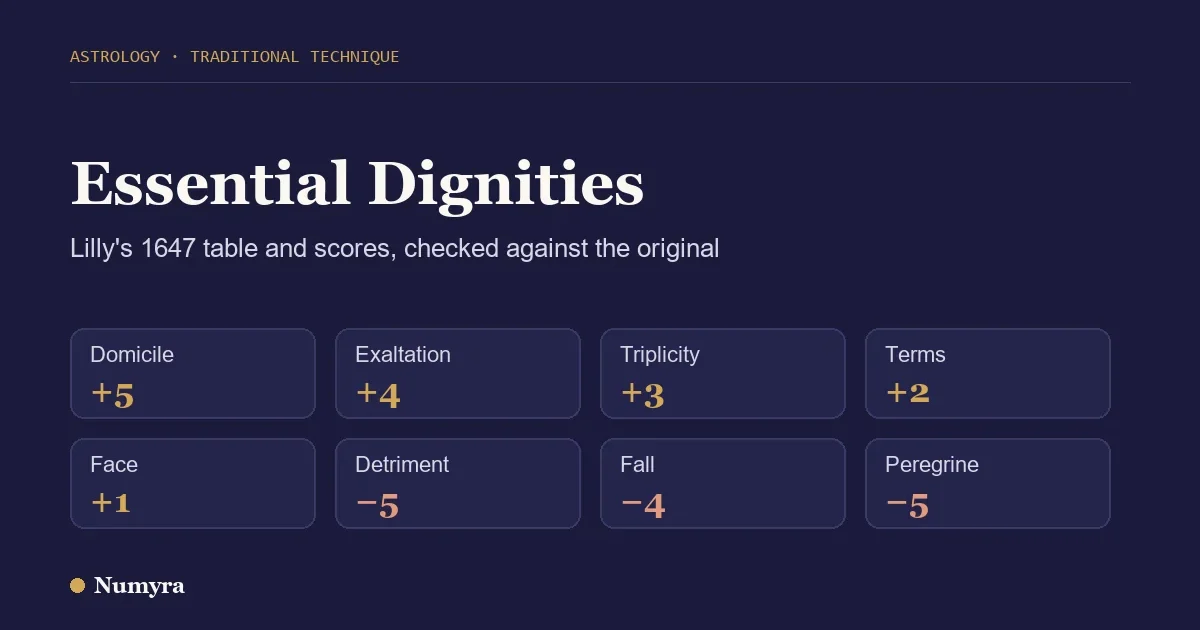
- There are five essential dignities. Lilly’s Christian Astrology (1647) scores them: domicile +5, exaltation +4, triplicity +3, terms +2, face +1.
- There are two debilities: detriment (−5), the sign opposite a planet’s domicile, and fall (−4), the sign opposite its exaltation. A planet with no dignity at all is “peregrine”, also −5.
- Triplicity depends on whether the chart is by day or by night: the Sun in Aries scores +8 in a day chart but only +5 at night, an example Lilly gives himself.
- Lilly titled his table “according to Ptolomy”, yet its terms differ from the Loeb translation of Ptolemy’s own table in 7 of the 12 signs, so the same placement can score differently by table.
- Ptolemy described houses, exaltations, triangles and terms in the 2nd century but gave no scores; the numbers are Lilly’s.
- This is a cultural tradition, presented for reflection, not advice.
In this guide
- What essential dignities are
- The five dignities and their scores
- Lilly’s table of essential dignities
- Domicile, detriment, exaltation and fall by planet
- Triplicity: why day and night matter
- Terms: one name, two tables
- Faces and decans
- Worked examples: scoring a planet
- Frequently asked questions
What essential dignities are
In traditional astrology every planet has parts of the zodiac where it is “at home” and parts where it is out of place. Essential dignity measures that fit, sign by sign and degree by degree. It is separate from accidental dignity, which scores a planet by its house position, speed, retrograde motion and aspects: an essential dignity belongs to the planet’s place in the zodiac itself, whoever’s chart it is in.
The idea is ancient. In the 2nd century the astronomer Claudius Ptolemy opened his chapter on the subject like this:
“The planets also have familiarity with the parts of the zodiac, through what are called their houses, triangles, exaltations, terms…”
— Ptolemy, Tetrabiblos I.17, trans. F. E. Robbins (Loeb Classical Library, 1940)
Ptolemy’s “houses” are the signs each planet rules and his “triangles” are what later astrologers call triplicities. He explained each relationship but never scored them. The points system astrologers use today comes from William Lilly’s Christian Astrology, published in London in 1647, which turned every dignity into a number so that two planets could be compared at a glance. Our article on Ptolemy’s Tetrabiblos explains where his book fits in the tradition.
The five dignities and their scores
| Condition | What it means | Lilly’s score |
|---|---|---|
| Domicile (house) | The planet is in a sign it rules, such as Mars in Aries | +5 |
| Exaltation | The sign where the planet is said to be honored, such as the Sun in Aries | +4 |
| Triplicity | The planet rules the sign’s element, by day or by night | +3 |
| Terms (bounds) | The planet rules the stretch of degrees it is in | +2 |
| Face (decan) | The planet rules the 10° third of the sign it is in | +1 |
| Detriment | The sign opposite its domicile, such as Venus in Aries | −5 |
| Fall | The sign opposite its exaltation, such as Saturn in Aries | −4 |
| Peregrine | No essential dignity of any kind at its degree | −5 |
Every number in that table is printed on page 115 of Christian Astrology, in what Lilly called “A ready Table whereby to examine the Fortitudes and Debilities of the Planets.” The same page scores mutual reception: two planets each in the other’s domicile count 5, as if each were at home, and reception by exaltation counts 4. Exaltation, Lilly adds on page 102, counts anywhere in the sign, “whether he be neer the very degree of his exaltation, yea or not”.
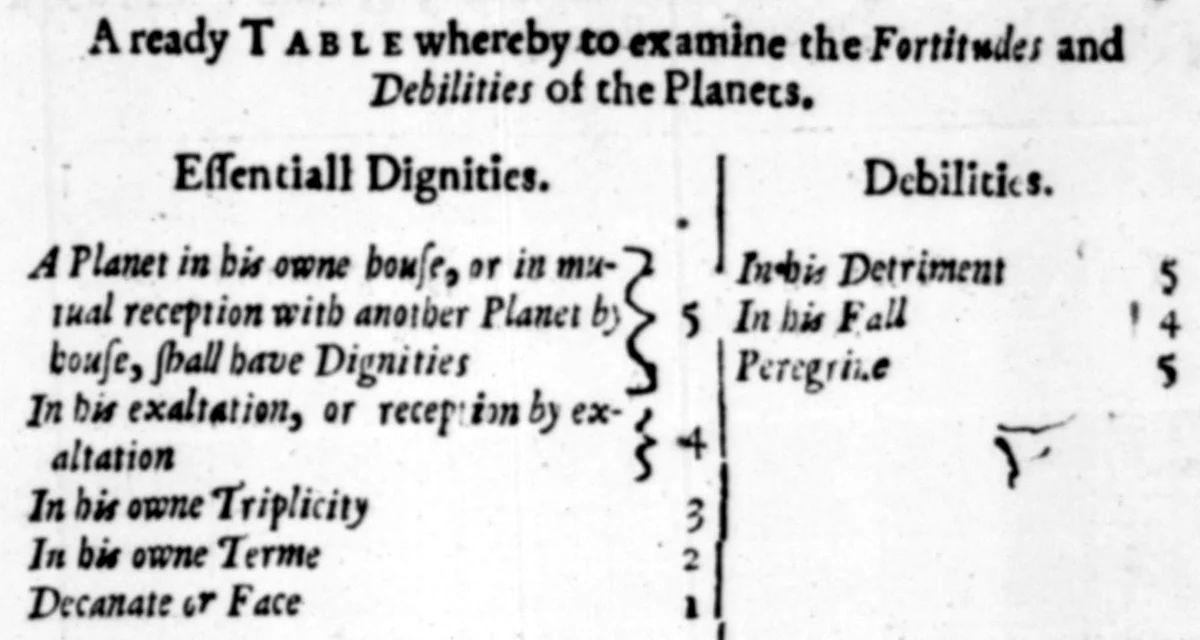
The face is worth only one point, but Lilly thought it still mattered, because one point is enough to stop a planet being peregrine. A planet relying on its face alone, he wrote on page 103, is:
“almost like a man ready to be turned out of doores, having much adoe to maintaine himselfe in credit and reputation”
— William Lilly, Christian Astrology (London, 1647), p. 103, original spelling
Lilly’s table of essential dignities
Lilly printed all of this as a single table on page 104, titled “A Table of the Essentiall Dignities of the Planets according to Ptolomy.” We transcribed it from a scan of the 1647 first edition and checked every cell against Deborah Houlding’s modern edition of the table on Skyscript; the two agree throughout. Here are the sign-level dignities, with each sign linked to its full profile:
| Sign | Domicile ruler | Exaltation | Triplicity (day / night) | Detriment | Fall |
|---|---|---|---|---|---|
| Aries | Mars (D) | Sun 19° | Sun / Jupiter | Venus | Saturn |
| Taurus | Venus (N) | Moon 3° | Venus / Moon | Mars | — |
| Gemini | Mercury (D) | North Node 3° | Saturn / Mercury | Jupiter | — |
| Cancer | Moon (D/N) | Jupiter 15° | Mars / Mars | Saturn | Mars |
| Leo | Sun (D/N) | — | Sun / Jupiter | Saturn | — |
| Virgo | Mercury (N) | Mercury 15° | Venus / Moon | Jupiter | Venus |
| Libra | Venus (D) | Saturn 21° | Saturn / Mercury | Mars | Sun |
| Scorpio | Mars (N) | — | Mars / Mars | Venus | Moon |
| Sagittarius | Jupiter (D) | South Node 3° | Sun / Jupiter | Mercury | — |
| Capricorn | Saturn (N) | Mars 28° | Venus / Moon | Moon | Jupiter |
| Aquarius | Saturn (D) | — | Saturn / Mercury | Sun | — |
| Pisces | Jupiter (N) | Venus 27° | Mars / Mars | Mercury | Mercury |
“D” and “N” mark whether the sign is the ruler’s day or night house; the Sun and Moon have one house each, which serves for both. Lilly also gives exaltations to the Moon’s nodes, the North Node at 3° Gemini and the South Node at 3° Sagittarius; our North Node guide covers what the nodes are. Ptolemy names the exaltation signs but gives no degrees, and he calls the opposite sign a planet’s “depression”; “fall” is the later word, the one our sign pages also note.
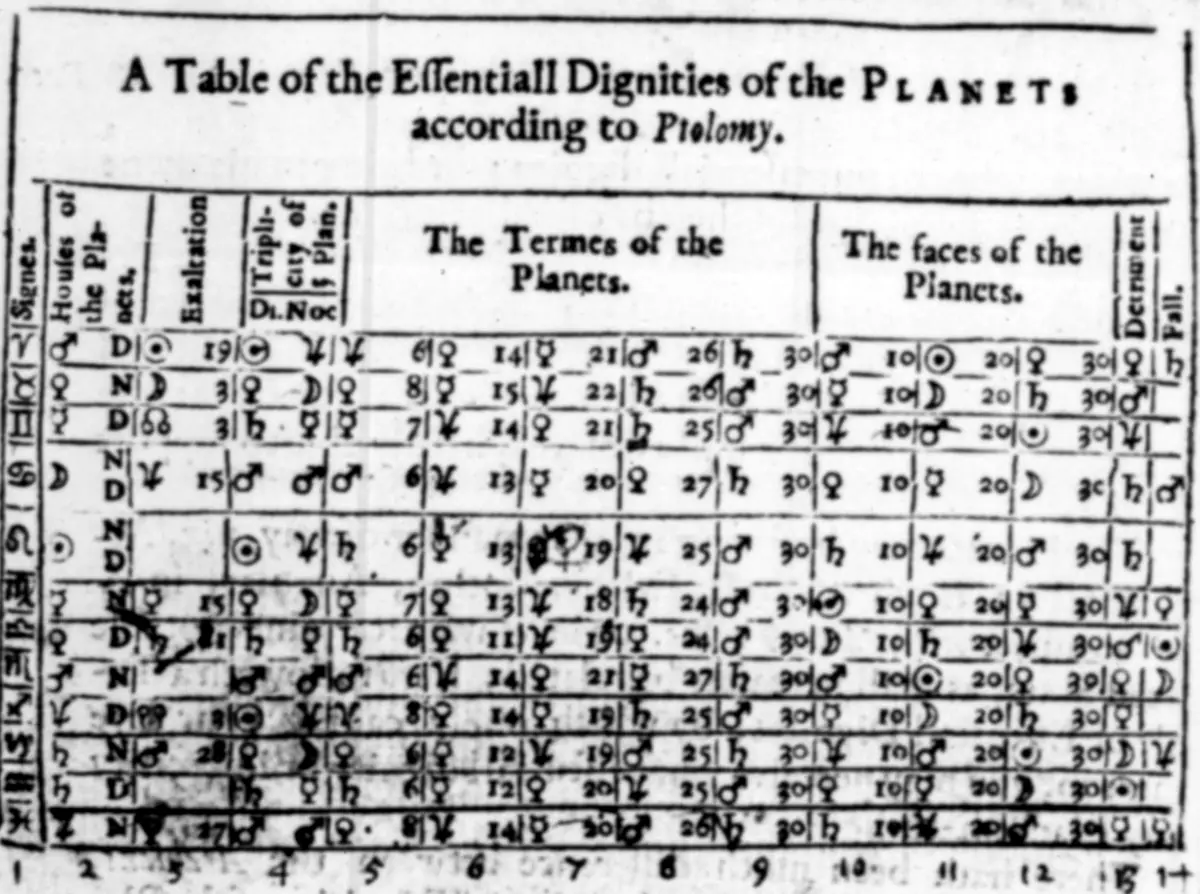
The smaller dignities, terms and faces, divide each sign by degree. Read “Jupiter 0–6” as Jupiter ruling from 0° up to 6°:
| Sign | Terms, by degree | Face 0–10° | Face 10–20° | Face 20–30° |
|---|---|---|---|---|
| Aries | Jupiter 0–6, Venus 6–14, Mercury 14–21, Mars 21–26, Saturn 26–30 | Mars | Sun | Venus |
| Taurus | Venus 0–8, Mercury 8–15, Jupiter 15–22, Saturn 22–26, Mars 26–30 | Mercury | Moon | Saturn |
| Gemini | Mercury 0–7, Jupiter 7–14, Venus 14–21, Saturn 21–25, Mars 25–30 | Jupiter | Mars | Sun |
| Cancer | Mars 0–6, Jupiter 6–13, Mercury 13–20, Venus 20–27, Saturn 27–30 | Venus | Mercury | Moon |
| Leo | Saturn 0–6, Mercury 6–13, Venus 13–19, Jupiter 19–25, Mars 25–30 | Saturn | Jupiter | Mars |
| Virgo | Mercury 0–7, Venus 7–13, Jupiter 13–18, Saturn 18–24, Mars 24–30 | Sun | Venus | Mercury |
| Libra | Saturn 0–6, Venus 6–11, Jupiter 11–19, Mercury 19–24, Mars 24–30 | Moon | Saturn | Jupiter |
| Scorpio | Mars 0–6, Jupiter 6–14, Venus 14–21, Mercury 21–27, Saturn 27–30 | Mars | Sun | Venus |
| Sagittarius | Jupiter 0–8, Venus 8–14, Mercury 14–19, Saturn 19–25, Mars 25–30 | Mercury | Moon | Saturn |
| Capricorn | Venus 0–6, Mercury 6–12, Jupiter 12–19, Mars 19–25, Saturn 25–30 | Jupiter | Mars | Sun |
| Aquarius | Saturn 0–6, Mercury 6–12, Venus 12–20, Jupiter 20–25, Mars 25–30 | Venus | Mercury | Moon |
| Pisces | Venus 0–8, Jupiter 8–14, Mercury 14–20, Mars 20–26, Saturn 26–30 | Saturn | Jupiter | Mars |
Domicile, detriment, exaltation and fall by planet
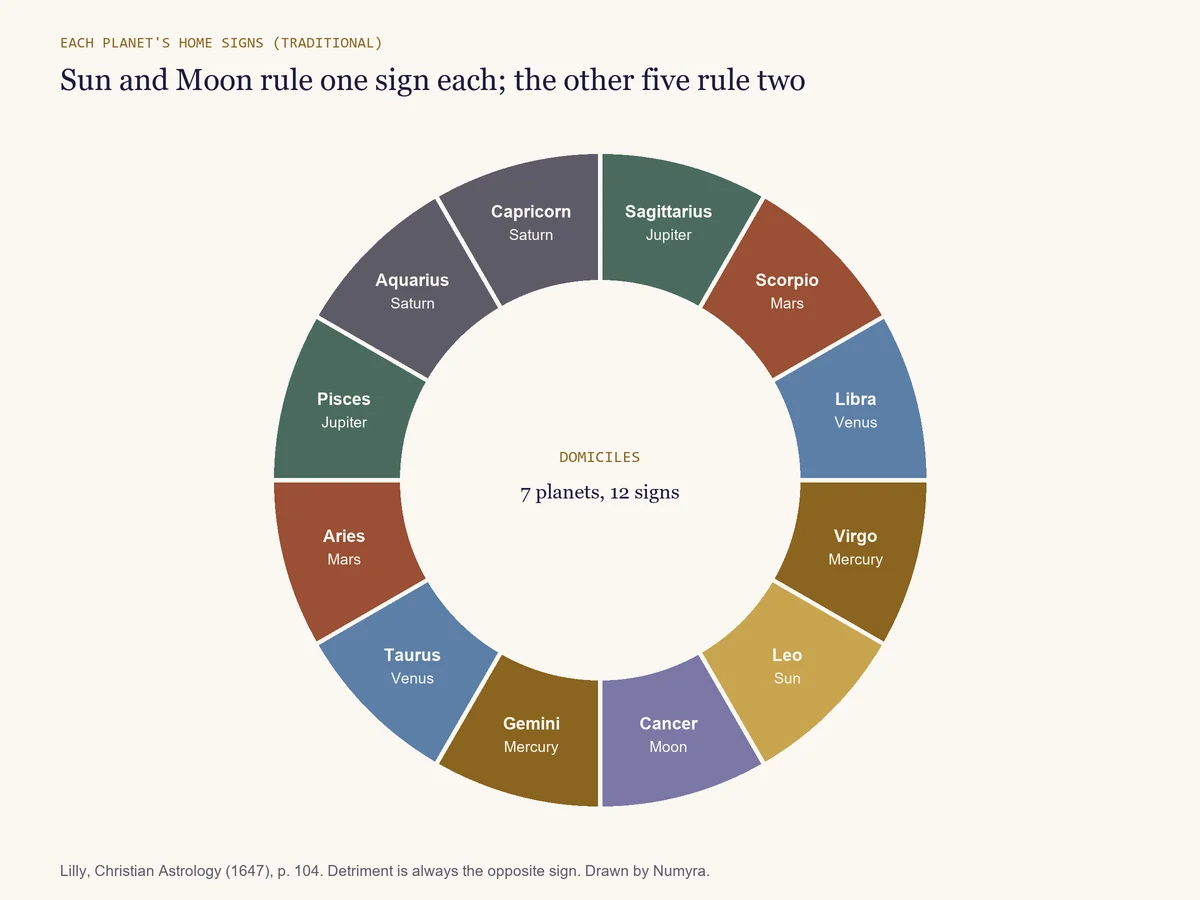
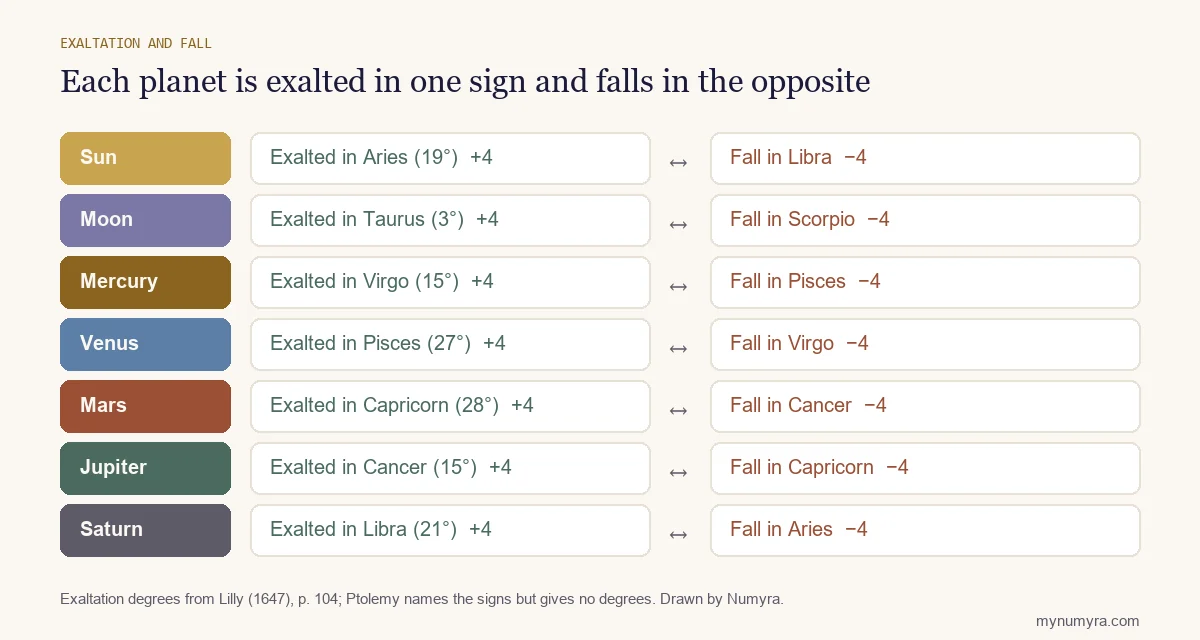
Most people meet essential dignity from the planet’s side: where is Mars strong, and where is it weak? The same table, turned around:
| Planet | Domicile | Detriment | Exaltation | Fall |
|---|---|---|---|---|
| Sun | Leo | Aquarius | Aries (19°) | Libra |
| Moon | Cancer | Capricorn | Taurus (3°) | Scorpio |
| Mercury | Gemini, Virgo | Sagittarius, Pisces | Virgo (15°) | Pisces |
| Venus | Taurus, Libra | Scorpio, Aries | Pisces (27°) | Virgo |
| Mars | Aries, Scorpio | Libra, Taurus | Capricorn (28°) | Cancer |
| Jupiter | Sagittarius, Pisces | Gemini, Virgo | Cancer (15°) | Capricorn |
| Saturn | Capricorn, Aquarius | Cancer, Leo | Libra (21°) | Aries |
Two patterns stand out. Detriment is always the sign directly opposite a domicile, and fall the sign opposite an exaltation. And Mercury is the only planet exalted in one of its own signs: in Virgo it collects 5 for domicile and 4 for exaltation, while in Pisces it suffers both detriment and fall.
Uranus, Neptune and Pluto are not in Lilly’s table; they were discovered in 1781, 1846 and 1930. Many modern astrologers give Uranus to Aquarius, Neptune to Pisces and Pluto to Scorpio, as our sign profiles note, but there is no traditional agreement on their exaltations and no traditional score, so this guide scores only the seven classical planets.
Triplicity: why day and night matter
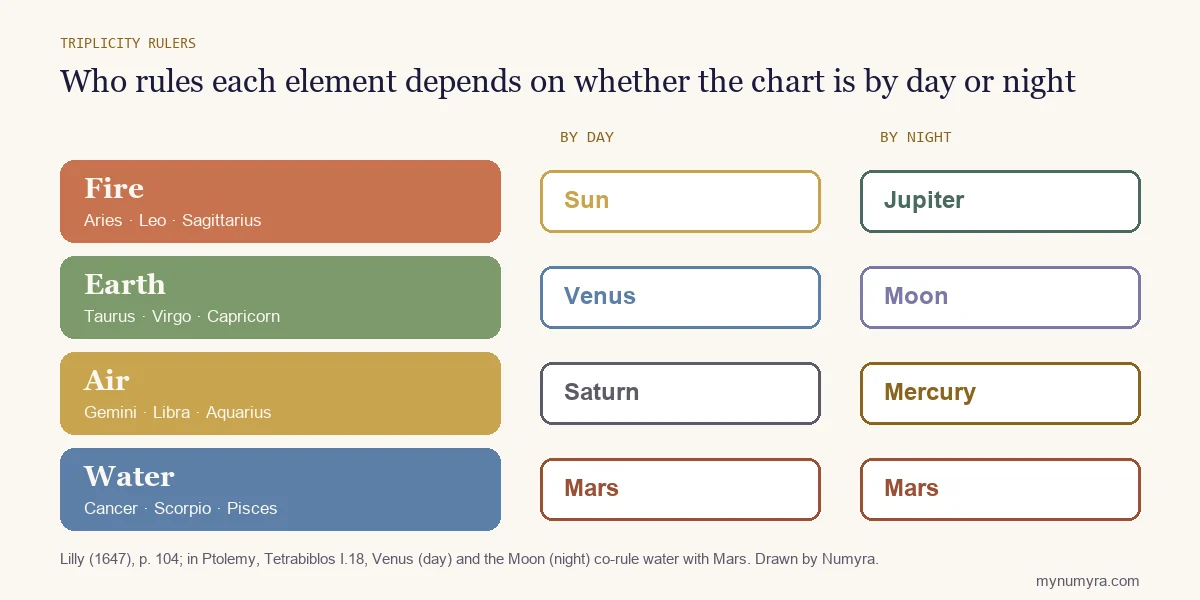
The twelve signs fall into four triplicities, one for each element (our guide to the four elements and three modalities explains the groups). Each triplicity has a ruler by day and a ruler by night, so you need to know whether the Sun was above or below the horizon when the chart was cast:
| Triplicity | Signs | Ruler by day | Ruler by night |
|---|---|---|---|
| Fire | Aries, Leo, Sagittarius | Sun | Jupiter |
| Earth | Taurus, Virgo, Capricorn | Venus | Moon |
| Air | Gemini, Libra, Aquarius | Saturn | Mercury |
| Water | Cancer, Scorpio, Pisces | Mars | Mars |
Lilly spells out the trap on page 102. If a chart is cast by night and the Sun is in Aries, the Sun earns four dignities for its exaltation, “but he shall not be allowed any dignity, as being in his triplicity”, because by night Jupiter rules the fire signs. The one exception is water, which Mars rules in Lilly’s table “night and day”. Ptolemy saw water differently: in Tetrabiblos I.18 Mars rules the water triangle with the Moon by night and Venus by day as co-rulers. Other traditions assign triplicities differently again, which is one more reason to say which table a score comes from.
Terms: one name, two tables
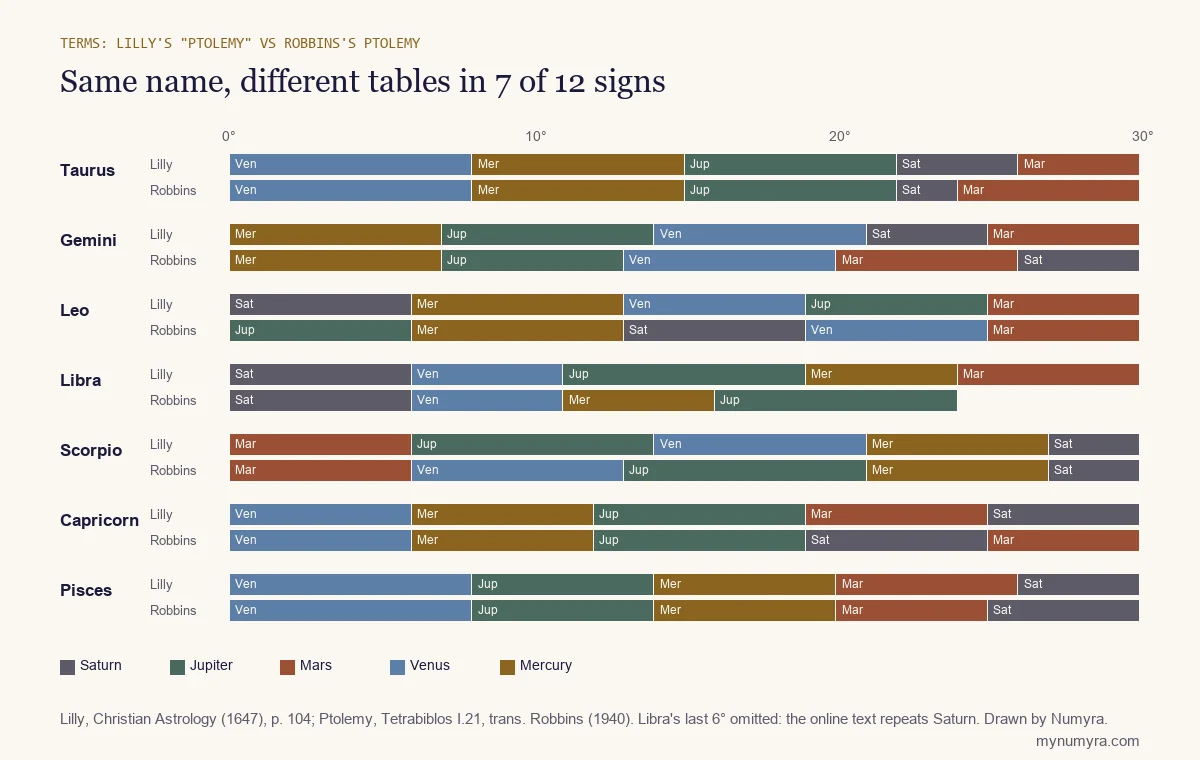
Terms, also called bounds, divide every sign into five unequal stretches, each ruled by one of the five planets other than the Sun and Moon. Ptolemy reports in Tetrabiblos I.20–21 that two systems were in circulation, the Egyptian and the Chaldaean, and then gives a third table of his own, based, he says, on “an ancient manuscript, much damaged”.
Lilly says his table follows Ptolemy. Yet when we compared his terms with the Ptolemaic table in Robbins’s Loeb translation, they matched in only five signs: Aries, Cancer, Virgo, Sagittarius and Aquarius. In the other seven, the order or the widths differ:
| Sign | Lilly, 1647 | Ptolemy, trans. Robbins (1940) |
|---|---|---|
| Taurus | Venus 0–8, Mercury 8–15, Jupiter 15–22, Saturn 22–26, Mars 26–30 | Venus 0–8, Mercury 8–15, Jupiter 15–22, Saturn 22–24, Mars 24–30 |
| Gemini | Mercury 0–7, Jupiter 7–14, Venus 14–21, Saturn 21–25, Mars 25–30 | Mercury 0–7, Jupiter 7–13, Venus 13–20, Mars 20–26, Saturn 26–30 |
| Leo | Saturn 0–6, Mercury 6–13, Venus 13–19, Jupiter 19–25, Mars 25–30 | Jupiter 0–6, Mercury 6–13, Saturn 13–19, Venus 19–25, Mars 25–30 |
| Libra | Saturn 0–6, Venus 6–11, Jupiter 11–19, Mercury 19–24, Mars 24–30 | Saturn 0–6, Venus 6–11, Mercury 11–16, Jupiter 16–24, then 24–30 |
| Scorpio | Mars 0–6, Jupiter 6–14, Venus 14–21, Mercury 21–27, Saturn 27–30 | Mars 0–6, Venus 6–13, Jupiter 13–21, Mercury 21–27, Saturn 27–30 |
| Capricorn | Venus 0–6, Mercury 6–12, Jupiter 12–19, Mars 19–25, Saturn 25–30 | Venus 0–6, Mercury 6–12, Jupiter 12–19, Saturn 19–25, Mars 25–30 |
| Pisces | Venus 0–8, Jupiter 8–14, Mercury 14–20, Mars 20–26, Saturn 26–30 | Venus 0–8, Jupiter 8–14, Mercury 14–20, Mars 20–25, Saturn 25–30 |
Lilly does not say which copy of Ptolemy he worked from, and we are not claiming either table is “wrong”. The practical point is that the same placement can score differently. Mars at 27° Capricorn falls in Saturn’s terms in Lilly’s table, but in Mars’s own terms in Robbins’s Ptolemaic table (25–30°) and in the Egyptian terms (26–30°), worth 2 extra points. Our worked examples below follow Lilly, because his scores were designed for his table; if you use another table, say so.
Faces and decans
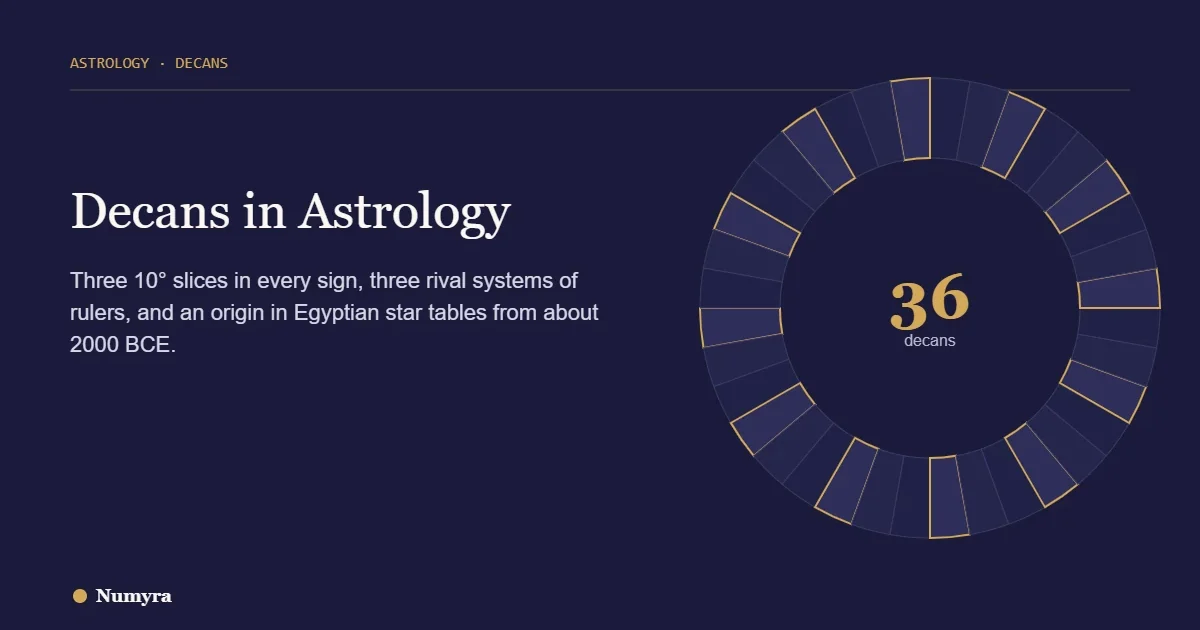
Faces split each sign into three 10° sections. Lilly’s faces start with Mars at 0° Aries and then follow the old order of the planets from slowest to fastest (Saturn, Jupiter, Mars, the Sun, Venus, Mercury, the Moon) all the way round the zodiac, which is why Aries runs Mars, Sun, Venus and Taurus runs Mercury, Moon, Saturn. Faces are the same thing as decans; our guide to the 36 decans covers their dates, meanings and the other ruler systems.
One trap: when Ptolemy uses the word “face” in Tetrabiblos I.23, he means something else entirely. His “proper face” is a planet that keeps “to the sun or moon the same aspect which its house has to their houses”, an aspect relationship, not a 10° slice of a sign. Lilly’s one point is for the 10° decan face.
Worked examples: scoring a planet
To score a planet, check its sign and degree against each column of Lilly’s table, add the dignities and subtract the debilities. Six examples, all worked from the tables above:
| Placement | Dignities | Debilities | Lilly total |
|---|---|---|---|
| Sun at 15° Aries, day chart | exaltation +4, triplicity +3, face +1 | none | +8 |
| Sun at 15° Aries, night chart | exaltation +4, face +1 | none | +5 |
| Moon at 3° Taurus, night chart | exaltation +4, triplicity +3 | none | +7 |
| Mars at 27° Capricorn | exaltation +4 | none | +4 |
| Venus at 10° Aries | terms +2 | detriment −5 | −3 |
| Sun at 15° Cancer | none | peregrine −5 | −5 |
The first two rows are Lilly’s own example: the same Sun loses its triplicity points at night. The Moon at 3° Taurus is in its exaltation and, at night, rules the earth triplicity too. Mars at 27° Capricorn shows the terms problem from the last section: +4 by Lilly’s table, +6 by the Egyptian or Robbins terms.
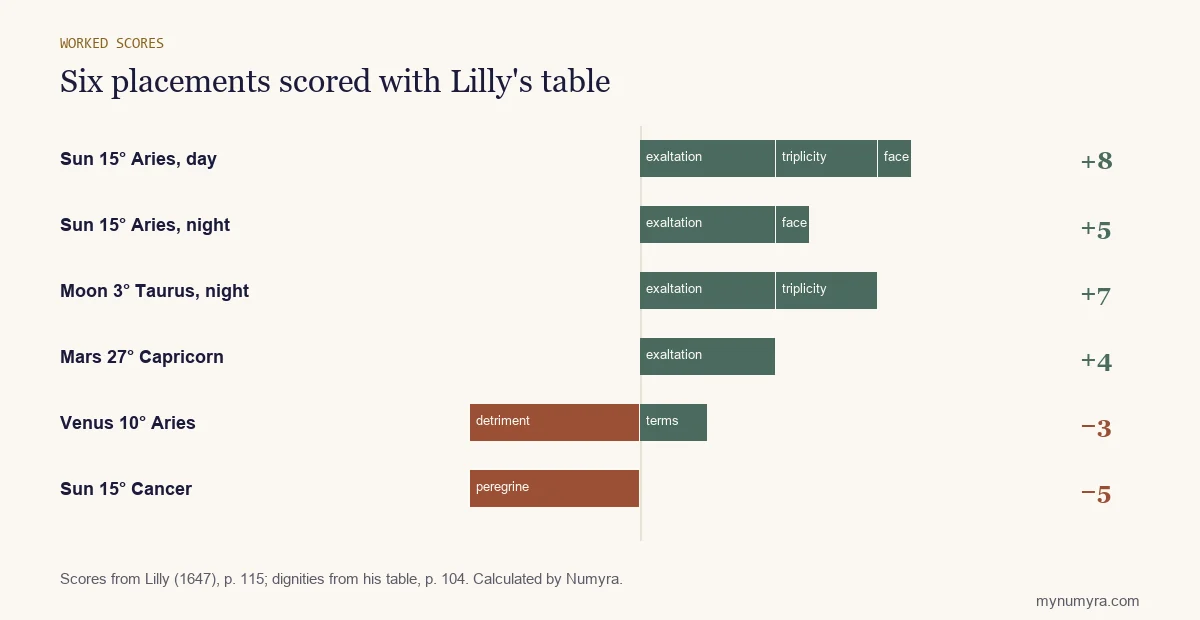
Venus at 10° Aries shows that dignity and debility can coexist: Aries is Venus’s detriment, but 6–14° Aries is Venus’s own term, so it scores −5 and +2, a net −3, and it is not peregrine. The Sun in Cancer has nothing at all: Lilly himself writes on page 112 that the Sun “in any part of” Cancer is peregrine. Lilly’s pages on dignity do not spell out whether peregrine should be counted on top of detriment or fall, so practice varies when a planet is in both.
Essential dignity is only half of Lilly’s assessment. On the same page 115 he scores accidental factors too: a planet in the 1st or 10th house gains 5, and one that is retrograde loses 5 (our guide to what retrograde actually means explains the motion). House positions need a full chart, which our Birth Chart calculator can start for the Sun, Moon and Rising sign; our guide to the twelve houses covers what each one means.
Frequently asked questions
What are the five essential dignities?
Domicile (a planet in a sign it rules), exaltation, triplicity, terms (also called bounds) and face (also called decan). William Lilly scored them +5, +4, +3, +2 and +1 in Christian Astrology (1647).
What is the difference between detriment and fall?
Detriment is the sign opposite a planet’s domicile, such as Venus in Aries, and Lilly scores it −5. Fall is the sign opposite its exaltation, such as Saturn in Aries, scored −4. That is where Saturn sits for the Saturn returns of 2026.
What does peregrine mean in astrology?
A planet is peregrine when it has no essential dignity of any kind at its degree: not domicile, exaltation, triplicity, terms or face. Lilly scores it −5. His own example is the Sun anywhere in Cancer.
What are the exaltation degrees?
In Lilly’s table: the Sun 19° Aries, the Moon 3° Taurus, Mercury 15° Virgo, Venus 27° Pisces, Mars 28° Capricorn, Jupiter 15° Cancer and Saturn 21° Libra. Lilly still gives the full four points anywhere in the exaltation sign.
Do Uranus, Neptune and Pluto have essential dignities?
Not in the traditional system, which was built before they were discovered. Many modern astrologers assign Uranus to Aquarius, Neptune to Pisces and Pluto to Scorpio as rulers, but there is no traditional score for them.
Which table of essential dignities should I use?
Lilly’s table is the one his point scores were designed for, so it is the natural choice if you use those scores. Some astrologers prefer the older Egyptian terms. The terms are where tables differ most, so state which table a score comes from.
Is essential dignity the same as accidental dignity?
No. Essential dignity comes from a planet’s sign and degree. Accidental dignity comes from its house position, speed, direction and aspects in a particular chart. Lilly scores both, separately.
Sources
- Lilly, William. Christian Astrology. London, 1647. Pp. 101–104 (dignities and table), 112 (peregrine), 115 (scores). Internet Archive scan.
- Ptolemy. Tetrabiblos I.17–23, trans. F. E. Robbins. Loeb Classical Library, 1940. LacusCurtius.
- Houlding, Deborah. “Table of Essential Dignities.” Skyscript. Used to cross-check our transcription of Lilly’s table.
- Numyra Methodology Desk. Table transcribed from the 1647 scan; worked scores calculated by script from that transcription.