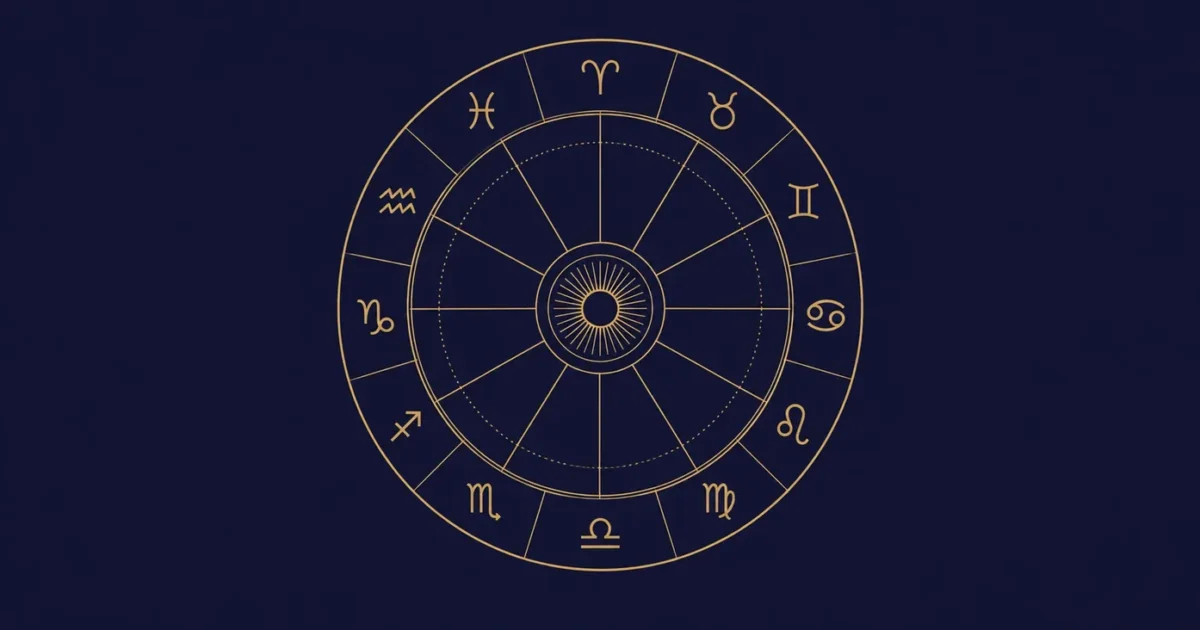
Every one of the 12 zodiac signs belongs to one of four elements and one of three modalities — and knowing both, together, explains a lot that knowing your sign alone doesn’t.
Key takeaways
- The 12 signs split into 4 elements (fire, earth, air, water — 3 signs each) and 3 modalities (cardinal, fixed, mutable — 4 signs each). Every sign has exactly one of each.
- Element and modality come from two genuinely separate historical sources: the four elements trace to the philosopher Empedocles (c. 450 BCE), while the specific idea of linking them to the zodiac signs first appears in Marcus Manilius’s Astronomica (1st century CE) — a full century before Ptolemy’s more famous Tetrabiblos.
- Two signs sharing an element (like Aries and Leo, both fire) still differ in modality — same underlying temperament, different pacing.
- This is the same element logic behind Numyra’s own Zodiac Compatibility calculator — Fire and Air are traditionally read as complementary, as are Earth and Water.
- Nothing here is a claim that this framework predicts real-world outcomes — a cultural tradition, presented for reflection and entertainment.
The four elements
Each sign belongs to one of four elements, and each element covers exactly three signs, spaced evenly around the zodiac:
| Element | Signs | Traditionally read as |
|---|---|---|
| Fire | Aries, Leo, Sagittarius | Passion, initiative, energy |
| Earth | Taurus, Virgo, Capricorn | Practicality, stability, the material world |
| Air | Gemini, Libra, Aquarius | Intellect, communication, ideas |
| Water | Cancer, Scorpio, Pisces | Emotion, intuition, depth |
This is the exact grouping Numyra’s Zodiac Compatibility calculator uses: Fire and Air are traditionally read as complementary (air feeds fire), Earth and Water are traditionally read as complementary (water nourishes earth), and pairings across the other combinations are read as more different in temperament — not worse, just different.
The three modalities
Separately, each sign also belongs to one of three modalities, which describe less what a sign is like and more how it tends to move through a situation:
| Modality | Signs | Traditionally read as |
|---|---|---|
| Cardinal | Aries, Cancer, Libra, Capricorn | Initiating — starts each season |
| Fixed | Taurus, Leo, Scorpio, Aquarius | Sustaining — holds a season at its peak |
| Mutable | Gemini, Virgo, Sagittarius, Pisces | Adapting — bridges into the next season |
The cardinal signs each open a season (Aries opens spring, Cancer opens summer, Libra opens autumn, Capricorn opens winter); the fixed signs sit in the middle of a season, when its character is most fully settled in; the mutable signs close a season out, easing the transition to the next one. The English names are modern, but the underlying distinction is ancient — Hellenistic astrologers described the same three categories using different Greek terms: tropical (“turning”) for what’s now called cardinal, solid (“steadfast”) for fixed, and double-bodied (“changing”) for mutable.
Where this framework actually comes from
Most explanations of zodiac elements treat “the four elements” and “the zodiac’s four elements” as though they arrived together. They didn’t — and the real sequence is more interesting than the usual shorthand.
The four elements themselves start with Empedocles, a philosopher from Akragas in Sicily working around 450 BCE. He called fire, earth, air and water “roots” rather than elements, named for Greek gods, and proposed that two opposing forces — Love and Strife — combine and separate them to form everything else. It was Plato who first used the word “elements” for them, and Aristotle who later refined the system and added a fifth, aether, for the heavens.
Applying those four elements specifically to the zodiac signs came later still, and from a different source than most people assume. The earliest surviving text to link them is Marcus Manilius’s Astronomica, a five-book Latin poem composed in the early 1st century CE — the oldest comprehensive work on astrological theory that survives today. That’s roughly a century before Claudius Ptolemy’s far more famous Tetrabiblos, and the timing matters for a specific reason: when Ptolemy discusses the same four three-sign groupings (what astrologers call “triplicities”), he doesn’t actually label them fire, earth, air and water in that passage — he ties them instead to the four cardinal directions and their winds. Ptolemy’s real, documented contribution was codifying the modality system (tropical/solid/double-bodied) with precision — the element labels most people now take for granted trace to Manilius, not to astrology’s most famous ancient text.
Why knowing both together tells you more
Two signs can share an element and still feel different, because modality is a separate axis. Aries and Leo are both fire signs — but Aries is cardinal (fire that starts things, quickly) and Leo is fixed (fire that holds steady once lit). Cancer and Scorpio are both water signs — Cancer cardinal (emotion that initiates connection), Scorpio fixed (emotion that runs deep and doesn’t let go). The element says what kind of energy a sign carries; the modality says how that energy tends to move. Reading only one axis misses half the picture — which is exactly why Numyra’s compatibility calculator and sign profiles reference both, not just one.
Every sign, by element and modality
| Sign | Element | Modality |
|---|---|---|
| Aries | Fire | Cardinal |
| Taurus | Earth | Fixed |
| Gemini | Air | Mutable |
| Cancer | Water | Cardinal |
| Leo | Fire | Fixed |
| Virgo | Earth | Mutable |
| Libra | Air | Cardinal |
| Scorpio | Water | Fixed |
| Sagittarius | Fire | Mutable |
| Capricorn | Earth | Cardinal |
| Aquarius | Air | Fixed |
| Pisces | Water | Mutable |
Frequently asked questions
What element is my zodiac sign?
Check the table above, or your full sign profile — every Numyra sign page states its element and modality directly.
What does it mean if I have no fire signs anywhere in my chart?
This framework is usually applied to a full birth chart (Sun, Moon, Rising and the planets), not just your Sun sign — a “missing” element there is read as an area you may need to consciously develop rather than one that comes naturally. Numyra’s own Sun-sign-based content covers the single-sign version of this; a full missing-element reading needs a complete birth chart, which we don’t offer yet — see our Birth Chart calculator page for why.
What’s the actual difference between an element and a modality?
Element describes a sign’s basic temperament (fire/earth/air/water); modality describes how that temperament tends to move through a season or situation (cardinal/fixed/mutable). Every sign has exactly one of each, and no two signs share both — which is why all 12 combinations are unique.
Which zodiac signs are cardinal, fixed, or mutable?
Cardinal: Aries, Cancer, Libra, Capricorn. Fixed: Taurus, Leo, Scorpio, Aquarius. Mutable: Gemini, Virgo, Sagittarius, Pisces — see the full table above for each sign’s element too.
Are fire and water signs compatible?
Traditionally read as a contrasting pairing rather than a complementary one — more different in temperament, not “incompatible.” See our Zodiac Compatibility calculator for how each specific pairing is traditionally read.
Sources
- “Empedocles.” MacTutor History of Mathematics Archive, University of St Andrews.
- “Marcus Manilius.” Wikipedia. Background on the Astronomica‘s composition date and its role as the earliest source linking the four elements to the zodiac signs.
- “Astronomica (Manilius).” Wikipedia. Background on the poem’s five books and its treatment of the zodiac.
- “Triplicity.” Wikipedia. On Ptolemy’s triplicity/directional-winds framing versus the element-labeled version.
- Numyra Methodology Desk. Astrology framework and sourcing standard.