Moon Sign Meanings: What Each One Means
Your Moon sign is traditionally read as your inner emotional life — what you actually need to feel settled, separate from how you present outwardly or your core Sun-sign identity.
Key takeaways
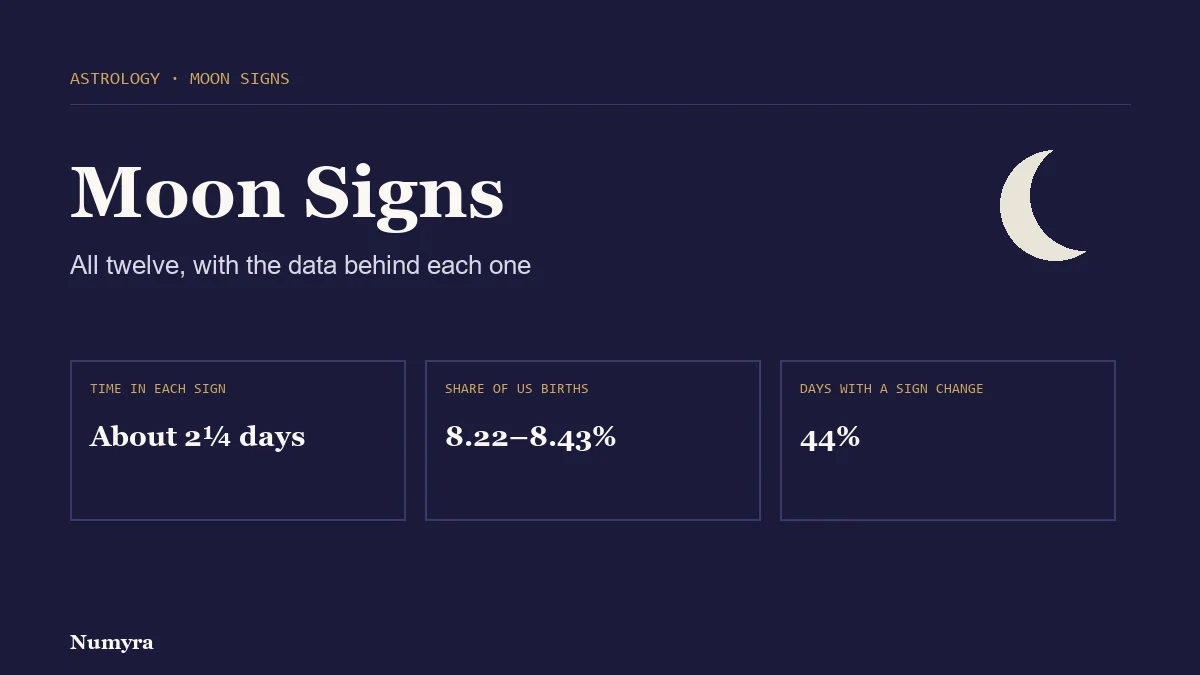
- The Moon changes sign on about 44% of days. On the other 56%, your birth date alone settles your Moon sign; on a change day you also need your birth time and place.
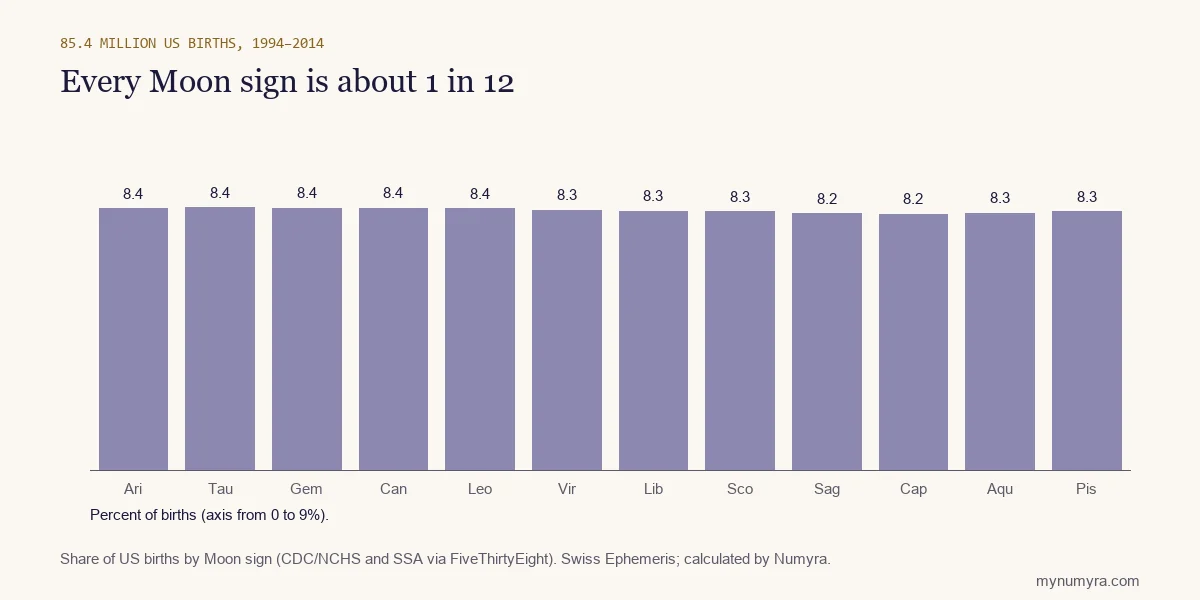
- The Moon stays in each sign for about 2¼ days and visits all 12 every 27.3 days, so every Moon sign is about equally common: 8.2% to 8.4% of US births from 1994 to 2014.
- Each Moon sign is traditionally read for emotional needs, comfort patterns, and what "feeling safe" looks like for that sign — a genuinely different angle from the same sign's Sun-sign reading.
- Nothing here is medical, financial, legal, or psychological advice — a cultural tradition, presented for reflection.
Every Moon sign
| Sign | Traditionally read as | Share of US births |
|---|---|---|
| Aries | Traditionally read as the quickest, most reactive placement of the Moon — feelings arrive fast, show up immediately, and tend to pass just as quickly once expressed. | 8.39% |
| Taurus | Traditionally read as the steadiest placement of the Moon — feelings take time to register, but once settled they run deep and are slow to shift. | 8.43% |
| Gemini | Traditionally read as the most verbally processed placement of the Moon — feelings are worked out by talking and thinking them through, not just sitting with them. | 8.42% |
| Cancer | Traditionally read as the Moon's own sign — the placement where its instincts are considered strongest and most natural, deeply nurturing and protective by default. | 8.41% |
| Leo | Traditionally read as the warmest, most expressive placement of the Moon — feelings are big, generous, and meant to be seen rather than kept quiet. | 8.39% |
| Virgo | Traditionally read as the most practically expressed placement of the Moon — care shows up through usefulness and order rather than open displays of feeling. | 8.35% |
| Libra | Traditionally read as the most relationally processed placement of the Moon — emotional wellbeing is closely tied to harmony with the people closest to them. | 8.32% |
| Scorpio | Traditionally read as the most emotionally private placement of the Moon — feelings run deep, but they're rarely shown at full strength until trust is earned. | 8.3% |
| Sagittarius | Traditionally read as the most freedom-seeking placement of the Moon — emotional wellbeing depends on room to roam, physically or otherwise. | 8.23% |
| Capricorn | Traditionally read as the most self-contained placement of the Moon — feelings are managed quietly, often through structure and responsibility rather than open display. | 8.22% |
| Aquarius | Traditionally read as the most intellectually processed placement of the Moon — feelings are understood with a degree of distance before they're fully felt. | 8.26% |
| Pisces | Traditionally read as an especially deep placement of the Moon — emotional sensitivity and intuition run strong, often absorbing what's felt by everyone nearby. | 8.3% |
Beyond the Moon sign: two points from the Moon's orbit
Two more placements in a birth chart come from the shape of the Moon's orbit rather than the Moon itself. The North Node is where the orbit crosses the Sun's path going north, and Black Moon Lilith is the orbit's farthest point from Earth. Day to day, astrologers also watch the Moon's phases and the void-of-course Moon before it changes sign.
Frequently asked questions
Can I find my Moon sign from my birth date alone?
Often, but not always. The Moon changes sign on roughly 44% of days, and on those days you need your birth time as well. Our Birth Chart calculator works it out from your birth date, time and place.
How is a Moon sign different from a Sun sign?
Your Sun sign is traditionally read as core identity; your Moon sign as inner emotional life, what you need to feel settled, which can be a different sign from your Sun. See our Sun, Moon and Rising explainer for the full picture.
Which Moon sign is the most common?
They are almost equal. Among 85.4 million US births from 1994 to 2014, every Moon sign had between 8.22% and 8.43% of births, about 1 in 12 each.
How long does the Moon stay in each sign?
About 2.28 days on average (from 1.96 to 2.54 days in our 2000–2009 check), completing the whole zodiac every 27.3 days.
Sources
- Numyra Editorial Desk. Sun, Moon and Rising Sign: What Each One Actually Means.
- Astrodienst. Swiss Ephemeris. Used for every Moon position and date on these pages.
- FiveThirtyEight. US births data, 1994–2014, from the CDC National Center for Health Statistics and the Social Security Administration.
- Numyra Methodology Desk. Astrology calculation standard.