The North Node is not a planet. It is a point in the sky where the Moon’s orbit crosses the Sun’s apparent path, and in astrology it is read as the direction you are meant to grow toward. Here is what it really is, what your North Node sign means, and where that reading came from.
Key takeaways
- The North Node (the Moon’s ascending node) is the point where the Moon’s orbit crosses the ecliptic heading north. The South Node sits exactly opposite.
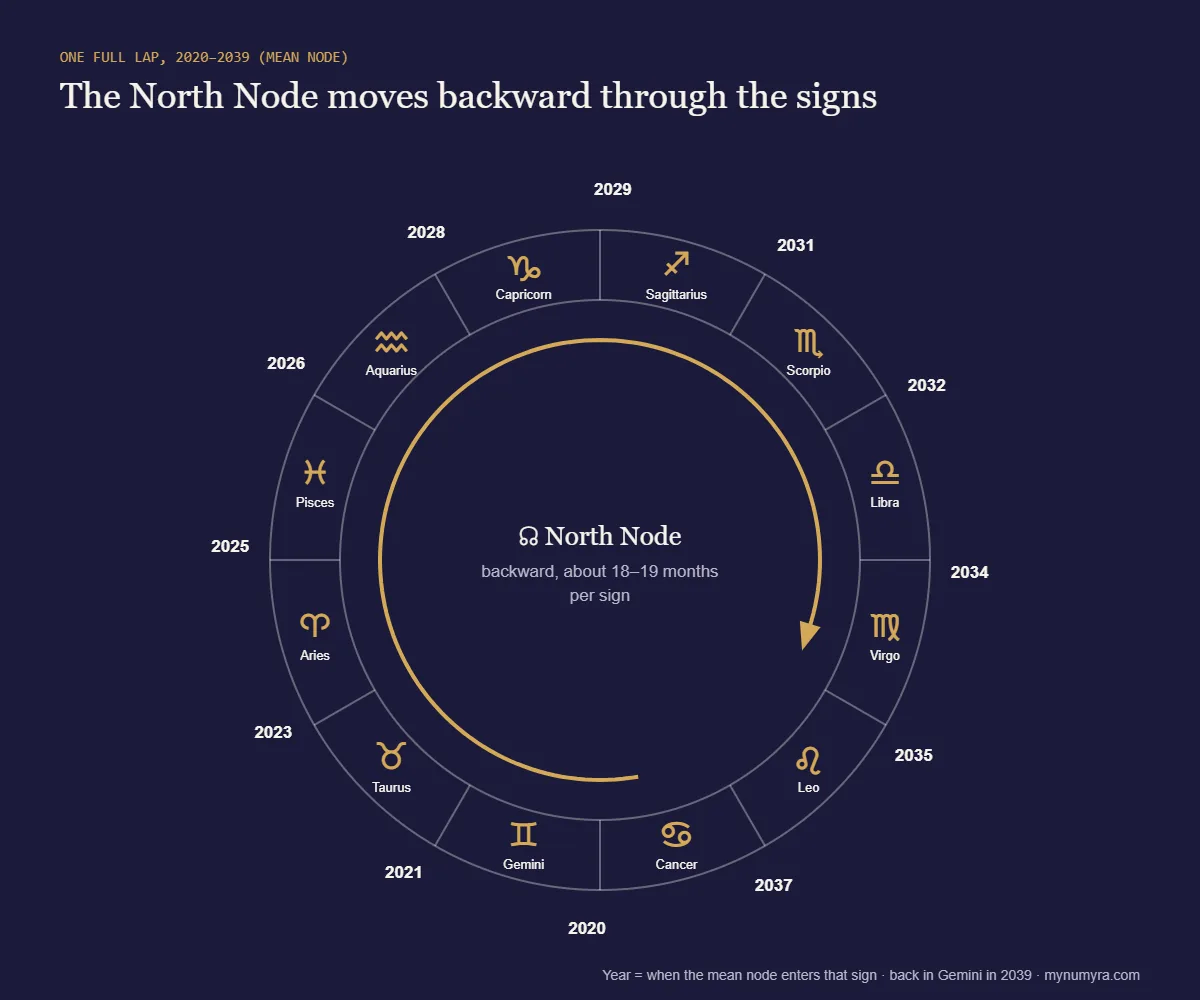
- The nodes move backward through the zodiac and complete a full circle every 18.6 years, spending roughly 18 to 19 months in each sign. That is why everyone born within the same stretch of about a year and a half shares a North Node sign.
- Eclipses only happen when the Sun is near one of the nodes, which is where their reputation as “fate” points comes from.
- Seventeenth-century astrology called the North Node the Dragon’s Head and treated it as lucky, a “Fortune”. The “soul purpose” and past-life reading most sites use today was popularised by 20th-century books.
- Use the table below to find your North Node sign from your birth date. It gives both the mean-node and true-node dates, which can differ by up to about five weeks.
- Nothing here is medical, financial, legal, or psychological advice. It is a cultural tradition, presented for reflection.
In this guide
- What the North Node actually is
- North Node vs. South Node
- Why the nodes are tied to eclipses
- Mean node vs. true node
- Find your North Node sign by birth date
- What each North Node sign is read as
- North Node by house
- What older astrology said: the Dragon’s Head and Tail
- Where the “karmic” reading came from
- Nodal returns: ages 18, 37 and 56
- The North Node in 2026
- Frequently asked questions
What the North Node actually is
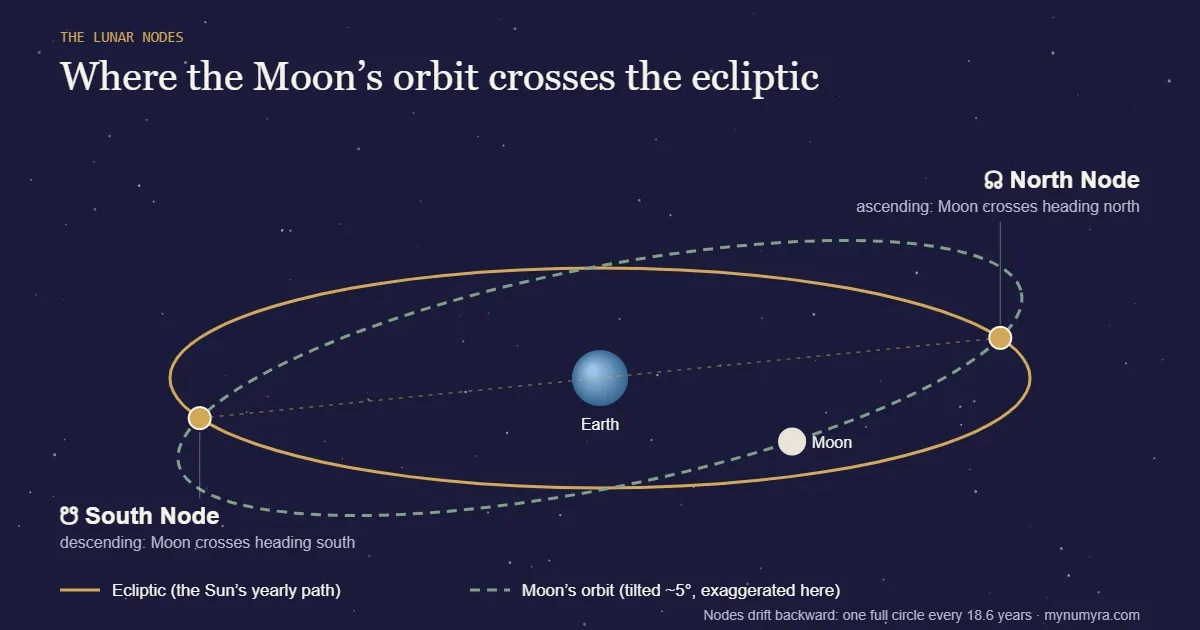
The Moon’s orbit around Earth is tilted about 5° against the ecliptic, the path the Sun appears to follow through the zodiac over a year. Two tilted circles cross at two points, and those crossing points are the lunar nodes. NASA’s eclipse site puts it simply: “The node where the Moon’s path crosses the ecliptic from south to north is the ascending node.” In astrology the ascending node is the North Node, and the descending node is the South Node.
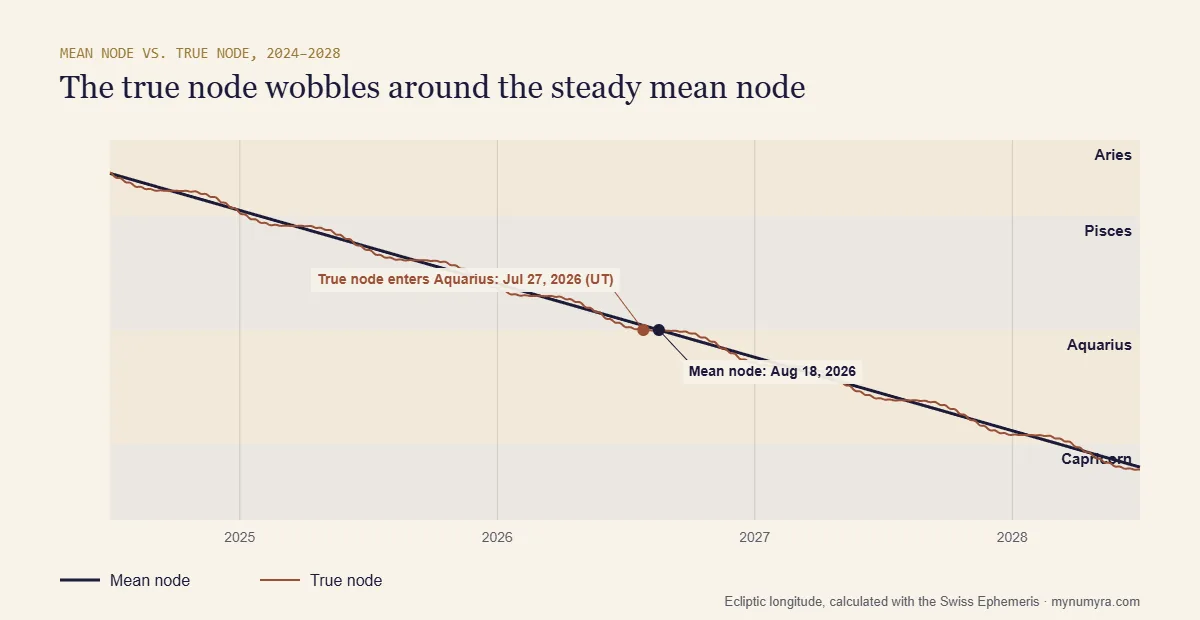
Because the nodes are crossing points rather than objects, nothing is physically “there”. They are calculated, in the same way a rising sign is calculated from the horizon rather than seen. And unlike the planets, the nodes move backward all the time, not just during an apparent retrograde phase. In NASA’s words, “the lunar nodes slowly rotate west or retrograde (opposite the Moon’s orbital motion) along the ecliptic”, and “One complete rotation of the ascending node about the ecliptic requires 18.6 years.” Divide 18.6 years by twelve signs and you get the North Node spending roughly 18 to 19 months in each sign, moving backward from Aries into Pisces, then Aquarius, and so on.
North Node vs. South Node
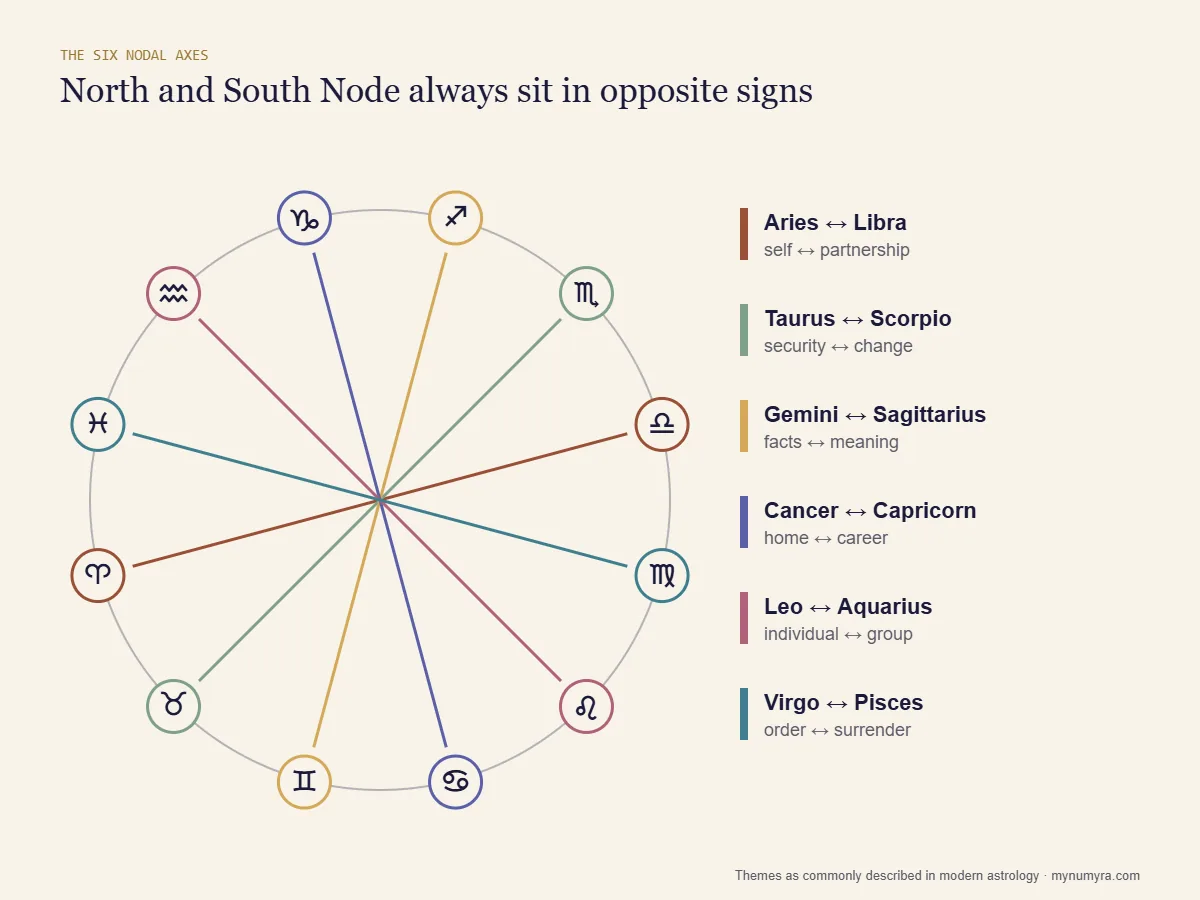
The two nodes are always exactly 180° apart, so if you know one you know the other: a North Node in Aries always comes with a South Node in Libra. Modern astrology reads them as one axis. The South Node is read as what comes naturally, habits and skills you lean on by default. The North Node is read as the less comfortable direction that brings growth when you move toward it. In a full birth chart, the house each node falls in is read as the area of life where that pull plays out; our guide to the astrological houses explains how houses work.
Why the nodes are tied to eclipses
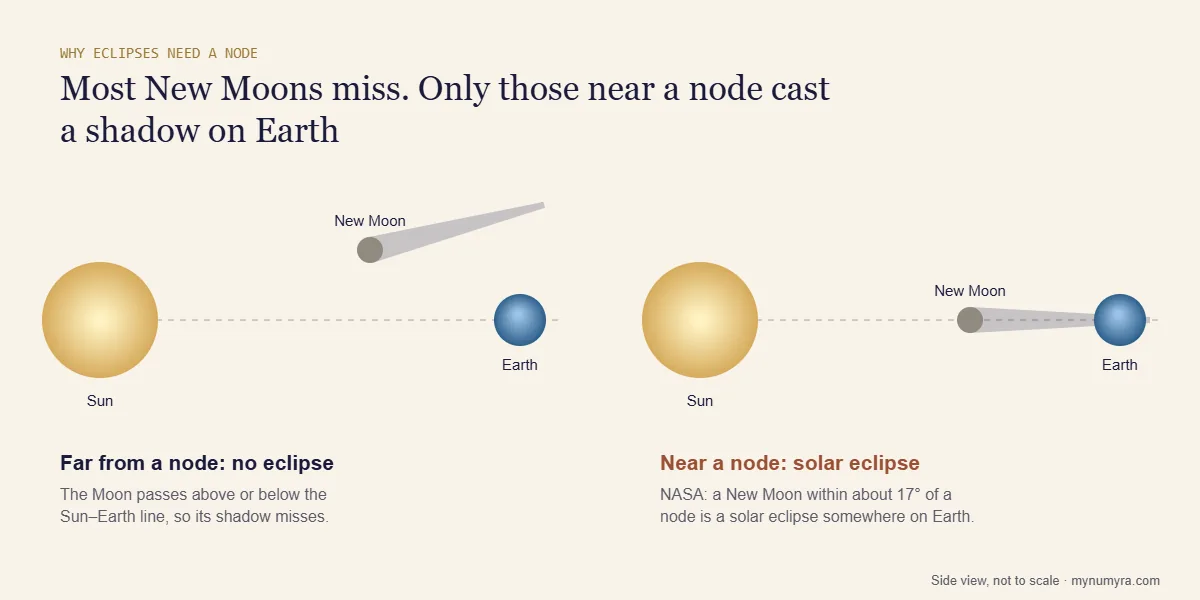
An eclipse needs the Sun, Moon and Earth to line up in three dimensions, not just two. Because the Moon’s orbit is tilted, most New and Full Moons pass a little above or below the Sun’s path and nothing happens. Only when a New or Full Moon falls close to a node does the shadow actually land. NASA gives the rule for solar eclipses: “If New Moon takes place within about 17° of a node, then a solar eclipse will be visible from some location on Earth.” That is why eclipses come in “seasons” roughly six months apart, as the Sun passes one node and then the other, and why the eclipse seasons slowly shift through the calendar as the nodes move backward. It is also the most likely root of the nodes’ old reputation as points of fate: they mark where the lights can be swallowed.
Mean node vs. true node
There are two standard ways to calculate the node. The mean node smooths the motion into a steady backward drift of about 0.053° a day. The true node follows the Moon’s real, wobbling orbit, so it occasionally stands still or even moves forward for a while and can sit up to about 2° away from the mean position (1.96° at most between 1940 and 2040, by our calculation). Near a sign boundary that wobble can make the true node cross the same line more than once: in December 2007 it moved from Pisces into Aquarius, back into Pisces and into Aquarius again within four days. Astrologers disagree about which to use, and both are in common software. The practical effect is on dates: in early 2025 the true node entered Pisces on January 11, while the mean node, by our calculation, entered on January 29. For most birthdays the choice makes no difference. The two methods put the sign change up to about five weeks apart, so if you were born between the two dates in the table below, your sign depends on which method you use.
Find your North Node sign by birth date
We calculated these dates ourselves with the Swiss Ephemeris, the open astronomical library behind much astrology software, for both the mean node and the true node. As a cross-check, the mean-node dates agree to within about three hours with the standard mean-node formula in Jean Meeus’s Astronomical Algorithms, which gives a full cycle of 18.61 years, matching NASA’s figure. Find the row that contains your birth date. The South Node is always the opposite sign.
| From (mean node) | Until (mean node) | North Node | South Node | True node enters |
|---|---|---|---|---|
| Apr 27, 1941 | Nov 15, 1942 | Virgo | Pisces | May 24, 1941 |
| Nov 15, 1942 | Jun 3, 1944 | Leo | Aquarius | Nov 21, 1942 |
| Jun 3, 1944 | Dec 22, 1945 | Cancer | Capricorn | May 11, 1944 |
| Dec 22, 1945 | Jul 11, 1947 | Gemini | Sagittarius | Dec 2, 1945 † |
| Jul 11, 1947 | Jan 28, 1949 | Taurus | Scorpio | Aug 2, 1947 |
| Jan 28, 1949 | Aug 17, 1950 | Aries | Libra | Jan 25, 1949 |
| Aug 17, 1950 | Mar 6, 1952 | Pisces | Virgo | Jul 26, 1950 |
| Mar 6, 1952 | Sep 23, 1953 | Aquarius | Leo | Mar 28, 1952 |
| Sep 23, 1953 | Apr 13, 1955 | Capricorn | Cancer | Oct 9, 1953 |
| Apr 13, 1955 | Oct 30, 1956 | Sagittarius | Gemini | Apr 2, 1955 |
| Oct 30, 1956 | May 20, 1958 | Scorpio | Taurus | Oct 4, 1956 |
| May 20, 1958 | Dec 7, 1959 | Libra | Aries | Jun 16, 1958 |
| Dec 7, 1959 | Jun 26, 1961 | Virgo | Pisces | Dec 15, 1959 |
| Jun 26, 1961 | Jan 13, 1963 | Leo | Aquarius | Jun 10, 1961 |
| Jan 13, 1963 | Aug 2, 1964 | Cancer | Capricorn | Dec 23, 1962 |
| Aug 2, 1964 | Feb 19, 1966 | Gemini | Sagittarius | Aug 25, 1964 |
| Feb 19, 1966 | Sep 9, 1967 | Taurus | Scorpio | Feb 19, 1966 |
| Sep 9, 1967 | Mar 29, 1969 | Aries | Libra | Aug 19, 1967 |
| Mar 29, 1969 | Oct 16, 1970 | Pisces | Virgo | Apr 19, 1969 |
| Oct 16, 1970 | May 5, 1972 | Aquarius | Leo | Nov 2, 1970 |
| May 5, 1972 | Nov 22, 1973 | Capricorn | Cancer | Apr 27, 1972 |
| Nov 22, 1973 | Jun 12, 1975 | Sagittarius | Gemini | Oct 27, 1973 |
| Jun 12, 1975 | Dec 29, 1976 | Scorpio | Taurus | Jul 10, 1975 |
| Dec 29, 1976 | Jul 19, 1978 | Libra | Aries | Jan 7, 1977 |
| Jul 19, 1978 | Feb 5, 1980 | Virgo | Pisces | Jul 5, 1978 |
| Feb 5, 1980 | Aug 25, 1981 | Leo | Aquarius | Jan 5, 1980 † |
| Aug 25, 1981 | Mar 14, 1983 | Cancer | Capricorn | Sep 20, 1981 † |
| Mar 14, 1983 | Oct 1, 1984 | Gemini | Sagittarius | Mar 16, 1983 |
| Oct 1, 1984 | Apr 20, 1986 | Taurus | Scorpio | Sep 11, 1984 |
| Apr 20, 1986 | Nov 8, 1987 | Aries | Libra | Apr 6, 1986 † |
| Nov 8, 1987 | May 28, 1989 | Pisces | Virgo | Dec 2, 1987 |
| May 28, 1989 | Dec 15, 1990 | Aquarius | Leo | May 22, 1989 |
| Dec 15, 1990 | Jul 4, 1992 | Capricorn | Cancer | Nov 18, 1990 |
| Jul 4, 1992 | Jan 21, 1994 | Sagittarius | Gemini | Aug 1, 1992 |
| Jan 21, 1994 | Aug 11, 1995 | Scorpio | Taurus | Feb 1, 1994 |
| Aug 11, 1995 | Feb 27, 1997 | Libra | Aries | Jul 31, 1995 |
| Feb 27, 1997 | Sep 17, 1998 | Virgo | Pisces | Jan 25, 1997 |
| Sep 17, 1998 | Apr 5, 2000 | Leo | Aquarius | Oct 20, 1998 |
| Apr 5, 2000 | Oct 24, 2001 | Cancer | Capricorn | Apr 9, 2000 |
| Oct 24, 2001 | May 13, 2003 | Gemini | Sagittarius | Oct 13, 2001 |
| May 13, 2003 | Nov 30, 2004 | Taurus | Scorpio | Apr 14, 2003 |
| Nov 30, 2004 | Jun 19, 2006 | Aries | Libra | Dec 26, 2004 |
| Jun 19, 2006 | Jan 7, 2008 | Pisces | Virgo | Jun 22, 2006 |
| Jan 7, 2008 | Jul 27, 2009 | Aquarius | Leo | Dec 15, 2007 † |
| Jul 27, 2009 | Feb 13, 2011 | Capricorn | Cancer | Aug 21, 2009 |
| Feb 13, 2011 | Sep 2, 2012 | Sagittarius | Gemini | Mar 3, 2011 |
| Sep 2, 2012 | Mar 22, 2014 | Scorpio | Taurus | Aug 30, 2012 |
| Mar 22, 2014 | Oct 10, 2015 | Libra | Aries | Feb 18, 2014 |
| Oct 10, 2015 | Apr 28, 2017 | Virgo | Pisces | Nov 12, 2015 |
| Apr 28, 2017 | Nov 16, 2018 | Leo | Aquarius | May 9, 2017 |
| Nov 16, 2018 | Jun 4, 2020 | Cancer | Capricorn | Nov 6, 2018 |
| Jun 4, 2020 | Dec 23, 2021 | Gemini | Sagittarius | May 5, 2020 |
| Dec 23, 2021 | Jul 12, 2023 | Taurus | Scorpio | Jan 18, 2022 |
| Jul 12, 2023 | Jan 29, 2025 | Aries | Libra | Jul 17, 2023 |
| Jan 29, 2025 | Aug 18, 2026 | Pisces | Virgo | Jan 11, 2025 |
| Aug 18, 2026 | Mar 7, 2028 | Aquarius | Leo | Jul 27, 2026 |
| Mar 7, 2028 | Sep 24, 2029 | Capricorn | Cancer | Mar 26, 2028 |
| Sep 24, 2029 | Apr 14, 2031 | Sagittarius | Gemini | Sep 23, 2029 |
| Apr 14, 2031 | Oct 31, 2032 | Scorpio | Taurus | Mar 21, 2031 |
| Oct 31, 2032 | May 21, 2034 | Libra | Aries | Dec 2, 2032 |
| May 21, 2034 | Dec 8, 2035 | Virgo | Pisces | Jun 3, 2034 |
| Dec 8, 2035 | Jun 27, 2037 | Leo | Aquarius | Nov 30, 2035 |
| Jun 27, 2037 | Jan 14, 2039 | Cancer | Capricorn | May 29, 2037 |
† The true node crossed this boundary more than once over a few days or weeks; the date shown is its first entry. All dates are Universal Time, so a change late in the day falls on the previous evening in North America. Our Birth Chart calculator currently covers the Sun, Moon and rising sign, not the nodes.
What each North Node sign is read as
Each pairing below is read as one axis: the South Node sign names the comfortable default, and the North Node sign names the growth direction. These are the themes that recur across modern astrology writing, not fixed predictions.
| North Node | South Node | Growth direction usually described |
|---|---|---|
| Aries | Libra | Acting on your own judgement; learning to go first without waiting for agreement. |
| Taurus | Scorpio | Building steady, simple security; letting go of crisis and control as a way of life. |
| Gemini | Sagittarius | Curiosity, listening and asking questions; less certainty, more conversation. |
| Cancer | Capricorn | Making room for feelings, family and home; not defining yourself only by achievement. |
| Leo | Aquarius | Personal creativity and being seen as an individual, not only as part of a group. |
| Virgo | Pisces | Practical service, routines and details; grounding ideals in daily work. |
| Libra | Aries | Partnership, compromise and seeing the other side; less going it alone. |
| Scorpio | Taurus | Depth, shared resources and change; less clinging to comfort and possessions. |
| Sagittarius | Gemini | Meaning, belief and the bigger picture; fewer facts, more faith in a direction. |
| Capricorn | Cancer | Responsibility, structure and public goals; less retreat into the familiar. |
| Aquarius | Leo | Community, shared causes and originality; less need for personal applause. |
| Pisces | Virgo | Trust, compassion and imagination; less perfectionism and over-analysis. |
The sign themes borrow from the signs themselves, so it helps to read the matching zodiac sign profile alongside your node: a North Node in Libra, for example, leans on Libra‘s traditional focus on balance and partnership.
North Node by house
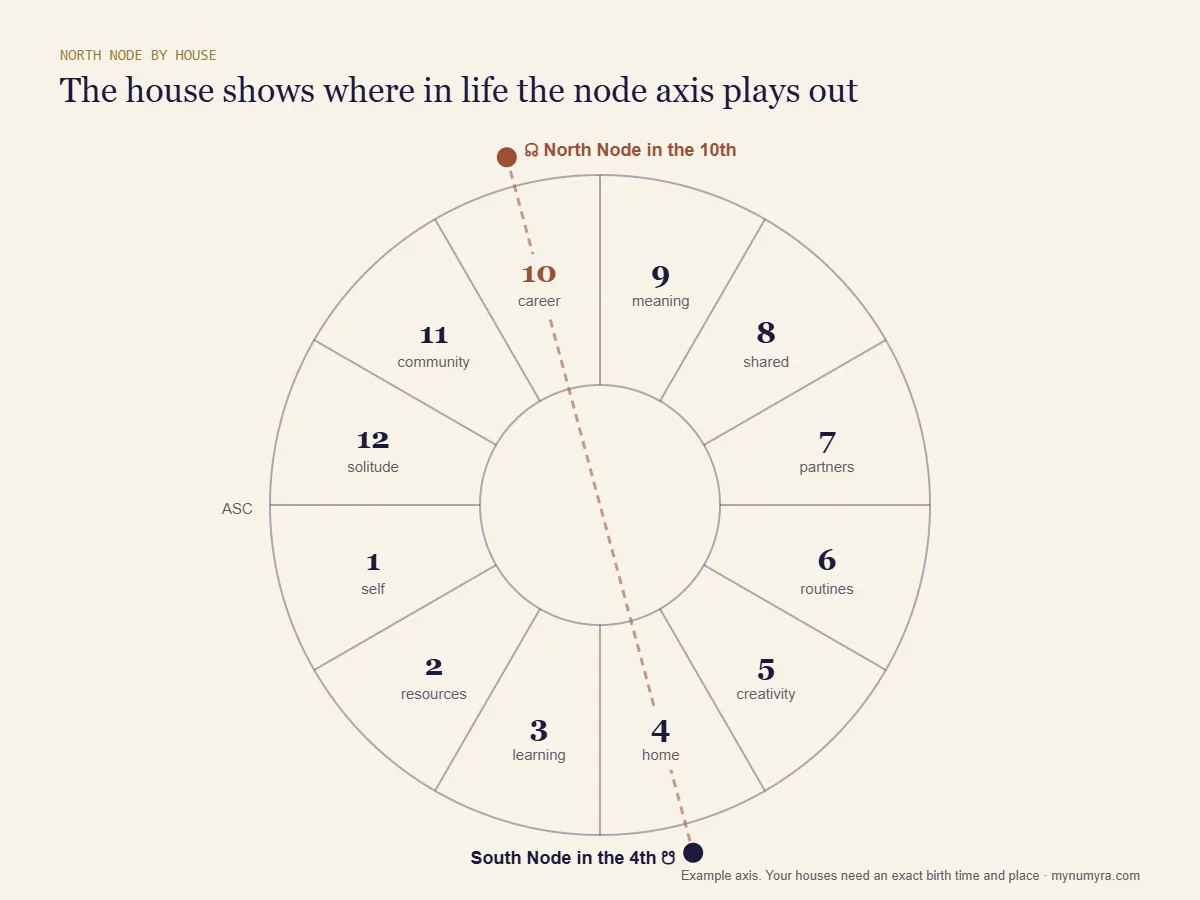
If you know your exact birth time, the house your North Node falls in narrows the theme to an area of life. Houses are set by the horizon at the moment and place of birth, so unlike the sign, the house cannot be read from a date table; you need a full chart. The South Node is always in the opposite house. As with the signs, these are the readings modern astrologers commonly give, not predictions.
| North Node house | South Node house | Growth direction usually described |
|---|---|---|
| 1st | 7th | Self-direction and independence; less defining yourself through partners. |
| 2nd | 8th | Your own resources, values and self-worth; less reliance on other people’s money or on crisis. |
| 3rd | 9th | Everyday learning, listening and local ties; less preaching from big theories. |
| 4th | 10th | Home, family and inner life; less living only for career and status. |
| 5th | 11th | Personal creativity, play and romance; less hiding inside the group. |
| 6th | 12th | Practical routines, health and daily work; less escaping into retreat. |
| 7th | 1st | Partnership and cooperation; less going it alone. |
| 8th | 2nd | Intimacy, shared resources and change; less clinging to security. |
| 9th | 3rd | Bigger-picture meaning, study and travel; less scattered information-gathering. |
| 10th | 4th | Career, public role and responsibility; less retreat into private comfort. |
| 11th | 5th | Friends, community and shared goals; less need for the personal spotlight. |
| 12th | 6th | Rest, solitude and inner or spiritual life; less over-control of details. |
What older astrology said: the Dragon’s Head and Tail
For most of astrology’s history the nodes were called the Dragon’s Head (North) and the Dragon’s Tail (South), and nobody read them as a life lesson. William Lilly’s Christian Astrology (1647), one of the most influential astrology textbooks in English, treats them much more simply. Of the North Node he writes (planet symbols in the original are given here as names in square brackets):
“The Head of the Dragon is Masculine, of the nature of [Jupiter] and [Venus], and of himselfe a Fortune”
William Lilly, Christian Astrology (London, 1647), Book 1, p. 83, spelling as printed
And of the South Node:
“The Tayle of the Dragon is Feminine by nature, and cleane contrary to the Head; for he is evill when joyned with good Planets”
William Lilly, Christian Astrology (1647), Book 1, p. 83
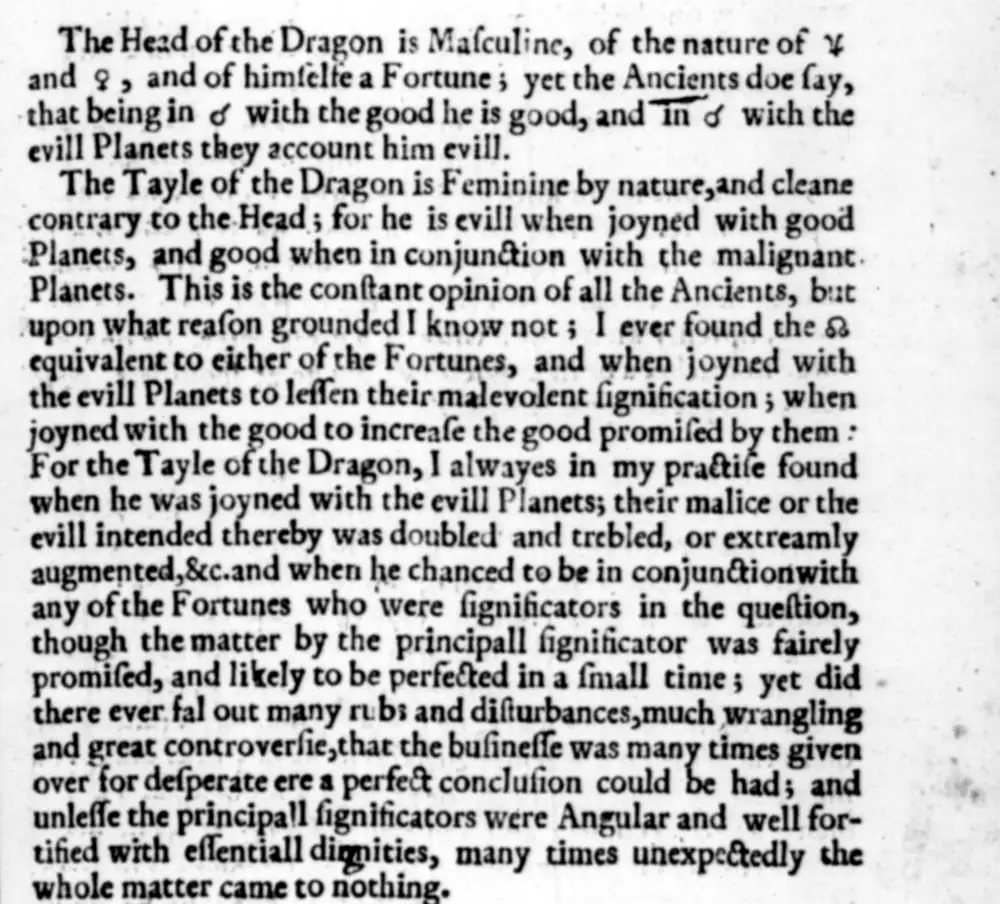
So in Lilly’s day the North Node was a “Fortune”, lucky in the same way as Jupiter and Venus, and the South Node was its unlucky opposite. Lilly calls the Tail’s reputation “the constant opinion of all the Ancients”, admits he does not know the reason for it, and says that in his own practice he found the Head equal to either of the two Fortunes, Jupiter and Venus. There is no past life, no comfort zone and no soul curriculum in that picture. The two readings are not really compatible. A modern astrologer who calls your South Node “your natural gifts” is saying something quite different from Lilly, who called it evil when it touched a good planet.
Where the “karmic” reading came from
The idea that the South Node shows past lives and the North Node your soul’s purpose in this one is a 20th-century development. It took hold in books such as Martin Schulman’s Karmic Astrology, Volume I: The Moon’s Nodes and Reincarnation (Samuel Weiser, 1975) and later Jan Spiller’s Astrology for the Soul (Bantam, 1997), which organises its entire reading around the North Node sign. Most of the “your North Node purpose” content online follows this framework, usually without saying where it comes from. That does not make it wrong or useless as a reflection tool. It is simply worth knowing that it is a modern interpretation layered onto a much older point, not an ancient teaching.
The same names show up in Indian astrology, where the North Node is Rahu and the South Node is Ketu. They are treated as powerful shadow planets in their own right, with a different set of meanings from either Lilly’s or the modern Western reading.
Nodal returns: ages 18, 37 and 56
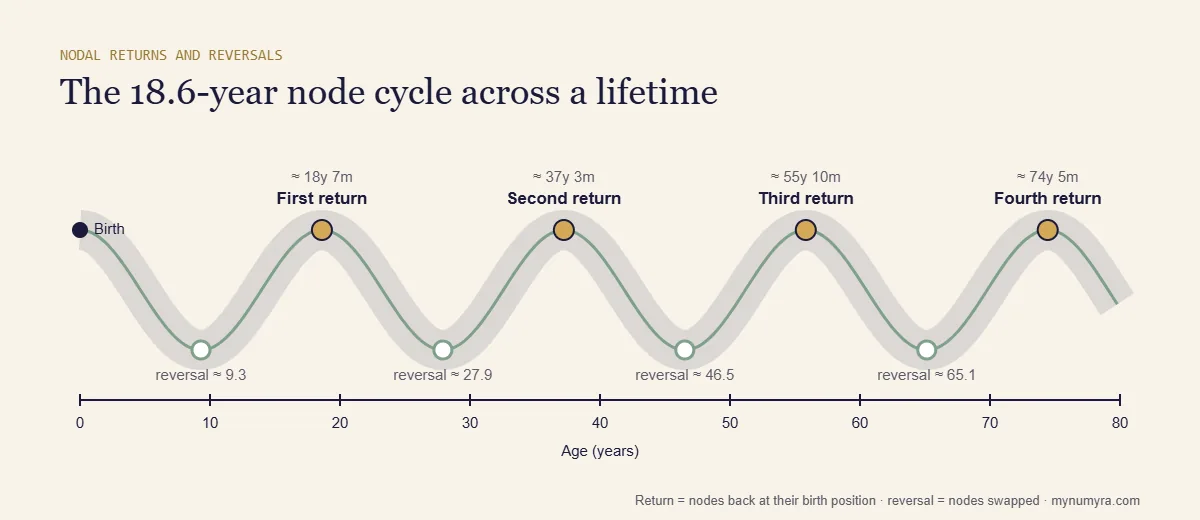
Because the nodes complete their cycle in 18.6 years, they come back to the position they held at your birth at about these ages:
| Nodal return | Approximate age |
|---|---|
| First | 18 years, 7 months |
| Second | 37 years, 3 months |
| Third | 55 years, 10 months |
| Fourth | 74 years, 5 months |
Astrologers who use the nodes read these returns as checkpoints for the North Node themes. Halfway between them, at about 9, 28, 46½ and 65, the nodes are reversed relative to your birth chart, which is read as the opposite emphasis. These ages are pure arithmetic from the 18.6-year cycle, so they hold whichever interpretation you prefer.
The North Node in 2026
The North Node spent 2025 and most of 2026 in Pisces, with the South Node in Virgo. It then moves backward into Aquarius, with the South Node entering Leo. By the true node that happens at about 01:00 Universal Time on July 27, 2026, which is the evening of July 26 in North America and matches the date CHANI gives. By the mean node it happens on August 18, 2026. The North Node stays in Aquarius until March 2028 (March 7 by the mean node, March 26 by the true node, again matching CHANI), the first time it has been in Aquarius since 2007 to 2009. If you were born between about January 2008 and July 2009, 2026 to 2028 brings the North Node back to your birth position: your first nodal return.
Frequently asked questions
Is the North Node the same as your rising sign?
No. Your rising sign is the zodiac sign on the eastern horizon at the moment you were born, so it changes every couple of hours and needs your exact birth time. Your North Node sign depends only on your birth date and is shared by everyone born within the same roughly 18-month window.
What determines your North and South Node?
Only the date you were born. The nodes are where the Moon’s orbit crosses the ecliptic, and that crossing point drifts backward through the zodiac over 18.6 years. Use the table above, or any astrology software, to look up your sign. The South Node is always the sign opposite your North Node.
Do I need my birth time to find my North Node?
Not for the sign. The table above only needs your birth date, unless you were born on the day of a change. You do need an exact birth time and place for the house, because houses are set by the horizon at the moment you were born.
What happens to the North Node in 2026?
It leaves Pisces and moves into Aquarius in summer 2026: on July 27 in Universal Time (the evening of July 26 in North America) by the true node, or August 18 by the mean node. The South Node moves from Virgo into Leo at the same time. It stays there until March 2028.
Should I use the mean node or the true node?
Astrologers are genuinely split, and there is no agreed standard. The two usually put your node in the same sign. It only matters if you were born between the mean-node and true-node dates in the table above, which can be up to about five weeks apart. In that case it is worth looking at both.
How long does the North Node stay in one sign?
About 18 to 19 months on average with the mean node. The true node’s stays vary a little more because of its wobble.
Are Rahu and Ketu the same as the North and South Node?
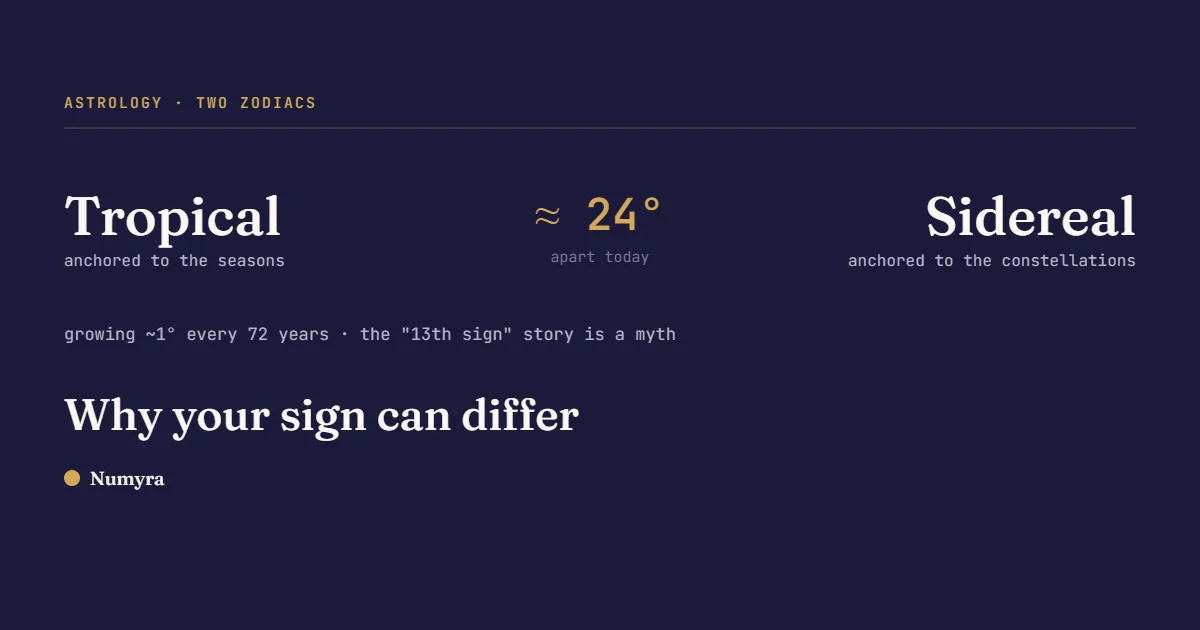
They are the same astronomical points. Rahu is the North Node and Ketu the South Node in Indian astrology, which usually works with the sidereal zodiac, so the sign can differ from the Western one. See our explainer on sidereal vs. tropical zodiacs.
Is the North Node lucky?
In older Western astrology, yes: Lilly called the Dragon’s Head “of himselfe a Fortune”, and wrote that in his own practice he found it as good as Jupiter or Venus. Modern astrology reads it less as luck and more as a direction of growth that feels unfamiliar at first.
Sources
- NASA Goddard Space Flight Center (Fred Espenak). “Eclipses and the Moon’s Orbit.”
- NASA Goddard Space Flight Center. “Periodicity of Solar Eclipses.”
- William Lilly, Christian Astrology, Book 1. London, 1647 (scan of the first edition, Internet Archive).
- Martin Schulman, Karmic Astrology, Volume I: The Moon’s Nodes and Reincarnation. Samuel Weiser, 1975.
- Jan Spiller, Astrology for the Soul. Bantam, 1997.
- CHANI. “North Node.” Source for the 2026 and 2028 true-node dates.
- Astrodienst. Swiss Ephemeris (Moshier mode), used for the mean-node and true-node dates.
- Jean Meeus, Astronomical Algorithms, 2nd ed. Willmann-Bell, 1998. Mean-node formula used as a cross-check.
- Numyra Methodology Desk: how we calculate astrology.