Moon in Taurus
Traditionally read as the steadiest placement of the Moon — feelings take time to register, but once settled they run deep and are slow to shift.
Key takeaways
- Emotional security built through routine and physical comfort — predictability itself is soothing, not boring.
- Slow, deliberate emotional processing — feelings are rarely rushed, in themselves or in others.
- A real value placed on consistency in the people close to them; sudden change can genuinely unsettle this Moon.
- A grounded, calming presence for others, even during their own quieter internal struggles.
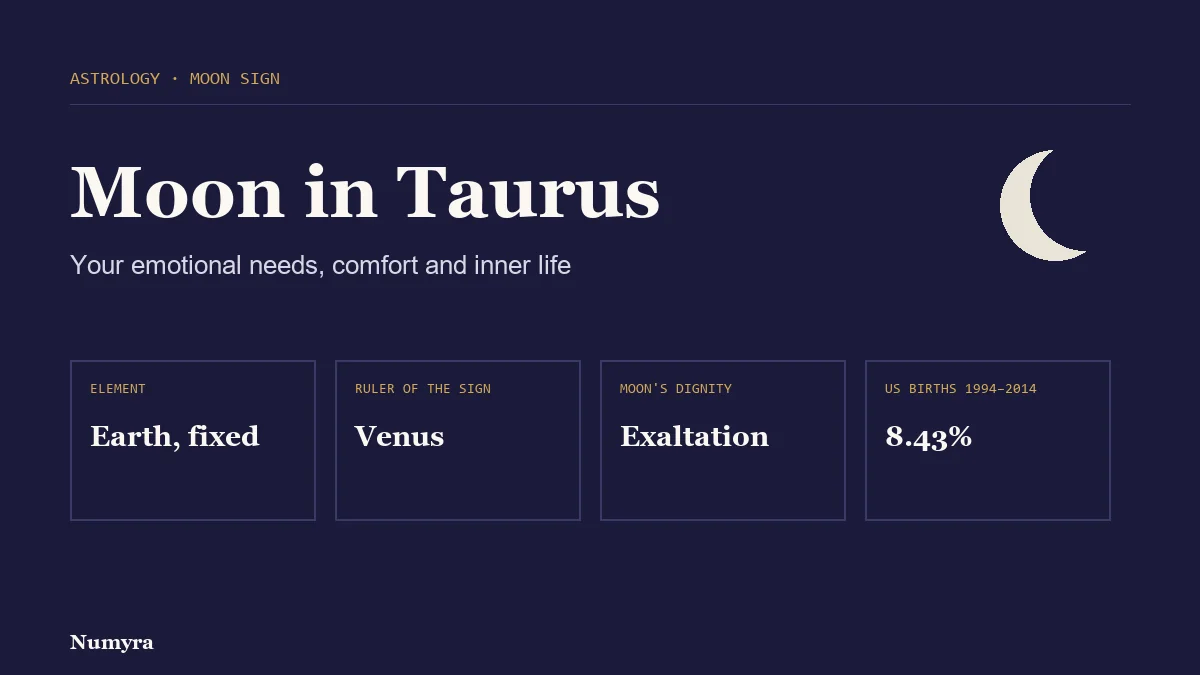
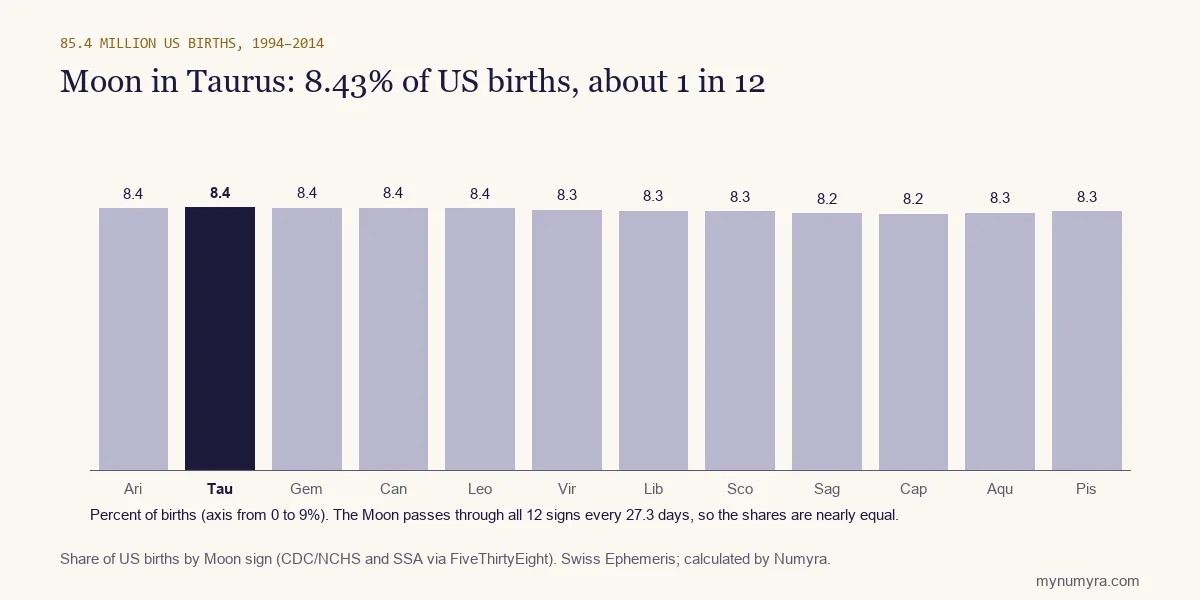
- Traditional dignity: exaltation. 8.43% of US births from 1994 to 2014 had the Moon in Taurus, about 1 in 12.
- Nothing here is medical, financial, legal, or psychological advice — a cultural tradition, presented for reflection.
Moon in Taurus at a glance
| Element and modality | Earth, fixed |
|---|---|
| Ruler of Taurus | Venus |
| The Moon's traditional dignity here | Exaltation |
| Share of US births, 1994–2014 | 8.43% (all 12 signs: 8.22–8.43%) |
| How long the Moon stays | About 2¼ days, returning every 27.3 days |
| Next Moon in Taurus | Sun, Oct 25, 2026 at 7:34 pm (US Eastern) |
What feeling emotionally safe looks like
Feels emotionally safe with familiar routines and physical comfort — a shared meal or a known place tends to land better than a long conversation about feelings.
Moon in Taurus in relationships
Moon in Taurus is traditionally read as loving through steady, physical care: cooking, showing up, keeping promises. It wants a partner whose affection is reliable rather than dramatic, and it takes its time deciding to trust. Once settled, it is read as one of the most loyal placements, though it can hold on to a relationship past the point where change was needed.
Astrologers compare two people's Moons as part of synastry, the chart-to-chart comparison, and read the Moon of a composite chart for the relationship's own emotional tone; for a quick element-based check, try our zodiac compatibility calculator.
Moon in Taurus under stress
Under stress, this Moon is read as going quiet and digging in. It recovers through the senses: sleep, food, a walk, a familiar room. Pushing it to decide or talk before it's ready tends to make it more stubborn. What helps is patience and practical comfort, with the big conversation saved for later.
The traditional shadow side
The traditional shadow side is emotional stubbornness — digging in rather than adapting, and a real risk of possessiveness when feeling insecure. The growth edge is allowing change without treating it as a threat to emotional footing.
Is Moon in Taurus strong or weak?
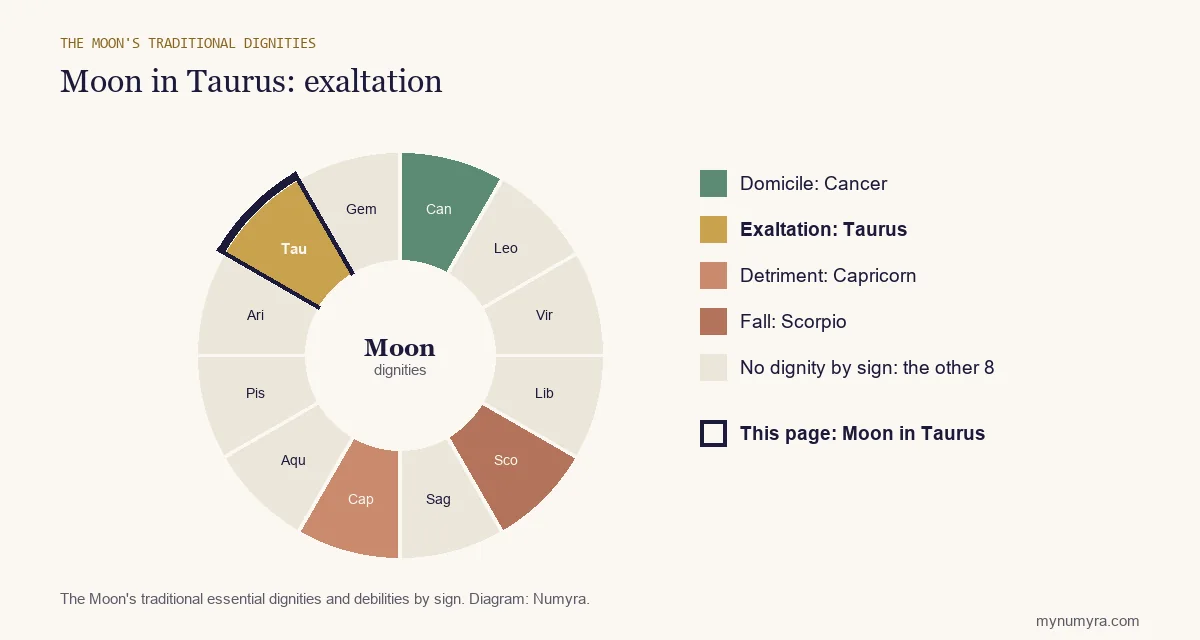
Tradition places the Moon's exaltation in Taurus, at 3°. In the system of essential dignities, exaltation is the second-strongest position by sign: the Moon is read as honored and especially stable here, which is why Moon in Taurus is so often called the calmest Moon.
The scheme is old. Ptolemy tied the Moon's exaltation to the new crescent: after meeting the Sun in Aries, the Moon first shows its light and starts to grow in the next sign, Taurus. He put the debility in the opposite sign:
"Taurus, this was called her exaltation, and the diametrically opposite sign, Scorpio, her depression."
Ptolemy, Tetrabiblos, Book I, chapter 19, trans. F. E. Robbins (1940)
Because Venus rules Taurus, astrologers also look at your Venus sign to see how a Moon in Taurus gets what it needs.
When is the Moon in Taurus next?
The Moon passes through Taurus for about two days every lunar month. Some astrologers time plans to these days. These are the next dates, calculated by the Numyra Methodology Desk with the Swiss Ephemeris and shown in US Eastern time. In 2027 the Moon visits Taurus 13 separate times.
| Moon enters Taurus | Moon leaves | Hours |
|---|---|---|
| Sun, Oct 25, 2026 at 7:34 pm | Tue, Oct 27, 2026 at 9:01 pm | 49 |
| Sun, Nov 22, 2026 at 5:09 am | Tue, Nov 24, 2026 at 6:09 am | 49 |
| Sat, Dec 19, 2026 at 3:29 pm | Mon, Dec 21, 2026 at 5:27 pm | 50 |
| Fri, Jan 15, 2027 at 11:43 pm | Mon, Jan 18, 2027 at 3:32 am | 52 |
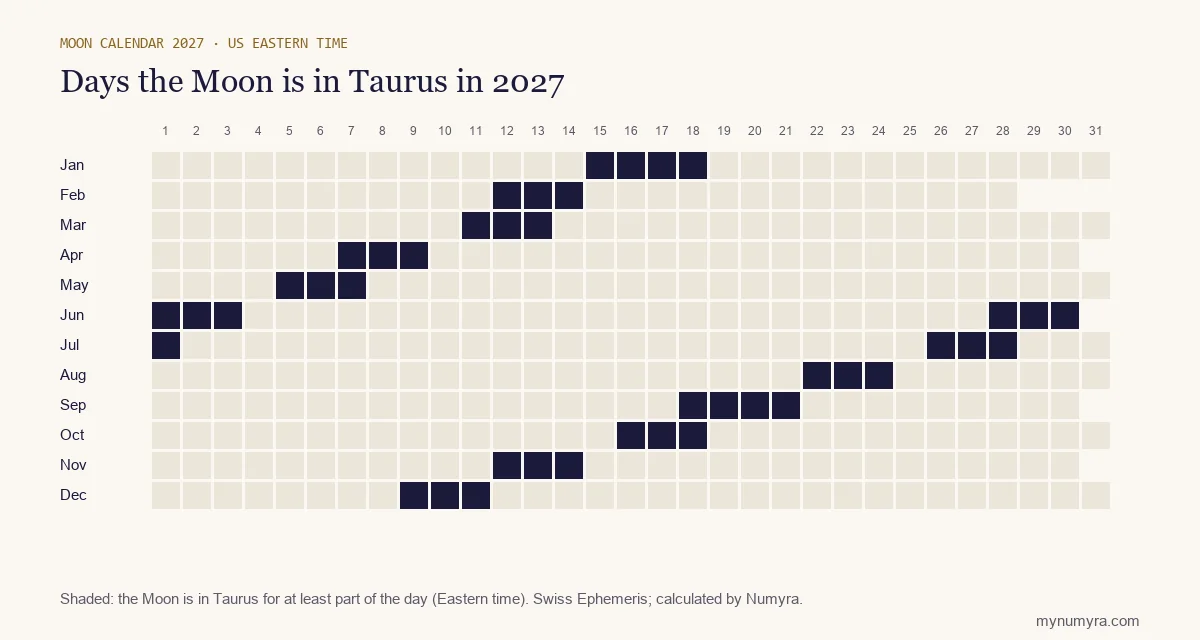
Pacific time is three hours earlier. Near the end of each stay the Moon is often void of course. For today's Moon sign, see our daily horoscope; for the monthly cycle, see Moon phases in astrology.
Moon sign vs. Sun sign
Your Sun sign is traditionally read as your core identity; your Moon sign is read as your inner emotional life — what you actually need to feel settled, separate from how you present yourself outwardly. The two aren't always the same sign, and when they differ, that's traditionally read as real internal contrast rather than a contradiction to resolve. See how this compares to Sun in Taurus and Taurus rising.
Moon in Taurus with each Sun sign
Astrologers rarely read a Moon sign alone. The most common next step is to pair it with the Sun sign, and the simplest way to do that is by the Sun's element. Find your Sun sign's row:
| Your Sun sign | How the pairing is traditionally read |
|---|---|
| Fire Sun Aries, Leo, Sagittarius | A fire Sun (Aries, Leo, Sagittarius) with a Taurus Moon is read as drive with a steady core: bold on the outside, wanting comfort and security underneath. The Moon is read as giving the fire staying power, so the pairing is good at finishing what it starts. |
| Earth Sun Taurus, Virgo, Capricorn | With a Sun in Taurus, Virgo or Capricorn, a Taurus Moon is read as thoroughly grounded: patient, practical and dependable, with identity and needs in close agreement. The traditional caution is resistance to change, since everything in the pairing values stability. |
| Air Sun Gemini, Libra, Aquarius | Air Suns (Gemini, Libra, Aquarius) with a Taurus Moon are read as a lively mind resting on calm emotions. Libra Suns share Venus as ruler and are read as especially attuned to beauty; the pairing is sociable yet hard to rattle. |
| Water Sun Cancer, Scorpio, Pisces | A water Sun (Cancer, Scorpio, Pisces) with a Taurus Moon is read as deep feeling held in a steady container. Scorpio Suns, opposite Taurus, are read as balancing intensity with calm; the pairing is nurturing and loyal, if slow to let go. |
A Sun and Moon in the same sign (a "double Taurus") is read as an even stronger dose of the earth row. For the full chart-to-chart picture between two people, see how zodiac compatibility really works.
Frequently asked questions
How do I find my Moon sign?
You need your birth date, and often your birth time too. The Moon spends about 2¼ days in each sign, so it changes sign on roughly 44% of days; on those days, your birth date alone can't settle it. Numyra's Birth Chart calculator works it out from your birth date, time and place, using real astronomical formulas.
Is my Moon sign more "real" than my Sun sign?
No. Traditional astrology reads them as different layers of the same chart, not competing claims. Sun, Moon and Rising are each read for a different part of the picture: identity, emotion and presentation.
What does a Moon in Taurus need in a relationship?
Moon in Taurus is traditionally read as loving through steady, physical care: cooking, showing up, keeping promises. It wants a partner whose affection is reliable rather than dramatic, and it takes its time deciding to trust.
Is Moon in Taurus a good placement?
Traditionally, yes: Taurus is the Moon's exaltation, the second-strongest position it can have by sign, read as stable and steady. Like every placement, it is a reading, not a guarantee.
How rare is a Moon in Taurus?
Not rare. Among 85.4 million US births from 1994 to 2014, 8.43% had the Moon in Taurus, about 1 in 12. Every Moon sign falls between 8.22% and 8.43%, because the Moon passes through all 12 signs every 27.3 days.
When is the Moon in Taurus next?
The Moon next enters Taurus on Sun, Oct 25, 2026 at 7:34 pm (US Eastern time) and stays until Tue, Oct 27, 2026 at 9:01 pm. It returns about every 27.3 days; the table on this page lists the next few dates.
Sources
- Ptolemy, Claudius. Tetrabiblos, Book I. 2nd century CE, trans. F. E. Robbins (LacusCurtius).
- Campion, Nicholas. A History of Western Astrology, vols. I–II. Continuum, 2008–2009.
- Astrodienst. Swiss Ephemeris. Moon positions and dates on this page were calculated with it.
- FiveThirtyEight. US births data, 1994–2014, from the CDC National Center for Health Statistics and the Social Security Administration.
- Numyra Methodology Desk. Astrology calculation standard.