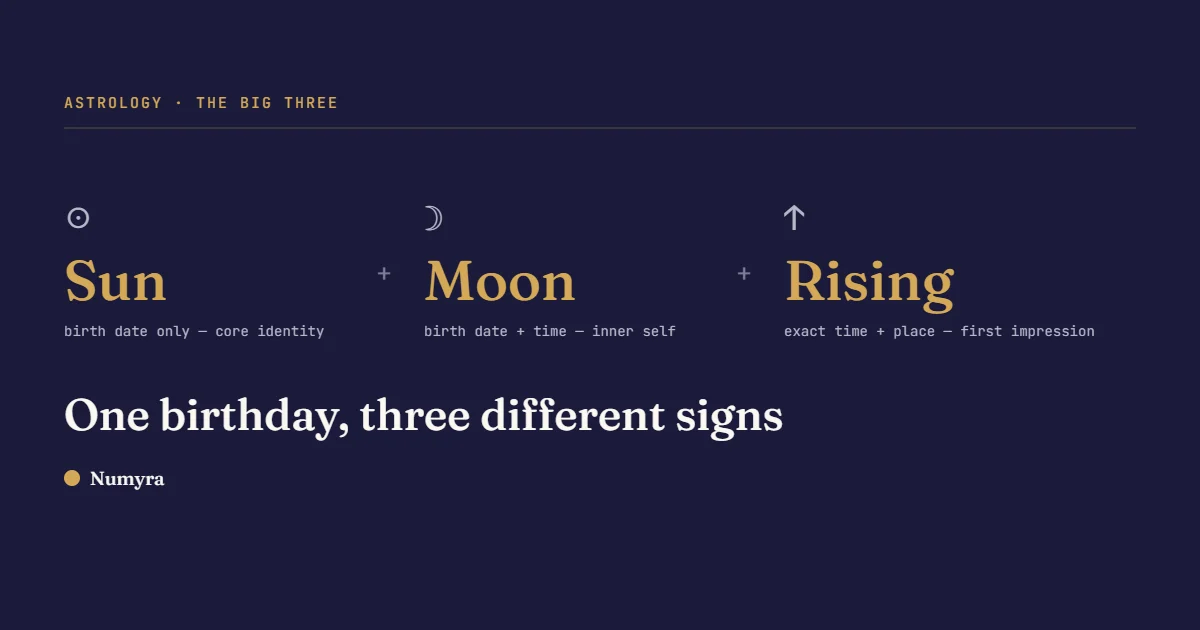
“What’s your sign?” usually means one thing: your Sun sign. But astrology actually reads three separate placements for a “complete” personal snapshot — and only one of them is the one from your birthday alone.
Key takeaways
- Your Sun sign — the one on every horoscope column — only needs your birth date. Your Moon sign and Rising sign (Ascendant) need your birth time and location too.
- Sun, Moon and Rising are traditionally read as three different layers: core identity, inner emotional life, and outward first impression, respectively.
- The Rising sign is the most time-sensitive of the three — it can change roughly every two hours, and that rate itself varies by how far your birthplace is from the equator.
- This is why our own astrology methodology hides house placements and the Rising sign whenever an exact birth time isn’t available, rather than guessing.
- None of this is a claim that any of these placements predicts real outcomes — cultural framework, presented for reflection and entertainment.
What each of the three actually measures
All three come from the same basic method — where a celestial point sat against the zodiac at a specific moment — but each uses a different point, and traditionally represents a different layer of the astrological reading:
- Sun sign — where the Sun sat in the zodiac on your birth date. This is your “sign” in the everyday sense, and the only one of the three you can get from a birthday alone. Traditionally read as core identity and basic temperament — see any of our 12 sign profiles for what each Sun sign traditionally describes.
- Moon sign — where the Moon sat at your exact birth time. Because the Moon moves through roughly one sign every 2.5 days, this needs a real birth date and a reasonably accurate time to calculate correctly. Traditionally read as emotional instinct and inner temperament — the “private” layer under the Sun sign’s more outward-facing one.
- Rising sign / Ascendant — the zodiac degree crossing the eastern horizon at your exact birth time and location. Traditionally read as first impression and outward presentation — sometimes described as the “mask” others see before they know you well.
The “Big Three,” side by side
| Placement | Needs | How often it changes | Traditionally read as |
|---|---|---|---|
| Sun sign | Birth date only | ~Once a month | Core identity |
| Moon sign | Birth date + approximate time | ~Every 2.5 days | Inner emotional life |
| Rising sign | Exact birth time + location | ~Every 2 hours (varies by latitude) | Outward first impression |
Why the Rising sign needs an exact time and place — and Moon sign needs a real time too
This is the part that separates a real chart from a guess. Because Earth rotates once roughly every 24 hours and there are 12 zodiac signs, each sign spends on average about two hours crossing the eastern horizon before the next one takes over as the Ascendant. Get the birth time wrong by even an hour, and you can easily land on the wrong Rising sign entirely.
It’s also not a flat two hours everywhere. How long each sign stays on the horizon depends on the birthplace’s latitude — some signs rise faster and some slower the further you get from the equator, so the same hour of birth can mean a different-length window for the Rising sign depending on where in the world someone was born. Getting this right requires an actual ephemeris (planetary position tables) plus real spherical-trigonometry math converting birth time, birthplace latitude/longitude, and the local sidereal time into an exact Ascendant degree — not a rough estimate.
The Moon sign is more forgiving but not immune to the same problem: the Moon changes sign roughly every 2.5 days, so an unknown birth date is a real problem, though an unknown birth time only occasionally puts you right on the edge between two signs.
Why we don’t have a Birth Chart calculator yet
Given all of that, we’ve deliberately held off shipping a Birth Chart / Moon-and-Rising calculator until we can do it properly. Our own published standard, on the Methodology page, is to calculate real planetary positions from the Swiss Ephemeris, convert birth times to UTC using the full IANA time zone database (including historical daylight-saving rules, which matter for older birth dates), and use Placidus houses. If someone doesn’t know their exact birth time, the honest move is to calculate for noon and clearly hide the house placements and Rising sign — not silently guess and present a wrong Ascendant as though it were exact. Building that properly is a bigger, separate project from our other calculators, which is why it’s still in progress rather than rushed out half-right.
Frequently asked questions
Can I find my Rising sign without knowing my exact birth time?
Not reliably. Because the Ascendant can change roughly every two hours, even being off by an hour can land you on the wrong sign. If you only know an approximate time, the honest answer is that your Rising sign is uncertain until you find a more exact birth time — often available on a birth certificate.
Is my Moon sign as time-sensitive as my Rising sign?
Less so. The Moon moves through a sign roughly every 2.5 days, so an approximate birth time is usually fine unless your birth happened close to the Moon’s actual sign-change moment that day — in which case even the date matters more than the time.
Why do some people say their “sign changed” as an adult?
Usually one of two reasons: they found a more exact birth time and recalculated a genuinely different Rising sign, or they’re referring to a completely separate technical debate — the sidereal-vs-tropical zodiac question we cover in our zodiac history article — which is unrelated to the Sun/Moon/Rising distinction here.
Sources
- “Ascendant.” Wikipedia. Technical definition and the mechanism behind how it’s calculated from birth time and location.
- “Sun, Moon and Rising Sign Meaning: What to Know About Astrological ‘Big Three.'” TODAY.com / NBC.
- Numyra Methodology Desk. Astrology calculation standard (Swiss Ephemeris, Placidus houses, noon-default policy).