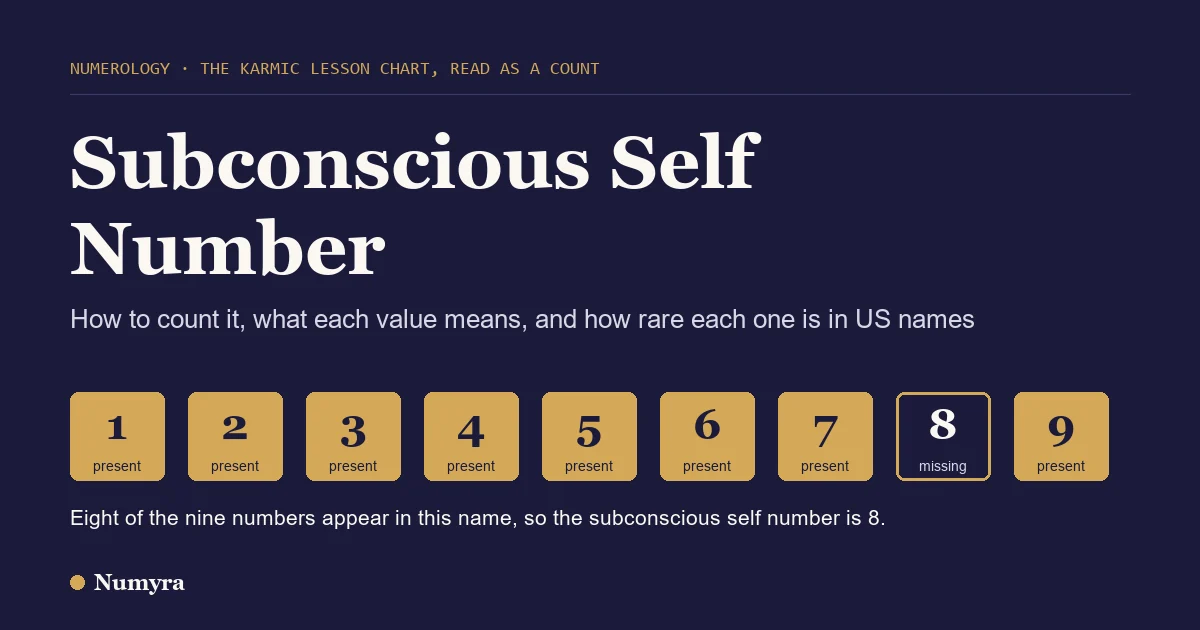
The subconscious self number is the count of different numbers, 1 to 9, that appear when every letter of your birth name is turned into its Pythagorean value. A name that contains all nine numbers has a subconscious self number of 9, a name with one number missing has 8, and so on down; it is simply 9 minus the number of karmic lessons in the name. The number is published in the charts of numerologist Hans Decoz, who reads it as your confidence when something sudden happens. This guide gives the method, the reading published for each value, where the idea traces back to, and a number no other page offers: how often each value really occurs in US names. In our calculation, 7 and 8 together make up 70% of full birth names, and a value below 5 is a one-in-500 case.
Key takeaways
- Method: convert each letter of the full birth name with the Pythagorean chart, then either count how many of the numbers 1 to 9 appear or subtract the number of missing numbers from 9. Decoz gives both versions, and his three sample readings agree with them: no lessons gives 9, one lesson (3) gives 8, two lessons (4 and 7) give 7.
- Origin: the earliest source we could read for the term is Decoz’s own website. The older idea of “missing numbers” is in Javane and Bunker’s 1979 book, but not under this name or as a count. We could not trace who first used the label.
- Original data: for a US first, middle and last name the values come out 9 for 12.4%, 8 for 35.3%, 7 for 34.9%, 6 for 14.6%, 5 for 2.7% and 4 for 0.20%. A 3 happens about once in 17,400 names, a 2 about once in 3.1 million, and a 1 essentially never.
- Name length drives it: each added letter raises the average value by roughly 0.13. With only a first and last name (12.4 letters on average) the typical value falls from 7.4 to 6.5, and only 2.4% reach 9.
- Sources disagree on 1 and 2: one site says 1 and 2 “don’t exist”, another labels 1 as a name with all nine numbers. Our counts show they are almost impossible for a full birth name but not for a first name alone (“Asa” is a 1).
- This is tradition, not a measured trait: see whether numerology is real. Treat the readings as prompts for reflection.
In this guide
- What the subconscious self number counts
- How to calculate yours, with four worked names
- Where the idea comes from
- What each value is said to mean
- How common each value is in US names
- How name length drives the result
- Can it be 1 or 2? Testing the claims
- How it differs from karmic lessons and the other name numbers
- How we calculated this
- Frequently asked questions
What the subconscious self number counts
Most name numbers add letter values together. The subconscious self does the opposite of adding: it asks only which of the nine values show up at all. The Pythagorean chart gives A, J and S the value 1; B, K and T the value 2; and so on up to I and R as 9 (our letter values chart shows all four traditional charts side by side). A letter that repeats adds nothing, so a name with six Es still has just one 5.
Decoz’s site defines what the count is meant to show in a single sentence.
The Subconscious Self reflects the confidence you have in your personal power and competence, as well as in your ability to deal with sudden events and situations.
Hans Decoz, The Subconscious Self, World Numerology
His reasoning is that every number present is a quality your name gives you for free. When a situation calls for a number you lack, he writes, there will be “some feeling of inadequacy, or uncertainty as to how to properly deal with the demands of the situation”. The more numbers a name holds, the more situations feel familiar. There is no research behind this link between letters and behavior; it is a symbolic reading, and the rest of this page treats it that way.
How to calculate yours, with four worked names
- Write out the full name given at birth. Decoz’s wording is the “full name at birth”, which means every first, middle and last name on the birth certificate, not a nickname. Ignore hyphens, apostrophes and spaces.
- Convert each letter with the Pythagorean chart: 1 = A J S, 2 = B K T, 3 = C L U, 4 = D M V, 5 = E N W, 6 = F O X, 7 = G P Y, 8 = H Q Z, 9 = I R.
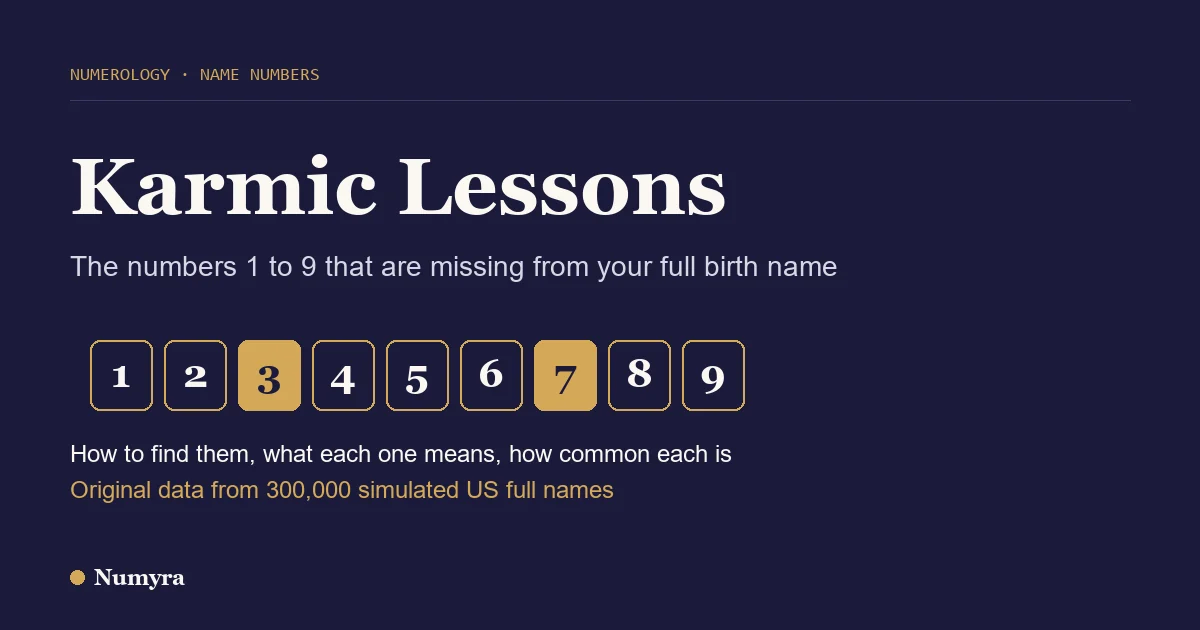
- Tally how often each number from 1 to 9 appears. A tally of zero means that number is missing (a karmic lesson).
- Count the numbers that appear, or subtract the number of missing ones from 9. Do not add the values or reduce anything. The answer is a whole number from 1 to 9.
Four invented names show how it works. Daniel Joseph Kowalski (20 letters) has every number from 1 to 9 at least once, so his subconscious self number is 9. Jordan Lee Park (13 letters) has everything except 8, so the answer is 8. Elizabeth Anne Washington (23 letters) also gets 8, but her missing number is 4, which is why two people with the same subconscious self number can have different gaps. Anna Lee Fox (10 letters) contains only 1, 3, 5 and 6, so five numbers are missing and her number is 4.
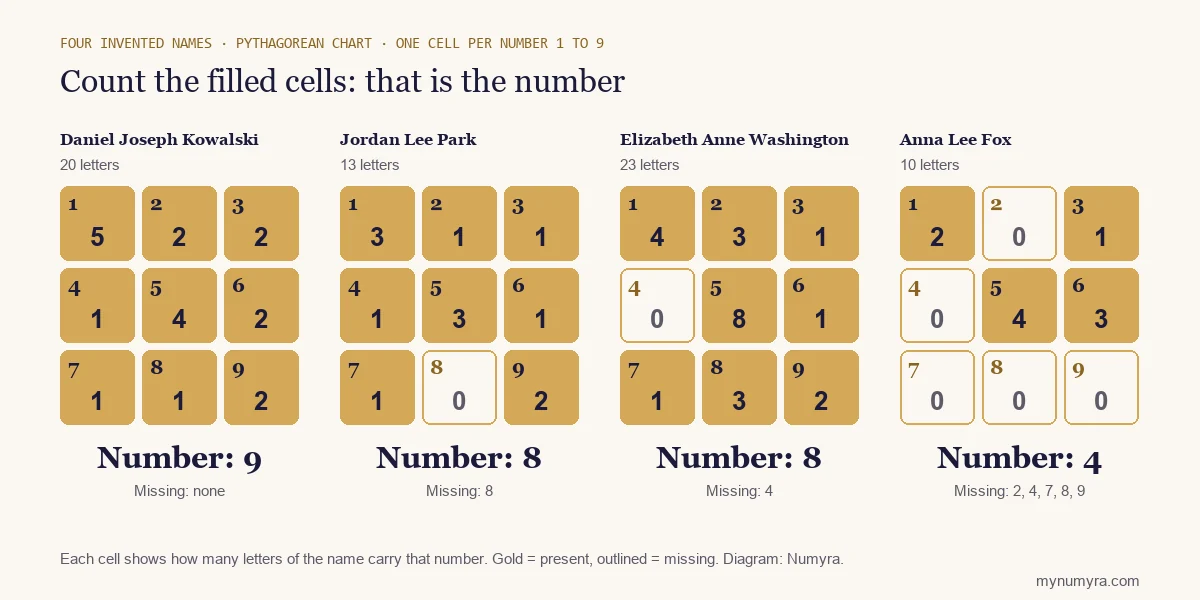
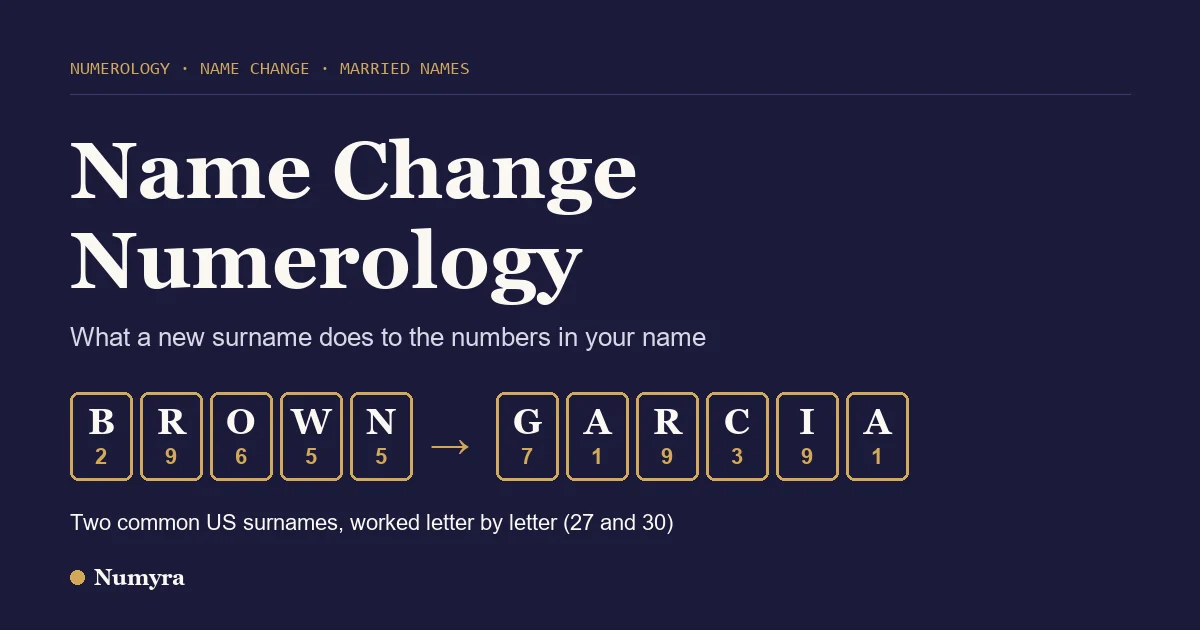
Our Name Numerology calculator adds up letter values in the Pythagorean or Chaldean chart but does not count which numbers appear, so the tally above is the way to get this one. Spelling matters, because one extra or missing letter can fill or open a gap. If you use a different name than the one on your birth certificate, the tradition reads the birth name, and our guide to name changes in numerology covers what a married or adopted name does to the other numbers.
Where the idea comes from
We looked for the first use of the term and could not find it, so here is what the sources we could actually read show.
The missing-numbers idea is older than the label. Faith Javane and Dusty Bunker’s Numerology and the Divine Triangle (1979) has a section headed “Missing Numbers in Your Name”. In the scan we read, it says that “the missing numbers in your name, sometimes called the karmic numbers” show qualities to develop, and it lists a short reading for each of the nine. It does not count the numbers a name contains and does not use the words subconscious self.
The count and the label appear on Decoz’s site. Decoz’s article names the number and gives two equivalent routes: count the numbers represented in the name, or “subtract the number of Karmic Lessons in your chart from 9”. It adds that the chart symbol for it is an arched “doorway”, and that it comes from the Karmic Lesson part of his chart, next to the Hidden Passion, and is part of his Personality Profile reading. His sample reports are consistent with the rule on every line we checked: “You have a Karmic Lesson of 0” goes with a Subconscious Self of 9, a lesson of 3 goes with 8, and lessons of 4 and 7 go with 7.
The other pages build on him. The pages we found (a 2008 blog post, SunSigns, Numerology Directory and Numeric Wisdom) all rest on Decoz’s material. The 2008 post and SunSigns repeat his confidence definition, and the 2008 post reproduces reading texts that are nearly identical to Decoz’s own for 7, 8 and 9; Numerology Directory and Numeric Wisdom use his counting rule. Decoz also has a printed book, Numerology: Key to Your Inner Self, which the Internet Archive holds only as a lending copy. We could not open it, so we cannot say whether it used the term before the website did, and we do not claim a date for the coinage.
What each value is said to mean
Decoz’s own reports give a paragraph for each value. We read his texts for 7, 8 and 9 directly in his sample reports. For 3, 4, 5 and 6 we found the texts only in copies (the 2008 blog post and SunSigns), so those four rows rest on secondary sources. The wording below is our paraphrase. The percentage is how often the value occurs among US first, middle and last names in our calculation (the next section explains it).
| Value | Numbers in the name | Share of US full names | Traditional reading (our paraphrase) | Where we read it |
|---|---|---|---|---|
| 9 | All nine | 12.4% | Competent and controlled in any situation; deep feelings and compassion but somewhat impersonal and hard to know; not demonstrative. Decoz adds a caution that all nine can mean aloofness or complacency when something sudden happens. | Decoz sample reports and article |
| 8 | Eight | 35.3% | Handles the unexpected efficiently and tends not to repeat mistakes; does not panic easily; wants reward for effort and links success to material things; businesslike, good with money, a “survivor” with leadership and organization. | Decoz sample reports |
| 7 | Seven | 34.9% | May look indifferent or aloof but is well balanced and can get through stormy times; under strain withdraws into a creative, analytical inner life; something of a loner who shares feelings sparingly. | Decoz sample report |
| 6 | Six | 14.6% | Likes to help others, sometimes at the cost of own needs; centered on home and family; responsible and willing to sacrifice; in distress turns to family and friends. | 2008 blog copy; SunSigns |
| 5 | Five | 2.7% | Tends to scatter energy and leave projects unfinished; needs discipline and organization; may try to escape difficulty by forcing change; learns and adapts quickly, and does best when grounded and willing to take on responsibility. | 2008 blog copy; SunSigns |
| 4 | Four | 0.20% | Gets lost in details, which causes confusion and indecision; needs to trust instinct, act quickly and avoid procrastination; needs a solid foundation of family and work with clear responsibility. | 2008 blog copy; SunSigns |
| 3 | Three | 0.0057% | Looks to friends and family for support in emergencies; life keeps presenting such moments until the person uses their own power; success comes from a well-defined goal that focuses energy. | 2008 blog copy; SunSigns |
| 1, 2 | One or two | essentially never | No reading in any Decoz material we found. SunSigns gives entries headed 1 and 2 that actually describe names with nine and eight numbers. | Decoz article; SunSigns |
Two things stand out. First, the readings move from capable to dependent as the number falls, but Decoz’s article adds a twist at the top: the sentence “Paradoxically, a person with all nine numbers represented tends to be aloof or overly complacent when dealing with sudden events” appears on his own page, which is why the 9 reading is mixed. Second, 1 and 2 have no reading in any of his material that we found, and a later section explains why that is unsurprising.
How common each value is in US names
None of the pages above says how often any value occurs. To find out we computed the subconscious self number for the whole population of US names in the data, not for a random sample of them. We took the Social Security Administration’s yearly lists of the 1,000 most popular first names for each sex (babies born 1994 to 2008), weighted by popularity, and the 151,671 surnames in the 2000 Census file, weighted by how many people hold them. We combined them exactly, assuming first, middle and last name are independent, with middle names drawn from the same sex’s list. The table gives the share of names for each value, for three kinds of name.
| Subconscious self number | First + middle + last name | First + last name only | First name alone |
|---|---|---|---|
| 1 | under 1 in a billion | 1 in 182 million | 0.011% |
| 2 | 1 in 3.1 million | 0.0045% | 2.9% |
| 3 | 0.0057% | 0.24% | 15.7% |
| 4 | 0.20% | 2.9% | 32.5% |
| 5 | 2.7% | 14.7% | 33.5% |
| 6 | 14.6% | 32.7% | 14.2% |
| 7 | 34.9% | 32.6% | 0.61% |
| 8 | 35.3% | 14.5% | 0.72% |
| 9 | 12.4% | 2.4% | none |
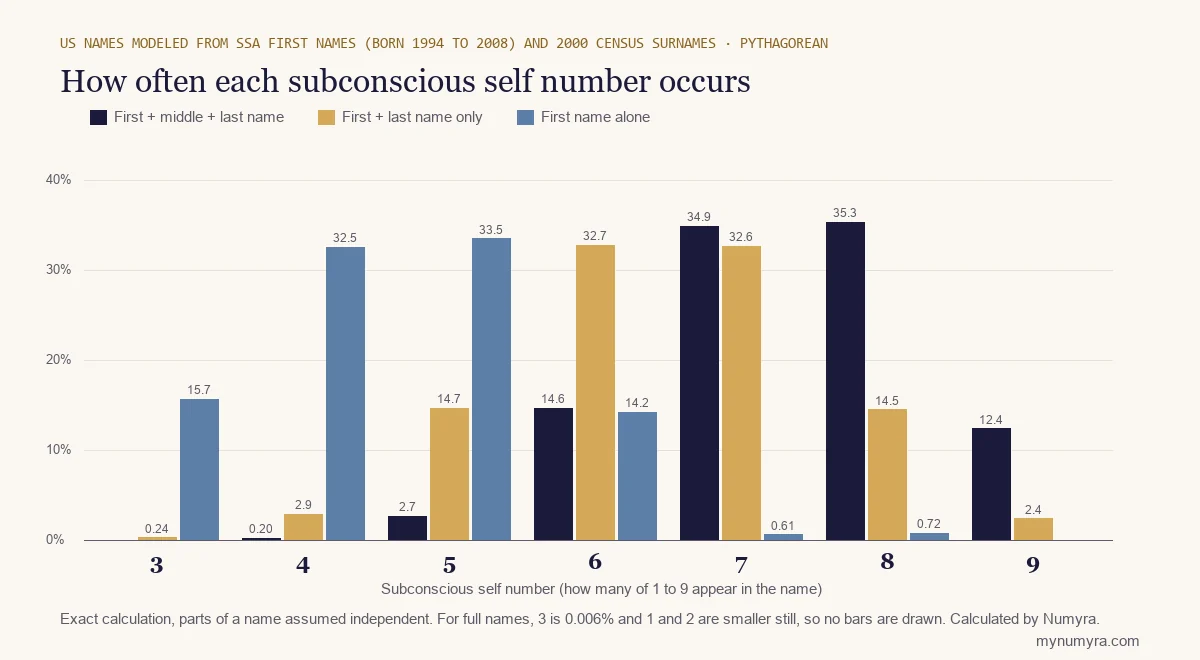
Reading across: a full birth name lands on 7 or 8 in 70% of cases, on 9 in 12.4%, and on 6 or lower in 17.5%. Drop the middle name and the whole distribution slides down by about a value: the average goes from 7.39 to 6.48, a 9 becomes five times rarer (2.4%), and 6 and 7 become the typical answers. Use a first name alone and the picture changes completely, with 4 and 5 making up two-thirds of names. Anyone calculating from only the name they go by is not computing the same thing Decoz describes.
The result is consistent with our guide to karmic lessons, which counted the same sample from the other side: 12.4% of full names have no lesson here, against 12.75% in that guide’s random simulation. The small gap comes from method. That simulation let a middle name come from either sex’s list, and when we recompute that way the exact figure is 12.7% to 12.8%. Decoz writes that the average person has two lessons, which would be a subconscious self number of 7; our full-name average is 7.39 (1.6 lessons) and our first-and-last-name average is 6.48 (2.5 lessons).
One more split: women’s full names reach 9 in 10.7% of cases and men’s in 14.0%, with averages of 7.33 and 7.46. The difference comes from the lists of popular names; it is not a claim about people.
The Chaldean version
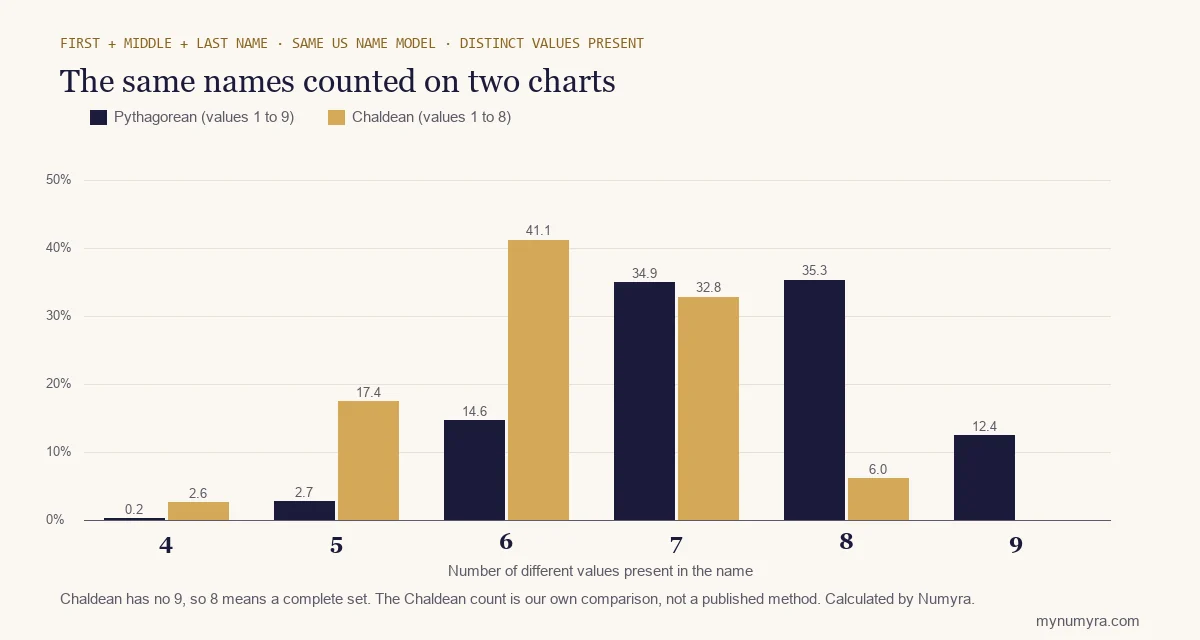
The Chaldean letter chart has no 9, so the same counting rule can reach only 8. No source we read defines a Chaldean subconscious self number, so this is our own comparison and not a tradition. Counting how many of the Chaldean values 1 to 8 appear in a full US name, all eight appear in 6.0% of names, seven in 32.8%, six in 41.1% and five in 17.4%, for an average of 6.2 of 8 (see the Pythagorean and Chaldean comparison for why the charts differ). The values are not comparable one for one, because 8 means a complete set in Chaldean and a single gap in Pythagorean.
How name length drives the result
The count has a ceiling of nine and a floor set by how many letters you have, so length does most of the work. A name needs at least nine letters just to have the chance of holding all nine values, and in practice it needs many more, because letters cluster on a few numbers: A, J, S, E, N and W alone make up about 40% of letters in American names, while H, Q and Z make up under 5%. The table shows the average value and the chance of reaching 9 by the total number of letters in the name.
| Total letters | Share of full names this long | Full name: average number | Full name: reaches 9 | Full name: 8 or 9 | First + last: average number | First + last: reaches 9 |
|---|---|---|---|---|---|---|
| 12 | 0.5% | 6.34 | 1.1% | 12.0% | 6.44 | 1.0% |
| 14 | 3.6% | 6.78 | 3.0% | 23.1% | 6.85 | 3.3% |
| 16 | 10.9% | 7.11 | 6.1% | 35.0% | 7.23 | 8.1% |
| 18 | 15.4% | 7.38 | 10.3% | 46.2% | 7.62 | 17.0% |
| 20 | 11.9% | 7.60 | 15.6% | 56.3% | 7.97 | 31.0% |
| 22 | 5.6% | 7.80 | 22.3% | 65.7% | too few names | too few names |
| 24 | 1.7% | 8.02 | 31.4% | 74.8% | too few names | too few names |
| 26 | 0.4% | 8.22 | 42.1% | 82.7% | too few names | too few names |
| 28 | 0.1% | 8.39 | 51.3% | 89.0% | too few names | too few names |
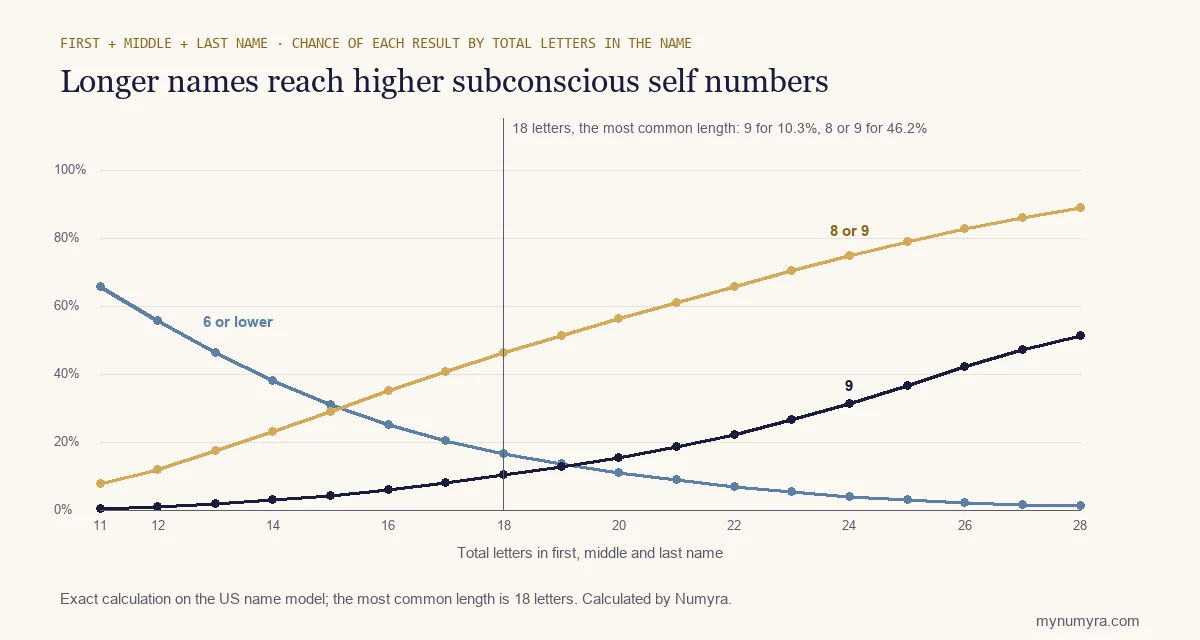
Between 14 and 22 letters, every extra letter adds about 0.13 to the average value, and the chance of a 9 climbs from 3% to 22% for a three-part name. At 28 letters it is about even. At the same total length a first-and-last name scores a little higher than a three-part name, so length is the main driver but not the only one. The most common length for a full birth name in our data is 18 letters, where 10.3% reach 9, 46.2% reach 8 or 9 and 16.7% sit at 6 or below. One consequence: in this tradition a longer name is a more “confident” name, and a person with a one-syllable surname and no middle name gets a lower number for reasons of spelling alone. Whether that tells you anything about a person is a different question, and no study we know of has tested it.
Can it be 1 or 2? Testing the claims
The sites disagree about the bottom of the scale, so we checked each claim against the computed distribution.
| Source | Claim | What our counts show |
|---|---|---|
| Decoz, World Numerology | A name can have “as few as three” numbers represented. | True but rare. A 3 is 0.0057% of full birth names and 0.24% of first-plus-last names. |
| Numerology Directory | Three is the least that can be represented; 1 and 2 “don’t exist”. | Nearly true for full birth names: a 2 is 1 in 3.1 million and a 1 never occurs. Not true for a first name alone, where 1 is 0.011% (for example Asa) and 2 is 2.9% (Anna, Adam, Ava). |
| SunSigns | Entry for 1: nine numbers in the name. Entry for 2: eight numbers. | Under the counting rule those names are a 9 (12.4%) and an 8 (35.3%), and the same page already has separate entries headed 9 and 8. |
| Numeric Wisdom | Interprets 3 to 9 only; 1 and 2 are not treated as subconscious self numbers. | Matches the data: values below 4 are 0.0058% of full names. |
Low values are not impossible, they are just hard to reach with the letters people actually have. Surnames help. Fox is the most common surname that holds only one value (all three letters are 6), and about 147,000 people carry it in the 2000 Census list, one in every 1,600. A fictional Anna Lee Fox has four values, and Asa Fox has two. For a full three-part birth name the same combination is far harder, because each added name has to avoid every number the others already supply. Calling 3 the practical minimum, as Decoz and Numerology Directory do, is a fair rule of thumb: values below it occur in fewer than one name in 3 million.
How it differs from karmic lessons and the other name numbers
All of these come from the same tally of letter values, which Decoz draws as a three-by-three Karmic Lesson chart. What differs is what you read off it.
- Karmic lessons list which numbers are missing, and the karmic lessons guide gives the reading for each. The subconscious self reports only how many are missing, so it is a coarser summary: two names with the same subconscious self number can have entirely different lessons, as Jordan Lee Park (missing 8) and Elizabeth Anne Washington (missing 4) do above.
- Karmic debt (13, 14, 16 and 19) is a different idea that comes from totals, not gaps. See karmic debt numbers.
- Hidden Passion is the number that appears most often in the name, the opposite end of the same tally. The two cannot be the same number, because the Hidden Passion has the highest count and a lesson has zero.
- Expression, Soul Urge and Personality add letter values instead of counting which values occur, so repeats matter to them and not to the subconscious self. Our guide to the three name numbers explains them.
Because the subconscious self is built from the same letters as the karmic lessons, it is not independent evidence of anything: it repeats what the chart already shows in one digit.
How we calculated this
The calculation covers a modeled population, not real individuals, and the details matter for how far to trust it. Our general standard for name-based numbers is on the methodology page.
- First names: the Social Security Administration’s top-1,000 baby names per sex and year, 1994 to 2008, from the hadley/data-baby-names compilation, weighted by each name’s share of births (1,550 girls’ names and 1,424 boys’ names appear at least once). Sexes are weighted 50/50. The SSA’s own download site blocks automated tools, which is why we used this compilation, which stops at 2008.
- Surnames: the 151,671 surnames in the 2000 Census surname file, weighted by the number of people holding each (about 242 million). Surnames outside the file are not modeled.
- Letters: only A to Z count, accents are reduced to the base letter, and the Pythagorean chart is the one above. Names over 40 letters are dropped (negligible).
- Calculation: for every first name and surname we recorded which of the nine values it contains and its length, then combined the groups exactly, with no random sampling, assuming the parts of a name are independent and a middle name comes from the same sex’s list. The Chaldean figures use the Chaldean chart and values 1 to 8.
- Limits: first names and surnames are in reality correlated (by language and heritage), the lists cover popular names only, and hyphenated or non-English spellings are outside them. The results describe typical US names, not any individual.
Numerology is a traditional interpretive system, not a tested science. Nothing here predicts how you will behave, and none of it is professional advice.
Frequently asked questions
What is the subconscious self number in numerology?
It is the count of different numbers from 1 to 9 that appear in your full birth name. Hans Decoz, whose charts publish it, reads it as your confidence in your own power and competence and in dealing with sudden events. It is a tradition, not a tested trait.
How do I calculate my subconscious self number?
Convert each letter of your full birth name with the Pythagorean chart (A, J, S = 1 through I, R = 9), then count how many of the numbers 1 to 9 appear at least once. Equivalent: 9 minus the number of missing numbers (karmic lessons).
What is the most common subconscious self number?
In our calculation for US first, middle and last names it is 8 (35.3%), with 7 just behind (34.9%). With only a first and last name the most common values are 6 and 7 (32.7% and 32.6%), and from a first name alone, 5 and 4.
Is the subconscious self number the same as karmic lessons?
No, but they are linked. Karmic lessons list the missing numbers; the subconscious self is 9 minus how many there are. It says how many gaps a name has, not which ones.
Can the subconscious self number be 1 or 2?
Hardly for a full birth name. In our data a 2 occurs about once in 3.1 million three-part names and a 1 essentially never, although a first name alone can be 1 or 2. Decoz says a name can have as few as three numbers, and several sites do not interpret 1 or 2 at all.
Does a higher subconscious self number mean more confidence?
In Decoz’s reading mostly yes: a name with eight numbers is described as more confident than one with five. He adds that a name with all nine can be aloof or overly complacent when something sudden happens. There is no research that links the count to behavior.
Which name do I use?
The full name at birth, with every first, middle and last name, as Decoz describes it. A nickname, a married name or a name with fewer parts changes the letters and can change the number, by about one value on average when a middle name is dropped.
Why did my number change when I left out my middle name?
Fewer letters means fewer chances to cover all nine numbers. In our data the average falls from 7.39 for a full birth name to 6.48 for a first and last name, and a 9 becomes five times rarer.
Sources
- Decoz, Hans. “The Subconscious Self.” World Numerology. Read 27 October 2026; source of the definition, both calculation rules and the quotations.
- Decoz sample reports: personality profile (lesson 0, Subconscious Self 9), personal numerology profile (lesson 3, Subconscious Self 8) and ultimate numerology reading (lessons 4 and 7, Subconscious Self 7). Read 27 October 2026.
- Javane, Faith, and Dusty Bunker. Numerology and the Divine Triangle. 1979; publisher listing. We read a scan of the 1979 edition for the “Missing Numbers in Your Name” section.
- Decoz, Hans. Numerology: Key to Your Inner Self. New York: Penguin Putnam, 2002; Internet Archive lending record (not opened).
- Bhardwaj, Manish. “Your Subconscious Number.” Its All About Numerology, 25 March 2008; copies of the readings for 3 to 9.
- Kuria, Joseph. “Numerology Subconscious Self Number Meanings.” SunSigns, updated 15 January 2026.
- Numerology Directory. “Subconscious Self Number.” 2023.
- Prabhu, Arun. “Subconscious Self Number: Meaning, Calculation and Examples.” Numeric Wisdom, updated 16 September 2026.
- US Social Security Administration. “Popular Baby Names.” Source of the national baby-name data (this site blocks automated checkers; it opens in a browser); top-1,000 lists compiled in hadley/data-baby-names.
- US Census Bureau. “Frequently Occurring Surnames from the 2000 Census.”