Your star sign is older than you’d think, stranger than the horoscope column makes it sound, and — technically — no longer pointing at the constellation it’s named after. Here’s the real history, in order.
Key takeaways
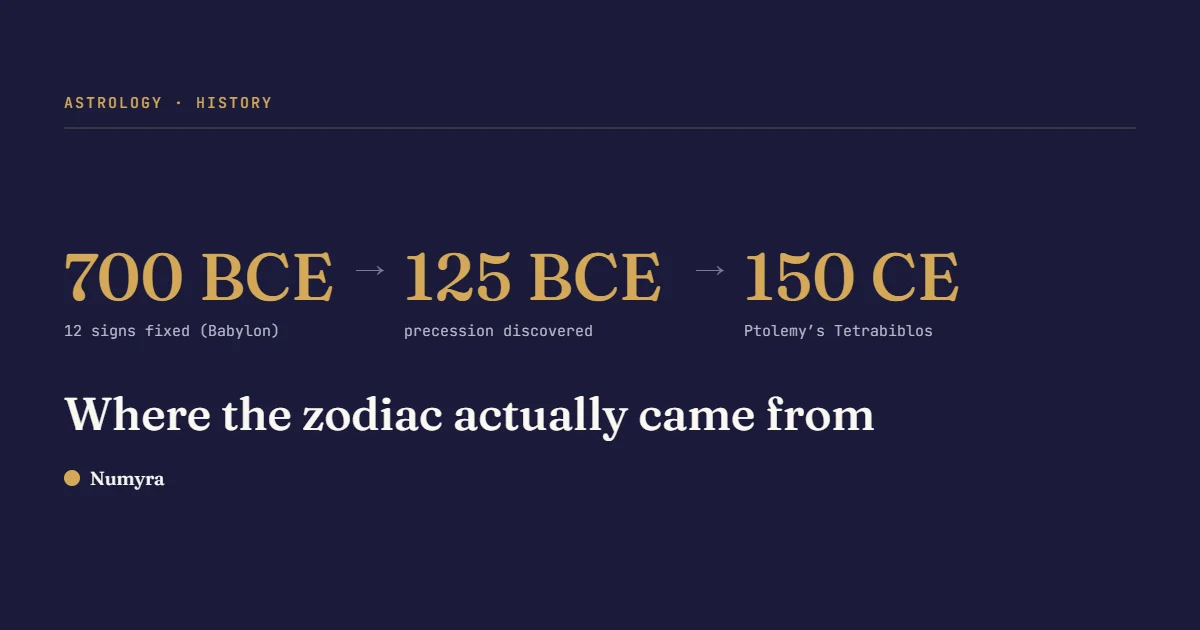
- The 12-sign zodiac was formalized by Babylonian astronomers by around 700 BCE, built from centuries of sky-watching that stretches back to at least 1000 BCE.
- Hellenistic Greek scholars adopted the Babylonian system and fused it with Greek philosophy; Claudius Ptolemy’s 2nd-century CE Tetrabiblos standardized the version of astrology still used in the West today.
- Around 125 BCE, the astronomer Hipparchus discovered that the stars slowly drift relative to the seasons — a real phenomenon called precession. It’s why the constellation behind “your sign” today isn’t where it was when the system was built, and why tropical and sidereal astrology now disagree.
- The core 12-sign lineup itself has stayed essentially unchanged for roughly 2,700 years, which is unusual longevity for any classification system.
- None of this is a claim that astrology predicts real-world outcomes — it’s cultural and historical background on a tradition, presented for reflection and entertainment.
Where the twelve signs actually started
The zodiac didn’t begin as horoscopes. It began as record-keeping. Babylonian priests and astronomers, working in what is now Iraq, tracked the Sun’s path across the sky over the course of a year and catalogued the constellations that path passed through. That path — the ecliptic — got divided into twelve equal segments, one for each lunar month, with names that map closely onto the ones still used today: the Twins, the Lion, the Scales.
The earliest Babylonian observations behind this system go back to roughly 1000 BCE, but the formal 12-sign zodiac as a fixed, equal-segment system was in place by about 700 BCE. It wasn’t originally personal. Babylonian sky omens were read for kings and cities — timing for planting, for military campaigns, for state decisions — not for predicting an individual’s Tuesday.
2,700 years, four milestones
| Date | What happened |
|---|---|
| c. 1000 BCE | Babylonian astronomers begin the sky-watching records the zodiac is built from. |
| c. 700 BCE | The 12-sign, equal-segment zodiac is formalized in Babylon. |
| c. 125 BCE | Hipparchus discovers precession — the slow drift behind the tropical/sidereal split. |
| c. 150 CE | Ptolemy’s Tetrabiblos standardizes the signs, 4 elements and 3 modalities into the framework Western astrology still uses. |
How the Greeks turned it into astrology
The system that would become recognizable as astrology arrived when Hellenistic Greek scholars encountered Babylonian sky-watching and merged it with their own philosophical frameworks — the four classical elements (fire, earth, air, water) and ideas about individual fate and character. This is the point where the zodiac stopped being purely a state-level omen system and started being read for individual lives.
The figure most responsible for locking that fusion into a lasting reference work is Claudius Ptolemy, the same 2nd-century CE Alexandrian astronomer known for his (incorrect, Earth-centered) astronomical model. His four-book astrological text, known today as the Tetrabiblos, systematized the 12 signs alongside the 4 elements and 3 modalities (cardinal, fixed, mutable) into essentially the same structural framework Western astrology still uses — the same one behind our own sign-by-element-and-modality breakdowns. The Tetrabiblos went on to function as the primary astrological reference across Europe and the Islamic world for over 1,400 years.
“The natural characters of the zodiacal signs themselves, as they have been handed down by tradition.”
— Claudius Ptolemy, Tetrabiblos, Book I, introducing his own chapter on the signs
It’s a small phrase, but a telling one — even Ptolemy, writing the book that would define Western astrology for over a millennium, frames the signs’ meanings as tradition handed down to him, not as something he’s proving from first principles.
The sky has moved since then — and that matters
Here’s the part most horoscope columns skip, and it’s the most genuinely interesting piece of the history: the stars don’t sit still relative to the calendar, and astrologers have known this for over two thousand years.
Around 125 BCE — before Ptolemy, working from his own star catalogue and comparing it against older Babylonian records — the Greek astronomer Hipparchus noticed that stars had shifted position relative to the equinoxes since earlier measurements. He correctly concluded the discrepancy wasn’t the stars moving, but a slow wobble in the Earth’s own rotational axis: a roughly 25,800-year cycle now called the precession of the equinoxes.
That discovery is the actual root of a confusion a lot of people run into: “wait, isn’t my sign different now?” It’s why there are two competing zodiacs today:
- Tropical zodiac — anchored to the seasons (0° Aries = the spring equinox point), not to the physical constellations. This is what mainstream Western astrology, including our own sign profiles, uses.
- Sidereal zodiac — anchored to the actual constellations’ current positions, which is used in Vedic (Jyotish) astrology and has drifted about one full sign away from the tropical version since antiquity, due to precession.
In other words: the tropical “Aries” season and the actual constellation Aries in the sky have been quietly drifting apart for two millennia. Both systems are internally consistent — they’re just anchored to different things. This is a case where the historical footnote is more interesting than most of the mystical explanations people reach for. See what that split actually means for your own sign today.
Why the lineup hasn’t changed in 2,700 years
What’s unusual isn’t that the zodiac exists — plenty of ancient classification systems do — it’s that this particular one has survived essentially intact since roughly 700 BCE. The names, the count, the basic ecliptic-segment structure: all still recognizable today, carried forward through Hellenistic astrology, medieval Islamic and European scholarship, and into the modern newspaper horoscope column with remarkably little structural change. Whatever else is true or not true about what the signs mean, the system’s staying power as a piece of cultural infrastructure is real and well documented.
Frequently asked questions
Did the Babylonians invent astrology, or just the zodiac?
Mainly the zodiac’s structure and the practice of reading the sky for omens. The individual-focused, character-and-fate version of astrology most people recognize today is largely a Hellenistic Greek development that came later, building on top of the Babylonian framework.
So is my “real” sign different from my horoscope sign?
Only if you’re using sidereal rather than tropical astrology. Western horoscope columns, and our own sign profiles, use the tropical zodiac, which is anchored to the seasons rather than the physical constellations — so nothing has “changed” for tropical astrology’s own internal logic. Sidereal systems, like Vedic astrology, calculate it differently, which is why you’ll sometimes see a claim that your sign has shifted.
Is there scientific evidence the zodiac predicts personality or events?
No controlled study has found that zodiac sign reliably predicts personality traits or life outcomes. This article covers the documented history of the system, not a claim about predictive accuracy — we treat astrology here as a cultural tradition and a framework for reflection, not as fact.
Did Ptolemy invent the zodiac signs’ personality meanings?
No — Ptolemy himself describes the signs’ characters as “handed down by tradition” rather than something he originated. He compiled and standardized existing Hellenistic astrological material into a lasting reference, rather than inventing the meanings from scratch.
Sources
- Waxman, Olivia B. “Where Do Zodiac Signs Come From? Here’s the True History Behind Your Horoscope.” TIME, June 21, 2018.
- Ptolemy, Claudius. Tetrabiblos, Book I, trans. F. E. Robbins, Loeb Classical Library, Harvard University Press, 1940. LacusCurtius. Direct source for the quoted line above.
- “Sidereal year.” Wikipedia. Background on the tropical/sidereal year distinction underlying the two zodiac systems.
- Numyra Methodology Desk. Astrology framework and sourcing standard.