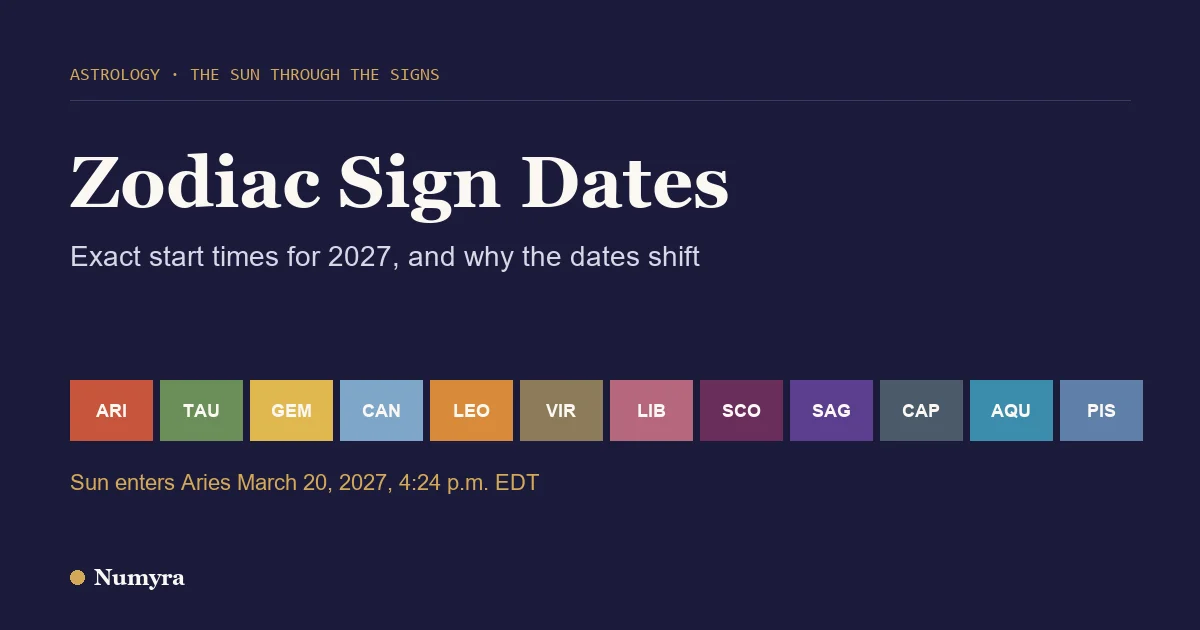
The zodiac sign dates run Aries March 21 to April 19, Taurus April 20 to May 20, Gemini May 21 to June 20, Cancer June 21 to July 22, Leo July 23 to August 22, Virgo August 23 to September 22, Libra September 23 to October 22, Scorpio October 23 to November 21, Sagittarius November 22 to December 21, Capricorn December 22 to January 19, Aquarius January 20 to February 18 and Pisces February 19 to March 20. Those are the usual dates, but the Sun changes sign at a different minute every year, so in 2027 four signs start a day earlier than the table you may know: Aries on March 20, Leo on July 22, Capricorn on December 21 and Pisces on February 18.
Key takeaways
- The 2027 zodiac year starts when the Sun enters Aries on March 20, 2027 at 4:24 p.m. EDT (1:24 p.m. PDT). Every other start time for 2027 and early 2028 is in the table below, in both Eastern and Pacific time.
- Each sign lasts between 29.4 and 31.5 days. In 2027 and 2028 the Sun spends 29.44 days in Capricorn but 31.45 days in Cancer, because Earth moves faster in January than in July.
- Across the 101 years from 1930 to 2030, Aries began on March 20 in 80 of them, March 21 in 18 and March 19 in 3 (2020, 2024 and 2028). No year since 1979 has started Aries on March 21 in US Eastern time.
- If you were born within a day of a boundary, the date alone cannot tell you your sign. You need your birth time and place, because the changeover is a specific minute, not a calendar day.
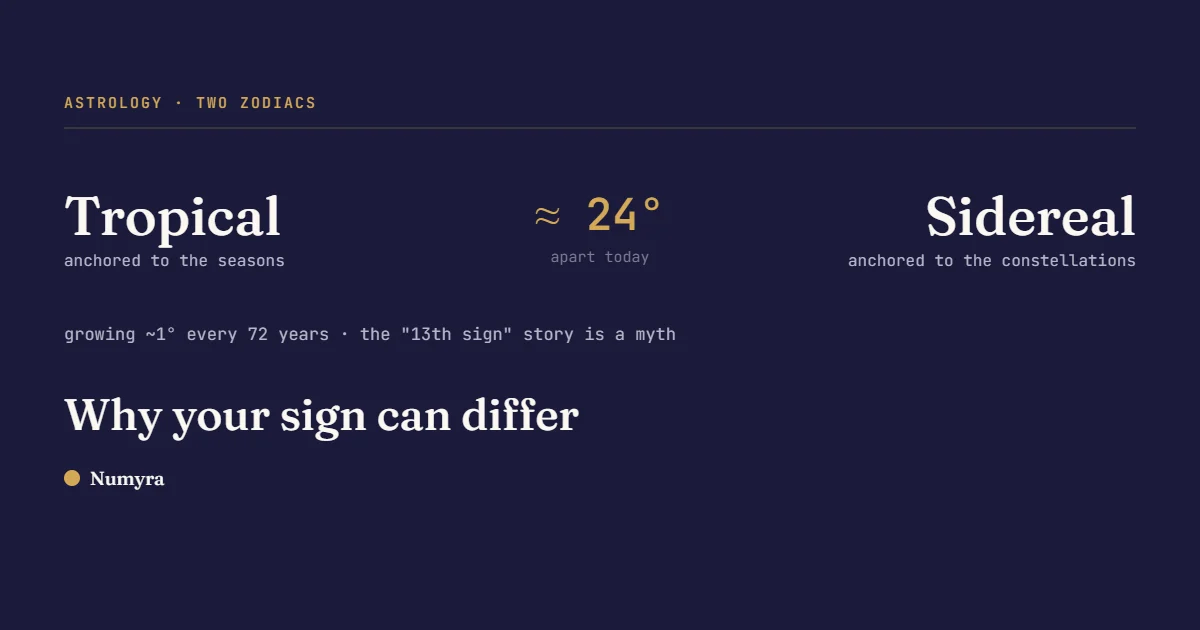
- These are tropical dates, the Western system, and they are fixed to the equinoxes and solstices. The sidereal (Vedic) zodiac shifts them by about 24 degrees, so most people have a different sign there.
In this guide
- Zodiac sign dates and the exact 2027 start times
- Why the dates change from year to year
- How often each sign starts on each date
- Why some signs are longer than others
- What to do if you were born on the cusp
- The same dates for 2026, 2027 and 2028
- Where the dates come from, and the sidereal difference
- How many people have each Sun sign
- Frequently asked questions
Zodiac sign dates and the exact 2027 start times
The “usual dates” column is the convention used on every sign page of this site and by most publications. The two right-hand columns show the exact minute the Sun reaches the start of each sign in 2027 and early 2028, calculated with the Swiss Ephemeris, the reference behind professional astrology software. Times are US Eastern and US Pacific, with daylight saving time applied when it is in force. A sign ends at the moment the next one begins.
| Sign | Usual dates | Sun enters (US Eastern) | Sun enters (US Pacific) | Days |
|---|---|---|---|---|
| Aries | Mar 21 – Apr 19 | Mar 20, 4:24 p.m. EDT | Mar 20, 1:24 p.m. PDT | 30.5 |
| Taurus | Apr 20 – May 20 | Apr 20, 3:17 a.m. EDT | Apr 20, 12:17 a.m. PDT | 31.0 |
| Gemini | May 21 – Jun 20 | May 21, 2:18 a.m. EDT | May 20, 11:18 p.m. PDT | 31.3 |
| Cancer | Jun 21 – Jul 22 | Jun 21, 10:10 a.m. EDT | Jun 21, 7:10 a.m. PDT | 31.5 |
| Leo | Jul 23 – Aug 22 | Jul 22, 9:04 p.m. EDT | Jul 22, 6:04 p.m. PDT | 31.3 |
| Virgo | Aug 23 – Sep 22 | Aug 23, 4:14 a.m. EDT | Aug 23, 1:14 a.m. PDT | 30.9 |
| Libra | Sep 23 – Oct 22 | Sep 23, 2:01 a.m. EDT | Sep 22, 11:01 p.m. PDT | 30.4 |
| Scorpio | Oct 23 – Nov 21 | Oct 23, 11:32 a.m. EDT | Oct 23, 8:32 a.m. PDT | 29.9 |
| Sagittarius | Nov 22 – Dec 21 | Nov 22, 8:16 a.m. EST | Nov 22, 5:16 a.m. PST | 29.6 |
| Capricorn | Dec 22 – Jan 19 | Dec 21, 9:42 p.m. EST | Dec 21, 6:42 p.m. PST | 29.4 |
| Aquarius | Jan 20 – Feb 18 | Jan 20, 2028, 8:21 a.m. EST | Jan 20, 2028, 5:21 a.m. PST | 29.6 |
| Pisces | Feb 19 – Mar 20 | Feb 18, 2028, 10:26 p.m. EST | Feb 18, 2028, 7:26 p.m. PST | 30.0 |
Aries on March 20 is the spring equinox. We cross-checked ours against the equinox and solstice times in the US Naval Observatory table for 2027 (March 20, 20:25 UT; June 21, 14:11 UT; September 23, 06:02 UT; December 22, 02:43 UT), and our Aries, Cancer, Libra and Capricorn entries fall within a minute of each. The tropical zodiac is anchored to those four moments, so every other boundary follows from them. Click a sign to read its profile: Aries, Taurus, Gemini, Cancer, Leo, Virgo, Libra, Scorpio, Sagittarius, Capricorn, Aquarius and Pisces.
Why the dates change from year to year
A sign is a 30-degree slice of the Sun’s yearly path, and the Sun takes about 365.24 days to go once round. The calendar year has 365 days, so the Sun arrives at each boundary about six hours later every year, until a leap day pulls it back 24 hours. The cycle repeats every four years, which is why the date wobbles by a day rather than drifting steadily. Because the leap day is skipped in century years not divisible by 400 (2100, for example), there is also a slow shift over centuries.
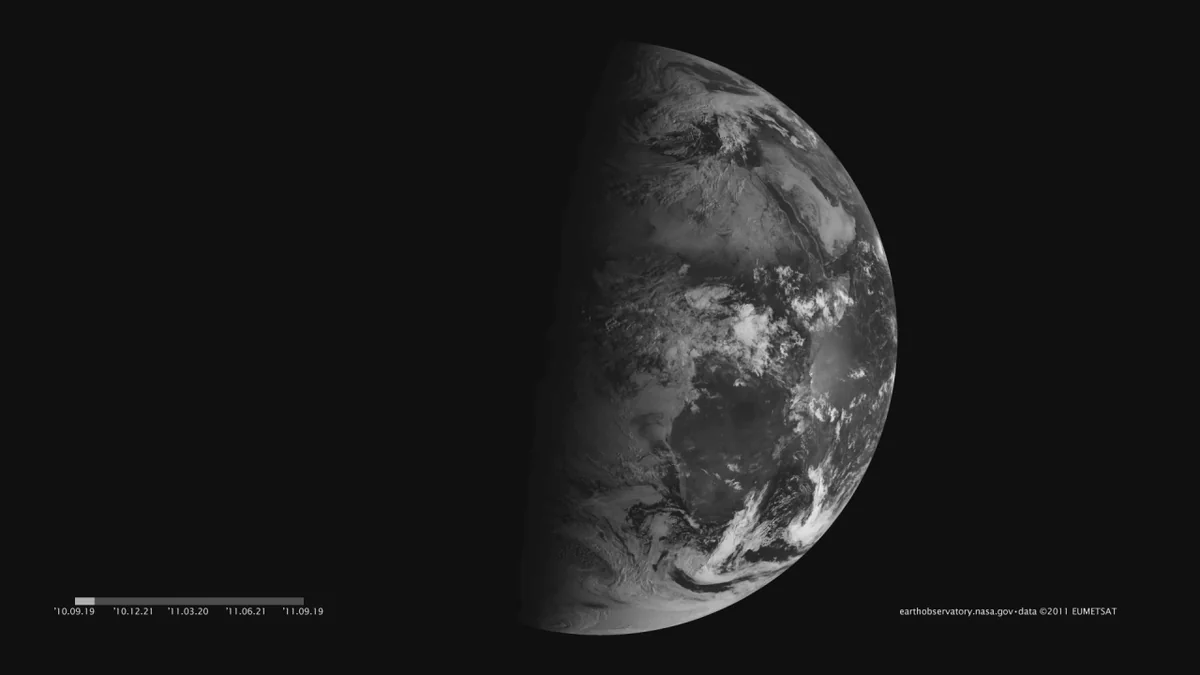
The second cause is the time zone. The Sun’s entry is a single instant, but the date depends on where you are. The Sun enters Leo on July 22, 2027 at 9:04 p.m. EDT, which is 6:04 p.m. PDT the same day but already 1:04 a.m. UT on July 23. Someone born at 10 p.m. in New York on July 22, 2027 is a Leo; someone born at 6 p.m. in New York the same day is a Cancer. Sites that print one fixed date for each sign are rounding that instant to a day.
How often each sign starts on each date
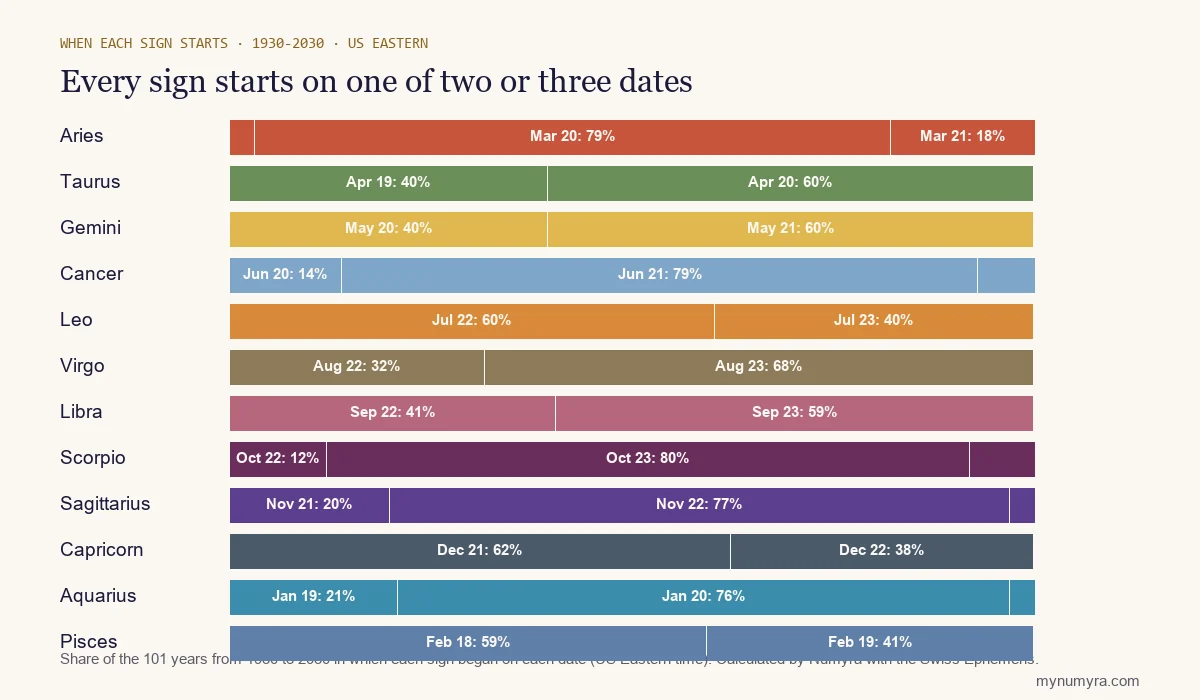
To see how much the dates really move, we calculated the Sun’s entry into every sign for each year from 1930 to 2030 (101 years), converting each instant to US Eastern time using the historical daylight saving rules. No sign started on more than three different dates, and seven of the twelve started on one of two.
| Sign | Usual start | Start dates seen, 1930 to 2030 (US Eastern) |
|---|---|---|
| Aries | Mar 21 | Mar 19 (3), Mar 20 (80), Mar 21 (18) |
| Taurus | Apr 20 | Apr 19 (40), Apr 20 (61) |
| Gemini | May 21 | May 20 (40), May 21 (61) |
| Cancer | Jun 21 | Jun 20 (14), Jun 21 (80), Jun 22 (7) |
| Leo | Jul 23 | Jul 22 (61), Jul 23 (40) |
| Virgo | Aug 23 | Aug 22 (32), Aug 23 (69) |
| Libra | Sep 23 | Sep 22 (41), Sep 23 (60) |
| Scorpio | Oct 23 | Oct 22 (12), Oct 23 (81), Oct 24 (8) |
| Sagittarius | Nov 22 | Nov 21 (20), Nov 22 (78), Nov 23 (3) |
| Capricorn | Dec 22 | Dec 21 (63), Dec 22 (38) |
| Aquarius | Jan 20 | Jan 19 (21), Jan 20 (77), Jan 21 (3) |
| Pisces | Feb 19 | Feb 18 (60), Feb 19 (41) |
For eight signs the usual date is also the most common one. For the other four it is not: the Sun entered Aries on March 20 in 80 of the 101 years (the usual date is March 21), Leo on July 22 in 61 (usual July 23), Capricorn on December 21 in 63 (usual December 22) and Pisces on February 18 in 60 (usual February 19). Those are the same four signs that start a day early in 2027. The usual date is a convenient rounding, not a fact of the sky.
Why some signs are longer than others
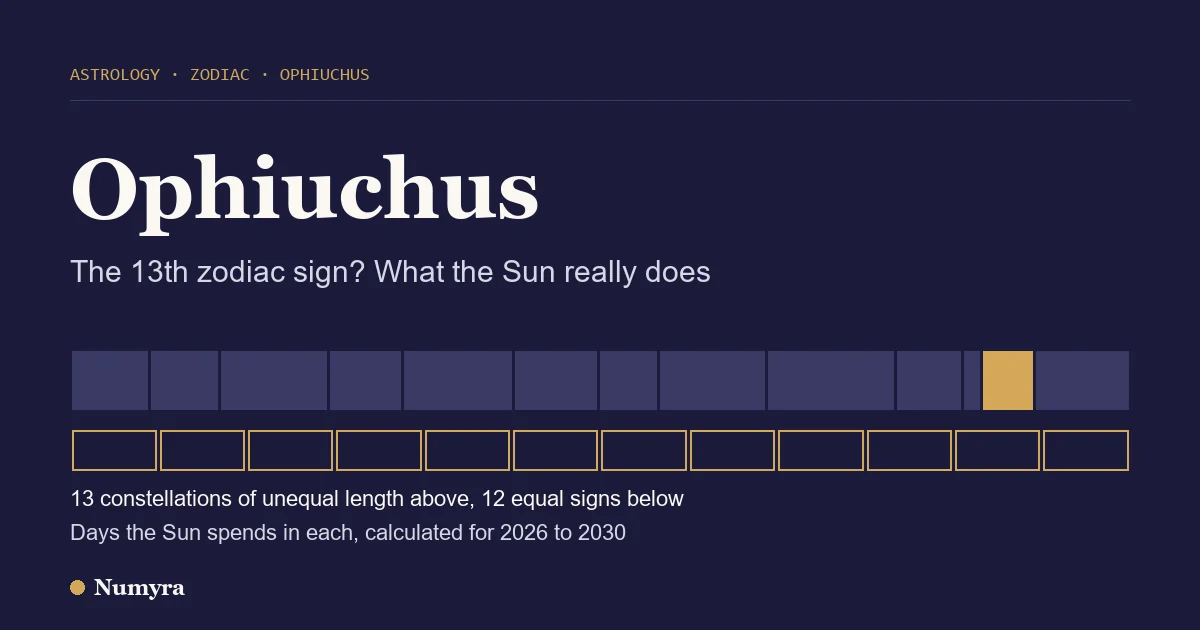
The zodiac signs are equal in angle (30 degrees each) but not in time. Earth’s orbit is slightly oval, and Earth moves fastest when it is closest to the Sun, in early January, and slowest when it is farthest, in early July. From Earth, the Sun therefore appears to sweep across the sky quickest in winter and slowest in summer. Across the 2027 to 2028 cycle, the Sun spends 29.44 days in Capricorn and 31.45 days in Cancer, a spread of more than two days.
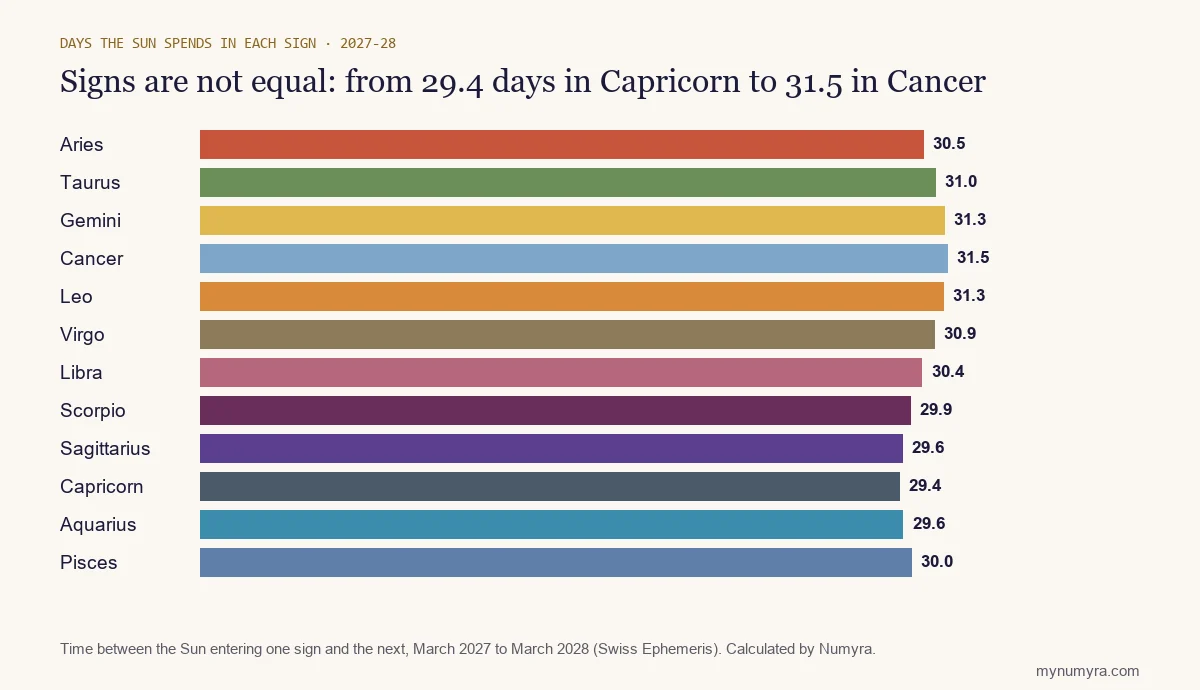
This is also why the “30 days per sign” rule of thumb fails at the edges: the Sun spends fewer than 30 days in Scorpio, Sagittarius, Capricorn, Aquarius and Pisces, and more than 30 in each of the other seven.
What to do if you were born on the cusp
The cusp is the boundary between two signs. In astrology it is also used loosely for the last or first few days of a sign, though there is no standard width: some writers use one day, some three. The sky does not work that way, because the changeover is one instant. To find out which side you fall on:
- Get the exact birth time and place. A birth certificate records both. The place matters because the changeover instant is converted to local time.
- Compare it with the changeover time for your birth year. The table above covers 2027 and the table further down gives 2026 and 2028. For other years, use a tool that calculates the Sun’s position from your birth data, such as the birth chart calculator in our calculators section, which computes it for you from the same ephemeris.
- If you do not know the birth time, you can still tell whether you are safely inside a sign. A birth in the middle of a sign gives the same answer for any time that day. Only a birth on the changeover day itself is uncertain.
The Sun moves about one degree a day, so someone born six hours before a boundary is only a quarter of a degree from the earlier sign and about a degree from being in its middle. Astrologers usually treat a Sun in the first or last degree or two of a sign as carrying some of the neighbouring sign’s character. That is a tradition, not a measured effect, and it is offered for reflection rather than prediction. Your Sun sign is also only one of the placements in a chart; see Sun sign vs. Moon sign vs. Rising sign.
The same dates for 2026, 2027 and 2028
Each column starts with the Sun entering Aries at the spring equinox and runs through to the following February. All times are US Eastern.
| Sign | 2026 cycle | 2027 cycle | 2028 cycle |
|---|---|---|---|
| Aries | Mar 20, 10:45 a.m. EDT | Mar 20, 4:24 p.m. EDT | Mar 19, 10:17 p.m. EDT |
| Taurus | Apr 19, 9:39 p.m. EDT | Apr 20, 3:17 a.m. EDT | Apr 19, 9:09 a.m. EDT |
| Gemini | May 20, 8:36 p.m. EDT | May 21, 2:18 a.m. EDT | May 20, 8:09 a.m. EDT |
| Cancer | Jun 21, 4:24 a.m. EDT | Jun 21, 10:10 a.m. EDT | Jun 20, 4:02 p.m. EDT |
| Leo | Jul 22, 3:13 p.m. EDT | Jul 22, 9:04 p.m. EDT | Jul 22, 2:53 a.m. EDT |
| Virgo | Aug 22, 10:18 p.m. EDT | Aug 23, 4:14 a.m. EDT | Aug 22, 10:00 a.m. EDT |
| Libra | Sep 22, 8:05 p.m. EDT | Sep 23, 2:01 a.m. EDT | Sep 22, 7:45 a.m. EDT |
| Scorpio | Oct 23, 5:37 a.m. EDT | Oct 23, 11:32 a.m. EDT | Oct 22, 5:13 p.m. EDT |
| Sagittarius | Nov 22, 2:23 a.m. EST | Nov 22, 8:16 a.m. EST | Nov 21, 1:54 p.m. EST |
| Capricorn | Dec 21, 3:50 p.m. EST | Dec 21, 9:42 p.m. EST | Dec 21, 3:19 a.m. EST |
| Aquarius | Jan 20, 2027, 2:29 a.m. EST | Jan 20, 2028, 8:21 a.m. EST | Jan 19, 2029, 2:00 p.m. EST |
| Pisces | Feb 18, 2027, 4:33 p.m. EST | Feb 18, 2028, 10:26 p.m. EST | Feb 18, 2029, 4:07 a.m. EST |
2028 is a leap year, and its Sun enters Aries on March 19 at 10:17 p.m. EDT, the earliest in the 1930 to 2030 range along with 2020 and 2024.
Where the dates come from, and the sidereal difference
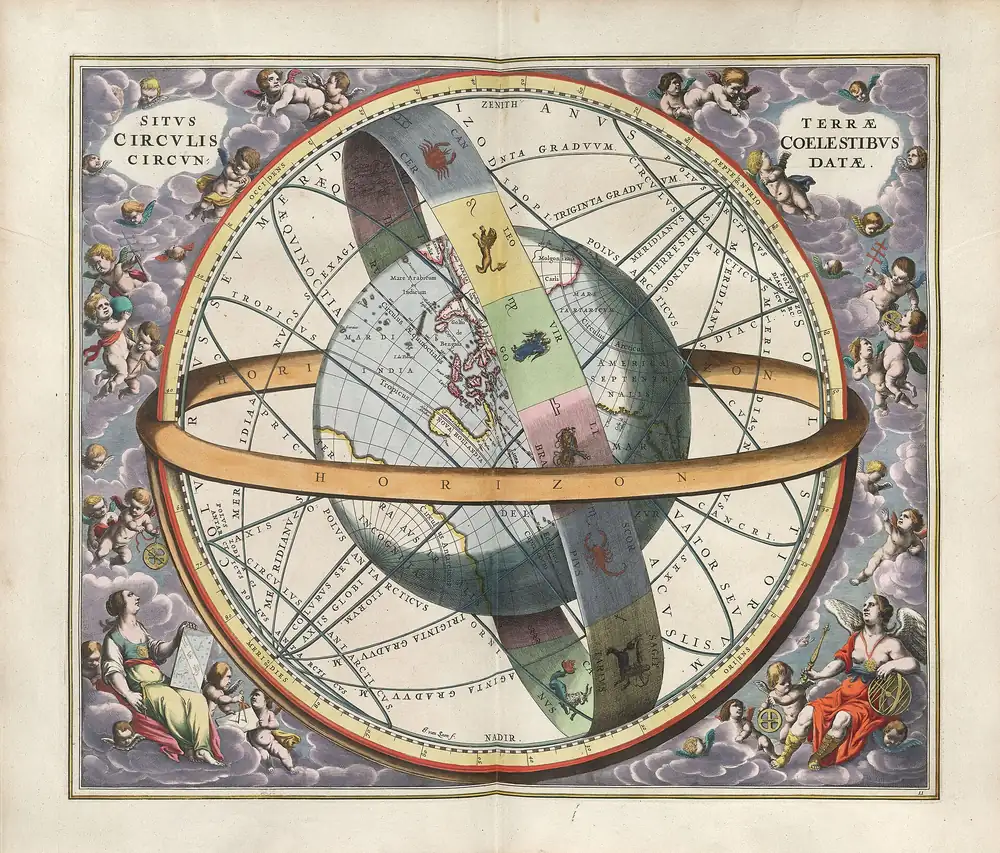
The Western zodiac is tropical: its starting point is not a star but the spring equinox, the moment the Sun crosses the celestial equator heading north. The ancient authors were explicit about this. In the Tetrabiblos, written around the second century CE, Ptolemy states the convention in his chapter on the seasons and the four angles:
“although there is no natural beginning of the zodiac, since it is a circle, they assume that the sign which begins with the vernal equinox, that of Aries, is the starting-point of them all”
Ptolemy, Tetrabiblos, Book I, chapter 10, trans. F. E. Robbins (Loeb Classical Library, 1940), via LacusCurtius
The constellations drifted against the equinox because Earth’s axis wobbles slowly (precession), so the sign called Aries no longer lines up with the stars called Aries. The sidereal zodiac, used in Vedic astrology, keeps the stars fixed and so sits about 24 degrees behind the tropical one today. For most people that means the Sun was in the previous sign by the sidereal count. Which one is “right” is a question of which reference point you choose, not of which one the sky confirms; the history is covered in Sidereal vs. tropical zodiac and where the 12 signs came from. The dates on this page are tropical.
How many people have each Sun sign
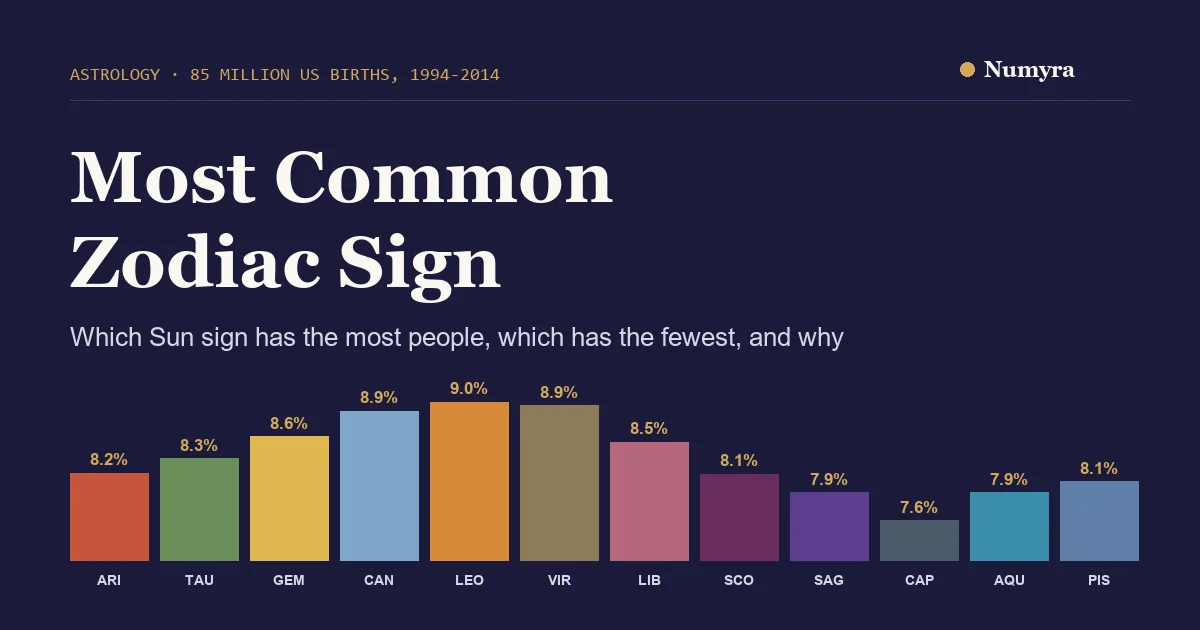
If births were spread evenly through the year, each sign’s share of people would match its length in days. They are not, and US data show it. We assigned every US birth from 1994 to 2014 (published by the CDC National Center for Health Statistics and the Social Security Administration) to its Sun sign, using the Sun’s position at midday on the birth date. Leo was the most common at 8.97% (see the full ranking of signs by US births) and Capricorn the least common at 7.6%, with Virgo (8.91%), Cancer (8.85%) and Libra (8.51%) near the top and Aquarius (7.94%) and Sagittarius (7.95%) at the bottom.
Sign length accounts for only part of that gap. Capricorn is the shortest sign, but its 7.6% is lower than the 8.1% its length alone would predict, because US births are fewer in winter and peak in late summer, the Leo and Virgo months. A sign’s share of the population says nothing about its character; it only reflects when babies are born and how long the Sun stays in each slice of sky.
Frequently asked questions
What are the dates for the 12 zodiac signs?
Aries March 21 to April 19; Taurus April 20 to May 20; Gemini May 21 to June 20; Cancer June 21 to July 22; Leo July 23 to August 22; Virgo August 23 to September 22; Libra September 23 to October 22; Scorpio October 23 to November 21; Sagittarius November 22 to December 21; Capricorn December 22 to January 19; Aquarius January 20 to February 18; Pisces February 19 to March 20. They can shift by a day in a given year.
When does Aries season start in 2027?
March 20, 2027 at 4:24 p.m. EDT (1:24 p.m. PDT), the spring equinox. Aries season ends when the Sun enters Taurus on April 20, 2027 at 3:17 a.m. EDT.
Why do zodiac dates differ between websites?
Because the Sun changes sign at a specific minute, and each site rounds that to a calendar day. Some use the most common date, some use the date in one time zone, and some use fixed ranges from an older book. The ranges here match the convention used across our sign pages.
What sign am I if I was born on the cusp?
It depends on your birth time and place, not only the date. On a changeover day, you are the earlier sign if you were born before the Sun’s entry and the later sign if after. A birth chart calculator that uses your exact time settles it.
Is the zodiac year the same as the calendar year?
No. The tropical zodiac year begins with Aries at the March equinox, nearly three months after the calendar year starts. Capricorn, Aquarius and Pisces fall at the start of the calendar year and Aries begins the next cycle in spring.
How long is each zodiac sign?
Between about 29.4 and 31.5 days. In the 2027 to 2028 cycle the Sun spends 31.45 days in Cancer, the longest, and 29.44 days in Capricorn, the shortest.
Is there a 13th zodiac sign?
The Sun does pass through the constellation Ophiuchus, but the zodiac signs are 12 equal 30-degree divisions measured from the equinox, not the outlines of constellations, so the system has 12 signs. See where the 12 zodiac signs came from.
Do zodiac dates predict anything?
The dates are an astronomical fact: the Sun is at a given position on a given day. What each sign is said to mean is a tradition, offered for reflection and entertainment, and it has not been shown to predict personality or events.
Sources
- Astrodienst. Swiss Ephemeris. Every Sun entry, sign length and start-date count (calculations by the Numyra Methodology Desk; times converted to US Eastern and Pacific with historical daylight saving rules).
- Wikipedia. Equinox, reproducing the US Naval Observatory equinox and solstice times for 2027, used to cross-check our Aries, Cancer, Libra and Capricorn entries.
- Ptolemy. Tetrabiblos, Book I, chapter 10, trans. F. E. Robbins (Loeb Classical Library), via LacusCurtius.
- NASA. Earth Fact Sheet. Sidereal orbit period 365.256 days and orbital eccentricity used for the sign-length explanation.
- FiveThirtyEight. US births data, 1994 to 2014, from the CDC National Center for Health Statistics and the Social Security Administration.