Ophiuchus is a real constellation, and the Sun does pass in front of it for about 18 days every year, from November 30 to December 18, but it is not a 13th zodiac sign. Zodiac signs are twelve equal 30-degree slices of the Sun’s path measured from the March equinox, and Ophiuchus only becomes a thirteenth division if you cut the sky along the constellation borders the International Astronomical Union fixed in 1930. We calculated when the Sun enters and leaves every IAU constellation from 2026 to 2030, checked all 65 crossings against NASA’s JPL Horizons service, and compared the result with the twelve signs, day by day and across 85 million US births.
Key takeaways
- The Sun is in front of Ophiuchus for 18.3 days every year. In 2027 that runs from 6:35 am Eastern on November 30 to 2:09 pm Eastern on December 18. Only the clock time moves from year to year; the length stays between 18.31 and 18.32 days.
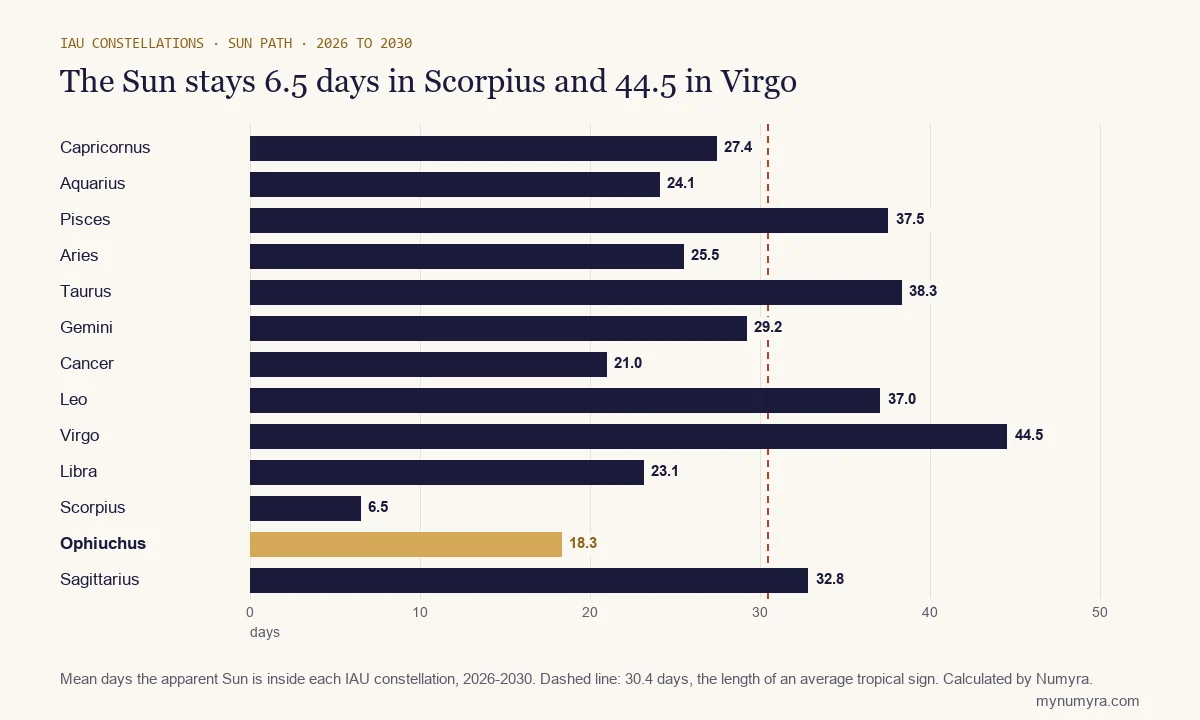
- The Sun crosses 13 IAU constellations, staying between 6.5 days (Scorpius) and 44.5 days (Virgo), while a tropical sign always lasts 29.4 to 31.5 days. NASA’s rounded figures of 7 and 45 days match ours.
- On only about 40 days a year (11%) does the sign in a horoscope share a name with the constellation behind the Sun. About 88% of US births from 1994 to 2014 would get a different sign name if constellations were used.
- Everyone born with the Sun in Ophiuchus, 4.98% of US births or about 4.25 million people in our data, was born in tropical Sagittarius, which is how Western astrology counts them.
- The 13th-sign story is old and keeps returning, from a 1970 book proposing 14 signs to the 2011 news cycle and NASA’s 2020 reply. It rests on borders drawn in 1930. This is astronomy and tradition, not prediction.
In this guide
- Is Ophiuchus a zodiac sign?
- When the Sun is in Ophiuchus, 2026 to 2030
- How long the Sun stays in each of the 13 constellations
- Which constellation is the Sun in on your birthday?
- What a constellation zodiac would do to US birthdays
- Why astrologers use 12 signs and where the borders come from
- Why the 13th-sign story keeps coming back
- Does any astrologer use 13 signs?
- If you were born from November 30 to December 17
- How we calculated this
- Frequently asked questions
Is Ophiuchus a zodiac sign?
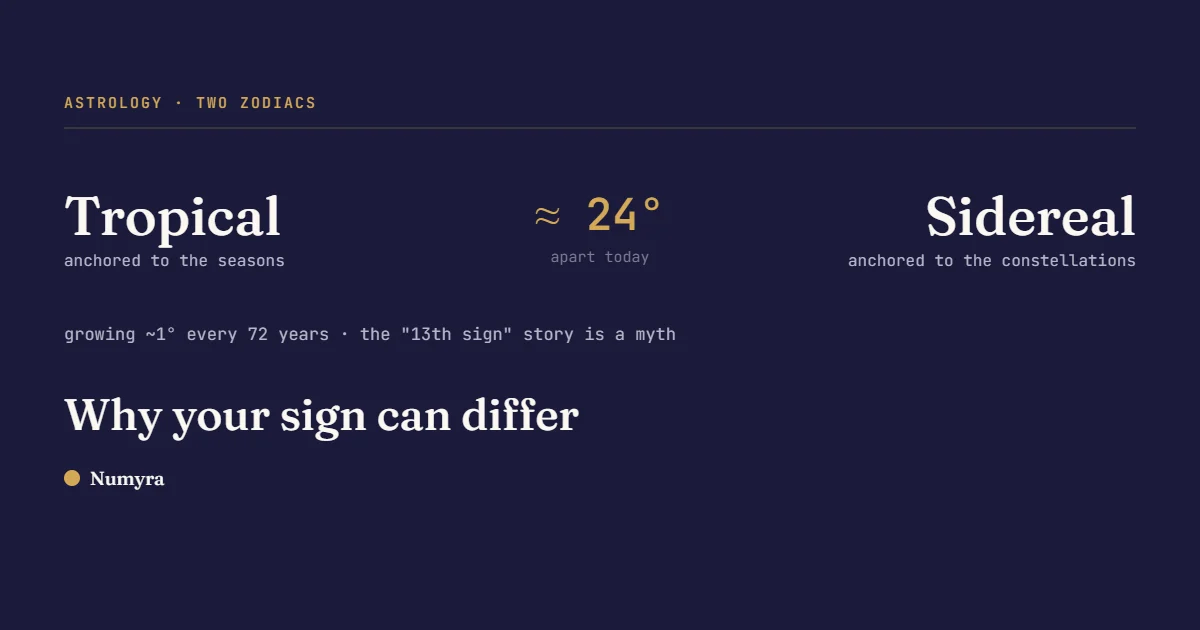
Not in Western astrology, and not in mainstream Vedic astrology either. The confusion comes from two different things sharing the word “zodiac”. A constellation is a patch of sky with fixed borders. A zodiac sign is an interval along the ecliptic, the Sun’s apparent yearly path. Tropical astrology, the system used on our zodiac sign profiles, measures that path from the March equinox and cuts it into twelve 30-degree signs, so the signs follow the seasons rather than the stars behind them. Our guide to sidereal versus tropical astrology explains the two reference points.
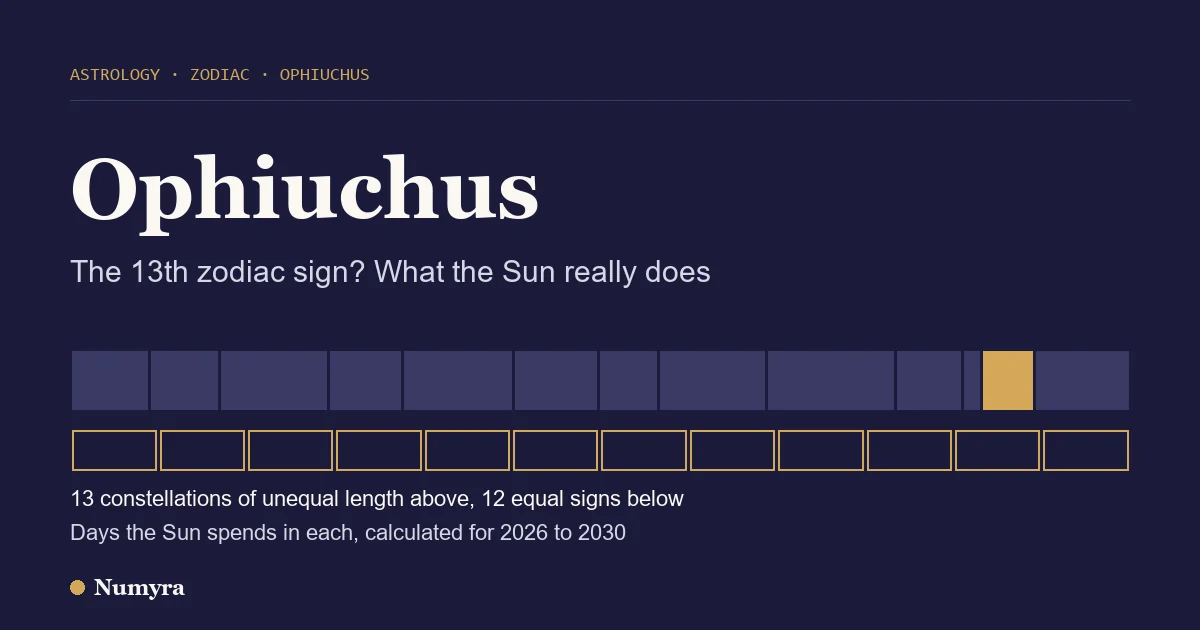
Ophiuchus, the Serpent-bearer, is one of the 88 IAU constellations, and the ecliptic cuts across its southern part. That puts thirteen constellations on the Sun’s path: Capricornus, Aquarius, Pisces, Aries, Taurus, Gemini, Cancer, Leo, Virgo, Libra, Scorpius, Ophiuchus and Sagittarius. The diagram below draws both divisions of the same circle for 2027. Scorpius is a thin sliver, Ophiuchus a wide slice between it and Sagittarius, and the twelve signs are even.
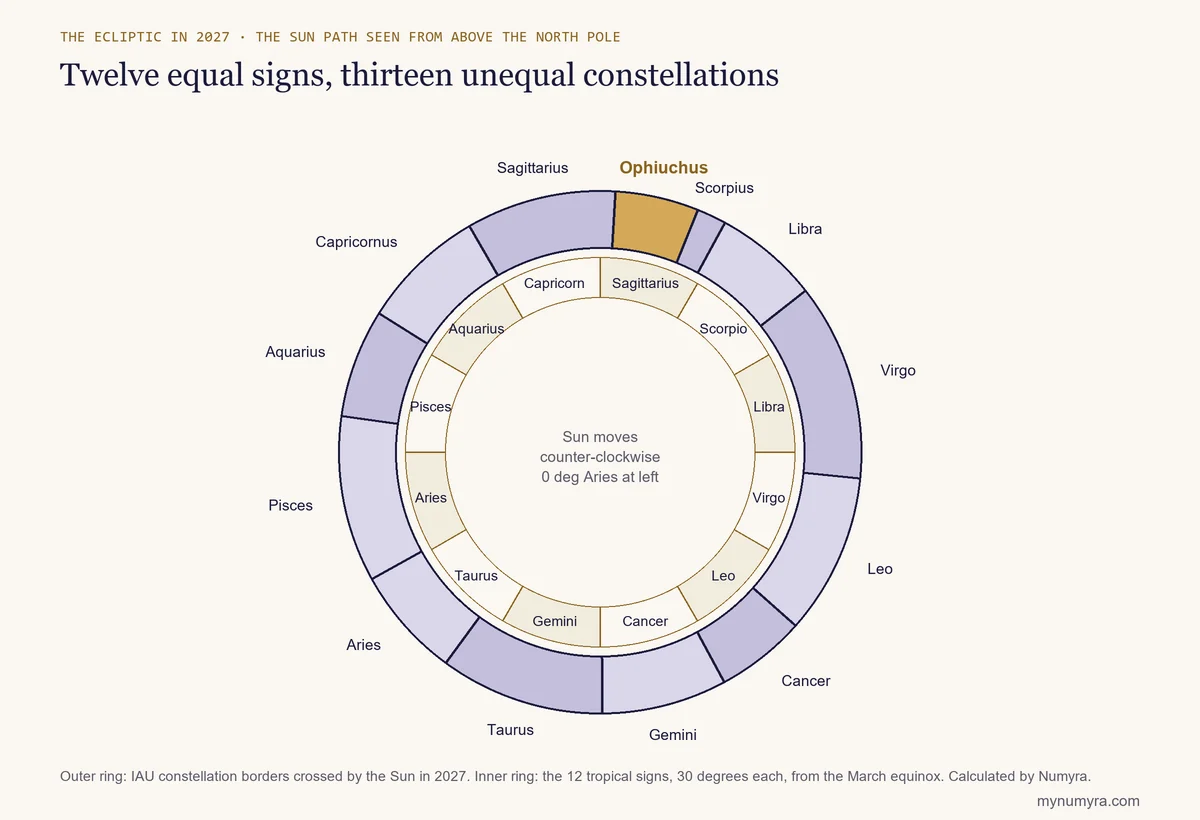
So “is Ophiuchus the 13th sign?” has two honest answers. If a sign means one of twelve equal slices of the ecliptic counted from the equinox, there is no thirteenth. If a sign meant the constellation behind the Sun, there would be thirteen, but Capricorn, Aquarius and most other signs would then start on different dates than any horoscope column prints.
When the Sun is in Ophiuchus, 2026 to 2030
Websites give November 29 or 30 for the start and December 17 or 18 for the end. Both are right, because the Sun crosses a fixed border at one instant, and that instant falls on different calendar dates in different years and time zones. These are the instants we calculated. Standard time applies on all of these dates (EST and PST).
| Year | Sun enters Ophiuchus | Sun leaves Ophiuchus | Days in Ophiuchus |
|---|---|---|---|
| 2026 | Mon, Nov 30, 12:28 am EST Sun, Nov 29, 9:28 pm PST |
Fri, Dec 18, 7:55 am EST Fri, Dec 18, 4:55 am PST |
18.31 |
| 2027 | Tue, Nov 30, 6:35 am EST Tue, Nov 30, 3:35 am PST |
Sat, Dec 18, 2:09 pm EST Sat, Dec 18, 11:09 am PST |
18.32 |
| 2028 | Wed, Nov 29, 12:38 pm EST Wed, Nov 29, 9:38 am PST |
Sun, Dec 17, 8:09 pm EST Sun, Dec 17, 5:09 pm PST |
18.31 |
| 2029 | Thu, Nov 29, 6:54 pm EST Thu, Nov 29, 3:54 pm PST |
Tue, Dec 18, 2:20 am EST Mon, Dec 17, 11:20 pm PST |
18.31 |
| 2030 | Sat, Nov 30, 1:03 am EST Fri, Nov 29, 10:03 pm PST |
Wed, Dec 18, 8:38 am EST Wed, Dec 18, 5:38 am PST |
18.32 |
The stay lasts 18.31 or 18.32 days every year, so the only thing that moves is the clock time: about six hours later each year, then jumps back a day in a leap year, which is why 2028 starts on November 29 in Eastern time. In 2027 the Sun is in front of Ophiuchus for 62% of tropical Sagittarius, a season of 29.56 days, and the rest is split between Libra (1.4 days), Scorpius (6.5) and Sagittarius itself (3.3). Our Sagittarius profile shows that sky breakdown for one sign; this guide extends it to all thirteen constellations and five years.
How long the Sun stays in each of the 13 constellations
The Ophiuchus window makes more sense next to the others. The table lists every constellation in the order the Sun reaches it from January, with the usual US Eastern entry dates for 2026 to 2030, the mean stay, and the arc of the ecliptic the borders cut out. The arcs add up to 360 degrees. The stays add up to 365.26 days, the sidereal year, because the constellations are fixed to the stars; the twelve signs add up to the tropical year of 365.24 days.
| Constellation | Sun enters (US Eastern) | Days the Sun stays | Arc of the ecliptic | Against an average sign (30.4 days) |
|---|---|---|---|---|
| Capricornus | Jan 19-20 | 27.4 | 27.8° | −3.0 days |
| Aquarius | Feb 16 | 24.1 | 24.2° | −6.4 days |
| Pisces | Mar 11-12 | 37.5 | 37.0° | +7.1 days |
| Aries | Apr 18-19 | 25.5 | 24.7° | −5.0 days |
| Taurus | May 13-14 | 38.3 | 36.7° | +7.9 days |
| Gemini | Jun 21 | 29.2 | 27.8° | −1.2 days |
| Cancer | Jul 20-21 | 21.0 | 20.1° | −9.5 days |
| Leo | Aug 10-11 | 37.0 | 35.8° | +6.6 days |
| Virgo | Sep 16-17 | 44.5 | 44.0° | +14.1 days |
| Libra | Oct 30-31 | 23.1 | 23.3° | −7.3 days |
| Scorpius | Nov 23 | 6.5 | 6.6° | −23.9 days |
| Ophiuchus | Nov 29-30 | 18.3 | 18.6° | −12.1 days |
| Sagittarius | Dec 17-18 | 32.8 | 33.4° | +2.4 days |
| Total | 365.26 | 360.0° |
Across 2026 to 2030 each stay changes by no more than 0.02 days. NASA’s Space Place page, last updated in January 2016, gives the two extremes in a single sentence:
“The line from Earth through the Sun points to Virgo for 45 days, but it points to Scorpius for only 7 days.”
NASA Space Place, “Constellations and the Calendar” (archived copy)
Our figures, 44.5 and 6.5 days, are the same numbers to more decimals. Ophiuchus, at 18.3 days, is the shortest stay after Scorpius; Cancer is next at 21.0. A tropical sign never gets that short or that long, because it is a fixed 30 degrees of the ecliptic; the 29.4 to 31.5 day range comes only from Earth moving a little faster in January and slower in July.
Which constellation is the Sun in on your birthday?
This strip lays the 2027 calendar year against both divisions. The top bar is the constellation behind the Sun and the bottom bar is the tropical sign; gold marks the days when the two carry the same name.
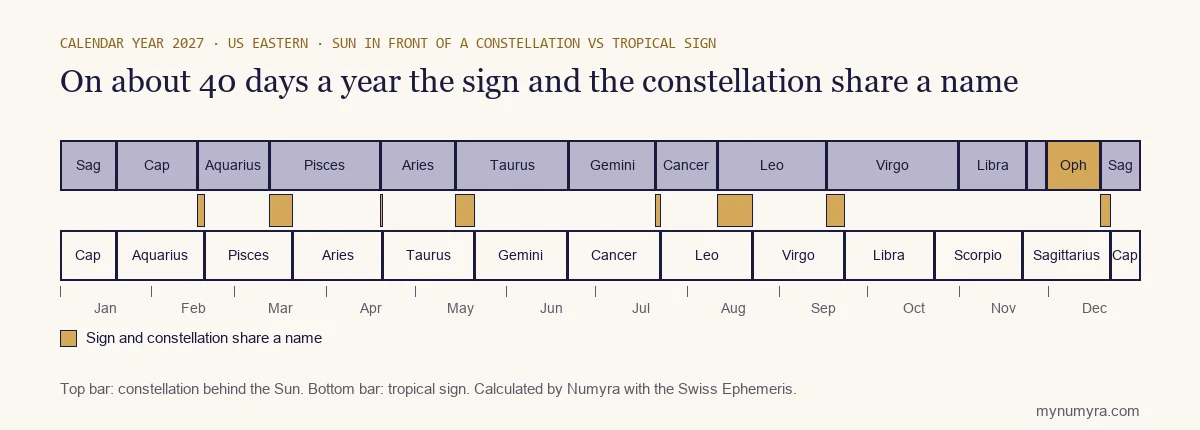
The table below turns it around: for each tropical sign in the 2027 to 2028 cycle, what the Sun is actually in front of, with days for each constellation.
| Tropical sign | Dates (US Eastern) | The Sun is in front of |
|---|---|---|
| Aries | Mar 20 to Apr 20 | Pisces 29.5 days; Aries 1.0 days |
| Taurus | Apr 20 to May 21 | Aries 24.5 days; Taurus 6.4 days |
| Gemini | May 21 to Jun 21 | Taurus 31.3 days |
| Cancer | Jun 21 to Jul 22 | Taurus 0.5 days; Gemini 29.2 days; Cancer 1.7 days |
| Leo | Jul 22 to Aug 23 | Cancer 19.3 days; Leo 12.0 days |
| Virgo | Aug 23 to Sep 23 | Leo 25.0 days; Virgo 5.9 days |
| Libra | Sep 23 to Oct 23 | Virgo 30.4 days |
| Scorpio | Oct 23 to Nov 22 | Virgo 8.2 days; Libra 21.7 days |
| Sagittarius | Nov 22 to Dec 21 | Libra 1.4 days; Scorpius 6.5 days; Ophiuchus 18.3 days; Sagittarius 3.3 days |
| Capricorn | Dec 21 to Jan 20 | Sagittarius 29.4 days |
| Aquarius | Jan 20 to Feb 18 | Capricornus 27.4 days; Aquarius 2.1 days |
| Pisces | Feb 18 to Mar 19 | Aquarius 22.0 days; Pisces 8.0 days |
Three seasons sit entirely in front of one earlier constellation: Gemini season in front of Taurus, Libra season in front of Virgo, and Capricorn season in front of Sagittarius. Sagittarius season is the busiest, with the Sun in front of four constellations, and only 3.3 of its 29.6 days (11%) are spent in front of Sagittarius. Add up the days when the names match (Leo 12.1, Pisces 8.0, Taurus 6.4, Virgo 5.9, Sagittarius 3.3, Aquarius 2.1, Cancer 1.7, Aries 1.0) and you get 40.5 days, 11.1% of 2027. For the exact moment each sign starts, see our zodiac sign dates for 2027.
What a constellation zodiac would do to US birthdays
We ran the same comparison on real people. Using the daily US birth counts published by the CDC’s National Center for Health Statistics (1994 to 2003) and the Social Security Administration (2004 to 2014), 85,386,227 births over 7,670 days, we assigned each birth to the constellation behind the Sun at the hour it occurred, spreading each day’s births evenly across the Eastern-time day.
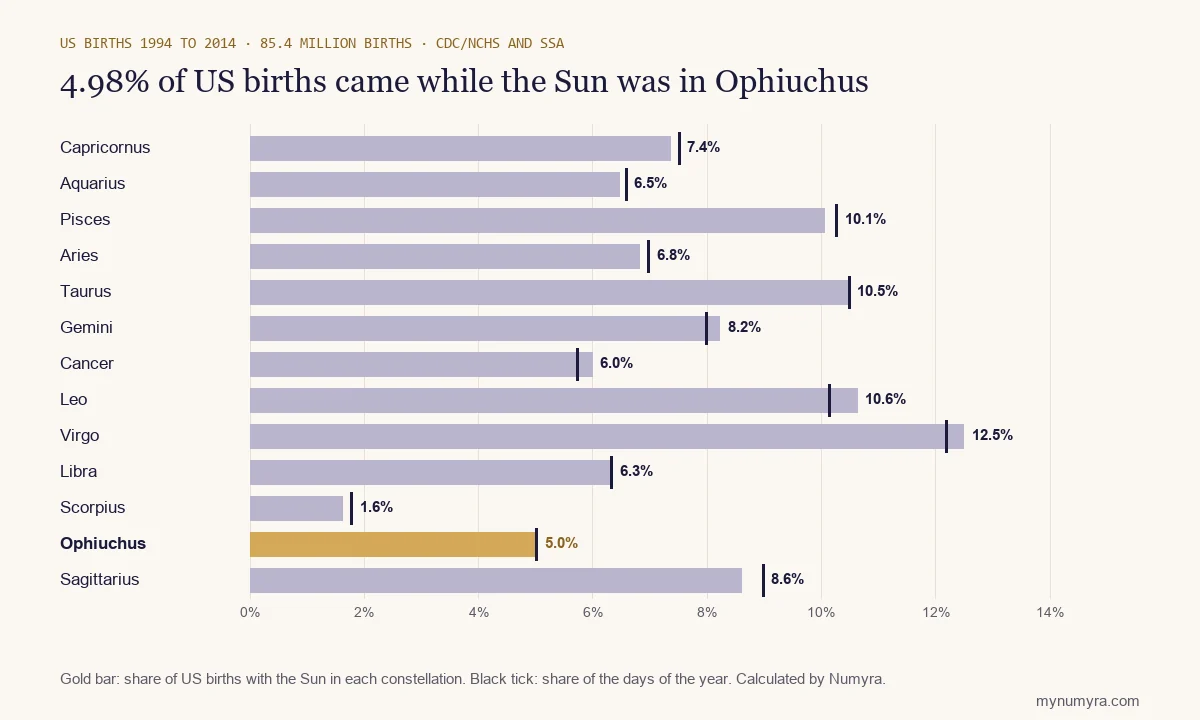
Of those births, 4.98% (about 4.25 million) came while the Sun was in Ophiuchus, almost exactly its 5.01% share of the year’s days. Virgo was the largest group at 12.5% and Scorpius the smallest at 1.6%. Every Ophiuchus birth falls inside tropical Sagittarius. Only 12.2% of births had a tropical sign that shares its name with the constellation behind the Sun, so about 88% of Americans in this period would hear a different sign name if constellations were used. Our ranking of the most common zodiac signs by US births uses the tropical signs and shows how birth seasonality shapes each one.
Why astrologers use 12 signs and where the borders come from
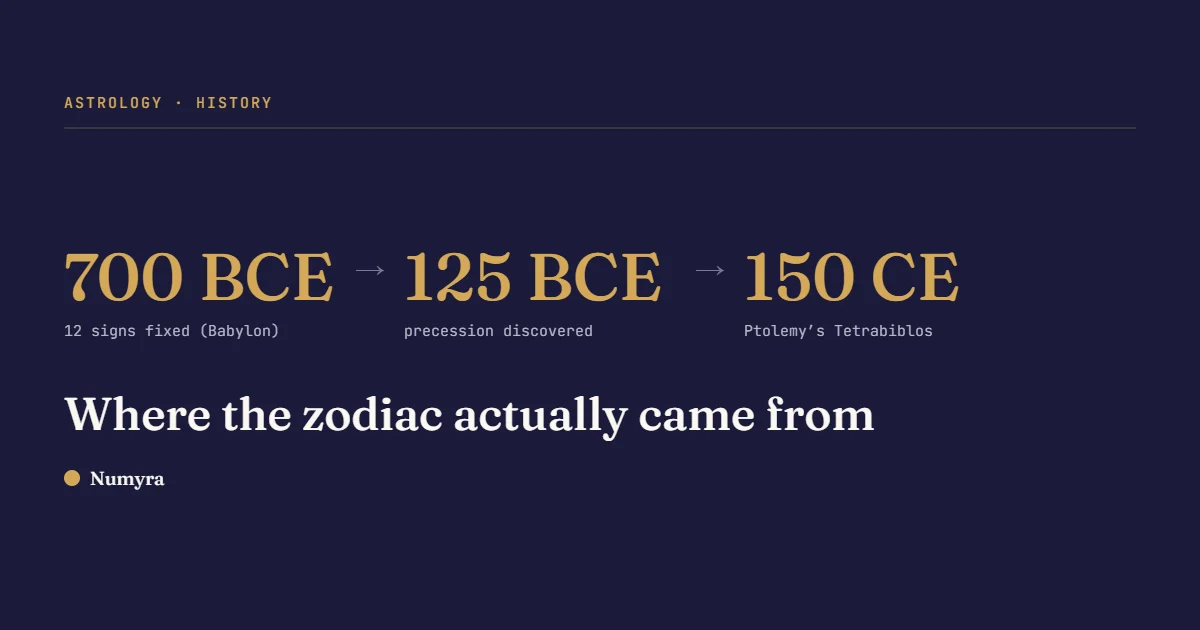
Tropical astrology is built on the seasons: 0 degrees Aries is the moment of the March equinox, whatever stars are behind the Sun. Twelve signs reflect a calendar of about twelve lunar months to a year, and NASA’s page ties the Babylonian choice of 12 to their 12-month calendar. Our guide to where the twelve signs came from follows that history, and Ptolemy’s Tetrabiblos is the second-century textbook that fixed the Western version. None of it needed constellation borders, because the signs were never drawn from them.
The borders are much younger. According to Astronomy magazine, atlases of the late 19th century drew constellation outlines with arbitrary borders and different sources disagreed, until a process the IAU began in 1922 and finalized in 1928 produced Eugene Delporte’s boundaries, published in 1930. The magazine’s summary is short:
“Uniformity didn’t occur until the 1930 agreement that gave us the 88 constellations we acknowledge today.”
Delporte’s lines run along right ascension and declination as they were in 1875. Before them there was no single exact answer to “how many days is the Sun in Ophiuchus?”, and a 13-constellation count to the day became possible only once the lines existed. The stretch of ecliptic inside the Ophiuchus border is 18.6 degrees long, and that stretch is the whole basis of the “13th sign”.
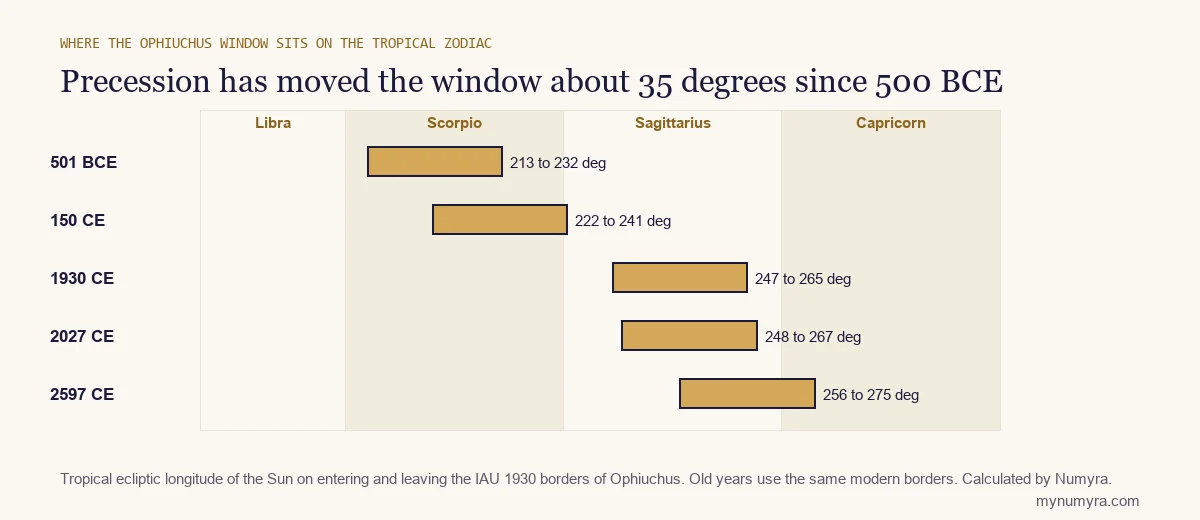
Precession also moves the window against the signs. Applying the same modern borders to other eras, the Sun’s Ophiuchus window in 2027 sits at 248 to 267 degrees of tropical longitude, which is 8 to 27 degrees of Sagittarius. In Ptolemy’s day, around 150 CE, it sat at 222 to 241 degrees, from 12 degrees of Scorpio to the start of Sagittarius, and by about 2600 CE its end will cross into tropical Capricorn. This is an illustration, not a claim about what ancient astronomers saw, since they had no borders to apply.
Why the 13th-sign story keeps coming back
The idea is older than the internet. Wikipedia’s account traces suggestions that the Sun is “in the sign of Ophiuchus” between November 30 and December 18 to at least the 1970s, including a 1977 article in the planetarium journal Planetarian. It also notes Steven Schmidt’s 1970 book Astrology 14, which proposed 14 equal signs by adding Ophiuchus and Cetus, and Walter Berg’s 1995 book The 13 Signs of the Zodiac. Both authors suggested Pluto as Ophiuchus’s ruler (Wikipedia, “Ophiuchus (astrology)”).
The mass-media version arrived in January 2011. Parke Kunkle, a Minnesota Planetarium Society board member who teaches astronomy at Minneapolis Community and Technical College, told the Star Tribune that the Sun is not really in the sign astrologers say, according to the Albany Times Union report reprinted by the Bend Bulletin. The “new dates” that circulated in that coverage match our constellation dates to within a day, for example Ophiuchus from November 29 to December 17. Astronomers were unimpressed. Ed Krupp of the Griffith Observatory told ABC7:
“Anybody 50 years ago or 100 years ago or yesterday for that matter could have and would have known that the stars and the signs don’t match up”
Ed Krupp, Griffith Observatory, quoted by ABC7
The astrologer Rob Brezsny said modern Western astrologers understood Kunkle’s point and found it irrelevant, since their work does not depend on distant stars or constellations.
NASA’s Space Place page contains the sentence that fuels the rest: the Sun is aligned with Ophiuchus for about 18 days a year. When the page resurfaced, NASA answered on social media in July 2020, and CBS News quoted the reply as “No, we did not change the zodiac.” The same page also states that astrology is not science and that no one has shown it can predict the future or describe people from their birth date. It makes a historical claim about the Babylonians leaving Ophiuchus out that we could not verify independently, so treat that part as NASA’s statement. The story keeps returning because its core is true, it is easy to share, and “your sign changed” is an irresistible headline.
Does any astrologer use 13 signs?
A few, but they are a small minority. Mainstream sidereal astrology, the Vedic system, still uses twelve equal 30-degree signs; it only moves the starting point back by an offset called the ayanamsa, about 24.2 degrees in December 2027 with the Lahiri standard. In that system the Sun is in sidereal Sagittarius from December 16, 2027 to January 14, 2028, so most of the Ophiuchus window, about 16 of its 18.3 days, falls in sidereal Scorpio. The 13-sign proposals of Schmidt and Berg are separate systems. Nothing here says which approach is better, only what each one measures. Our sidereal versus tropical guide compares the offsets, and the Scorpio profile has the same sky breakdown as Sagittarius.
If you were born from November 30 to December 17
In tropical astrology you are a Sagittarius, because the Sun was between 8 and 27 degrees of the sign Sagittarius on those dates, and that is what horoscope columns, and our sign profiles, mean by your Sun sign. If you want to see how the Sun, Moon and rising sign differ, start with our Sun, Moon and rising sign guide, then run the birth chart calculator.
The constellation itself has its own lore, and Wikipedia’s summary notes that the Roman poet Manilius wrote of Ophiuchus as protection against snakes and that a fourth-century astrologer linked its bright star Ras Alhague with physicians. That is mythology attached to a constellation, not a classical sign with a personality profile, so we do not offer Ophiuchus traits. Astrology is a tradition of interpretation. Nothing on this page predicts your personality or your future.
How we calculated this
- Sun position. Swiss Ephemeris through pyswisseph (Moshier ephemeris), the geocentric Sun without aberration or light deflection, referred to the J2000 equator, which is how catalogue star positions are defined.
- Borders. The 357-line Delporte 1930 table digitized by Nancy Roman in 1987 (CDS catalogue VI/42) with the precession routine from its own C program, ported to Python. The port reproduces all 8 sample results printed in the CDS documentation.
- Check. For each of the 65 constellation changes from 2026 to 2030 we asked JPL Horizons for the Sun’s astrometric position 30 minutes before and after, then 2 minutes before and after: 130 of 130 results in both runs put the Sun in the expected constellation. That keeps each entry time within about two minutes of Horizons.
- Births. FiveThirtyEight’s compilation of CDC/NCHS and SSA daily US birth counts, 1994 to 2014, dates only. Birth times are not in the data, so each day is spread evenly over 24 hours of US Eastern time, an assumption.
- Time zones. US Eastern and Pacific, with standard time on every date shown.
- Source differences. Our sign profiles compute times from the Sun’s apparent position of date, so their times can differ from those here by up to about eight minutes; the US Eastern dates agree for 2026 to 2030.
Frequently asked questions
Is Ophiuchus a real zodiac sign?
It is a real constellation but not one of the twelve zodiac signs. Western and mainstream Vedic astrology divide the ecliptic into twelve equal 30-degree signs, so Ophiuchus has no place in either system.
What are the Ophiuchus dates?
The Sun is in front of Ophiuchus from November 29 or 30 to December 17 or 18, about 18.3 days. In 2027 the entry is at 6:35 am EST on November 30 and the exit at 2:09 pm EST on December 18.
Did NASA add a 13th zodiac sign?
No. NASA’s Space Place page only notes that the Sun is aligned with Ophiuchus for about 18 days a year, and when the story resurfaced in 2020 NASA replied that it did not change the zodiac.
If I was born between November 30 and December 17, am I an Ophiuchus?
Astronomically the Sun was in front of Ophiuchus on those dates. In tropical astrology, which horoscope columns use, you are a Sagittarius, because signs are measured from the equinox and not from constellations.
How many constellations does the Sun pass through?
Thirteen IAU constellations: Capricornus, Aquarius, Pisces, Aries, Taurus, Gemini, Cancer, Leo, Virgo, Libra, Scorpius, Ophiuchus and Sagittarius, for between 6.5 and 44.5 days each.
Why don’t astrologers add Ophiuchus?
Because the tropical signs are not constellations. They are twelve equal slices measured from the March equinox, so adding a constellation would not change them. Astrologer Rob Brezsny made this point when the story ran in 2011.
Does Vedic astrology use Ophiuchus?
No. Mainstream sidereal astrology also uses twelve equal signs and only shifts the starting point by about 24 degrees. A few 13-sign systems exist, such as those proposed by Steven Schmidt and Walter Berg, but they are a small minority.
How long does the Sun stay in each zodiac sign compared with each constellation?
A tropical sign lasts 29.4 to 31.5 days. The Sun’s stay in a constellation ranges from 6.5 days in Scorpius to 44.5 days in Virgo, with Ophiuchus at 18.3.
Sources
- NASA Space Place. “Constellations and the Calendar” (page last updated January 13, 2016; the original address now redirects, so this is the Internet Archive copy of July 17, 2020). Source of the 45-day, 7-day and 18-day figures and the statement that astrology is not science.
- Astronomy. “Where did the constellations come from?” History of the 1922 to 1930 IAU boundary agreement and Delporte’s book.
- Roman, N. G. (1987), PASP 99, 695. CDS catalogue VI/42, the digitized Delporte (1930) constellation boundaries and the program used for our port.
- NASA JPL. Horizons System. Independent positions of the Sun used to check all 65 constellation changes, 2026 to 2030.
- Astrodienst. Swiss Ephemeris. Sun positions, tropical and sidereal (Lahiri) entries (calculations by the Numyra Methodology Desk).
- FiveThirtyEight. US births data, 1994 to 2014, from the CDC National Center for Health Statistics and the Social Security Administration. Dates only.
- ABC7. “Did shifting stars change your zodiac sign?” Ed Krupp’s quotation and the 2011 chart of dates.
- Lee, Stephanie, Albany Times Union. “New zodiac sign knocks astrology world off axis”, The Bulletin (Bend, Oregon), January 15, 2011. Parke Kunkle and Rob Brezsny.
- CBS News. “No, NASA has not discovered a new zodiac sign”, July 17, 2020.
- Wikipedia. “Ophiuchus (astrology)”. History of 13-sign proposals (Schmidt 1970, Berg 1995) and the Manilius and Ras Alhague references, each of which cites its own primary source there.