Every house numerology page online will tell you what your address number “means.” Almost none of them will tell you that this isn’t an ancient practice at all — it’s a modern extrapolation of core numerology, applied to something Pythagoras never had: a street address. Here’s the honest version, including how to actually calculate it.
This tends to come up at a specific moment — signing a lease, closing on a house, or just noticing a new apartment number for the first time — which is exactly when a quick, confident-sounding “meaning” is most tempting to take at face value. We’d rather slow that down a little and show the real math, the real gaps in the tradition’s own history, and where sources genuinely disagree, before getting to what each number is traditionally read as.
Key takeaways
- House numerology reduces your street number (and any unit letters) to a single digit using the same Pythagorean or Chaldean method used for names — it’s an application of numerology, not a separate ancient tradition of its own.
- Master numbers (11, 22, 33) and karmic debt numbers (13, 14, 16, 19) are handled inconsistently across sources for addresses — we show you both conventions rather than silently picking one.
- If your address has letters (an apartment or unit number like “5R”), the Pythagorean and Chaldean systems can genuinely disagree on the result — the same way they do for names.
- Nothing here is real estate, financial, or life advice — a cultural tradition, presented for reflection.
In this guide
- How to calculate your house number
- What each house number is traditionally read as
- Master numbers: 11, 22 and 33
- Karmic debt numbers: 13, 14, 16 and 19
- A different “bad 13”: why buildings skip the 13th floor
- Does the street name matter too?
- When your address has letters
- Where house numbers themselves come from
- Is house numerology an ancient practice?
- How this compares to your other numbers
- Frequently asked questions
How to calculate your house number
The method is the same digit-reduction used throughout numerology: add every digit in your street number together, then keep reducing the sum until you reach a single digit (with two traditional exceptions — see below).
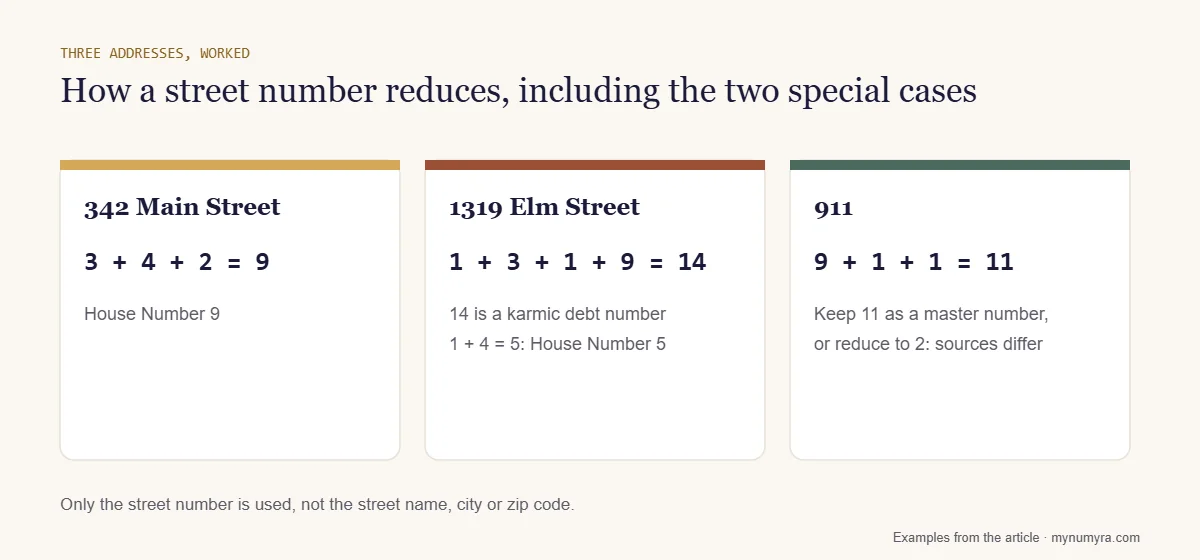
Worked example: 342 Main Street
| Step | Math |
|---|---|
| Add the digits | 3 + 4 + 2 = 9 |
| Reduce | Already a single digit — House Number 9 |
Only the street number itself is used — not the street name, city, or zip code. If you live in an apartment or unit, most sources add the unit number to the street number as a separate step, or calculate it separately and note both (we do the latter — see the letters section below for why apartment letters need their own explanation).
What each house number is traditionally read as
These readings borrow directly from the same core-number archetypes used throughout numerology — a 9 house is read through the same lens as a Life Path 9, applied to a home instead of a person.
Master numbers: 11, 22 and 33
Numerology’s own master numbers — 11, 22 and 33 — are traditionally kept unreduced when they appear in a birth-date or name calculation. Address numerology sources genuinely disagree on whether the same rule applies to a house number. A house numbered 911, for example, reduces digit-by-digit to 11 (9+1+1=11) before any further reduction — some sources stop there and read it as a master-number house; others reduce it fully to 2 (1+1=2) the same way any other double-digit total would be. We show both rather than pretend there’s a single settled answer: read it as 11 if you find the master-number framing meaningful, or as 2 if you prefer full reduction — both are genuinely used across the tradition.
Karmic debt numbers: 13, 14, 16 and 19
Four specific two-digit totals — 13, 14, 16 and 19 — are traditionally read differently from every other number that reduces further. These are called “karmic debt numbers,” and the reading isn’t about the final single digit at all, but about the fact that the total passed through one of these four numbers on its way there.
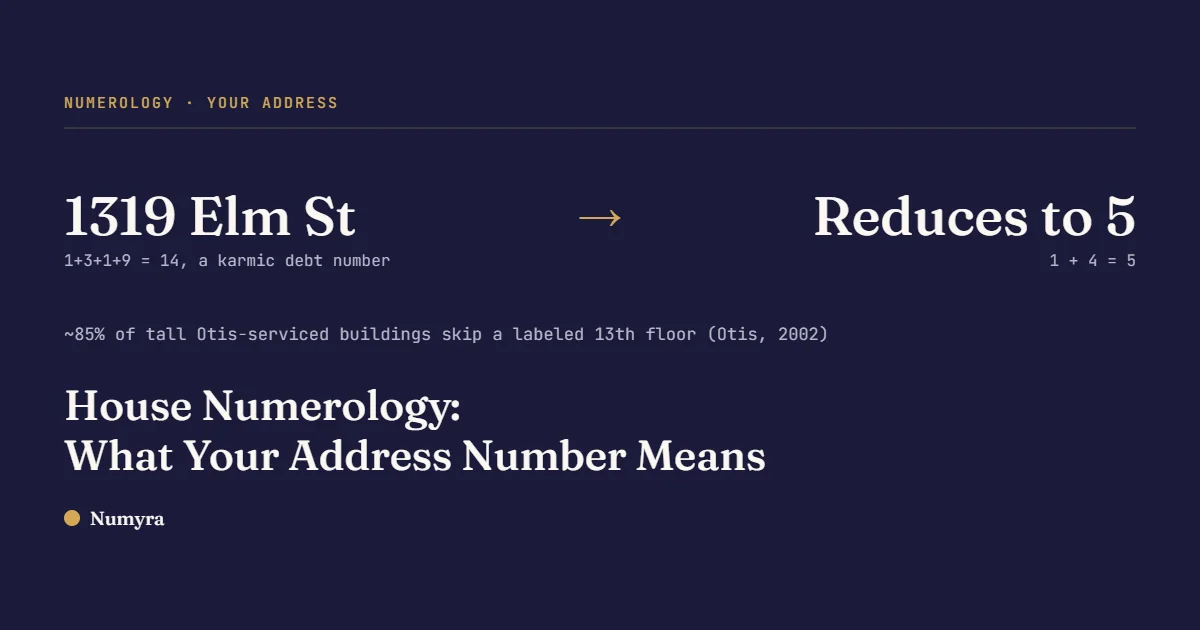
Worked example: 1319 Elm Street
| Step | Math |
|---|---|
| Add the digits | 1 + 3 + 1 + 9 = 14 |
| Reduce | 1 + 4 = 5 — passes through the karmic debt number 14 on the way to House Number 5 |
Traditional readings treat each of the four numbers as pointing to a specific, different lesson rather than a single blanket warning:
We’re being direct about something most house-numerology pages gloss over: no source we could find, including the ones with the most detailed karmic-debt writeups, actually explains why these specific four numbers were singled out rather than any other two-digit total. Treat this as a genuine, long-standing part of the tradition — not as something with a documented origin we can point to.
A different “bad 13”: why buildings skip the 13th floor
Numerology’s karmic debt 13 is often confused with a completely separate, much more visible phenomenon: real buildings that skip labeling a 13th floor entirely. That practice is real and well documented, but it isn’t numerology — it’s Western triskaidekaphobia, a general fear of the number 13 with roots in medieval Christian and older folklore, applied to architecture. An Otis Elevator executive estimated in 2002 that around 85% of buildings tall enough to have a 13th floor, and serviced by Otis elevators, didn’t label one — the button marked “14” simply opens onto the actual thirteenth floor. A more recent study of New York City residential condo buildings found only about 5% have a labeled 13th floor at all, and separate market research found apartments on an actual 13th floor sold roughly 18% less often than comparable units elsewhere in the same building.
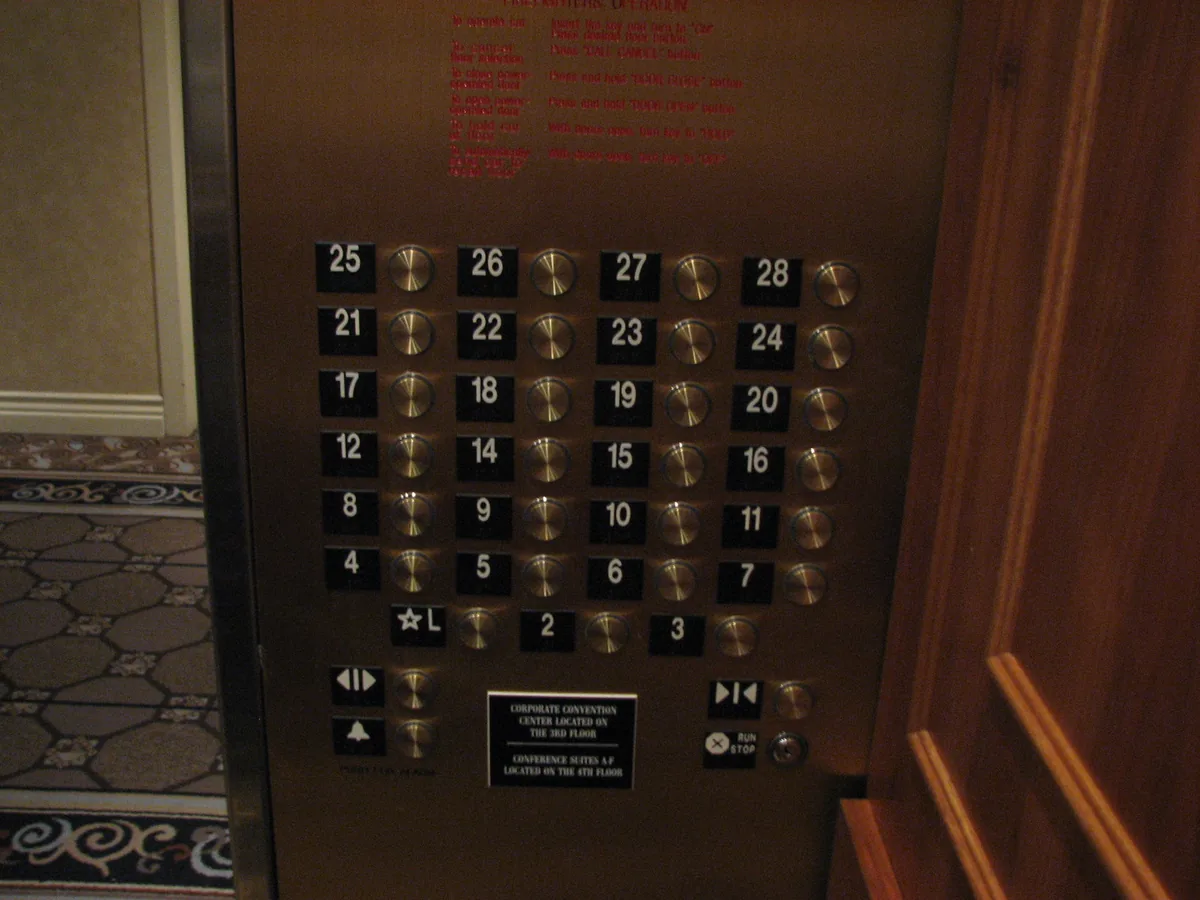
Worth being precise about the difference: that widespread building-numbering practice is driven by general cultural superstition and, evidently, real buyer preference — not by numerology’s karmic-debt reading of 13, which is a narrower, specific tradition about what happens when a calculation passes through that number on its way to a single digit. A house numbered 13 itself (reducing to 1+3=4) isn’t automatically “unlucky” in numerology the way a skipped 13th floor implies — the karmic-debt reading only applies when 13 shows up as an intermediate sum during reduction, as in the 1319 Elm Street example above, not as the address number itself.
Does the street name matter too?
Some sources also apply word-based numerology (the same letter-to-number conversion used for names) to the street name itself, not just the house number — “Elm Street” would get converted and reduced the same way a person’s name would. This is a real, if far less consistent, extension of the practice: sources disagree much more on whether to include the street type (“Street,” “Avenue,” “Boulevard”), whether to use the full official name or a common abbreviation, and how to handle multi-word names. Given that inconsistency, and because the house number itself is the one element every source agrees is the core of the practice, we’re presenting the number as the primary reading here and flagging the street-name variant honestly as a secondary, less standardized layer rather than pretending there’s a single settled method for it.
When your address has letters
An apartment or unit number like “5R” mixes a digit with a letter, and this is exactly where the Pythagorean and Chaldean systems — the same two systems compared in depth on our Pythagorean vs. Chaldean guide — can genuinely disagree, because they assign different numeric values to the same letter.
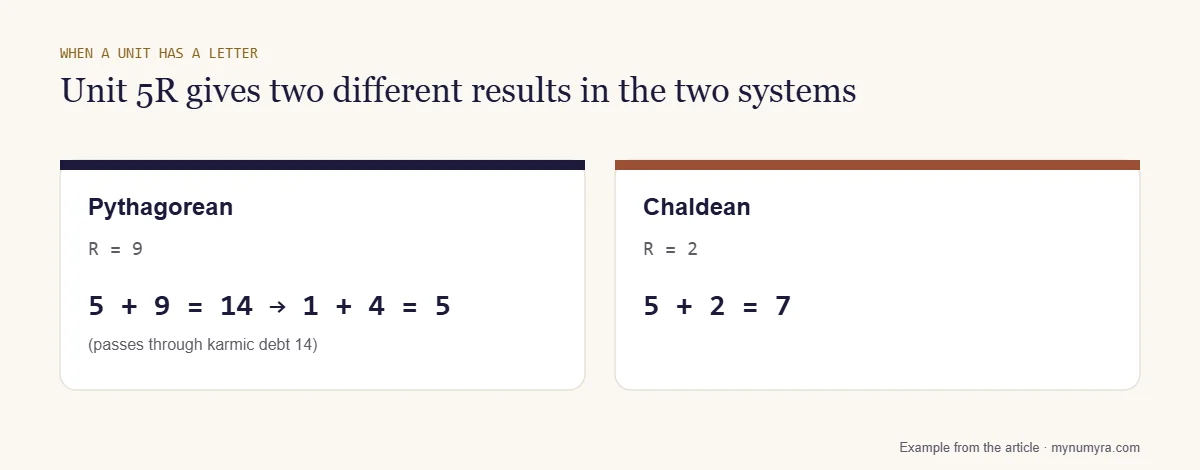
Worked example: Unit 5R
| System | R’s value | Total |
|---|---|---|
| Pythagorean | 9 | 5 + 9 = 14 → 1+4 = 5 |
| Chaldean | 2 | 5 + 2 = 7 |
Same unit, two genuinely different results — 5 under Pythagorean (and one that passes through karmic debt 14 along the way), 7 under Chaldean, purely because the two systems value the letter R differently. Neither is more “correct” than the other; they’re separate historical charts. See the full letter-value tables on our Pythagorean vs. Chaldean guide if you want to work out a different letter yourself.
Where house numbers themselves come from
There’s a second, separate history worth knowing here, and it has nothing to do with numerology at all: house numbers as a practical system are their own real invention, with a documented origin. Early, unsuccessful attempts to number Paris buildings date to the 15th and 16th centuries. A real, sustained system began with a 1724–1728 cadastral survey to track the city’s expansion, followed by a numbering scheme tied to tax and census administration — dwelling numbers were introduced specifically to make government officials’ jobs easier, not for navigation and certainly not for spiritual meaning. Paris almanac editor Marin Kreenfelt de Storcks numbered the city’s main doors in 1779, and a formal decree made street numbering compulsory across France in 1805. The practice spread across Europe and eventually the world over the following century as a purely administrative tool.
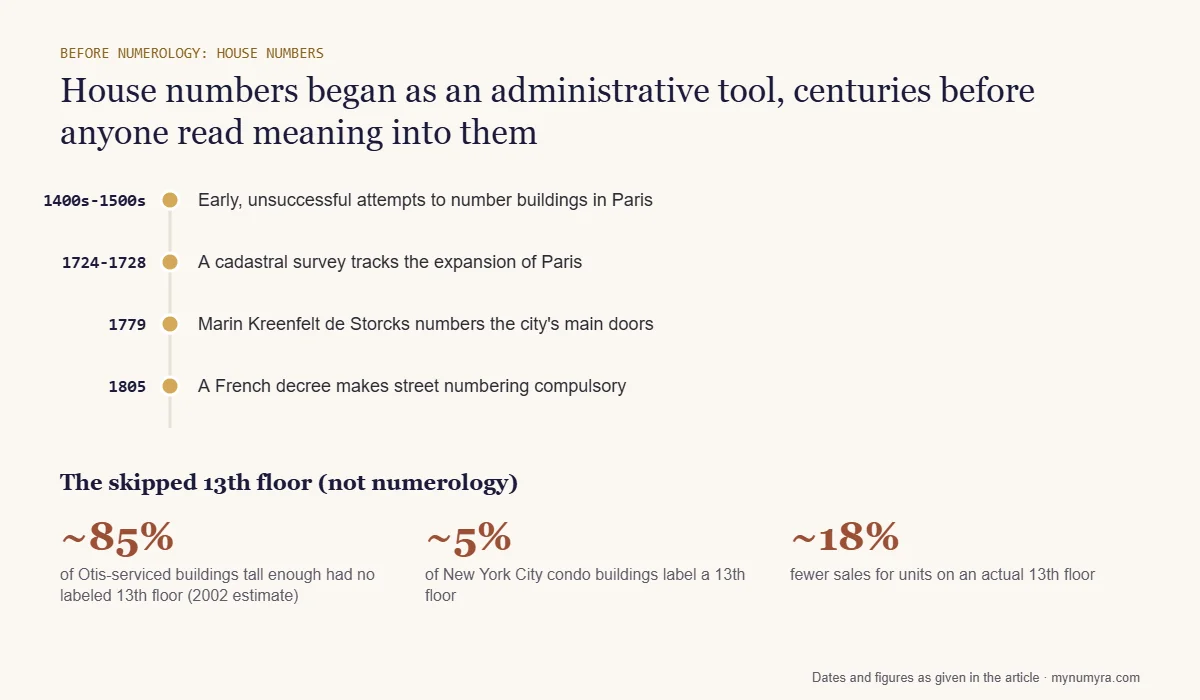
That matters for the same reason the letter-chart history above does: the number on your door predates numerology’s symbolic reading of it by roughly two centuries, and was invented for tax collectors, not for anyone’s spiritual reflection. None of the house-numerology pages we researched mention this — worth knowing if you’re weighing how much historical weight the practice actually carries.
Is house numerology an ancient practice?
Direct answer: no, not as its own standalone tradition — and we haven’t found a house-numerology page that says this plainly. What’s genuinely old is the underlying numerology: the Pythagorean number-symbolism this borrows from dates back over two thousand years, and the letter-to-number charts themselves were set out in the early-to-mid 20th century (Pythagorean by L. Dow Balliett, Chaldean’s modern form by Cheiro — see our full history of both systems). Applying that same math specifically to a street address, rather than a name or birth date, is a more recent extrapolation — a natural enough extension of the same logic, but not itself a documented ancient practice with its own separate lineage. We think that’s worth saying directly rather than implying otherwise the way most sources in this space do. The closest thing to an early source we found is in Balliett’s own 1908 book, which has a whole chapter on furnishing numbered rooms in colors matched to their numbers, and even advises using those colors in public buildings and hotels:
“You may expect strong events of all kinds in rooms 8, 9, 11, 22, as they possess strong vibrations.”
— L. Dow Balliett, The Philosophy of Numbers (1908), p. 103
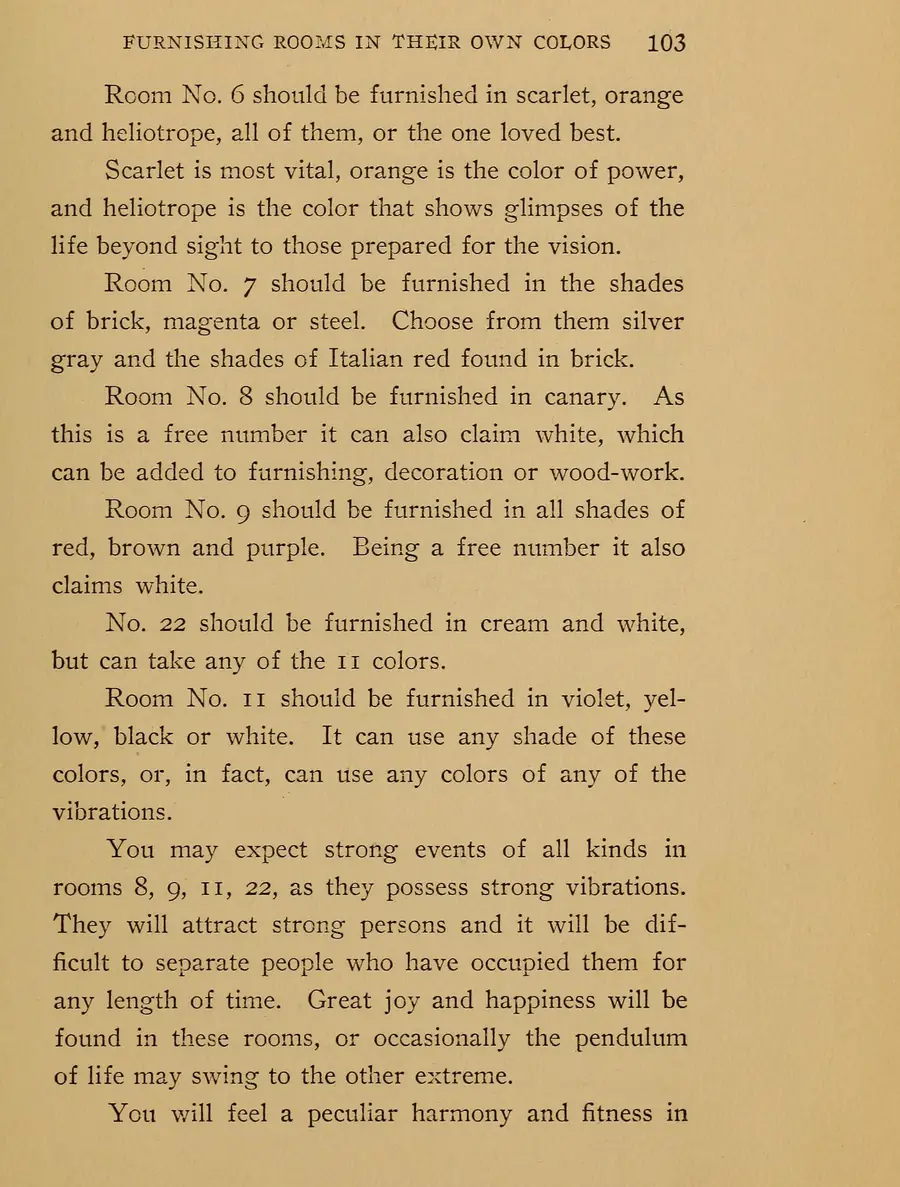
That is a reading of room numbers, not street addresses, and it dates from 1908, so it supports the point above rather than changing it: applying numerology to the places people live is an early-20th-century idea, not an ancient one.
How this compares to your other numbers
A house number is a fifth kind of reading alongside the core numbers numerology already gives you — worth knowing how it’s different from each.
Destiny NumberFrom your full birth name — a talent to develop, separate from where you live.
Pythagorean vs. ChaldeanThe same two letter systems used here, compared in full with worked examples.
Frequently asked questions
Do I use the whole address or just the house number?
Just the street number itself — not the street name, city, or zip code. If you’re in an apartment or unit, calculate the unit separately from the street number rather than combining them, since they’re genuinely different numbers with different traditional readings.
Is house numerology the same as Feng Shui house numbers?
No — they’re separate traditions with separate origins. Feng Shui’s reading of numbers comes from Chinese tradition and is tied partly to how the numbers sound in Mandarin or Cantonese; house numerology as described here comes from Western Pythagorean and Chaldean numerology. The two can give different, unrelated readings for the same address.
Should I avoid buying a house with a “bad” number?
That’s a personal decision, but we’d encourage keeping this in the same entertainment-and-reflection frame as the rest of numerology — no traditional reading here should outweigh the real, practical factors in a home purchase.
Do master numbers and karmic debt numbers apply to every address?
Only when the math actually produces one along the way — most street numbers reduce to a plain 1 through 9 without passing through 11, 22, 33, 13, 14, 16, or 19 at all. See the worked examples above for exactly when each applies.
Can I change my house number’s numerology reading?
Some sources suggest adding a nameplate with a different number, or spelling out the number in words, as informal ways some practitioners use to shift the reading — we haven’t found a source that documents this as part of the original tradition rather than a more recent add-on.
Is a 13th-floor apartment the same as a karmic debt 13 address?
No — a unit literally numbered 13 reduces to 1+3=4 in numerology, a plain single-digit reading with no special karmic-debt meaning. The karmic-debt reading of 13 only applies when 13 shows up as an intermediate step during reduction of a longer number, not when it’s the final digit-sum itself.
Does this apply to business addresses too?
The same calculation method is sometimes applied to business addresses by the sources we researched, though with even less consistency than residential readings — treat any business-specific claims with the same caution as the rest of this practice.
Sources
- Dudley, Underwood. Numerology: Or What Pythagoras Wrought. Mathematical Association of America, 1997.
- Balliett, L. Dow. The Philosophy of Numbers: Their Tone and Colors. 1908. Internet Archive. Origin of the modern Pythagorean letter chart this article’s calculations use.
- Numyra Editorial Desk. Pythagorean vs. Chaldean Numerology: How the Two Systems Differ. Full letter-value tables and worked examples for both systems.
- “House numbering.” Wikipedia. Paris’s 1724–1728 cadastral survey, the 1779 numbering by Marin Kreenfelt de Storcks, and the 1805 French decree.
- Otis Elevator Company, cited via multiple 2002 news reports, on the estimated share of serviced buildings without a labeled 13th floor.
- Numyra Methodology Desk. Name-based and letter-based calculation standard.