A business name number is the total of the letter values in the name, reduced to a single digit (or kept as 11, 22 or 33), and numerologists read a meaning into it. The letter chart decides the result: the Pythagorean and Chaldean charts gave the same one-digit number for only 10.0% of 500 large US company names, so two calculators can disagree about one business. The advice to give a business name a “strong” number such as 8 appears, in the earliest source we found, as one line in L. Dow Balliett’s 1905 book, while Cheiro told some people to avoid 8. We found no controlled test linking a name’s number to business results. This guide shows the arithmetic, the sources and our own test on 500 large-company names.
Key takeaways
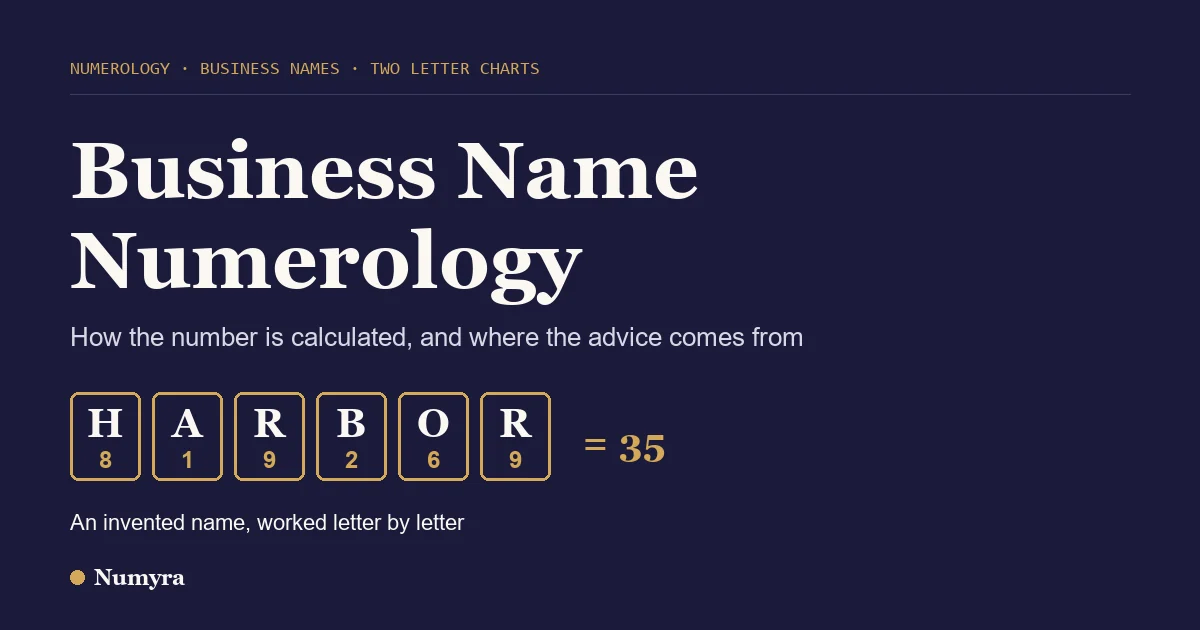
- The calculation is simple: convert each letter with a chart, add, and reduce. A worked invented name, Harbor Lantern Coffee, is a 6 in the Pythagorean chart and an 8 in the Chaldean chart.
- The chart choice settles the answer. Across 500 names in a public S&P 500 list, the two charts gave the same one-digit number for 50 names (10.0%), and for 11.2% of 29,923 other US business names.
- The sources disagree on the “best” number. Balliett (1905) wrote that a business name should make 8, 9, 11 or 22. Cheiro told people born under 4 or 8 to drop the 8 and use a 1, 3, 5 or 6. One 2025 guide calls 1, 5, 6 and 9 lucky and warns new businesses off 8.
- Large US company names are spread almost evenly across the nine numbers (chi-square p = 0.51 Pythagorean, p = 0.23 Chaldean). Numbers 1, 5, 6 and 9 made up 45.6% of names against 44.4% expected from an even spread.
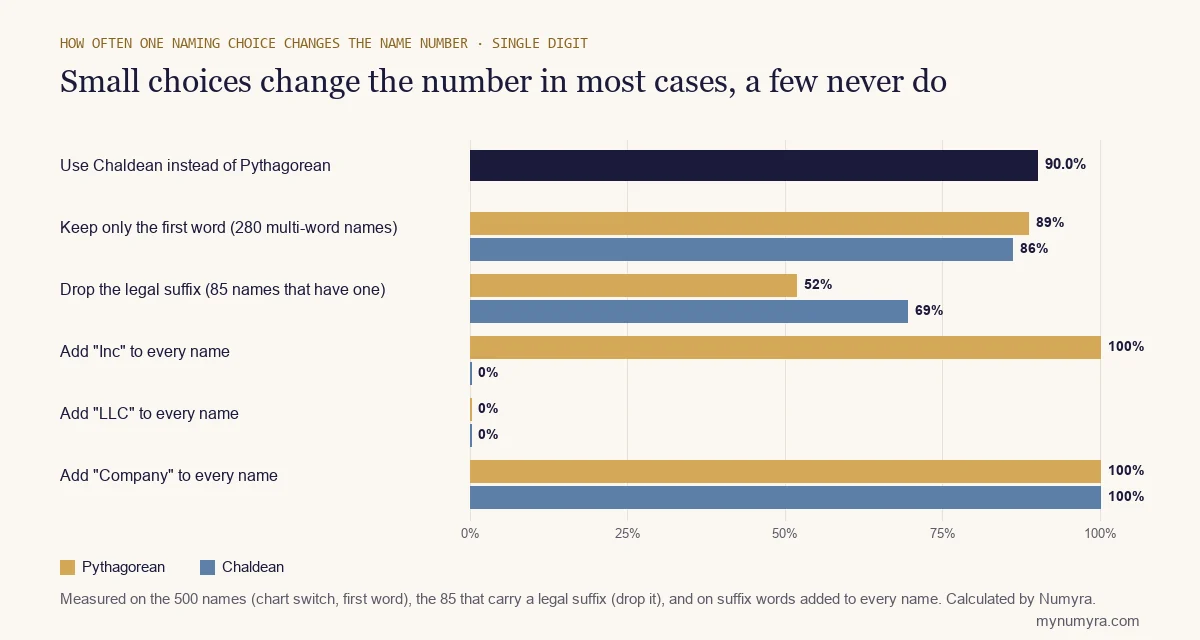
- Small naming choices move the number: keeping only the first word changes the Pythagorean number for 89% of names, adding “Inc” changes every one, and adding “LLC”, “Ltd” or “Co” never does. This is tradition, not evidence of business results, and it is not business or legal advice.
In this guide
- How to calculate a business name number
- Pythagorean or Chaldean: one name, two numbers
- Legal name, trade name or brand: which letters count
- Where the “strong number” advice comes from
- Where the sources disagree
- What we found in 500 large-company names
- Spelling tweaks and how far one letter moves the number
- What has and has not been tested
- How to use a name number without overstating it
- How we ran the numbers
- Frequently asked questions
How to calculate a business name number
The method is the same one used for a person’s Destiny (Expression) number, applied to the name of a business. Write down the name exactly as you intend to use it, then follow four steps.
- Keep the letters and drop spaces, punctuation, ampersands and digits. Our calculators work this way, and so does every figure on this page.
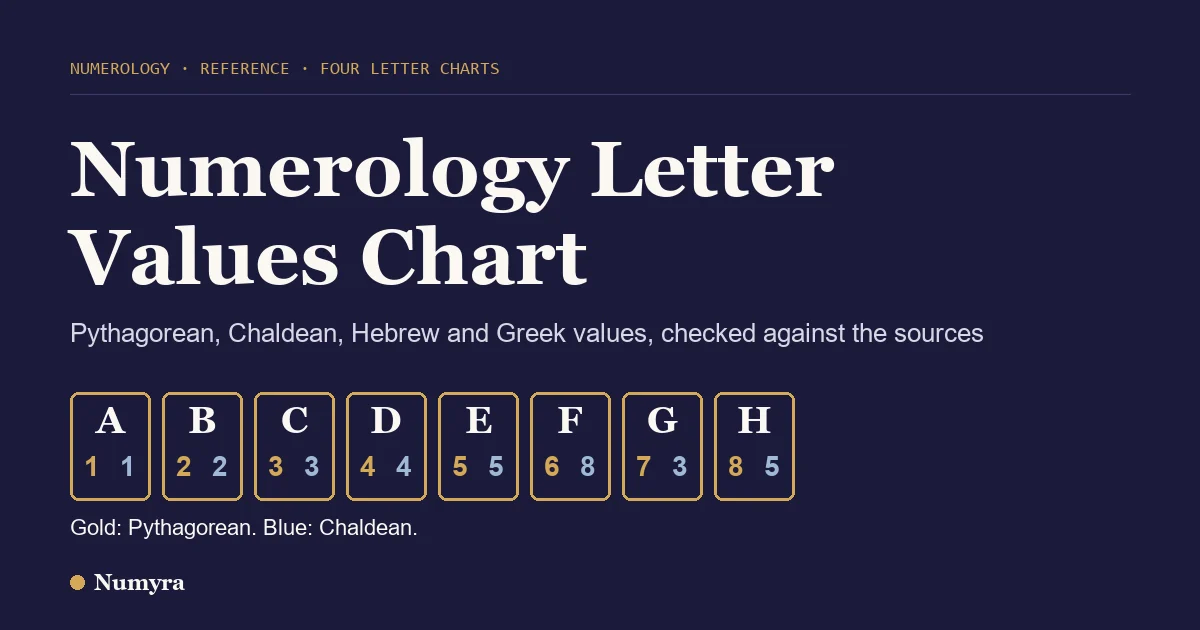
- Give each letter its value from the chart you chose. In the Pythagorean chart, A to I are 1 to 9 and the cycle repeats (J is 1 again). The Chaldean chart assigns 1 to 8 by sound and gives nothing the value 9.
- Add all the values.
- Reduce the total by adding its digits until one digit remains, keeping 11, 22 and 33 as they appear (see why 11, 22 and 33 are treated as master numbers).
Here is an invented name, chosen only for the arithmetic. Any resemblance to a real business is accidental.
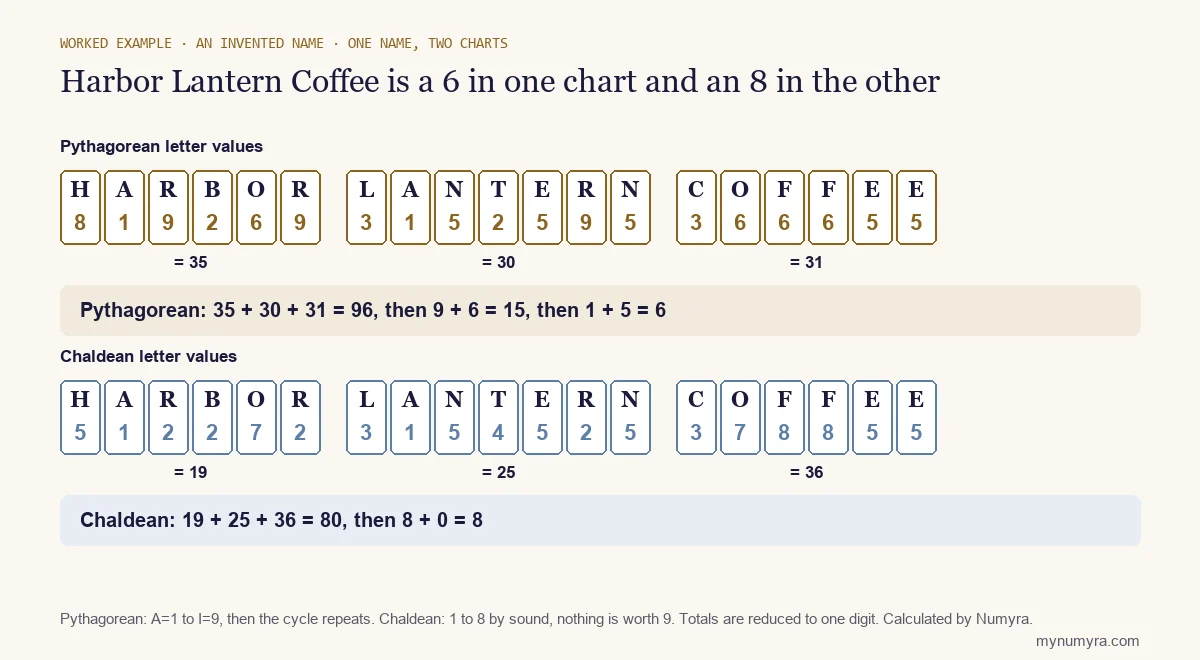
Harbor Lantern Coffee comes to 96 in the Pythagorean chart, then 9 + 6 = 15, then 1 + 5 = 6. In the Chaldean chart it comes to 80, which reduces to 8. A second invented name, Mapleford Dental, totals 65 in the Pythagorean chart. Adding 6 + 5 gives 11, a master number, so it stays 11, although a one-digit-only method would call it a 2. In the Chaldean chart the same name totals 64 and becomes 1. Whether a calculator keeps master numbers therefore matters too; our name numerology calculator states its rule, and calculating a chart by hand walks through the steps. The Chaldean tradition also reads the total before the last reduction (the 80 above), which this guide shows but does not interpret.
Pythagorean or Chaldean: one name, two numbers
The two charts assign the 26 letters differently, as the table shows. For all 26 letters side by side, with Hebrew and Greek values, see our Pythagorean vs. Chaldean comparison and the wider comparison with Kabbalah numerology.
| Value | Pythagorean letters | Chaldean letters |
|---|---|---|
| 1 | A J S | A I J Q Y |
| 2 | B K T | B K R |
| 3 | C L U | C G L S |
| 4 | D M V | D M T |
| 5 | E N W | E H N X |
| 6 | F O X | U V W |
| 7 | G P Y | O Z |
| 8 | H Q Z | F P |
| 9 | I R | none |
How often does the choice change the answer? We calculated both numbers for each of the 500 names in the public S&P 500 list we used (the source is described below). The charts agreed on 50 of them, 10.0%, so nine names in ten change number when you change chart. The same check on 29,923 US business names from Wikidata gave 11.2%, close to the one in nine you would expect if the charts were unrelated. Our Destiny Number pages report the same pattern for people: 8.1% of popular first names get the same number from both charts.
That is why a calculator that does not say which chart it uses cannot be checked. We tested this on one popular guide. Its method section says it follows the Pythagorean chart, and it names well-known businesses as examples of particular numbers. We recomputed the 12 examples that are not Indian companies. Five of them (the ones it gives for numbers 1, 5 and 7, apart from one) come out right only in the Pythagorean chart. Six (the ones it gives for 8, 9 and the compound 51) come out right only in the Chaldean chart, and one matches both. No single chart reproduces the list, so the page mixes the two without saying so. We name no company here because the point is the method, not the businesses.
Legal name, trade name or brand: which letters count
A business often has three names: the registered legal name, a “doing business as” or trade name, and the brand on the sign. Numerology offers no single rule, but the earliest writer we checked gave one. Cheiro answered a reader’s question about titles like “Miss” or “Mrs” with a principle that extends to business use:
it is “the name one is most known by” that should be used in working out the number of a name
Cheiro, Cheiro’s Book of Numbers, London: Herbert Jenkins, p. 117 (Internet Archive scan)
He adds that a woman known as “Miss Jones” at work should use that name for her working life, calling it her “trade name”. For a company, that points to the name customers actually use. One modern business-name calculator site says the same and strips “Pvt Ltd, LLP, Inc, Co” before it calculates, and most of the pages we read do not mention the question. The choice matters, because the legal suffix is an extra word with its own value:
| Suffix | Pythagorean value | Effect on the one-digit number | Chaldean value | Effect on the one-digit number |
|---|---|---|---|---|
| Inc | 17 | adds 8, the same as subtracting 1 | 9 | none |
| Incorporated | 66 | adds 3 | 49 | adds 4 |
| Corp | 25 | adds 7 | 20 | adds 2 |
| Corporation | 63 | none | 47 | adds 2 |
| Co | 9 | none | 10 | adds 1 |
| Company | 33 | adds 6 | 29 | adds 2 |
| Ltd | 9 | none | 11 | adds 2 |
| Limited | 36 | none | 22 | adds 4 |
| LLC | 9 | none | 9 | none |
| LLP and PLC | 13 | adds 4 | 14 | adds 5 |
The effects are pure arithmetic: a suffix that totals a multiple of 9 cannot change a one-digit number, and any other total shifts it by a fixed amount. We confirmed each row by adding the suffix to every name in the list (after removing any suffix it already had). Where the master-number rule applies, a “none” suffix can still switch a 2 to an 11. In the list itself, 85 of the 500 names carry a legal suffix, and dropping it changed the Pythagorean number for 44 of them (52%) and the Chaldean number for 59 (69%).
The shape of the name matters as much. For the 280 names that still have two or more words once any legal suffix is removed, using only the first word, the way a brand is often shortened, gave the same Pythagorean number as the full name for 32 names (11.4%) and the same Chaldean number for 39 (13.9%). Reducing each word separately and then adding the results, which is the order Balliett used, gave the same one-digit number as adding every letter at once for all 347 names that have two or more words as published, in both charts. The two orders differ only when a master number appears along the way.
Where the “strong number” advice comes from
Modern calculator pages repeat the idea that a business name should carry a strong number, often 8. The earliest source we found for a rule of this kind, after searching the full texts of Balliett’s and Cheiro’s books for passages about business names, is How to Attain Success Through the Strength of Vibration, by Mrs. L. Dow Balliett (Atlantic City, 1905; we read the 1913 printing). In the chapter on choosing a husband or wife she writes:
As it is better to have one of the strong numbers in active use at all times a business name or a pen name should be so formed that it makes 8, 9, 11 or 22, as they attract the stronger forces in nature and humanity.
L. Dow Balliett, How to Attain Success Through the Strength of Vibration, 1905, p. 43 (Internet Archive scan)
Three things stand out. “Strong” meant 8, 9 and the master numbers 11 and 22, a different set from the lists on modern pages. Balliett gave no reason beyond the numbers’ own symbolism, and the same book says the number 8 means “freedom of forms”, with no mention of money. And her letter chart on page 14 is the Pythagorean chart in the table above, so her rule belongs to that chart. She also wrote that a person whose name and birth number clash may need “some slight change in the name” to bring them into accord (p. 39), the root of the spelling advice discussed below. The wider history is in our guide to what numerology is.
She applied the same logic to place, writing that one should be “as careful in business in selecting his street and number as in choosing a wife” (p. 40). We cover that tradition in house numerology and address numbers.
Where the sources disagree
Everyone agrees on how to add up the letters once the chart is fixed. What the totals mean for a business is another matter, and the sources we read do not agree.
| Source | Numbers it favors | Numbers it warns about |
|---|---|---|
| Balliett, 1905 (Pythagorean chart) | 8, 9, 11 and 22 for a business name | None named for names |
| Cheiro, Book of Numbers (Chaldean chart), p. 91 | For people with a birth number of 4 or 8: a name number of 1, 3, 5 or 6 | 8 and 4 (“not to increase the peculiar influence of the 4 and 8”); he also left out 9 in that rule |
| A business-name guide for India, last updated July 2025 | 1, 5, 6 and 9 “series”; 33 and 51 as especially fortunate | 8, which it says new businesses should avoid |
| Google AI Overview for this search, 22 Oct 2026 | 1 for startups; 8 for power, authority and wealth | 8, as “high-risk or volatile for new startups” |
The disagreement is built in. Balliett sought 8, Cheiro avoided it for two of his birth numbers, and the modern guide cited above says to choose from the 1, 5, 6 and 9 series and keep new businesses away from 8. There is no way to settle a quarrel between three traditions with arithmetic, and as far as we know no study has compared business outcomes by name number to arbitrate it. Our own look at the numbers is next.
What we found in 500 large-company names
One guide says the “lucky” numbers are common among Fortune 500 companies, and a calculator site lists large companies under number 9. Those are claims about names that can be checked. We took the 500 distinct names in a public list of S&P 500 companies, calculated each one’s number in both charts and compared the counts with what an even spread would give.
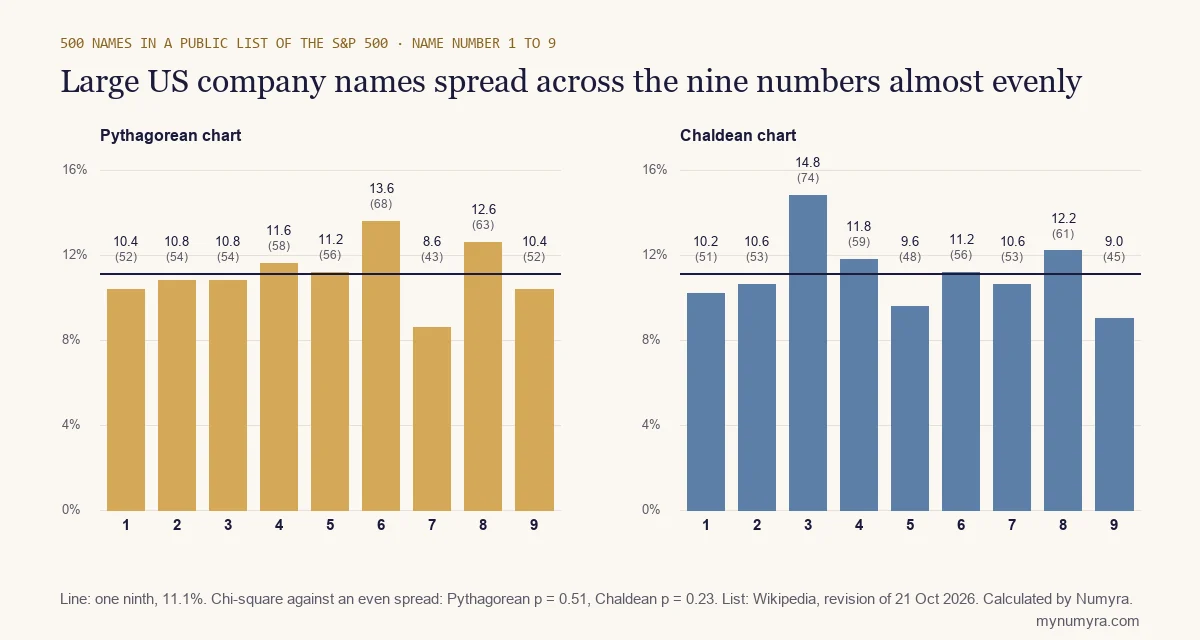
In the Pythagorean chart the counts run from 43 names for number 7 to 68 for number 6. In the Chaldean chart they run from 45 for number 9 to 74 for number 3. Both patterns are within chance: a chi-square test against an even spread gives p = 0.51 for Pythagorean and p = 0.23 for Chaldean. A comparison list of 29,923 US business names from Wikidata is just as even, with every number between 10.8% and 11.4%, and the S&P names do not differ from it (p = 0.51 and 0.25).
| Claim tested (Pythagorean chart) | Share of the 500 names | Expected from an even spread | p-value |
|---|---|---|---|
| Numbers 1, 5, 6 or 9 are lucky and common in big companies | 45.6% (228) | 44.4% | 0.62 |
| Number 9 is the number for large business names | 10.4% (52) | 11.1% | 0.67 |
| Number 8 is the number of wealth and power | 12.6% (63) | 11.1% | 0.29 |
| 8, 9, 11 or 22 (Balliett’s strong numbers; all letters added, master numbers kept) | 33.2% (166) | 32.1% (the share in the 29,923-name list) | 0.63 |
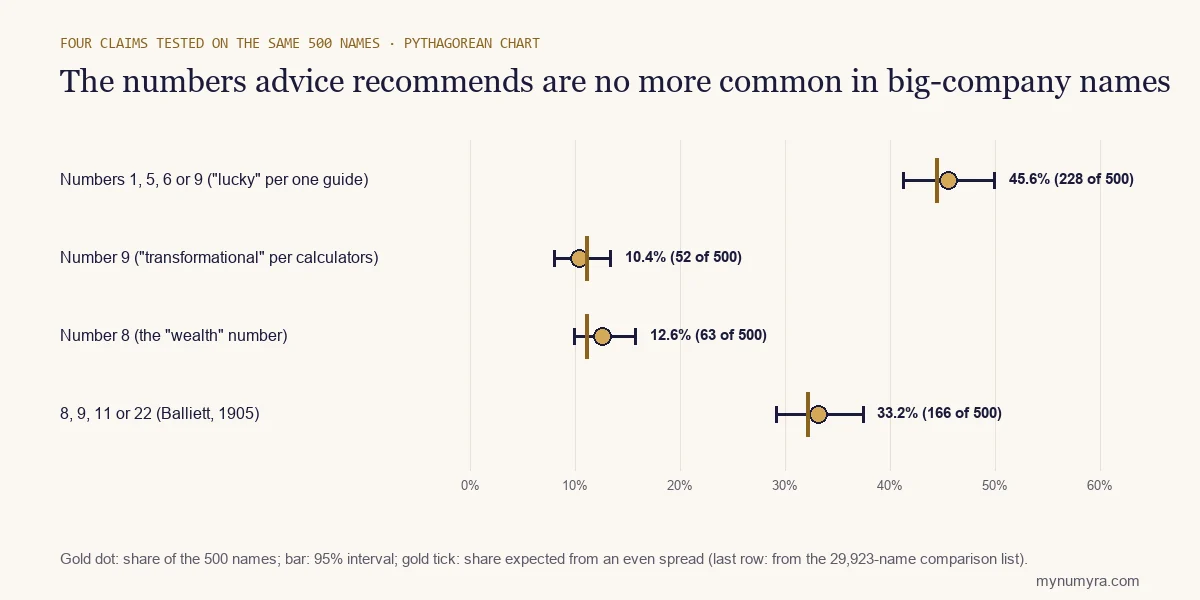
In the Chaldean chart the same 1, 5, 6 and 9 group makes up 40.0% of the names (200 of 500), slightly below the 44.4% an even spread gives (p = 0.048). That is the wrong direction for the claim and, with about a dozen tests run on this list, about what chance produces. So the data show no sign that big US companies favor the numbers modern guides call lucky, and none that they avoid 8.
What this does not show matters as much. We have no outcome measure for these companies and no list of the businesses that failed, so a name number cannot be said to have helped or hurt any of them, and membership of the list is itself a result of size, not of naming. What the data do show is that the pattern the guides describe is not visible among the names of very large companies, the place those guides point to.
Spelling tweaks and how far one letter moves the number
Numerologists often suggest changing a name slightly if the number is unwelcome: a doubled letter, an added letter or a dropped initial. Balliett’s 1905 advice to make “some slight change in the name” is the root of that habit. The arithmetic shows how easy it is. In the Pythagorean chart, one extra letter at the end of any of the 500 names can produce each of the nine numbers, because the 26 letters between them cover every remainder. In the Chaldean chart, one extra letter can reach each of the other eight numbers, but never leave the name unchanged, since no letter is worth 9. In the Pythagorean chart, adding an I or an R (both worth 9) changes nothing.
This is why a name number cannot carry information about a business: a number that one letter can steer to any target is a property of the spelling, not of the company. The freedom has costs, too. The US Patent and Trademark Office tells applicants to “consider whether the public will remember, pronounce, and spell your trademark”, and says coined, arbitrary or suggestive names make stronger trademarks than descriptive or generic ones (USPTO, Strong trademarks). A name chosen for its number can easily fail those tests.
What has and has not been tested
We found no published controlled test of whether a business name’s number predicts anything about the business, and the pages that sell calculators cite none. Two of them say so: the India-focused guide answers its own question about proof by saying there is no scientific proof, and the calculator site mentioned earlier writes that numerology “has no predictive power that has been demonstrated under controlled conditions”. Our review of whether numerology is real covers the controlled tests of birth numbers that do exist, why readings feel accurate and what a fair test would need. It found no pattern, and name numbers have been tested even less.
Some features of a name do have research behind them, and none of them is a number. In ten experiments with 608 participants, Silva and colleagues found that eBay sellers with easy-to-pronounce or short usernames were rated as more trustworthy than sellers with hard-to-pronounce or long ones, even when reputation information was available (Frontiers in Psychology, 2017). That is a finding about usernames and trust ratings, not company results, but it shows the kind of effect a name can really have. When choosing between candidates, the practical tests (say it aloud, spell it over the phone, search for it, check that it is free and not confusingly similar) tell you more than the total of its letters.
How to use a name number without overstating it
Used as a way to think about a name, a number can be a harmless extra. Fix the chart and the rule before you look, calculate every candidate the same way, and treat the result as a tiebreaker between names that already pass the practical tests. To compare it with the owner’s numbers, as Balliett and modern guides suggest, use the same chart; our Expression, Soul Urge and Personality guide explains the name numbers, and the story of Cheiro explains the Chaldean chart.
Do not rename a trading business for its number. A name carries recognition, search presence and legal history, and no source above gives evidence that the number was worth giving them up. This page is educational information about a cultural tradition. It is not business, financial or legal advice, and nothing on it has been shown to predict how a business will perform. For naming and trademark questions, the USPTO page above is the official starting point, and a business or trademark attorney can advise on your own case.
How we ran the numbers
Charts and rule. The two charts are the table above, the same one our name calculator uses. Accents were removed, and spaces, punctuation and digits were ignored. The one-digit result is the digital root of the letter total, and the master-number rule keeps 11, 22 and 33 when the running total reaches them. Names. The S&P list is the “Security” column of Wikipedia’s List of S&P 500 companies, revision 1381317423 of 21 October 2026 (503 rows, 500 distinct names after merging share classes), used as published, so some names carry a legal suffix and some do not. Wikipedia text is under CC BY-SA 4.0 and the names are facts. The comparison list is the first 30,000 English labels Wikidata (CC0) returned for United States items that are an instance of business, 29,923 distinct. It is a convenience sample, not a random one, and includes defunct and tiny businesses. The S&P 500 overlaps with, but is not, the Fortune 500 the guides mention; we used it because a public, dated list was available. Tests. Chi-square tests against an even spread and between the two lists, and exact binomial tests for the claims. We ran about a dozen, so a single p-value near 0.05 deserves little weight. Sources. The Balliett and Cheiro quotes were read by eye from Internet Archive page scans and checked against the OCR text. The Google result and AI Overview were read on 22 October 2026 and will change. Limits. We tested claims about the numbers big companies carry, not name numbers against any outcome, and we know of no outcome study.
Frequently asked questions
How do I calculate the numerology number of a business name?
Convert each letter with the Pythagorean or Chaldean chart, add the values, then add the digits of the total until one digit remains, keeping 11, 22 and 33. Harbor Lantern Coffee, an invented name, totals 96 in the Pythagorean chart and reduces to 6.
Should I include Inc, LLC or Ltd when I calculate?
Cheiro wrote that the name a person or business is most known by should be used, which usually means leaving the legal suffix out. It matters for some suffixes: “Inc” moves every Pythagorean one-digit number by 8, while “LLC”, “Ltd”, “Co” and “Corporation” never change it.
Is the Pythagorean or the Chaldean chart better for a business name?
Neither has been shown to work better. Balliett’s rule for business names was written for the Pythagorean chart, while many modern Indian guides prefer the Chaldean one. The two agreed on only 10.0% of 500 large US company names, so state which one you used.
What is the best number for a business name?
The sources disagree. Balliett (1905) favored 8, 9, 11 and 22; Cheiro advised some people to avoid 8; a 2025 guide calls 1, 5, 6 and 9 lucky and warns new businesses off 8. No study compares businesses by name number.
Do big companies have lucky name numbers?
Not in the list we checked. Among 500 S&P 500 names, 45.6% carried 1, 5, 6 or 9 in the Pythagorean chart against 44.4% expected from an even spread (p = 0.62), and the distribution of all nine numbers did not differ from even (p = 0.51).
Can I change my business name number by changing the spelling?
Yes, arithmetically: one extra letter can move a name to any of the nine Pythagorean numbers. That ease is why the number says little about a business, and a respelling can make the name harder to say, find and register as a trademark.
Does numerology predict whether a business will succeed?
No test shows that it does. We found no controlled study of name numbers and business results, and the review of birth-number tests on our numerology evidence page found no pattern.
Should I match the business name number to the owner’s birth date?
Tradition says so: Balliett wrote that there should be a certain harmony between the name digit and the birth number, and modern guides repeat it with their own compatibility tables. There is no test of whether the match matters, so treat it as a reflection exercise, not a rule.
Sources
- Balliett, L. Dow. How to Attain Success Through the Strength of Vibration. Atlantic City: L. N. Fowler, 1905 (1913 printing). Internet Archive scan.
- Cheiro. Cheiro’s Book of Numbers. London: Herbert Jenkins. Internet Archive scan (Digital Library of India).
- US Patent and Trademark Office. “Strong trademarks.”
- Silva, R. R., Chrobot, N., Newman, E., Schwarz, N., and Topolinski, S. “Make It Short and Easy: Username Complexity Determines Trustworthiness Above and Beyond Objective Reputation.” Frontiers in Psychology, 8, 2017.
- Wikipedia. “List of S&P 500 companies.” Revision of 21 October 2026, CC BY-SA 4.0. Company names only.
- Wikidata Query Service, US business labels, retrieved 22 October 2026. CC0.
- GoDaddy Resources (India). “Business name numerology: meaning, lucky numbers and free tools.” Updated July 2025. Cited for the claims we tested.
- businessnamenumerologycalculator.com, home page, read 22 October 2026. Cited for its suffix rule and its statement on predictive power.