Yes: across 85.4 million US births from 1994 to 2014, about 2.8 percent fewer babies were born on the 13th of a month than on other days, and about 6.3 percent fewer on Friday the 13th, even after allowing for the day of the week, holidays and long-term trend. We tested every date of the month and all 35 Friday the 13ths in those years, and the dip is real in the data. This guide shows the result and how we got it, where the superstition really came from (it is younger than most people think), what numerology says about 13, and every Friday the 13th from 2026 to 2030, starting with this Friday, November 13, 2026. It is data and tradition, not prediction.
Key takeaways
- On the 13th of the month, US births ran 2.8% below what the weekday, holiday and monthly baseline predicts (95% range 2.5% to 3.2%). No other date of the month differs from the average by more than 1%.
- On a Friday the 13th the shortfall is 6.3%, about 786 fewer births than expected on a day that averaged 11,708. All 35 Friday the 13ths from 1994 to 2014 had fewer births than the Fridays a week before and after, by 2.2% to 11.8%.
- The dip is about 3% on Monday to Thursday 13ths and under 1% on Saturday and Sunday. That fits the idea that scheduled births, not spontaneous labor, are being steered away from the date, but births data cannot prove why.
- The superstition is documented from the 1800s, not antiquity: French writing from 1834, a biography of the composer Rossini in 1869 and a Wall Street novel in 1907. The Knights Templar and Last Supper stories are later explanations, not early evidence.
- Numerology reduces 13 to 4. Cheiro wrote in 1926 that the dread of 13 is unfounded; Hans Decoz says personal cycles outweigh the date. Nine Friday the 13ths fall from 2026 to 2030, three of them in 2026.
In this guide
- What the births data show
- How we tested it
- Is it only the 13th? All 31 dates compared
- Why Friday loses most and weekends barely at all
- All 35 Friday the 13ths, one by one
- Where the Friday the 13th superstition came from
- What numerology says about 13
- Friday the 13th dates, 2026 to 2030
- Other studies and what this does not show
- Frequently asked questions
- Sources
What the births data show
Fewer babies are born on the 13th. In the daily US birth counts from 1994 to 2014, a 13th of the month had about 2.8% fewer births than the same weekday would normally have, and a Friday the 13th about 6.3% fewer. The table gives the estimates, each with the range within which the true value should lie 95 times out of 100.
| Which 13ths | Number of dates | Births vs expected | 95% range |
|---|---|---|---|
| Every 13th | 252 | -2.8% | -3.2% to -2.5% |
| Monday to Thursday 13ths | 144 | -3.0% | -3.3% to -2.7% |
| Friday the 13th | 35 | -6.3% | -6.9% to -5.7% |
| Saturday and Sunday 13ths | 73 | -0.9% | -1.6% to -0.3% |
Put in babies, a Friday the 13th averaged 11,708 births, about 786 fewer than the model expects for that kind of Friday. Across all 35 of them that is roughly 27,500 births that did not happen on the date; over all 252 of the 13ths it is about 79,600, or 0.09% of the 85.4 million. A 2017 reprint by ABC7 of a FiveThirtyEight analysis by Carl Bialik put the Friday the 13th gap at about 800 births, so our figure agrees with it. We add every date of the month, every weekday and each event.
How we tested it
The data are the daily counts of US births in the files FiveThirtyEight published: the CDC’s National Center for Health Statistics for 1994 to 2003 and the Social Security Administration for 2004 to 2014, 7,670 days and 85,386,227 births in all. The two sources count slightly differently, so each day is only compared with days in its own run of years. We took the log of each day’s births and removed three things before looking at the 13th:
- a separate baseline for each of the 252 months, which absorbs the trend and the season;
- a separate weekday pattern for 1994 to 1999, 2000 to 2006 and 2007 to 2014;
- holidays: the day itself, the day before and the day after each federal holiday, plus Christmas Eve, December 26 and 31, July 3 and 5, Valentine’s Day, Halloween, Easter weekend and February 29;
No medical, regional or demographic data exist in these files, so nothing else could be adjusted. The 13th is then one more yes-or-no variable, with uncertainty measured by treating each month as one cluster. Because a result like this can depend on the data source, we repeated it. The 13th and Friday the 13th gaps are almost identical whichever way the sources are split.
| Data used | Births | Every 13th | Friday the 13th |
|---|---|---|---|
| CDC 1994 to 2003 plus SSA 2004 to 2014 (main) | 85,386,227 | -2.8% | -6.3% |
| CDC 1994 to 1999 plus SSA 2000 to 2014 | 85,712,738 | -2.8% | -6.3% |
| CDC alone, 1994 to 2003 | 39,722,137 | -2.7% | -6.2% |
| SSA alone, 2000 to 2014 | 62,187,024 | -2.9% | -6.5% |
The gap did not appear only in recent years either: 2.6% for 1994 to 1999, 2.9% for 2000 to 2006 and 2.9% for 2007 to 2014. Our birthday number guide uses the same births with a simpler comparison (Fridays on the 13th against Fridays on the 12th and 14th, 5.8% fewer) and reaches the same conclusion.
Is it only the 13th? All 31 dates compared
A fair test asks whether the 13th is unusual or merely one of many dates that wobble. We gave every date of the month its own variable and compared it with the average of all 31. The 13th is 2.7% below that average. The next lowest is the 11th at 0.8% below, and the highest is the 20th at 1.0% above; the other 28 dates all sit within 1% of normal.
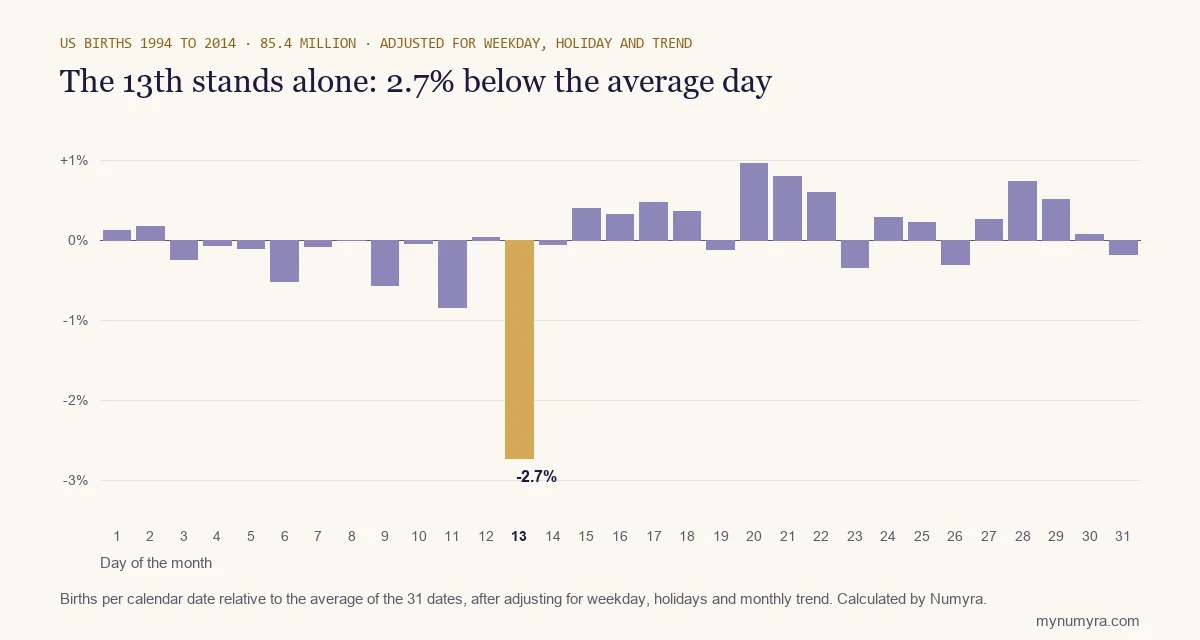
The same check works for Fridays. We measured whether Fridays that land on each date of the month differ from other Fridays. Fridays on the other 30 dates range from 1.2% below normal to 2.0% above, which is the scatter chance produces when you run 30 comparisons; Fridays on the 13th are 4.2% below normal beyond the general 13th effect, about 11 standard errors from zero. Nothing else on the calendar looks like it.
This also tests a numerology idea directly. Cheiro, a 1920s writer on numbers, grouped the 4th, 13th, 22nd and 31st as “4” dates, since 13 adds to 4. If that mattered, the 4th, 22nd and 31st should dip too. They do not: the 4th is 0.1% below the average, the 22nd 0.6% above and the 31st 0.2% below. Nor do the other karmic debt dates dip: the 14th is 0.1% below, the 16th 0.3% above and the 19th 0.1% below (see our guide to karmic debt numbers for that tradition). Only the 13th does, which points at the calendar superstition and away from a pattern in the digits.
Why Friday loses most and weekends barely at all
The size of the dip depends sharply on the weekday, and that is the best clue to what causes it. On Monday to Thursday the 13th loses about 3% of births, on Friday 6.3%, and on Saturday and Sunday under 1%.
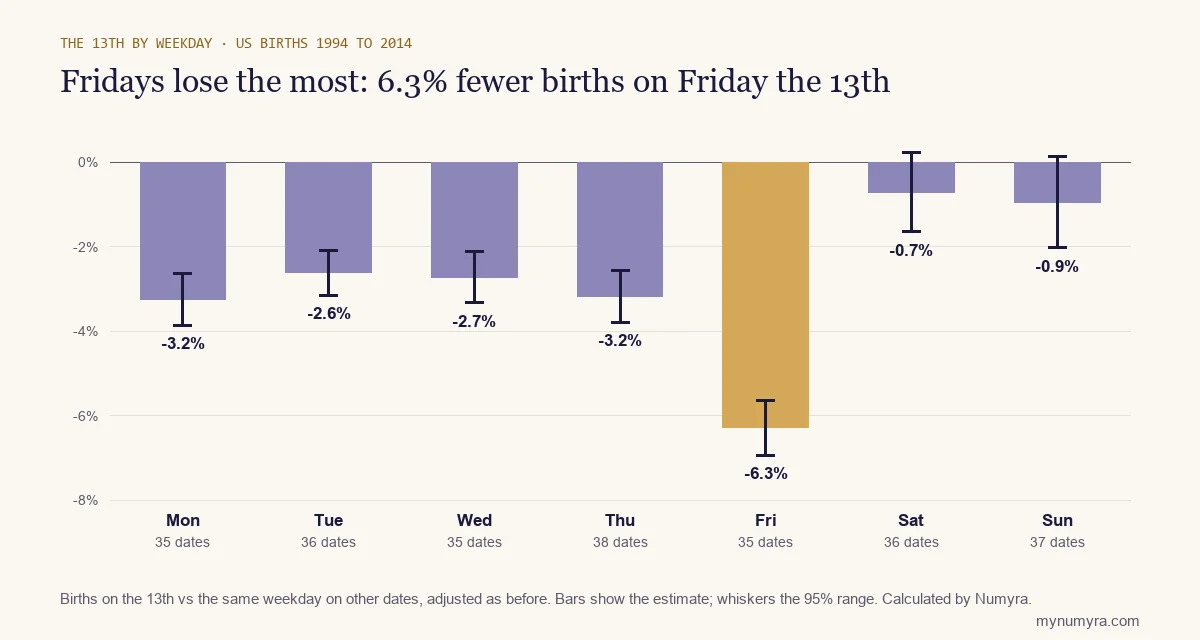
Weekdays and weekends are very different kinds of day for births. Over these years a Saturday averaged 8,593 births and a Sunday 7,610, against 11,563 to 12,788 on the weekdays. The FiveThirtyEight piece points to deliveries that are scheduled, either induced or by cesarean section, and says the 13th effect is smallest on weekends, when delivery wards are staffed more thinly and tend to schedule fewer births. A baby that arrives in spontaneous labor cannot read the calendar, so a date effect should be small where most births are spontaneous and larger where many are scheduled. That is the pattern in the chart, and it is why a scheduling explanation fits the numbers.
It is only a fit. The files contain a date and a count, nothing on why a delivery happened that day, so we cannot separate a parent asking to avoid the date from a hospital scheduling office quietly doing the same, or from some other reason entirely.
All 35 Friday the 13ths, one by one
An average can hide a few extreme days, so here is each event on its own: births on every Friday the 13th divided by the average of the Fridays one week before and after, which needs no model at all.
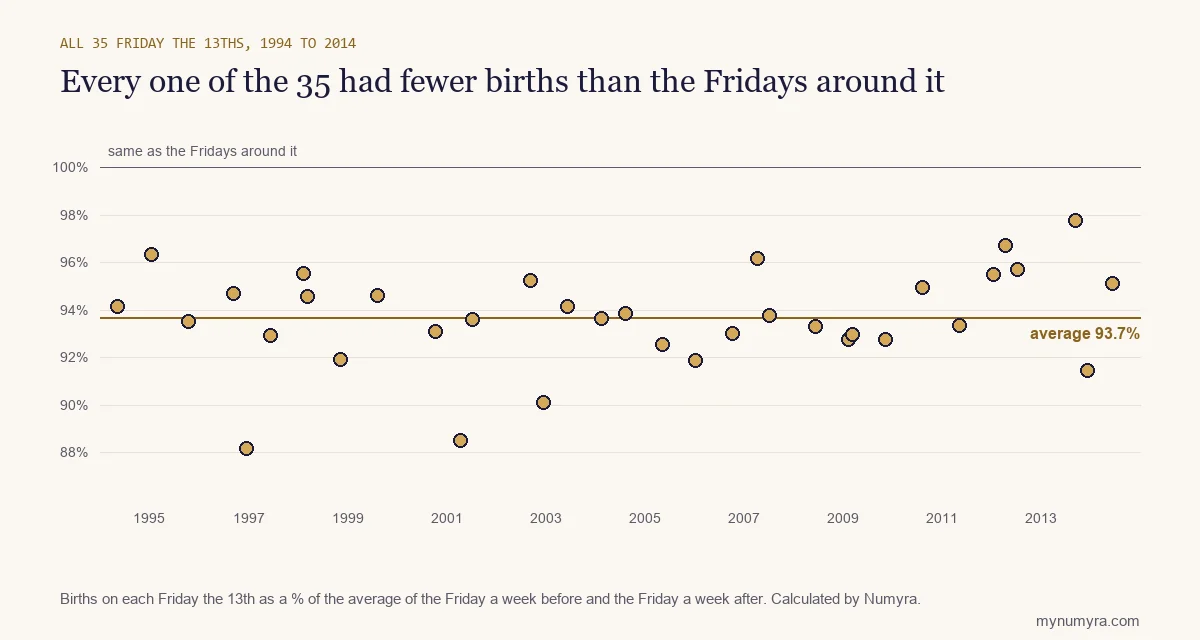
All 35 are below 100%. They range from 88.2% to 97.8% of their neighbours, the average is 93.7% (11,708 births against 12,501), and a fair coin would land all 35 on the same side only about once in 17 billion tries (a two-sided sign test gives p of about 6 in 100 billion).
Did the missing births turn up on nearby days? A little, perhaps. The Thursday before a Friday the 13th ran 0.8% above normal and the Monday after 0.7% above, each with an uncertainty of about 0.3% to 0.4%, which hints at some births moved by a day or two but is too small to prove it. The Saturday after was 0.4% below.
Where the Friday the 13th superstition came from
Almost every popular account starts with the Last Supper (13 at the table, then a Friday crucifixion) or with the Knights Templar, arrested in France on October 13, 1307. The documented record starts much later. The folklorist Stephanie Hall of the Library of Congress writes that the idea Friday the 13th is unlucky is not very old and seems to have arisen in the 19th century, and the earliest examples her colleague Stephen Winick found are French: a 1834 article in the Revue de Paris and an 1834 play, Les Finesses des Gribouilles, whose character blames a birth on Friday, December 13, 1813 for all his misfortunes. She notes that explanations such as the Templar arrests try to supply an early source, but the problem is showing historic evidence for the belief before 1900; she found no American newspaper mention of an unlucky Friday the 13th before the 20th century, and that a Manhattan Thirteen Club, which set out to break such taboos, held its first dinner for 13 people on Friday, January 13, 1882.
The first English text we could check is the closing pages of H. Sutherland Edwards’ The Life of Rossini, published in London in 1869. Rossini died on Friday, November 13, 1868, and Edwards remarks on the coincidence:
if it be true that, like so many other Italians, he regarded Friday as an unlucky day, and thirteen as an unlucky number, it is remarkable that on Friday, the 13th of November, he died.
H. Sutherland Edwards, The Life of Rossini (London, 1869), closing pages (Project Gutenberg)
Edwards treats Friday and thirteen as two separate beliefs that happened to meet. Rossini’s date is also this week’s: November 13, 2026 is a Friday, as November 13, 1868 was.
The belief reached a mass American audience in the 20th century. Thomas W. Lawson’s 1907 novel Friday, the Thirteenth is built around a Wall Street broker who exploits the traders’ fear of that day, and the text treats the day as the Street’s day of bad luck. Some writers credit the novel with popularizing the idea; that is a claim about influence we cannot test, but the book does show that by 1907 a Wall Street audience was assumed to know the superstition.
The fear is not universal: in Italy the unlucky day is Friday the 17th, and in Spanish-speaking countries and Greece it is Tuesday the 13th, according to the same Library of Congress piece. Our guides to the skipped 13th floor in buildings and to the 13th zodiac sign that was never added show two other places where 13 is treated as special, for unrelated reasons.
What numerology says about 13
In Pythagorean numerology 13 is a two-digit number that reduces by adding its digits: 1 + 3 = 4. A person born on the 13th has a birthday number of 13/4, and a total that passes through 13 on its way to a single digit is one of the four “karmic debt” numbers (13, 14, 16 and 19). We do not repeat that tradition here; our karmic debt numbers guide traces it to a 1972 book and shows how often each number appears. What is useful here is what the older sources said about the fear itself.
Cheiro, the pen name of Count Louis Hamon, devoted a whole chapter of Cheiro’s Book of Numbers to the question. It is titled “The Dread of the 13 Unfounded”, and it opens:
Nearly all people have an extraordinary dread of the number 13, which, if they only knew the real truth, is not at all the unlucky number they imagine it to be.
Cheiro, Cheiro’s Book of Numbers (Herbert Jenkins, seventh impression), p. 101 (Internet Archive scan)
His argument is that 13 reduces to 4, so it belongs to the series 4, 13, 22 and 31, and that the old picture for 13, a skeleton with a scythe, was misread as simple death when it stood for the overturning of the old order. He also blames the early Church for making the number taboo, a claim he gives without a source. Cheiro’s table of numbers for the days of the week gives Friday the number 6, the number of Venus; the weekday rulers are explained in our planetary hours guide. His full entry for the compound 13 is in our guide to Chaldean compound numbers.
The numerologist Hans Decoz goes further in a short essay on the date:
Numerologists generally consider any possible universal negative influences of a date, such as Friday the 13th, to be negligible in relation to the individual.
Hans Decoz, “The Numerology of Friday the 13th,” World Numerology
His reason is that personal cycles matter more than the calendar. So neither the 1926 handbook nor this modern site treats the date as an omen for everyone; what we tested in numerology is in Is numerology real? Where numerology adds something is in reading the date as a number. Using our method (reduce month, day and year separately, keep 11, 22 and 33, then add), every Friday the 13th has a 4 as its day, and the date as a whole varies.
Friday the 13th dates, 2026 to 2030
There are nine Friday the 13ths in the next five years, three of them in 2026. A year has at least one and at most three. The date number column is the numerological reading of the whole date, shown as month + day + year; the all-digits method gives the same result for every row.
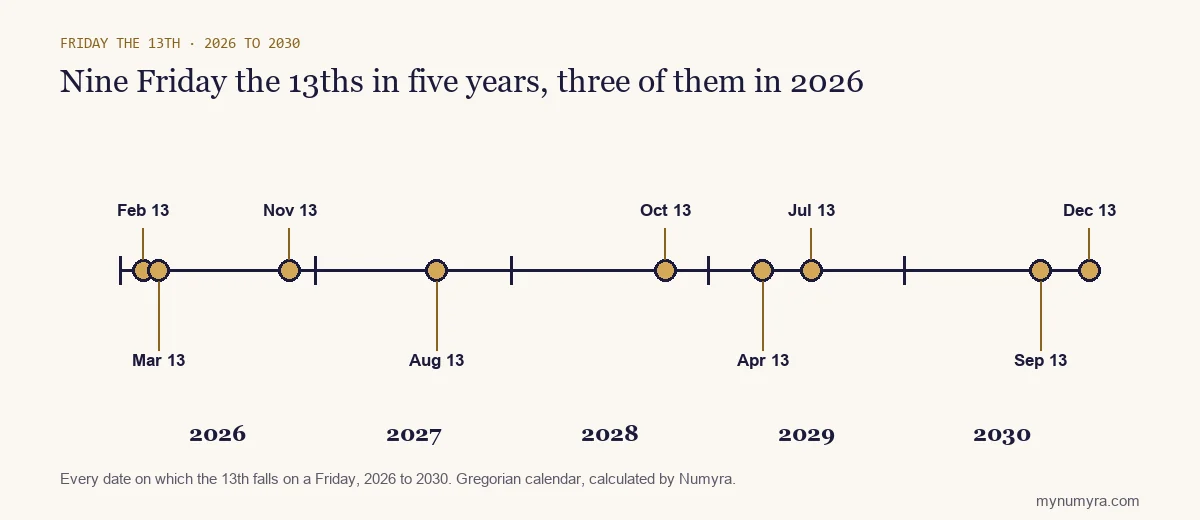
| Date | Month, day, year | Date number |
|---|---|---|
| Friday, February 13, 2026 | 2 + 4 + 1 = 7 | 7 |
| Friday, March 13, 2026 | 3 + 4 + 1 = 8 | 8 |
| Friday, November 13, 2026 | 11 + 4 + 1 = 16 | 16/7 |
| Friday, August 13, 2027 | 8 + 4 + 11 = 23 | 23/5 |
| Friday, October 13, 2028 | 1 + 4 + 3 = 8 | 8 |
| Friday, April 13, 2029 | 4 + 4 + 4 = 12 | 12/3 |
| Friday, July 13, 2029 | 7 + 4 + 4 = 15 | 15/6 |
| Friday, September 13, 2030 | 9 + 4 + 5 = 18 | 18/9 |
| Friday, December 13, 2030 | 3 + 4 + 5 = 12 | 12/3 |
The 13th falls on a Friday slightly more often than on any other day. Over the 4,800 months of the 400-year Gregorian cycle, we counted 688 Friday the 13ths, against 687 for Wednesday and Sunday, 685 for Monday and Tuesday and 684 for Thursday and Saturday. In 2027 only one falls, August 13; the 2027 date uses the master number 11 for its year, which our guide to why 11, 22 and 33 are kept whole explains. If you want the same number for your own birth date, the Life Path calculator shows every step.
Other studies and what this does not show
Studies of other outcomes disagree. A 1993 paper in the BMJ, “Is Friday the 13th bad for your health?”, compared Friday the 13th with Friday the 6th in one English health region: fewer cars on the southern M25 and 65 transport-accident hospital admissions against 45, a result the authors called significant at p < 0.05. A 2008 report by the Dutch Centre for Insurance Statistics, as relayed by DutchNews, found fewer road accidents on a Friday the 13th, an average of 7,500 against 7,800 on ordinary Fridays. Both are small, single comparisons, and neither concerns births.
The birth result has limits of its own. It says fewer babies were born on the date. It does not say that a baby born then has any particular character or luck, that superstition rather than another scheduling habit caused the dip, or that the pattern holds outside the United States or after 2014. We have no hospital records, only daily counts. Astrology and numerology are traditions of interpretation, not predictions, and nothing here is medical advice; if you are scheduling a delivery, the date is a conversation with your doctor, not a number on a page.
Frequently asked questions
Are fewer babies born on Friday the 13th?
Yes, in US data. From 1994 to 2014 a Friday the 13th averaged 11,708 births, about 6.3% fewer than expected after adjusting for weekday, holidays and trend. All 35 Friday the 13ths had fewer births than the Fridays a week before and after.
Why are there fewer births on the 13th?
The data cannot say, but the pattern fits scheduling. The dip is about 3% on Monday to Thursday, 6.3% on Friday and under 1% on weekends, where most births are spontaneous. FiveThirtyEight reported that many births are scheduled and that some parents avoid the date.
When did the Friday the 13th superstition start?
The documented belief dates from the 19th century. The Library of Congress folklorist Stephanie Hall cites French examples from 1834, and the first English text we checked is an 1869 biography of Rossini, who died on Friday, November 13, 1868. The Last Supper and Knights Templar stories are explanations offered later.
What does numerology say about the number 13?
It reduces to 4 (1 + 3) and is one of the four karmic debt numbers in modern numerology. Cheiro wrote in his 1926 handbook that the dread of 13 is unfounded, and Hans Decoz says personal cycles outweigh any effect of the date. See our karmic debt numbers guide.
When is the next Friday the 13th?
November 13, 2026, then August 13, 2027, October 13, 2028, April 13 and July 13, 2029, and September 13 and December 13, 2030. The February 13 and March 13 dates of 2026 have passed.
How many Friday the 13ths can there be in a year?
Every year has at least one and no year has more than three. 2026 has three (February, March and November). Between 1994 and 2014 the years with three were 1998, 2009 and 2012.
Is it unlucky to be born on Friday the 13th?
No tradition we checked sets out a standard reading. About 410,000 of the 85.4 million births in our data fell on a Friday the 13th, roughly 0.5%. In numerology the 13th is a birthday number of 13/4; our birthday number guide lists every date.
Sources
- FiveThirtyEight. US births data: daily counts from the CDC National Center for Health Statistics (1994 to 2003) and the Social Security Administration (2000 to 2014); we use the SSA file from 2004. Dates only. Analysis by the Numyra Methodology Desk.
- Carl Bialik, “Some people are too superstitious to have a baby on Friday the 13th”, FiveThirtyEight, reprinted by ABC7 (2017).
- Stephanie Hall, “Who’s Afraid of Friday the Thirteenth?” Folklife Today, Library of Congress (2017).
- H. Sutherland Edwards. The Life of Rossini (London: Hurst and Blackett, 1869), via Project Gutenberg.
- Thomas W. Lawson. Friday, the Thirteenth (1907), via Project Gutenberg.
- Cheiro. Cheiro’s Book of Numbers (London: Herbert Jenkins, seventh impression), Internet Archive scan; chapter XVIII, pp. 101 to 104, and the table of numbers for the days of the week.
- Hans Decoz. “The Numerology of Friday the 13th”, World Numerology.
- T. J. Scanlon and others. “Is Friday the 13th bad for your health?” BMJ 1993;307:1584 to 1586.
- DutchNews. “Fewer accidents on Friday 13” (2008), reporting the Dutch Centre for Insurance Statistics.